
Artificial intelligence has changed how businesses create website content. From blog posts and product descriptions to landing pages and marketing emails, AI writing tools can generate content within seconds. However, an important question remains: Does AI-generated content perform better than human-written content in Google Search?
In 2026, businesses are increasingly combining AI technology with human creativity to improve content production. But publishing more articles does not automatically lead to better search rankings.
Google prioritizes content that provides genuine value, satisfies search intent, and demonstrates reliability. Whether content is written by a person or generated with AI is not, by itself, the deciding factor.
This guide compares AI-generated content and human-written content, explains Google's approach, and explores practical strategies for improving SEO performance.
What Is AI-Generated Content?
AI-generated content refers to text created using artificial intelligence tools based on instructions or prompts.
Popular AI writing tools include ChatGPT, Google Gemini, Claude, and Jasper. These tools can assist with researching topics, developing outlines, drafting articles, generating headlines, and improving existing content.
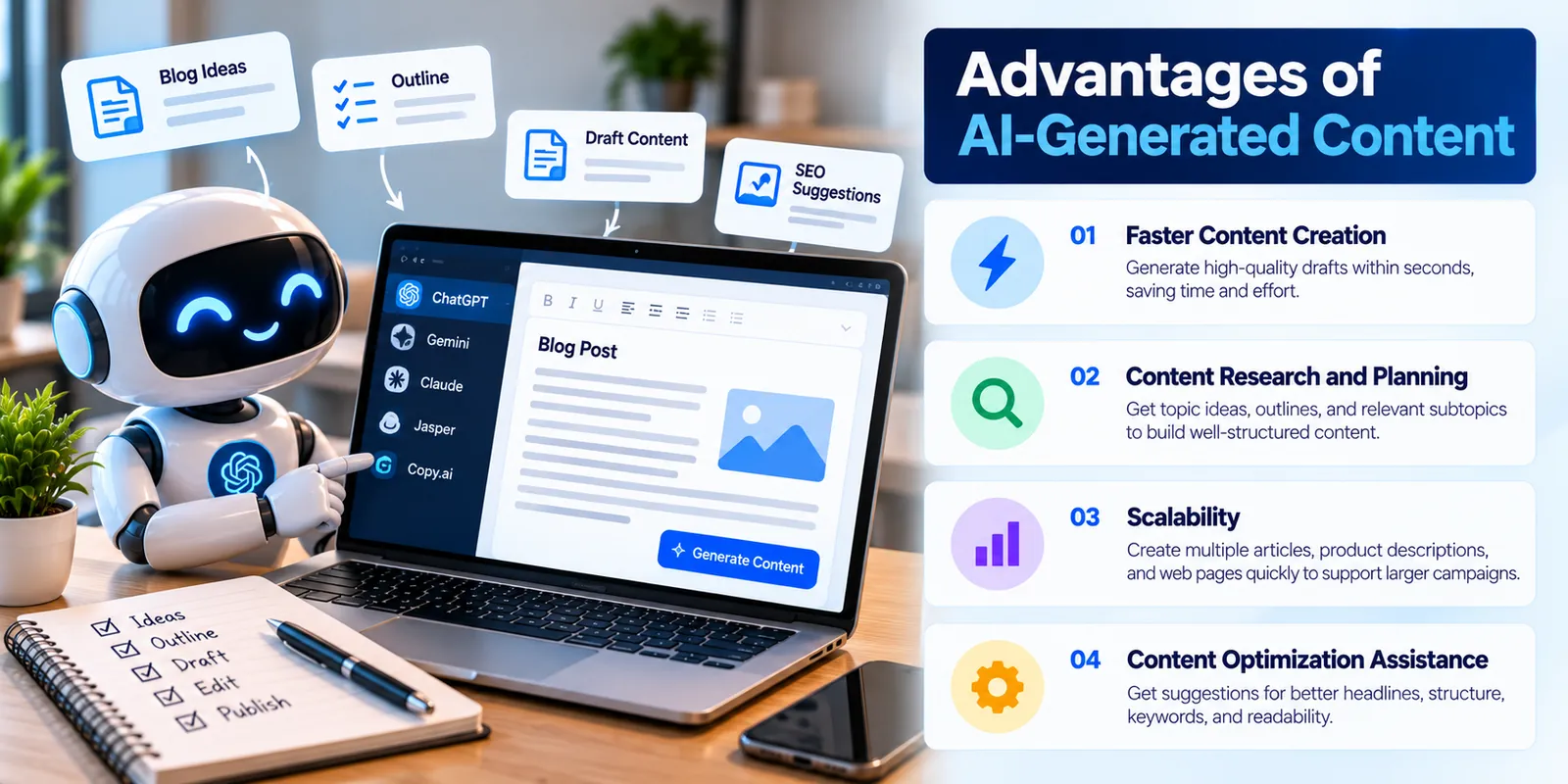
Advantages of AI-Generated Content
1. Faster Content Creation
AI tools can generate initial drafts quickly, helping businesses reduce the time required for routine content production.
2. Content Research and Planning
AI can help organize ideas, identify potential subtopics, and create structured content outlines.
3. Scalability
Businesses managing multiple websites or content campaigns can use AI to support larger editorial workloads.
4. Content Optimization Assistance
AI tools can suggest headings, improve readability, and help writers identify missing explanations.
However, AI-generated content can also contain factual inaccuracies, outdated information, repetitive language, or unsupported claims. Every important statement should be reviewed before publication.
What Is Human-Written Content?
Human-written content is created by writers, subject-matter experts, marketers, or professionals using their own knowledge, research, and experience.
Unlike automatically generated drafts, human-written articles can directly incorporate firsthand observations, original interviews, practical examples, and personal expertise.
Advantages of Human-Written Content
1. Original Experience
Human writers can share real experiences, experiments, customer interactions, and lessons learned.
2. Stronger Brand Personality
Experienced writers can develop a distinctive tone that reflects a company's audience and identity.
3. Better Contextual Judgment
Human experts can evaluate complex information, recognize uncertainty, and explain industry-specific challenges.
4. Authentic Storytelling
Original stories, case studies, and personal insights can make content more memorable and useful.
Human-written content also has limitations. It can take longer to produce, require higher editorial costs, and still contain mistakes or weak SEO optimization.

AI-Generated Content vs Human-Written Content: Key Differences
| Factor | AI-Generated Content | Human-Written Content |
|---|---|---|
| Creation speed | Usually faster | Usually slower |
| Production cost | Can reduce drafting costs | Often requires more editorial time |
| Original experience | Cannot independently provide firsthand experience | Can include genuine firsthand experience |
| Creativity | Useful for brainstorming and variations | Strong for original perspectives and storytelling |
| Accuracy | Requires fact-checking | Also requires research and verification |
| Brand voice | Needs guidance and editing | Can develop a distinctive voice |
| Scalability | Supports high-volume drafting | Depends on available writers |
| SEO performance | Depends on quality and usefulness | Depends on quality and usefulness |
| Best use | Drafting, outlining, ideation | Expert analysis, interviews, original insights |
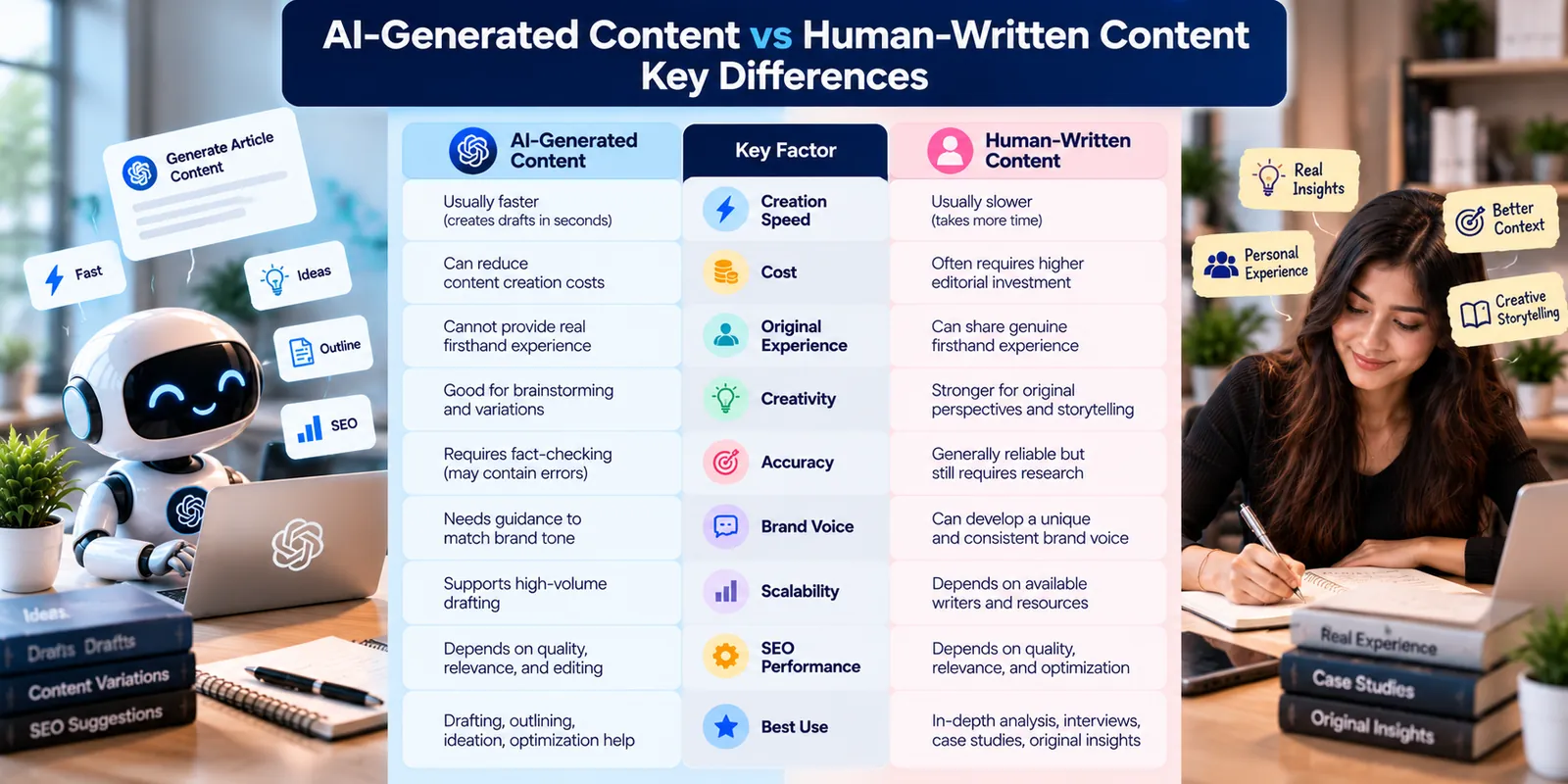
Key takeaway: Neither content type automatically receives better Google rankings. The quality of the final published page matters more than the writing method.
Does Google Rank AI-Generated Content in 2026?
Yes. Google can rank AI-generated content when it meets its quality standards.
Google's official guidance explains that its ranking systems focus on rewarding helpful, original, and reliable content, regardless of how that content is produced.
This means businesses can use AI writing tools without automatically violating Google's policies.
However, using AI to produce large amounts of low-value content primarily to manipulate search rankings can violate Google's scaled content abuse policy.
What Google Looks for in High-Quality Content
Google encourages publishers to focus on several important qualities:
Originality: Does the page provide useful information beyond what competitors already publish?
Accuracy: Are the facts correct, current, and supported by reliable sources?
Relevance: Does the article directly answer the user's search query?
Expertise: Does the content demonstrate appropriate knowledge of the subject?
Trustworthiness: Can readers understand who created the content and why they should trust it?
For example, an AI-assisted SEO article that includes original Search Console observations, verified examples, and expert explanations may provide more value than a generic article written entirely by a human.
Similarly, a thoroughly researched human-written guide may outperform an unedited AI draft that repeats information already available across dozens of websites.
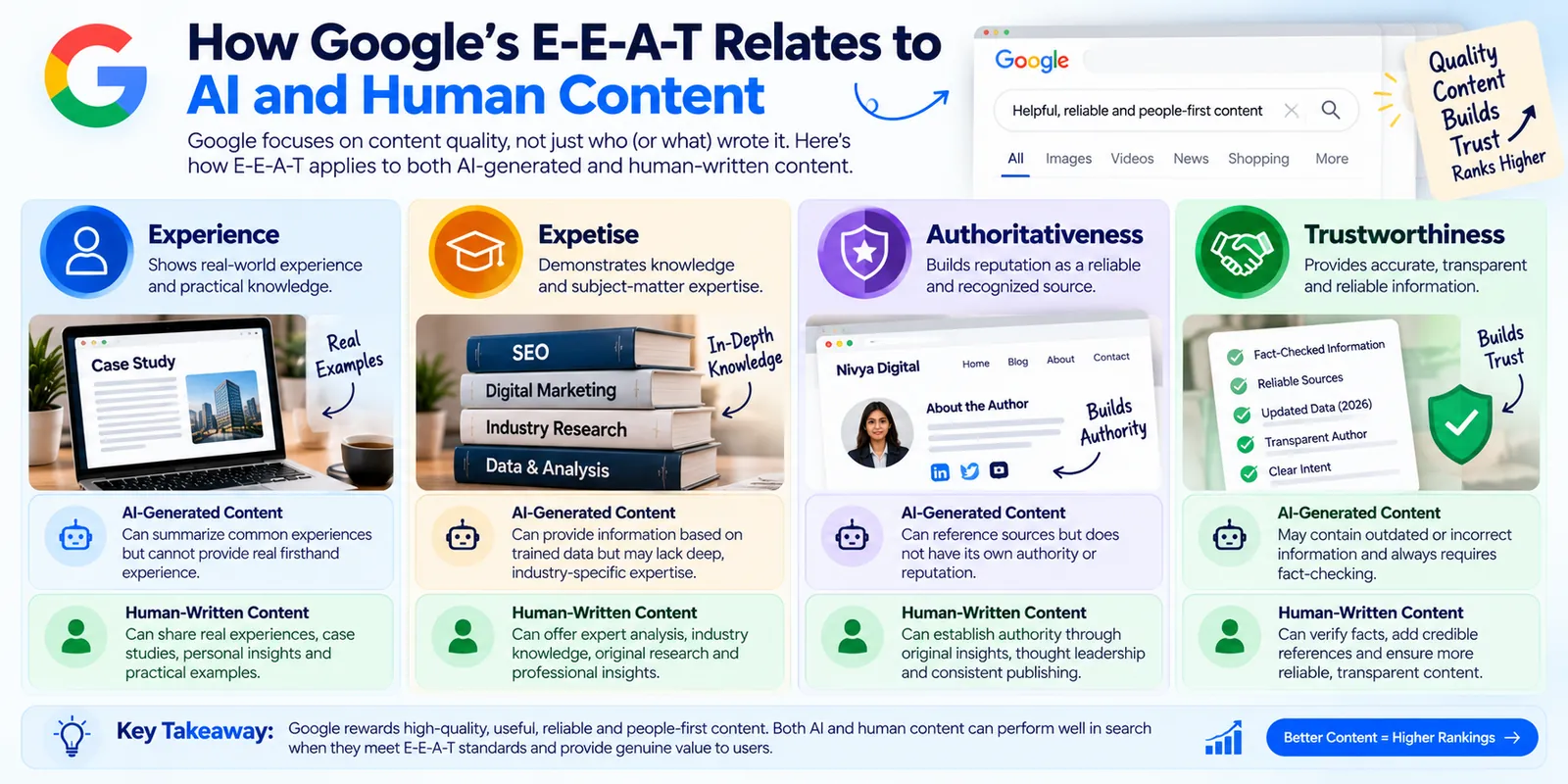
How Google's E-E-A-T Relates to AI and Human Content
E-E-A-T stands for Experience, Expertise, Authoritativeness, and Trustworthiness.
It is a framework discussed in Google's search quality guidance, rather than a single numerical ranking score.
Experience
Content can demonstrate experience through original testing, real projects, firsthand observations, and practical examples.
For example, an SEO agency could publish a case study explaining how it diagnosed an indexing problem and what happened after implementing fixes.
Expertise
Expertise involves demonstrating an appropriate understanding of the topic.
A technical SEO article should accurately explain crawling, indexing, canonical tags, and structured data rather than providing vague recommendations.
Authoritativeness
Authoritativeness relates to whether a source is recognized as knowledgeable or dependable within its subject area.
Original research, useful resources, and credible references can help establish authority over time.
Trustworthiness
Trustworthiness is especially important. Accurate information, transparent authorship, reliable references, and honest claims help readers evaluate a website.
AI can assist with presenting these elements, but it cannot replace genuine experience or verification.
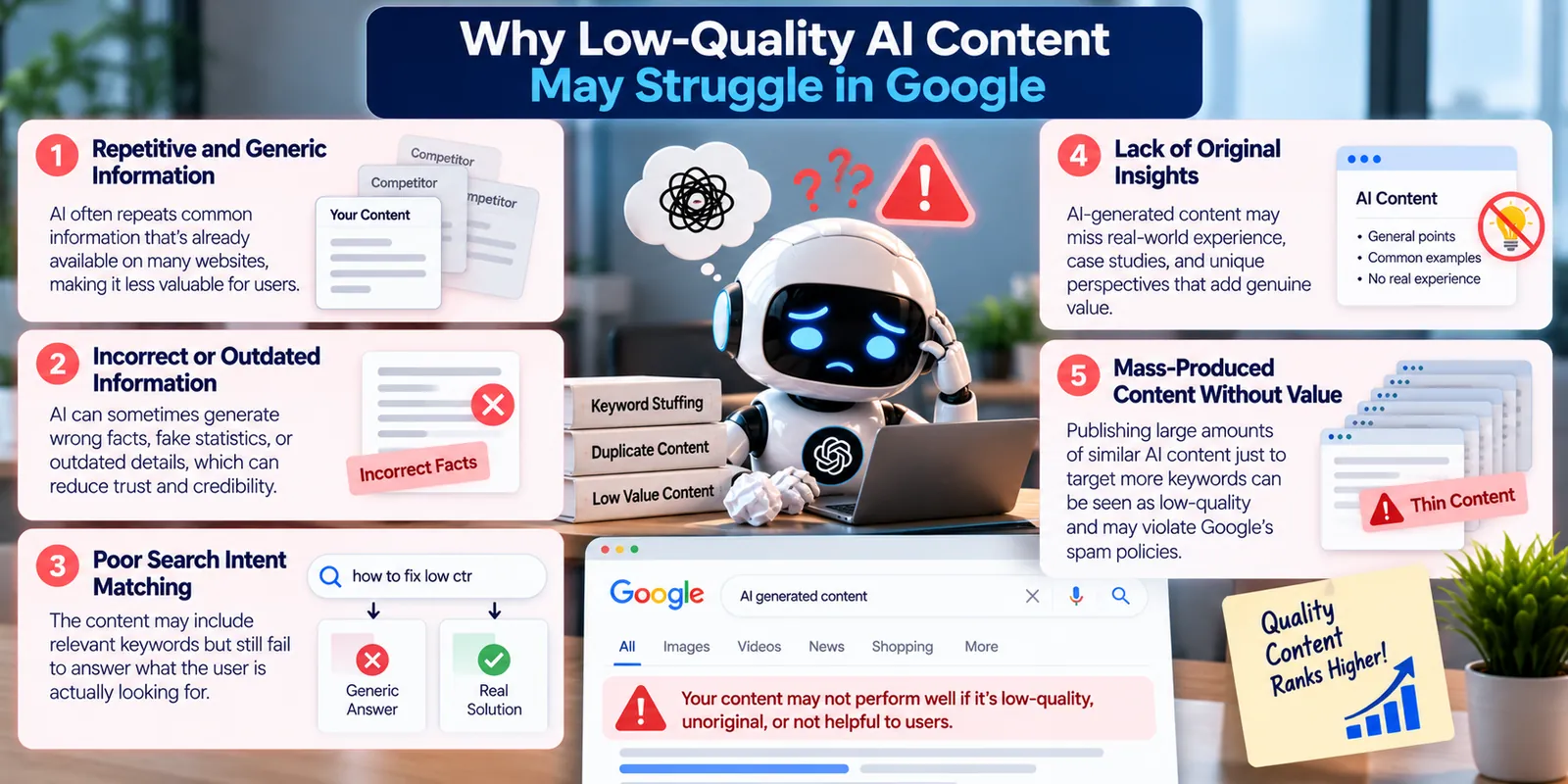
Why Low-Quality AI Content May Struggle in Google
AI-generated content can perform poorly when businesses publish drafts without sufficient review.
1. Repetitive and Generic Information
Many AI drafts summarize commonly available information without introducing new insights.
If an article offers nothing different from competing pages, readers may have little reason to choose it.
2. Incorrect or Fabricated Information
AI systems can produce convincing statements that are not accurate.
Incorrect statistics, invented quotations, or misleading recommendations can damage credibility.
3. Poor Search Intent Matching
A page may contain relevant keywords but still fail to answer the user's actual question.
For example, someone searching for “how to fix low CTR in Google Search Console” likely wants practical troubleshooting steps rather than a general definition of CTR.
4. Mass-Produced Content Without Added Value
Publishing hundreds of similar articles purely to capture keyword variations can create quality and spam-policy risks.
The issue is not the use of AI itself. It is the lack of meaningful value for readers.
Can Human-Written Content Also Perform Poorly?
Absolutely.
Human-written articles are not automatically helpful, accurate, or original.
Content may struggle when it includes keyword stuffing, outdated recommendations, misleading headlines, thin explanations, or copied information.
A manually written article that ignores search intent may perform worse than a carefully edited AI-assisted guide.
The most useful comparison is therefore not simply AI versus human. It is high-quality content versus low-quality content.
Which Performs Better for SEO in 2026?
There is no universal winner.
Different content workflows suit different business requirements.
AI Content Works Well for Supporting Tasks
AI is particularly useful for brainstorming, creating initial outlines, organizing research questions, and preparing drafts that will undergo editorial review.
Human Content Is Valuable for Original Insights
Human expertise is especially valuable for case studies, product testing, interviews, professional analysis, and topics requiring careful judgment.
Hybrid Content Offers a Practical Approach
For many businesses, combining AI assistance with human oversight is an effective content production strategy.
A hybrid workflow uses AI for speed while keeping humans responsible for research quality, accuracy, originality, and final editorial decisions.
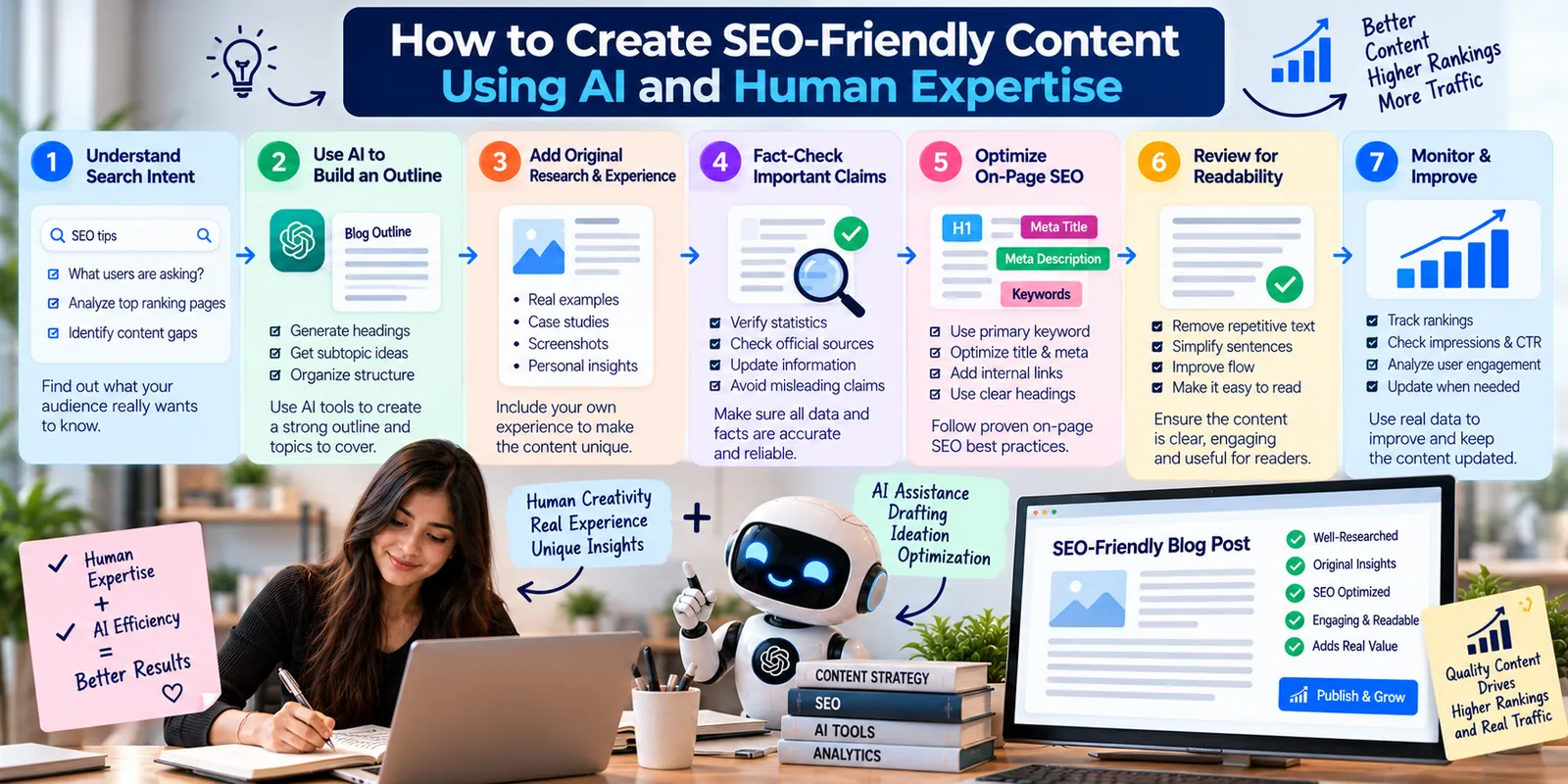
How to Create SEO-Friendly Content Using AI and Human Expertise
Step 1: Understand Search Intent
Research what your audience wants to know.
Analyze relevant search results, common questions, and the problems readers are trying to solve.
Step 2: Use AI to Build an Outline
Generate potential headings and supporting questions.
Review the outline manually to remove irrelevant sections and identify missing topics.
Step 3: Add Original Research and Experience
Include useful examples, real project observations, screenshots, interviews, or independently verified data.
These elements help differentiate your article from generic summaries.
Step 4: Fact-Check Important Claims
Verify statistics, technical recommendations, product details, and policy statements using authoritative sources.
Avoid publishing unsupported claims simply because they sound convincing.
Step 5: Optimize On-Page SEO
Use a descriptive title, logical heading structure, relevant internal links, helpful image alt text, and a clear meta description.
Include your primary keyword naturally without repeating it unnecessarily.
Step 6: Review the Content for Readability
Remove repetitive explanations, simplify complicated sentences, and make sure each section serves a clear purpose.
Step 7: Monitor Results and Improve
Use Google Search Console to review impressions, clicks, CTR, and search queries.
Use analytics tools to understand how visitors engage with the content.
Update the article when information changes or when new questions become relevant.
AI Content and Google AI Overviews: What Changes in 2026?
Traditional search results are no longer the only way people discover information.
Google AI Overviews and AI Mode introduce additional ways for users to explore questions and find relevant sources..
Google's guidance for generative AI search continues to emphasize unique, valuable content and established SEO best practices.
For publishers, this creates an opportunity to develop content with original examples, clear explanations, useful visuals, and credible supporting evidence.
Instead of creating dozens of near-identical articles, businesses should focus on resources that provide information readers cannot easily find elsewhere.
Final Verdict: AI-Generated or Human-Written Content?
The best-performing content is not necessarily the content written by AI or by a human. It is the content that best satisfies users' needs.
AI can make content production faster and more efficient. Human writers contribute judgment, expertise, creativity, and original experience.
For businesses in 2026, a balanced approach is often the most practical option: use AI as an assistant, maintain human editorial responsibility, and prioritize genuinely useful information.
At Nivya Digital, we believe effective content marketing starts with understanding the audience and creating resources that support real business goals.
A thoughtful combination of content strategy, SEO, and quality-focused publishing can help businesses strengthen their online presence over time..
Comments (1)
Nice Articles