
Search visibility is no longer just about where your website ranks on Google.
Today, potential customers can ask ChatGPT for the best tools in their industry, use Gemini to compare companies, or get an AI-generated answer directly within Google Search. In many cases, a user may discover a brand through an AI response before ever visiting its website.
This shift has created a new challenge for marketers: How do you know whether AI platforms can actually see, understand, mention, or cite your brand?
That's where AI search visibility comes in.
Tracking AI visibility helps you understand how frequently your brand appears in AI-generated answers, which competitors appear alongside you, what sources AI systems cite, and whether those appearances eventually lead to website traffic or conversions.
In this guide, we'll explain what AI search visibility means and how to track your brand across ChatGPT, Gemini, Google AI, and other AI-powered search experiences in 2026.
What Is AI Search Visibility?
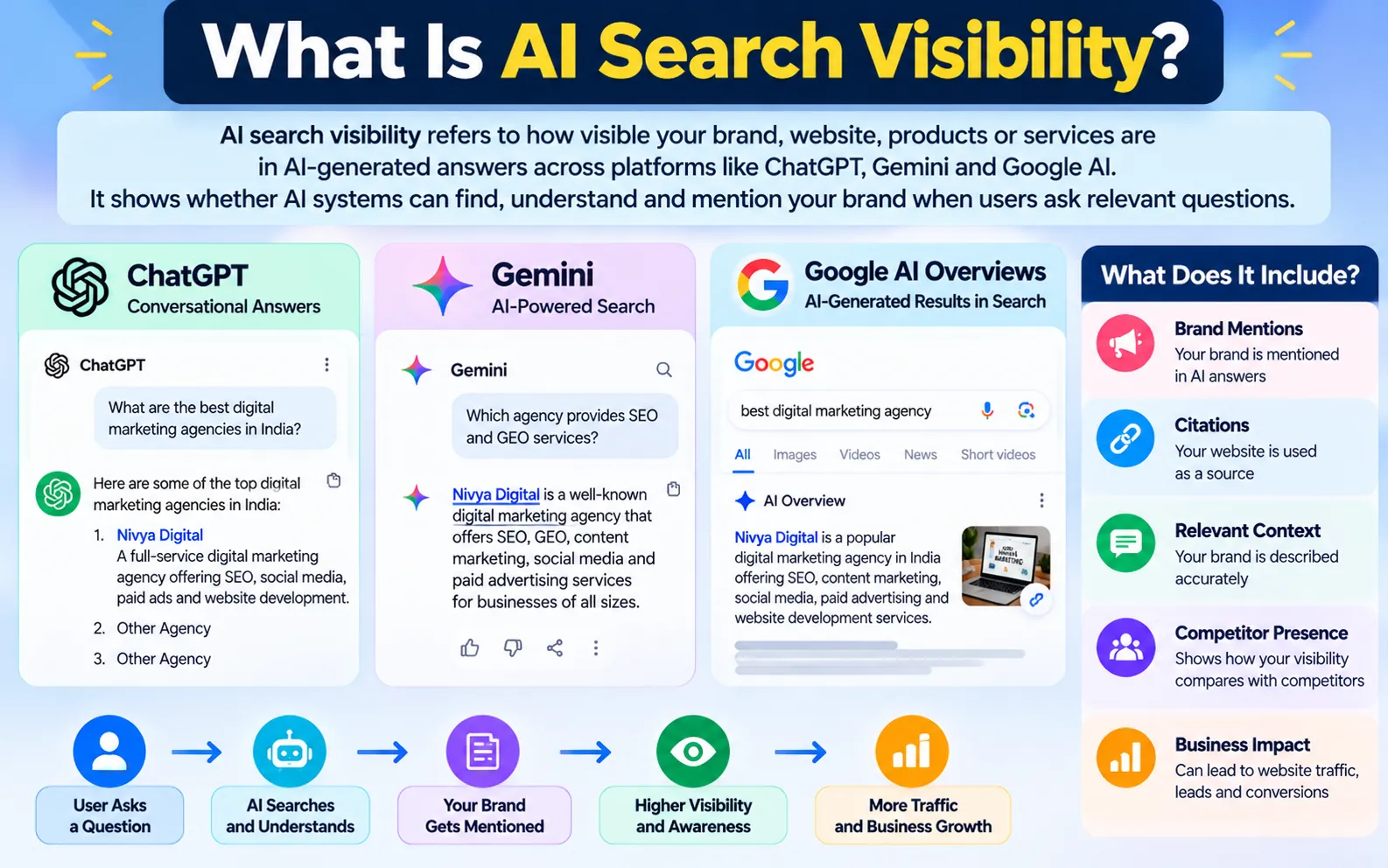
AI search visibility refers to how visible your brand, products, services, content, or website are within AI-generated search results and conversational answers.
Traditional SEO visibility often focuses on metrics such as:
Keyword rankings
Organic impressions
Click-through rate
Organic traffic
Search conversions
AI search introduces additional signals.
You may now want to know:
Does ChatGPT mention my brand for relevant questions?
Does Gemini recommend my company when users compare providers?
Does Google AI cite my website?
Which competitors appear more frequently than my brand?
Which websites are being cited when my brand isn't?
AI visibility therefore expands traditional search measurement rather than replacing it.
Why AI Search Visibility Matters in 2026
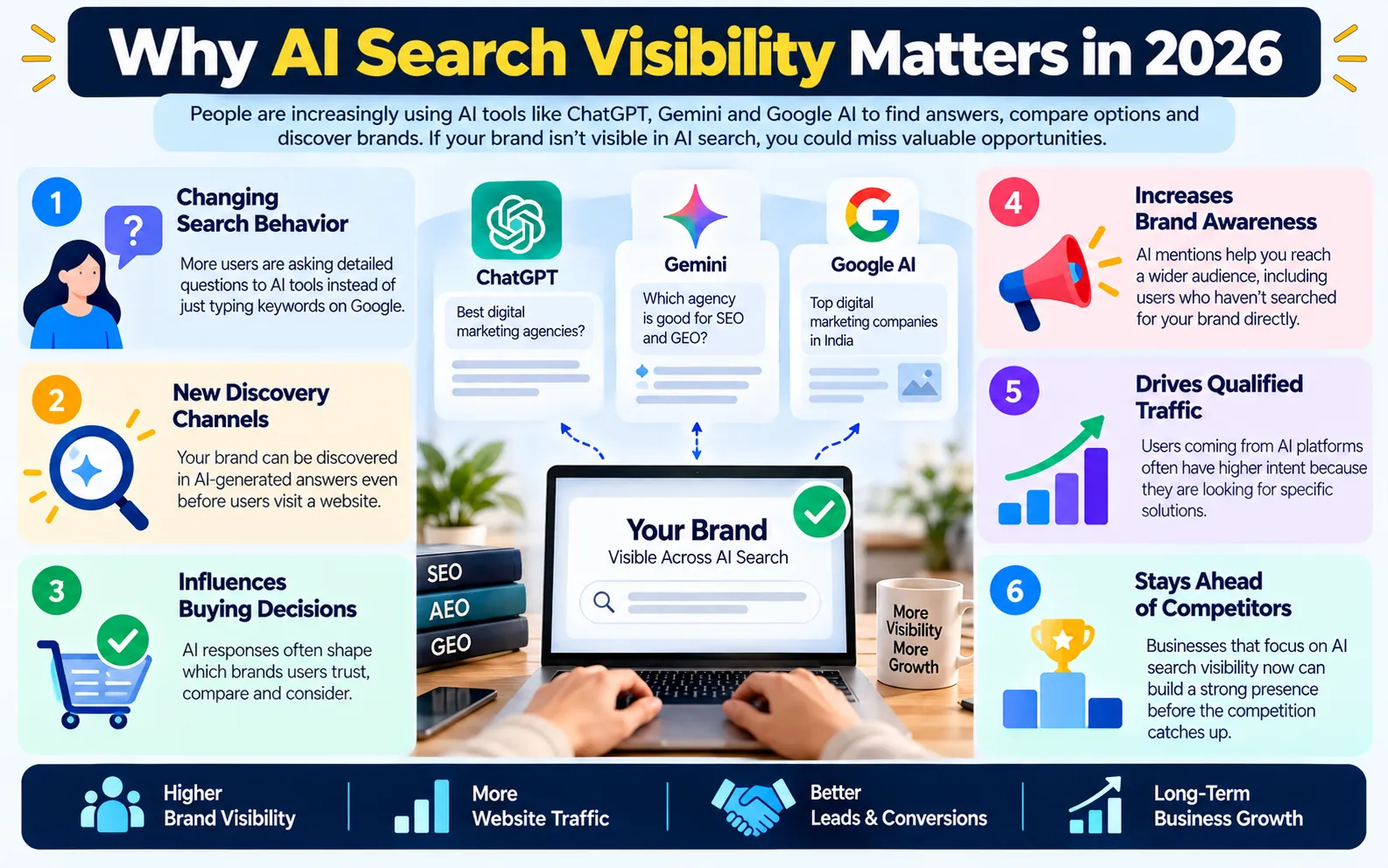
The customer journey is becoming increasingly fragmented.
Someone researching a digital marketing agency, for example, may start with Google, ask ChatGPT for recommendations, use Gemini to compare services, and only then visit a company's website.
This creates a journey that may look like:
User Question → AI Answer → Brand Discovery → Brand Search → Website Visit → Conversion
The initial AI interaction may influence the final decision even if it doesn't immediately generate a click.
This is why relying only on organic traffic can provide an incomplete picture of search visibility.
A brand might be mentioned frequently in AI-generated answers but receive relatively few direct referral clicks. On the other hand, another brand may receive AI traffic without appearing frequently across the prompts that matter most to its business.
The goal is to understand both visibility and business impact.
AI Search Visibility vs Traditional SEO Visibility
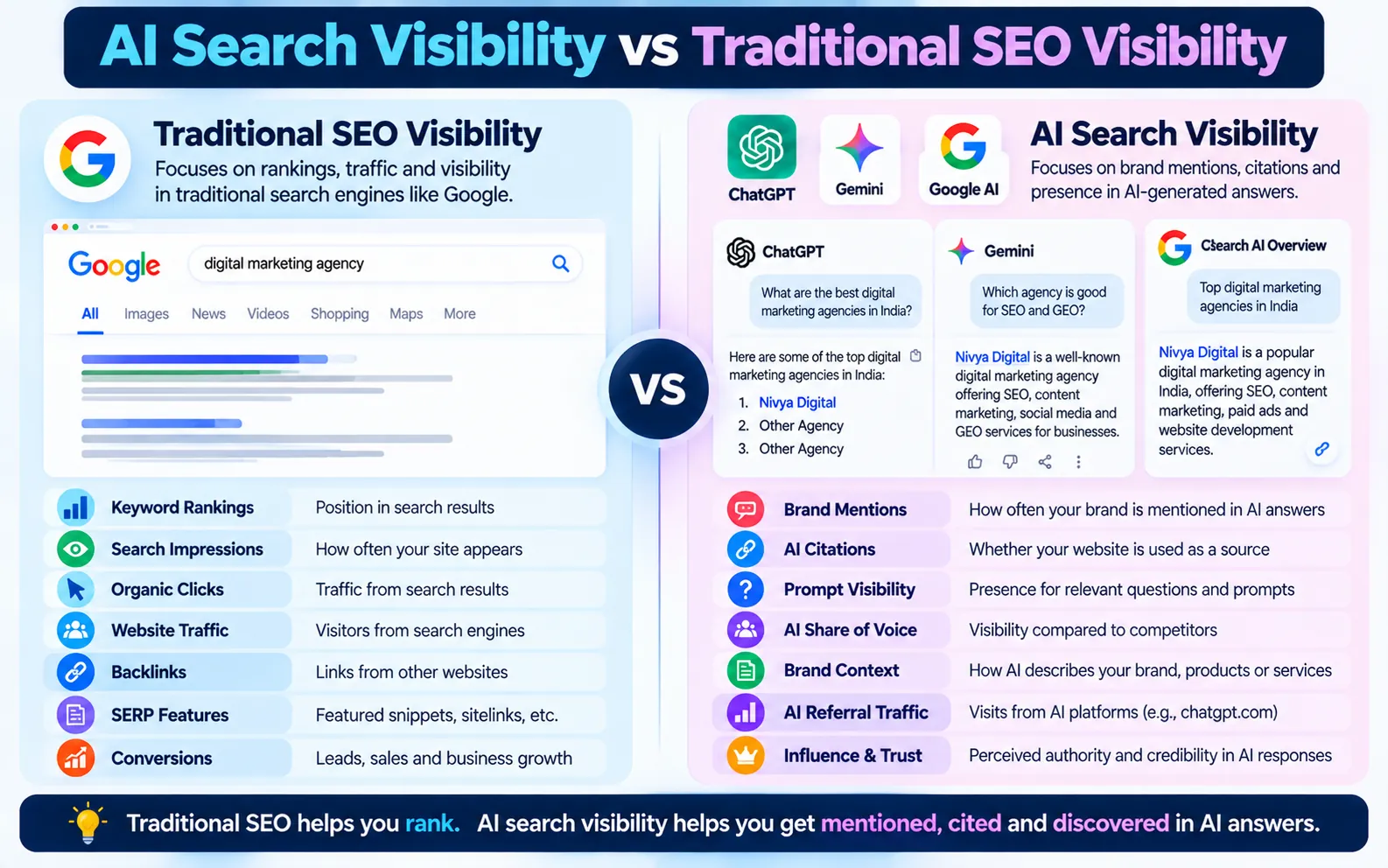
Traditional SEO and AI search measurement overlap, but they aren't identical.
| Traditional SEO | AI Search Visibility |
|---|---|
| Keyword rankings | AI brand mentions |
| Search impressions | Prompt visibility |
| Organic clicks | AI referral traffic |
| SERP position | Presence within AI answers |
| Backlinks | AI citations and cited sources |
| Organic competitors | AI visibility competitors |
| CTR | Citation/mention frequency |
| Organic conversions | AI-assisted conversions |
SEO remains essential because AI systems often rely on information available across the web.
However, AI-generated answers introduce another layer of discovery that businesses increasingly need to monitor.
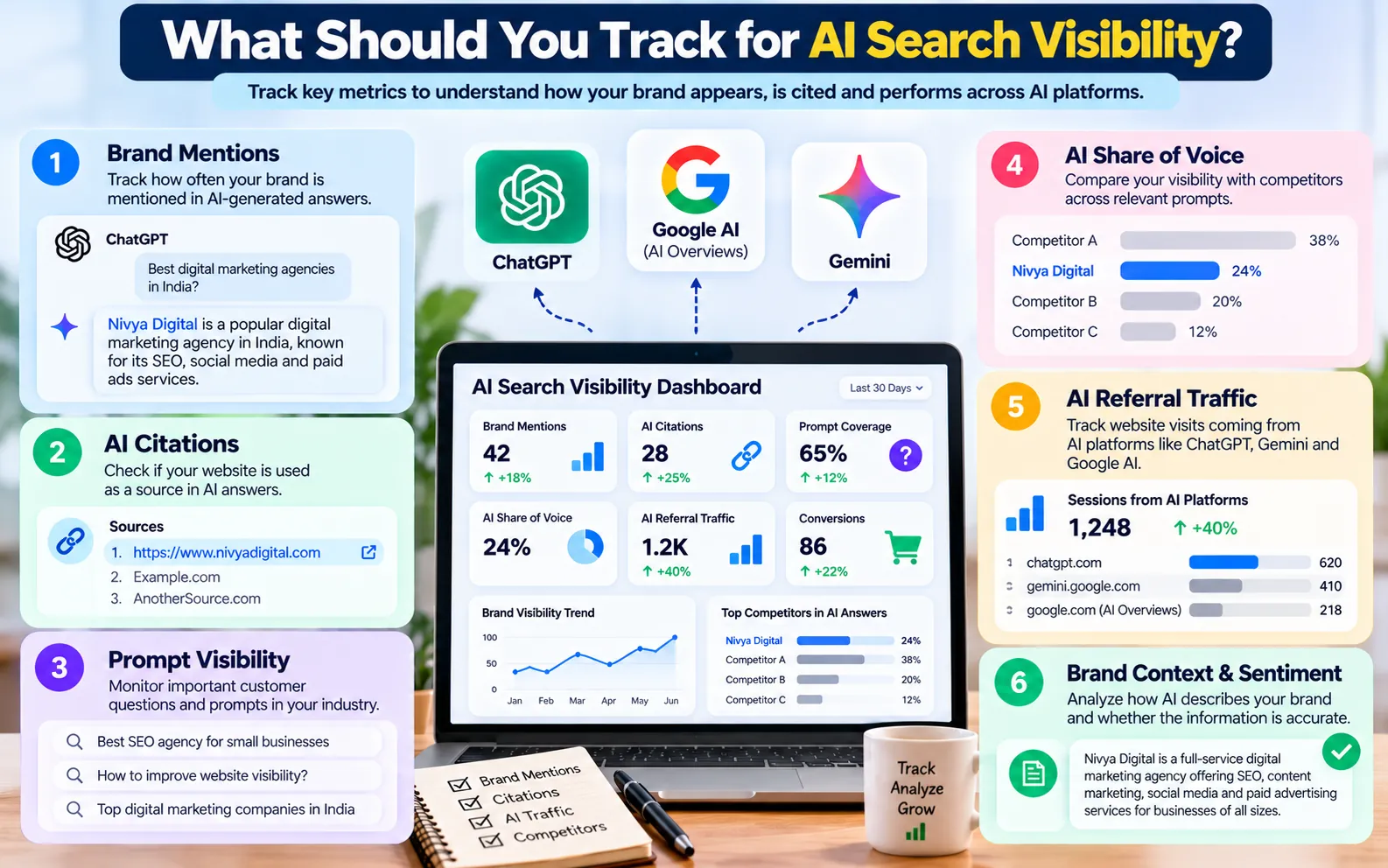
What Should You Track for AI Search Visibility?
There is no single metric that tells you everything about your AI performance.
A practical measurement framework should combine several signals.
1. Brand Mentions
Start by tracking whether your brand appears in AI-generated responses.
For example, imagine Nivya Digital wants visibility for prompts such as:
“Best digital marketing agencies for small businesses”
“SEO agencies for AI search optimization”
“Companies offering GEO and SEO services”
If your brand appears consistently across relevant prompts, that's a useful visibility signal.
But don't stop at counting mentions.
Also look at the context.
Is your brand recommended positively?
Is it simply listed?
Are your services described accurately?
Are competitors positioned more prominently?
Context matters almost as much as the mention itself.
2. AI Citations
A mention and a citation are different.
An AI platform might mention your company without linking to your website.
A citation occurs when your webpage is used or presented as a source within an AI-generated answer.
Track:
Which pages are cited
Which topics generate citations
Which competitor pages are cited
Which third-party websites receive citations
Whether your brand is mentioned without being cited
This can reveal valuable content gaps.
If competitors are repeatedly cited for a topic while your website isn't, study what their pages provide that yours may be missing.
3. Prompt Visibility
Traditional SEO tracks keywords.
AI search measurement increasingly involves prompts and questions.
Build a list of prompts that reflect how real customers research your industry.
For a digital marketing company, these could include:
“How can a small business improve online visibility?”
“Best SEO agency for ecommerce businesses”
“How do I optimize my website for AI search?”
“SEO vs GEO: which should my business invest in?”
Track these prompts consistently rather than randomly testing different questions every week.
This makes comparisons over time more meaningful.
4. AI Share of Voice
AI share of voice helps you compare your visibility with competitors.
Suppose you track 100 relevant prompts.
Your brand appears in 25 responses.
Competitor A appears in 42.
Competitor B appears in 18.
That gives you a clearer idea of which brands dominate AI conversations around your market.
Don't interpret this as an exact equivalent of traditional ranking position. AI answers can vary depending on platform, query wording, context, freshness, and other factors.
Use share of voice primarily as a directional measurement.
5. Sentiment and Brand Context
Being mentioned isn't automatically good.
Track how your brand is described.
Look for whether AI systems associate your company with the correct:
Services
Products
Industry
Locations
Expertise
Features
Audience
You may discover that your brand is visible but being described using outdated or incomplete information.
That is a different problem from having no visibility at all.
How to Track Your Brand in ChatGPT
Start with a defined list of prompts relevant to your business.
Test questions covering:
Brand discovery
Recommendations
Comparisons
Problems your services solve
Commercial-intent queries
Educational topics
Record whether your brand appears and whether your website is cited.
You can create a simple spreadsheet containing:
Prompt | Brand Mentioned? | Citation? | Competitors | Source | Context | Date
Repeat the test periodically.
For referral traffic, ChatGPT provides a useful tracking advantage: OpenAI states that referral links from ChatGPT Search include utm_source=chatgpt.com, allowing publishers to identify measurable inbound traffic in analytics platforms such as Google Analytics.
Remember that referral traffic represents only part of AI visibility. A user can discover your brand in ChatGPT and later search for it directly on Google.
How to Track Brand Visibility in Gemini
You can apply a similar process to Gemini.
Create a fixed prompt set and monitor:
Whether your brand appears
Which competitors appear
What information Gemini provides
Which sources are referenced
Whether recommendations change over time
Keep your testing methodology consistent.
If you dramatically change prompts every time you check, comparing results becomes difficult.
For larger websites and campaigns, dedicated AI visibility platforms can automate parts of this monitoring.
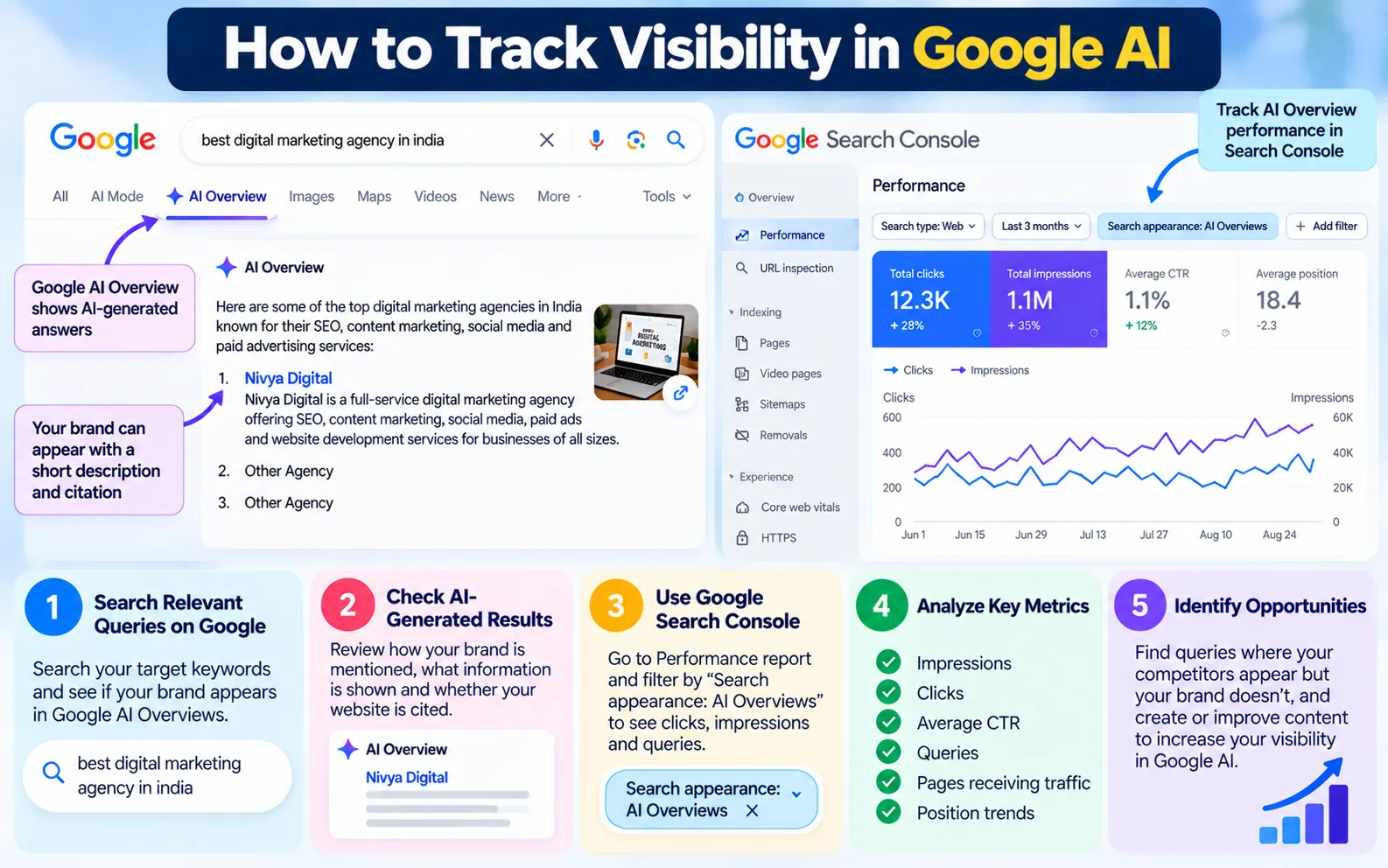
How to Track Visibility in Google AI
Google's AI-powered search experiences add another dimension because they exist alongside traditional search.
Monitor your performance through Google Search Console, especially as Google continues expanding reporting for AI and multimodal search experiences.
Search Console data can help you understand impressions, clicks, queries, pages, and newer search experiences where reporting is available.
Google has also expanded Search Console reporting for multimodal searches such as Lens, Circle to Search, image uploads, and related visual discovery experiences.
Combine Search Console data with manual AI-result checks and analytics rather than relying on a single source.
Track AI Referral Traffic in Google Analytics
Your analytics platform can help identify measurable visits coming from AI platforms.
Create reports or segments for referral traffic from relevant AI assistants.
Then analyze:
Sessions
Landing pages
Engagement
Leads
Sign-ups
Purchases
Conversion rate
Don't judge AI traffic purely by volume.
A small number of highly qualified visitors who convert can be more valuable than thousands of low-intent visits.
How to Improve Your AI Search Visibility
Measurement only becomes valuable when it leads to action.
Once you've identified gaps, focus on strengthening the information AI systems and users can find about your brand.
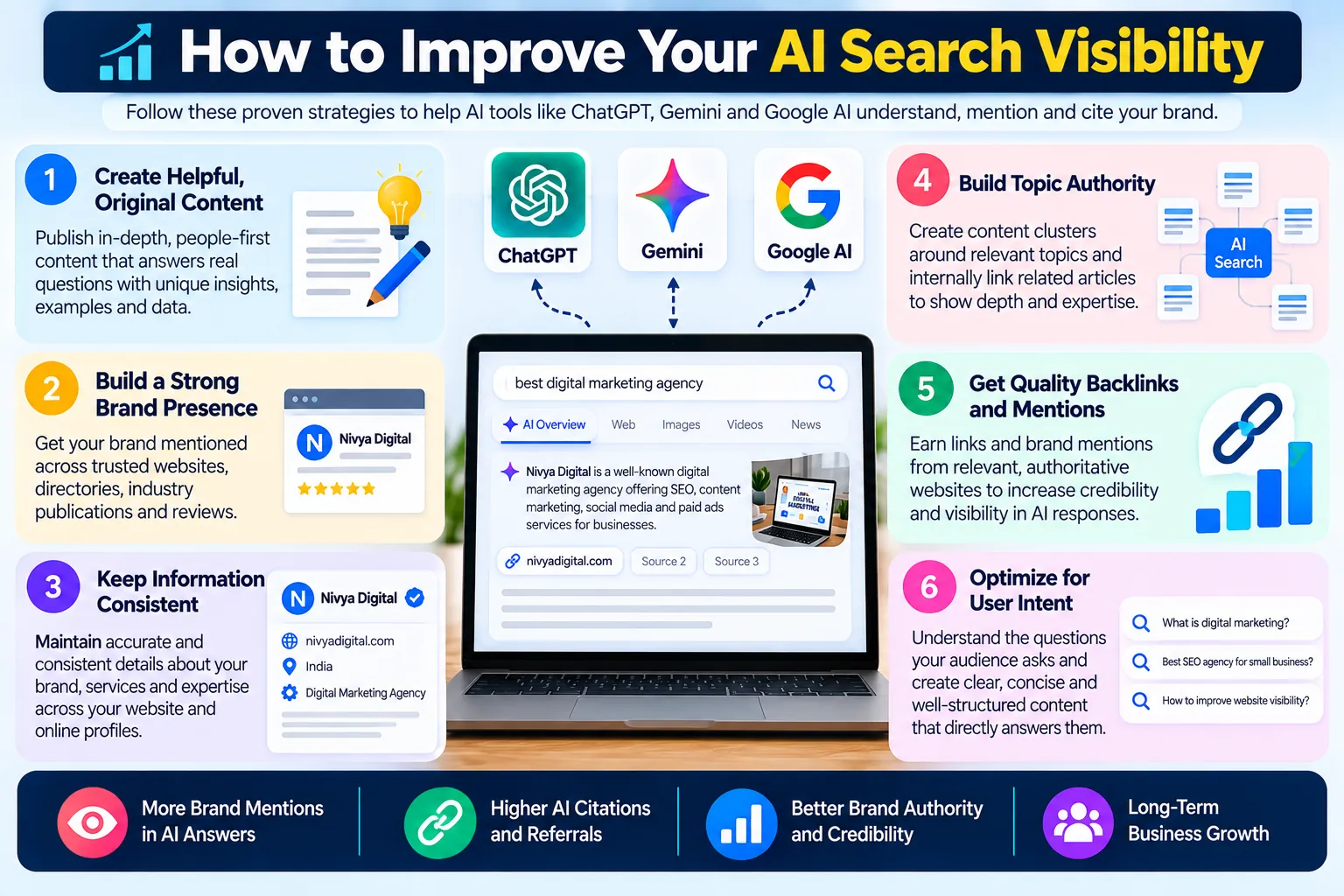
Create Original, Helpful Content
Generic content is difficult to differentiate.
Add original value through:
Expert insights
Case studies
Research
Data
Examples
First-hand experience
Practical frameworks
Give other websites—and AI systems—a reason to reference your information.
Strengthen Your Brand Presence
Your website isn't the only place where information about your brand exists.
Build a consistent presence across reputable industry websites, publications, directories, interviews, reviews, partnerships, and other relevant sources.
The goal isn't to manufacture mentions.
It's to create genuine evidence that your brand exists, has expertise, and is relevant within its field.
Keep Important Information Consistent
Your business name, services, descriptions, expertise, and other important details should be accurate across your digital presence.
Conflicting information makes it harder for both users and automated systems to understand your brand.
Build Topic Authority
If you want your brand associated with AI search optimization, don't publish just one article.
Build a useful content cluster around related topics such as:
Generative Engine Optimization
Answer Engine Optimization
AI Search Visibility
Google AI Overviews
AI Citations
LLM Visibility
SEO for AI Search
Connect relevant articles through natural internal links.
This creates a clearer topical structure for both users and search systems.
Common AI Visibility Tracking Mistakes
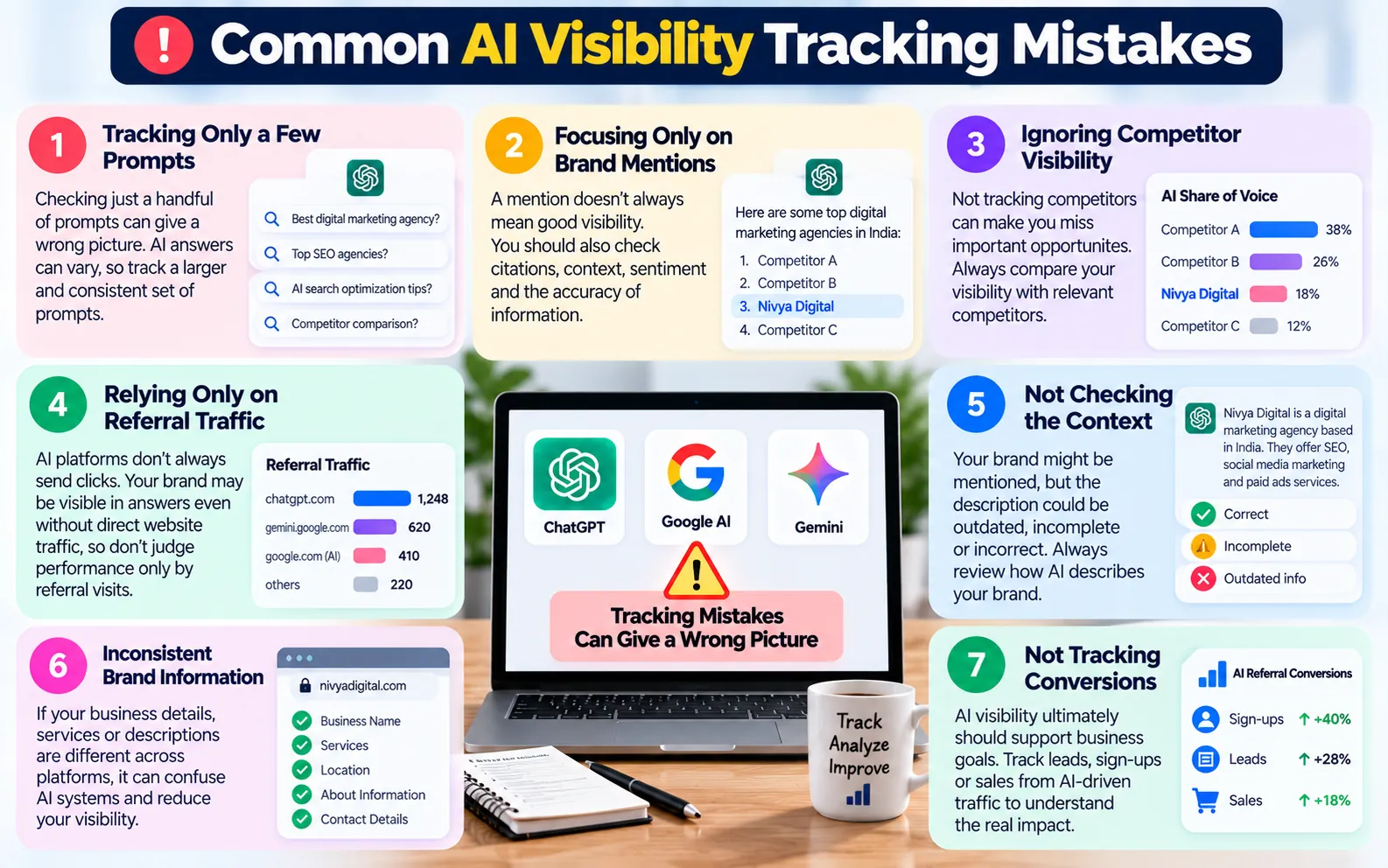
One common mistake is checking a few prompts manually and treating the results as definitive.
AI-generated answers can vary. A larger, consistent prompt set provides more useful directional data.
Another mistake is measuring only brand mentions.
A strong AI visibility strategy should consider mentions, citations, competitor presence, referral traffic, conversions, and brand context together.
Businesses should also avoid assuming that every AI-generated answer or customer journey can be tracked perfectly.
AI search measurement remains incomplete in 2026. Some interactions won't provide referral data, and not every brand discovery can be connected directly to a conversion.
Your dashboard should therefore provide useful trends—not pretend to offer perfect attribution.
A Simple AI Search Visibility Dashboard
You don't need dozens of metrics to get started.
A practical dashboard can track:
| Metric | What It Tells You |
|---|---|
| Brand Mentions | How often your brand appears |
| AI Citations | How often your pages are sourced |
| Prompt Coverage | Which important questions surface your brand |
| AI Share of Voice | Visibility compared with competitors |
| AI Referral Traffic | Visits coming from AI platforms |
| Landing Pages | Content receiving AI-driven visits |
| Brand Context | How AI describes your business |
| Conversions | Business results from measurable AI traffic |
Review these metrics monthly and compare changes over time.
Final Thoughts
AI search visibility is becoming an important extension of traditional SEO measurement.
Rankings and organic traffic still matter, but they no longer tell the complete story of how people discover brands online.
Businesses should now understand whether they appear in ChatGPT conversations, Gemini responses, Google AI experiences, and other AI-powered discovery environments.
Start with a small set of meaningful prompts. Track brand mentions, citations, competitors, referral traffic, and conversions. Then use those insights to improve your content, authority, and overall digital presence.
At Nivya Digital, we believe the strongest approach isn't choosing between traditional SEO and AI search optimization. It's building a search strategy that makes your brand discoverable wherever your audience looks for answers.
In 2026, the question isn't only “Where does my website rank?”
It's also:
“When customers ask AI about my industry, does my brand become part of the answer?”
Comments (0)
No comments yet
Start the discussion by sharing your perspective