
Search engine optimization is changing in 2026. Businesses are no longer competing only for traditional Google rankings. They are also trying to become visible in AI-powered search experiences, including Google AI Overviews, AI Mode, and conversational AI assistants.
This shift has created an important question: Is AI SEO better than traditional SEO for generating website traffic, improving search visibility, and attracting qualified leads?
The answer is not as simple as choosing one over the other. Traditional SEO remains the foundation of organic search success, while AI SEO introduces new tools, workflows, and opportunities to understand how people discover information.
In this guide, we compare AI SEO vs traditional SEO, explain their differences, examine their impact on Google rankings and AI visibility, and help businesses decide where to invest in 2026.
What Is Traditional SEO?
Traditional SEO is the process of improving a website's visibility in organic search engine results through technical optimization, content development, keyword targeting, and authority building.
Its primary objective is to help search engines discover, understand, and rank relevant website pages.
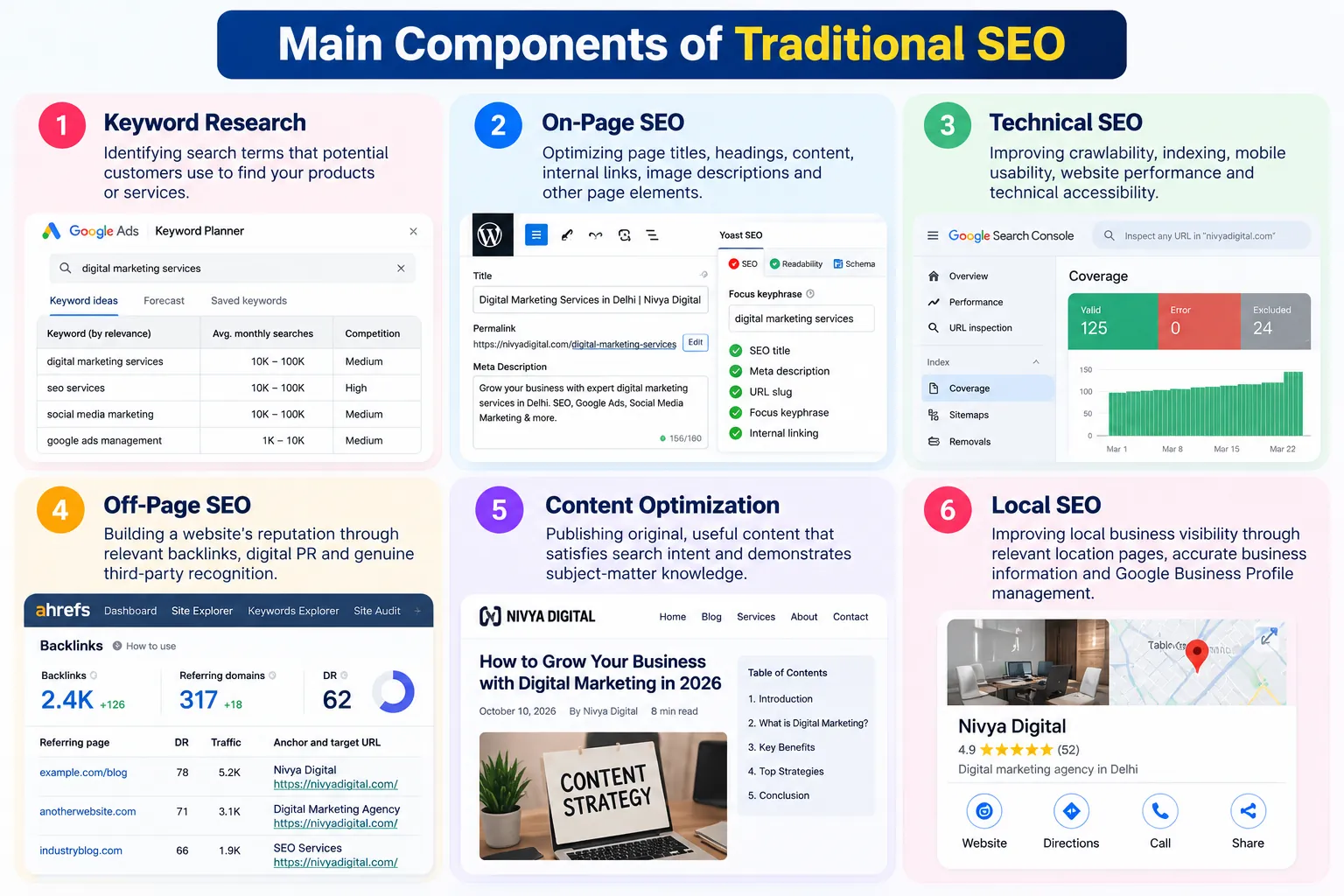
Main Components of Traditional SEO
- Keyword Research
Identifying search terms that potential customers use to find products, services, and information.
- On-Page SEO
Optimizing page titles, headings, content, internal links, image descriptions, and other page elements.
- Technical SEO
Improving crawlability, indexing, mobile usability, website performance, and technical accessibility.
- Off-Page SEO
Building a website's reputation through relevant backlinks, digital PR, and genuine third-party recognition.
- Content Optimization
Publishing original, useful content that satisfies search intent and demonstrates subject-matter knowledge.
- Local SEO
Improving local business visibility through relevant location pages, accurate business information, and Google Business Profile management.
Traditional SEO remains essential because search engines still need to access and understand website content before they can confidently surface it to users.
What Is AI SEO?
AI SEO refers to using artificial intelligence to support search optimization and adapting SEO strategies to AI-powered discovery experiences.
The term is commonly used in two related ways.
1. AI-Assisted SEO
This involves using AI tools to improve existing SEO workflows.
Examples include:
Generating initial keyword ideas and topic clusters.
Analyzing large keyword or performance datasets.
Creating draft content outlines.
Identifying potential content gaps.
Supporting technical SEO investigations.
Summarizing competitor research.
AI can speed up these activities, but its recommendations still require human review and reliable data.
2. SEO for AI-Powered Search
This involves helping content remain useful, discoverable, and credible as search experiences incorporate AI-generated responses.
Relevant experiences include Google AI Overviews, Google AI Mode, and other AI-powered research tools.
Some marketers use terms such as Generative Engine Optimization (GEO) and Answer Engine Optimization (AEO) to describe parts of this work.
However, these terms should not be confused with separate, guaranteed ranking systems. Google's guidance emphasizes that established SEO best practices remain relevant to its generative AI search features.
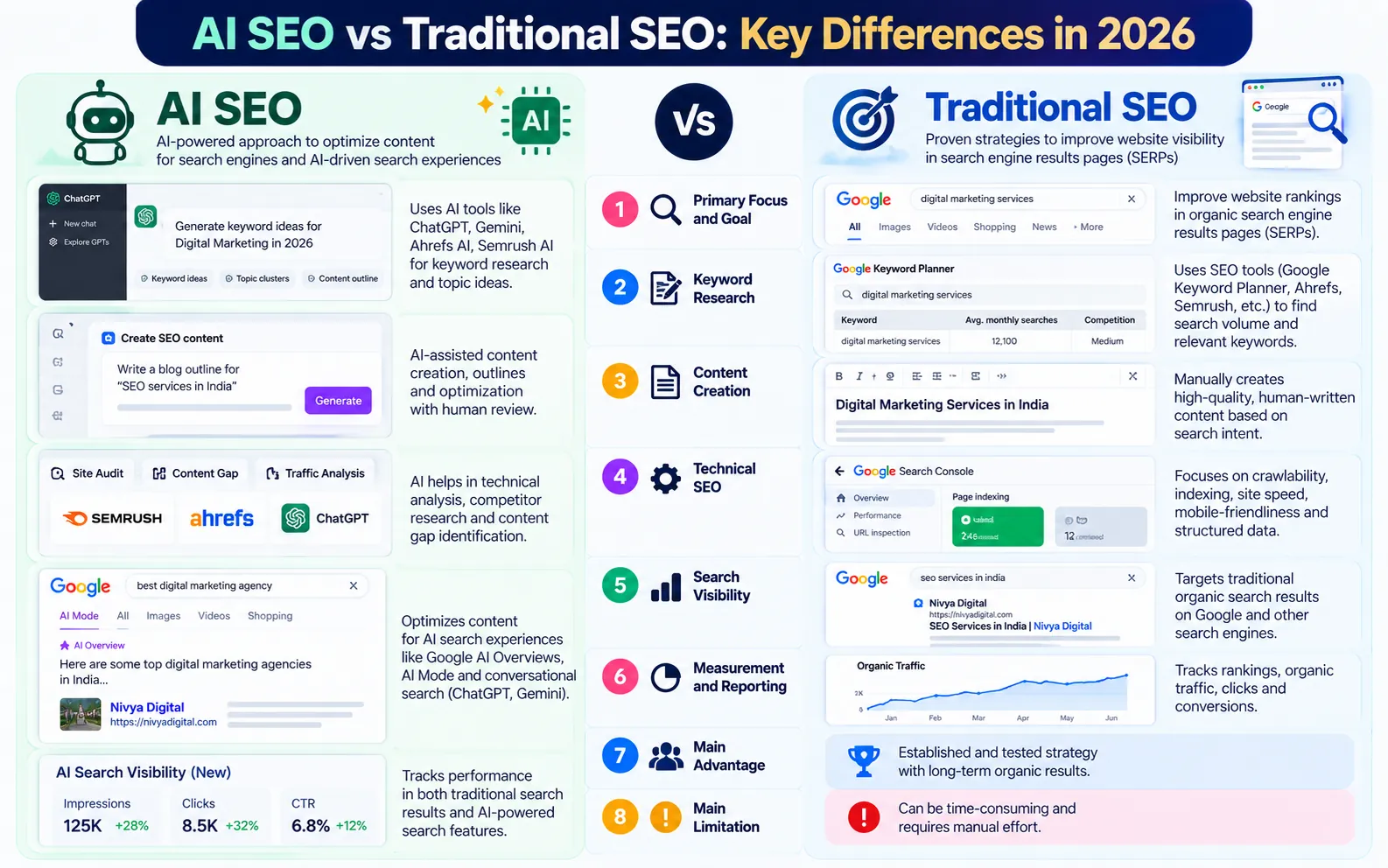
AI SEO vs Traditional SEO: Key Differences in 2026
| Factor | Traditional SEO | AI SEO |
|---|---|---|
| Primary focus | Organic search visibility | AI-assisted optimization and AI-era discovery |
| Keyword research | SEO tools and search data | AI-supported research with verified data |
| Content creation | Human-led research and writing | AI-assisted workflows with editorial review |
| Technical SEO | Crawling, indexing, performance | Same fundamentals with AI-assisted analysis |
| Search visibility | Traditional organic results | Organic results plus AI-powered experiences |
| Measurement | Rankings, clicks, traffic, conversions | Traditional KPIs plus AI visibility indicators |
| Main advantage | Established optimization framework | Faster analysis and broader discovery planning |
| Main limitation | Can require substantial manual work | AI output may be inaccurate or generic |
Key takeaway: AI SEO does not replace traditional SEO. It builds on many of the same foundations while changing how optimization work can be performed and measured.
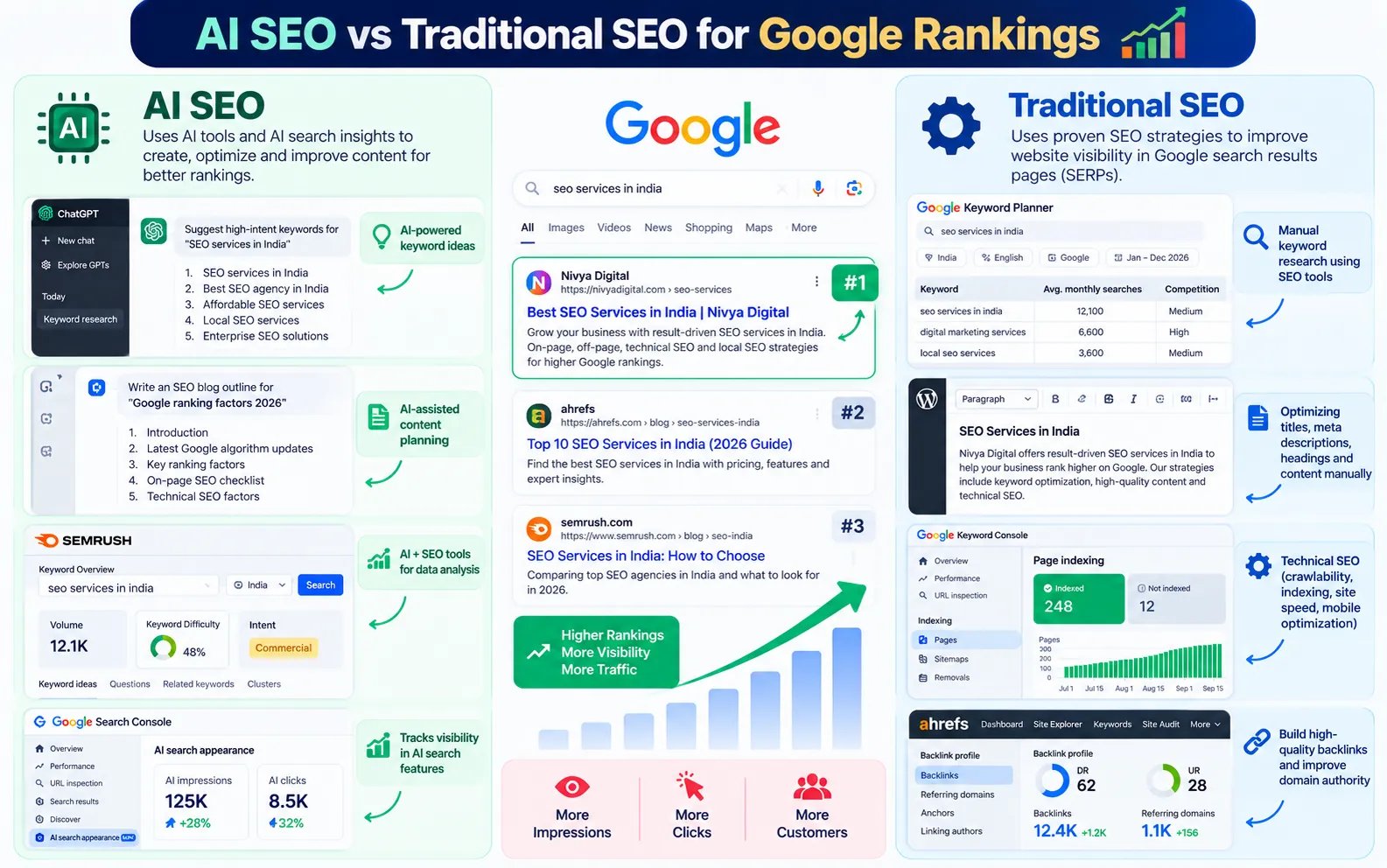
AI SEO vs Traditional SEO for Google Rankings
Google rankings remain important because many customers continue to use search engines to compare services, evaluate businesses, and make purchasing decisions.
Traditional SEO directly addresses the fundamentals needed to compete in organic results.
These include relevant content, strong internal linking, accessible website architecture, reliable information, and a good user experience.
AI SEO can support these activities by helping marketers identify patterns, review content coverage, and organize research.
For example, an SEO specialist can use AI to group hundreds of search queries by intent. However, the specialist should validate search demand using reliable SEO tools and decide which topics deserve dedicated pages.
Can AI-Generated Content Rank on Google?
AI-generated content is not automatically excluded from Google Search.
The important distinction is whether the content provides genuine value.
A detailed article supported by original examples, verified information, and expert editing can be useful regardless of whether AI assisted its production.
In contrast, publishing large volumes of generic, repetitive, or inaccurate content primarily to manipulate rankings creates quality and spam risks.
Which Is Better for Google Rankings?
Traditional SEO fundamentals remain indispensable.
AI tools may improve the efficiency of optimization, but using AI does not automatically improve rankings.
For businesses, the strongest approach is usually to combine established SEO practices with carefully supervised AI assistance.
AI SEO vs Traditional SEO for AI Search Visibility
AI-powered search experiences have changed how users discover information.
Instead of viewing only a list of links, users may encounter generated explanations that include references to relevant websites.
This creates another visibility opportunity for publishers and businesses.
How AI Search Visibility Works
Google AI Overviews and AI Mode can present supporting links to web content while answering questions.
A user researching website development, for example, might ask:
"Which is better for a small Indian business: WordPress or Shopify?"
An AI-powered search experience may combine information from multiple relevant sources to explain the differences.
A useful comparison article could potentially be surfaced as a supporting resource, but inclusion is never guaranteed.
How to Improve AI Search Readiness
Businesses should prioritize:
Clear, useful answers: Explain questions directly without unnecessary repetition.
Original expertise: Add practical examples, real observations, and evidence that generic summaries cannot provide.
Technical accessibility: Make important pages crawlable, indexable, and easy to navigate.
Content accuracy: Verify facts, update outdated information, and explain limitations.
Relevant internal links: Connect related guides, comparisons, and service pages.
Helpful visual content: Use meaningful images, diagrams, and videos when they improve understanding.
There is no special markup or separate technical requirement that guarantees inclusion in Google's AI Overviews or AI Mode.
Which Is Better for AI Visibility?
An AI-aware SEO strategy can help businesses prepare for emerging discovery experiences.
However, traditional SEO remains part of that strategy because Google's AI search features continue to rely on established search systems.
The practical objective is not to abandon SEO for AI optimization. It is to make existing SEO work more useful across different search experiences.
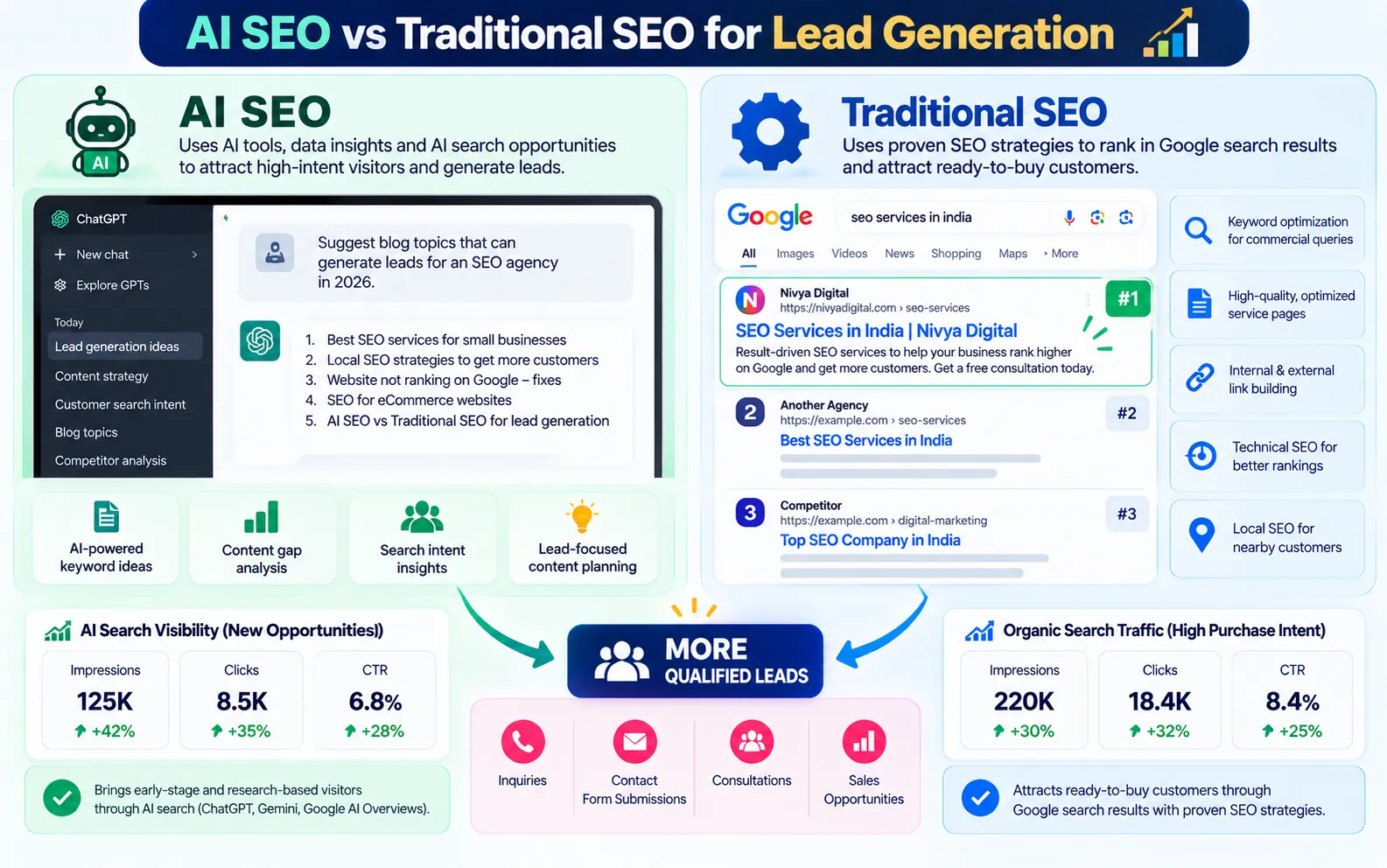
AI SEO vs Traditional SEO for Lead Generation
Traffic and visibility are valuable, but businesses ultimately need meaningful outcomes.
These may include contact form submissions, consultation requests, phone calls, purchases, and qualified inquiries.
A website can receive substantial organic traffic without generating many customers.
Similarly, a page may receive fewer visits but attract users who are ready to purchase a service.
Traditional SEO for Leads
Traditional SEO can target commercially relevant queries such as:
SEO services for small businesses
Digital marketing agency in India
WordPress website development services
Google Ads management services
These searches may indicate that a user is evaluating a provider or preparing to make an inquiry.
Dedicated service pages, relevant case studies, and clear calls to action help turn that interest into potential leads.
AI SEO for Leads
AI-assisted workflows can help businesses identify customer questions, analyze conversion paths, and develop content for different buying stages.
AI search visibility may also introduce a brand to users during early research.
However, being mentioned in an AI response is not equivalent to generating a lead.
Businesses still need to measure what happens after a visitor reaches their website.
Which Strategy Generates Better Leads?
Neither approach can guarantee better lead generation on its own.
The outcome depends on search intent, content quality, competition, website usability, and conversion strategy.
A combined approach offers a practical way to support discovery while maintaining a clear focus on customer inquiries.
AI SEO vs Traditional SEO: Which Is More Cost-Effective?
Traditional SEO commonly involves investments in content creation, technical improvements, research tools, and ongoing optimization.
AI tools can reduce the time required for selected tasks, including drafting outlines, classifying keywords, and reviewing data.
However, AI introduces its own costs, such as subscriptions, quality assurance, fact-checking, and staff training.
AI-generated recommendations may also create additional work when they contain incorrect information.
Businesses should therefore compare total workflow cost and business outcomes, not simply the price of an AI subscription.
A lower-cost content production process is not necessarily more cost-effective if the resulting pages fail to attract qualified visitors.
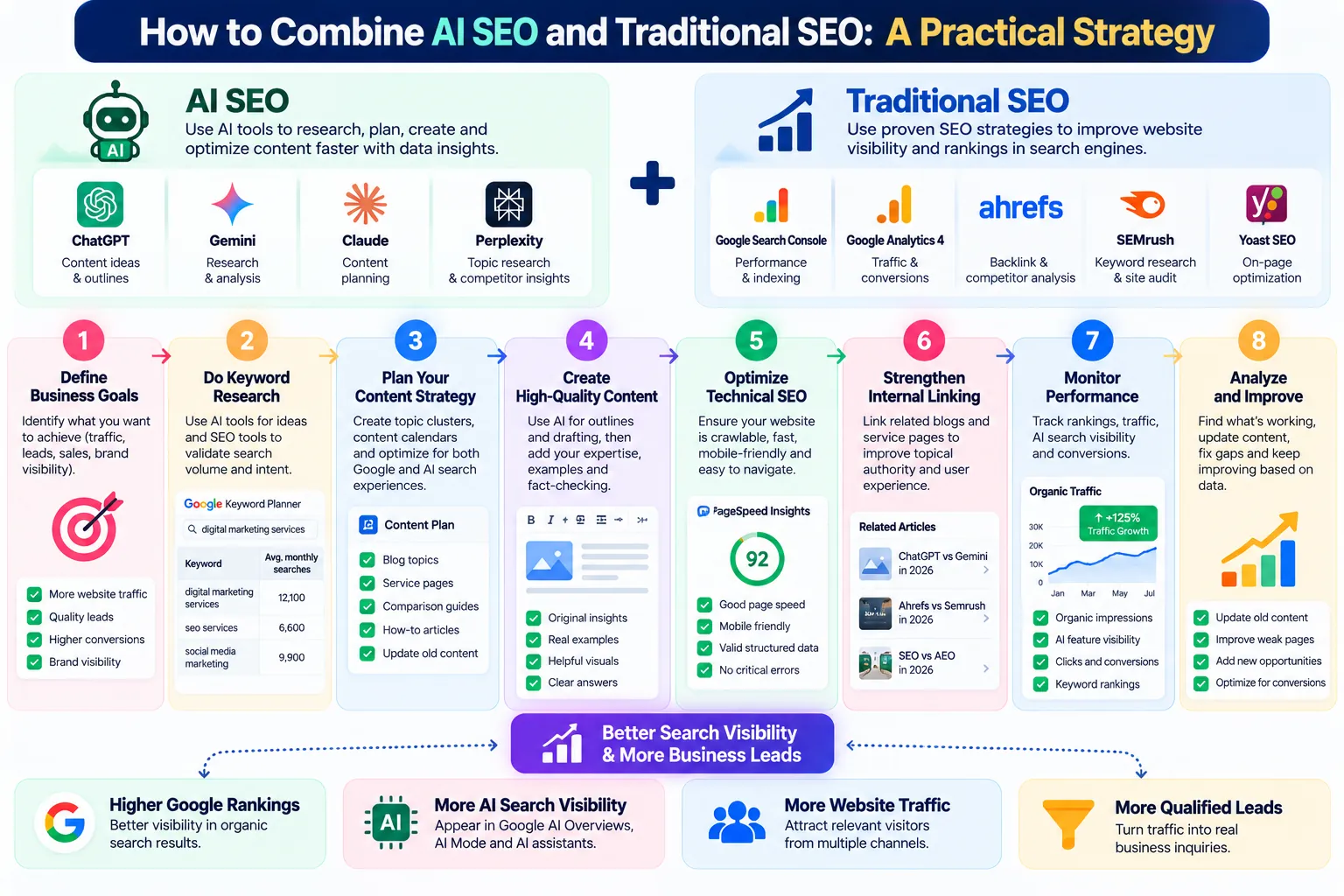
How to Combine AI SEO and Traditional SEO: A Practical Strategy
Instead of choosing one approach, businesses can integrate both into a structured workflow.
Step 1: Identify Business Goals
Define the outcomes that matter most.
For example, a digital marketing agency may prioritize qualified inquiries for SEO, website development, and paid advertising services.
Step 2: Conduct Verified Keyword Research
Use tools such as Google Search Console, Google Keyword Planner, Ahrefs, or Semrush to investigate search demand.
AI can help organize ideas, but it should not be treated as a reliable source of exact keyword volume without supporting data.
Step 3: Map Search Intent
Separate informational, commercial, and transactional topics.
For example:
Informational: What is AI SEO?
Comparative: AI SEO vs traditional SEO
Commercial: Best SEO services for small businesses
Transactional: Hire an SEO agency
This helps determine whether a topic belongs in a blog post, comparison guide, or service page.
Step 4: Create Original, Helpful Content
Use AI for brainstorming and structuring where appropriate.
Then strengthen the content with firsthand knowledge, relevant examples, original explanations, and fact-checking.
Step 5: Optimize Technical SEO
Check indexing, internal linking, page experience, and other technical fundamentals.
AI can help interpret reports, but important changes should be reviewed before implementation.
Step 6: Strengthen Internal Linking
Connect related articles and service pages naturally.
For example, a guide about AI SEO could link to an existing comparison of ChatGPT vs Gemini when discussing AI-assisted research and content creation.
It could also link to Ahrefs vs Semrush when explaining keyword and competitor analysis.
Step 7: Monitor Organic and AI Search Performance
Track impressions, clicks, conversions, and changes in search visibility.
Use available AI search reporting to understand whether pages appear in relevant generative search experiences.
Step 8: Improve Based on Results
Review pages that attract visitors but fail to generate inquiries.
Update weak calls to action, clarify service offerings, improve content relevance, and test conversion improvements.
How to Measure AI SEO and Traditional SEO Success in 2026
Businesses should evaluate both visibility and outcomes.
| KPI | What It Measures | Why It Matters |
|---|---|---|
| Organic impressions | Search result exposure | Indicates discoverability |
| Organic clicks | Visits from search results | Measures traffic acquisition |
| Keyword rankings | Visibility for tracked queries | Helps monitor competitive position |
| AI feature impressions | Exposure in supported AI search reporting | Adds insight into AI-era visibility |
| Engagement | User interaction with pages | Helps evaluate visitor experience |
| Conversions | Forms, calls, purchases, or inquiries | Connects marketing to business goals |
| Qualified leads | Relevant potential customers | Measures commercial value |
| Conversion rate | Share of visitors completing a goal | Helps identify landing-page opportunities |
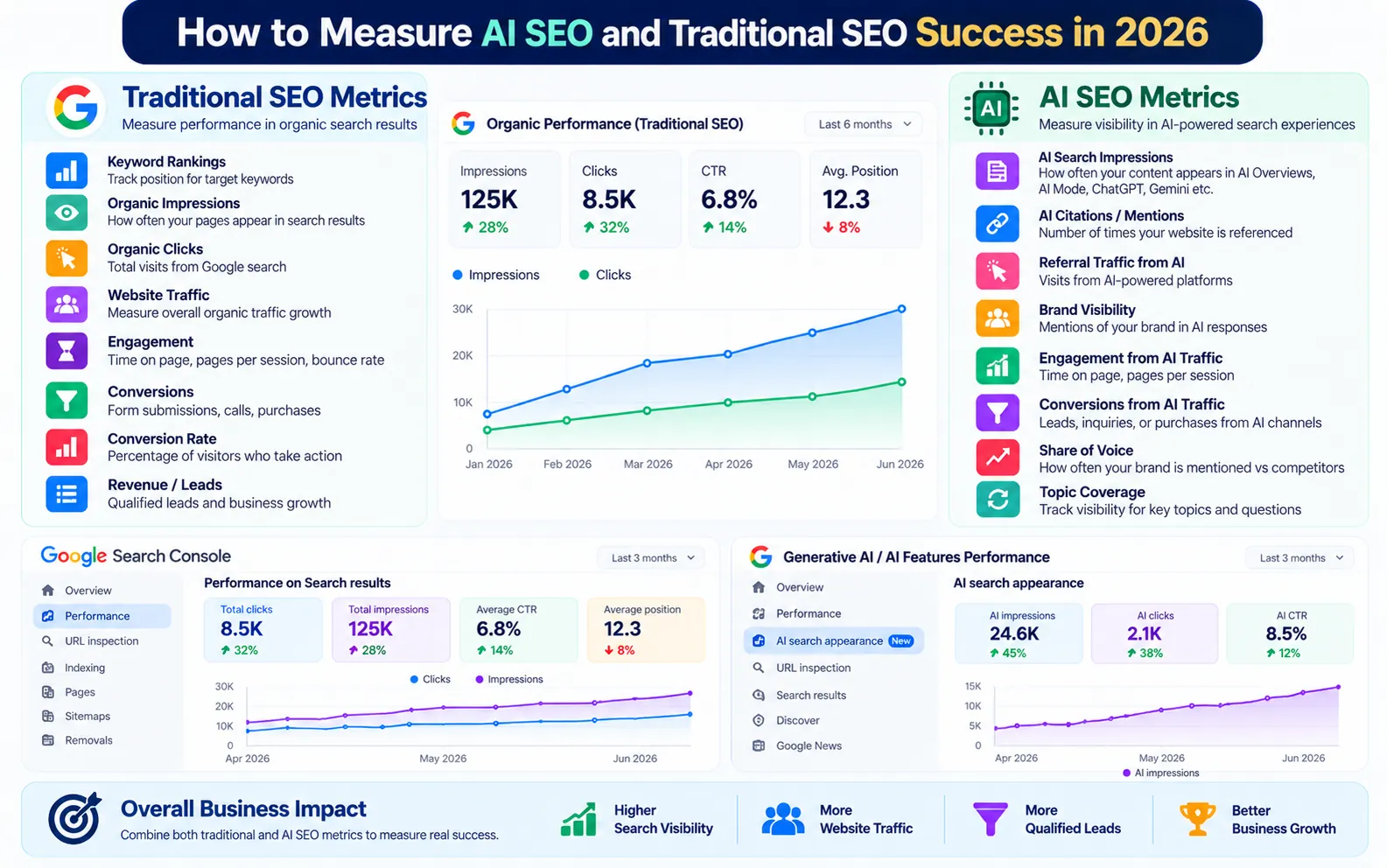
In 2026, Google introduced dedicated generative AI performance reporting in Search Console, giving website owners additional insight into visibility within supported AI search features.
Businesses should use these reports alongside standard Search Console and analytics data rather than treating AI impressions as direct evidence of revenue.
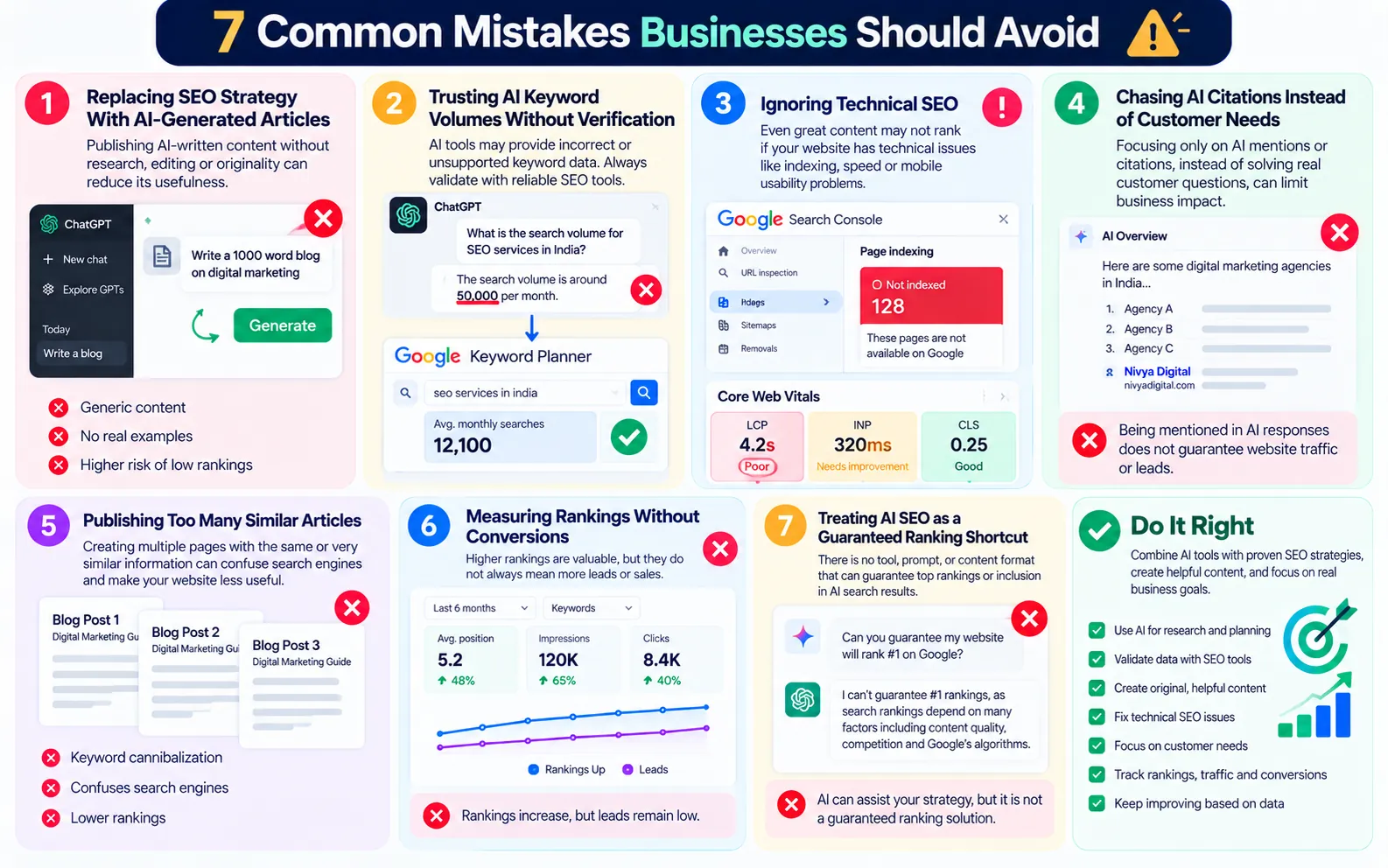
7 Common Mistakes Businesses Should Avoid
1. Replacing SEO Strategy With AI-Generated Articles
Publishing AI-written content without research, editing, or originality can reduce its usefulness.
2. Trusting AI Keyword Volumes Without Verification
AI assistants may provide inaccurate or unsupported estimates. Validate metrics through appropriate tools.
3. Ignoring Technical SEO
Strong writing cannot compensate for important pages that search engines cannot access properly.
4. Chasing AI Citations Instead of Customer Needs
Visibility is valuable, but content should first answer real customer questions.
5. Publishing Too Many Similar Articles
Creating multiple pages that repeat the same information can make a website less useful and harder to navigate.
6. Measuring Rankings Without Conversions
Higher rankings do not necessarily mean more qualified leads or sales.
7. Treating AI SEO as a Guaranteed Ranking Shortcut
No AI tool, prompt, schema markup, or content format can guarantee top rankings or inclusion in AI-generated answers.
AI SEO vs Traditional SEO: Which Should Small Businesses Choose?
For most small businesses, traditional SEO should remain the foundation.
Start with a technically accessible website, clear service pages, accurate business information, and useful content that matches customer needs.
Once these fundamentals are established, introduce AI tools where they can genuinely improve efficiency.
A small business with limited resources might use AI to organize blog topics, draft content briefs, and analyze performance reports.
However, it should continue investing in content quality, customer experience, and conversion optimization.
The best strategy is not AI SEO instead of traditional SEO. It is traditional SEO strengthened by responsible AI assistance and awareness of new search experiences.
Final Verdict: AI SEO vs Traditional SEO in 2026
AI SEO and traditional SEO should not be viewed as competing replacements.
Traditional SEO provides the foundation for search engine discovery, technical accessibility, content relevance, and website credibility.
AI-assisted SEO can make research and optimization workflows more efficient, while AI-aware strategies help businesses understand changing search behavior.
For Google rankings, established SEO practices remain essential.
For AI search visibility, businesses should prioritize original, useful, technically accessible content rather than shortcuts.
For lead generation, the winning strategy is the one that attracts relevant visitors and converts their interest into measurable business outcomes.
Grow Your Business With Nivya Digital
At Nivya Digital, we help businesses build a stronger digital presence through SEO, content marketing, website development, and digital marketing services.
If your goal is to improve search visibility, attract relevant website visitors, and generate more qualified inquiries, explore our SEO services and discover how a structured digital marketing strategy can support your growth.
Editorial note: This article reflects publicly available Google Search guidance as of October 2026. AI search products, reporting capabilities, and search behavior may continue to evolve.
Comments (0)
No comments yet
Start the discussion by sharing your perspective