
The way people search for information online is changing. For years, Google Search has been the starting point for finding websites, comparing products, researching services, and answering everyday questions. Today, AI-powered tools like ChatGPT Search offer another way to discover information.
Instead of browsing multiple search results, users can ask questions in natural language and receive summarized answers with links to relevant sources.
This shift raises an important question for businesses and digital marketers: ChatGPT Search vs Google Search—which one matters more in 2026?
Both platforms help people find information, but they offer different search experiences. Understanding these differences can help businesses build smarter content strategies and improve their online visibility.
In this guide, Nivya Digital explores how ChatGPT Search and Google Search work, their key differences, their impact on SEO, and practical ways to prepare your website for both.
What Is ChatGPT Search?
ChatGPT Search is a web search capability within ChatGPT that helps users find timely information through a conversational interface.
Rather than displaying only a traditional list of websites, ChatGPT can combine information from web sources into a direct response and provide links or citations that users can explore.
For example, someone might ask:
"What are the best digital marketing strategies for a small ecommerce business in 2026?"
ChatGPT Search can retrieve relevant information, explain different approaches, and help the user understand which strategies may suit their goals.
Users can also ask follow-up questions to explore a topic in greater detail.
How Does ChatGPT Search Work?
ChatGPT can search the web when current information would improve its answer. Users can also select the search feature manually when available.
It may use search providers to retrieve relevant information and generate a response based on the question and available sources.
Key Features of ChatGPT Search
Conversational answers to search questions.
Access to current web information when search is used.
Links and citations to supporting sources.
Follow-up questions within the same conversation.
Helpful explanations of complex topics.
Support for research, comparisons, and information discovery.
However, AI-generated answers can contain mistakes. Users should verify important information against reliable sources.
What Is Google Search?
Google Search is a search engine that helps users discover information across websites, images, videos, news, products, and other online resources.
Google discovers web pages through crawling, processes their content through indexing, and selects relevant results for users' searches.
For example, someone searching for:
"SEO agency for small businesses"
may see organic website listings, sponsored results, local business information, or other search features depending on the query.
Google also offers AI-powered experiences, including AI Overviews and AI Mode.
This means Google Search in 2026 is no longer limited to traditional blue-link results.
How Does Google Search Work?
Google Search generally operates through three important stages:
Crawling: Googlebot discovers and accesses web pages.
Indexing: Google processes eligible content and may store it in its search index.
Serving results: Google selects relevant information when users perform searches.
Being indexed does not guarantee a prominent ranking.
Key Features of Google Search
Organic search results and website discovery.
Search results for images, videos, news, and products.
Local business and location-based information.
AI Overviews and AI Mode.
Search tools for navigating different types of content.
Opportunities for businesses through SEO and advertising.
Google remains useful for both informational research and searches where users want to visit specific websites.
ChatGPT Search vs Google Search: Key Differences in 2026
Although both platforms help users discover information, their interfaces and search experiences differ.
| Feature | ChatGPT Search | Google Search |
|---|---|---|
| Main experience | Conversational answers with web sources | Search results with links and AI features |
| Search format | Natural-language questions and follow-ups | Keywords, questions, and conversational queries |
| Results | Generated responses with supporting links | Organic listings, ads, and other search features |
| Follow-up questions | Central to the conversational experience | Available through AI Mode and connected AI experiences |
| Website discovery | Through cited or linked sources | Through organic results and other search features |
| Business visibility | Search citations and relevant source links | Organic rankings, AI features, and paid placements |
| Best suited for | Explanations, comparisons, and guided research | Broad discovery, navigation, local search, and research |
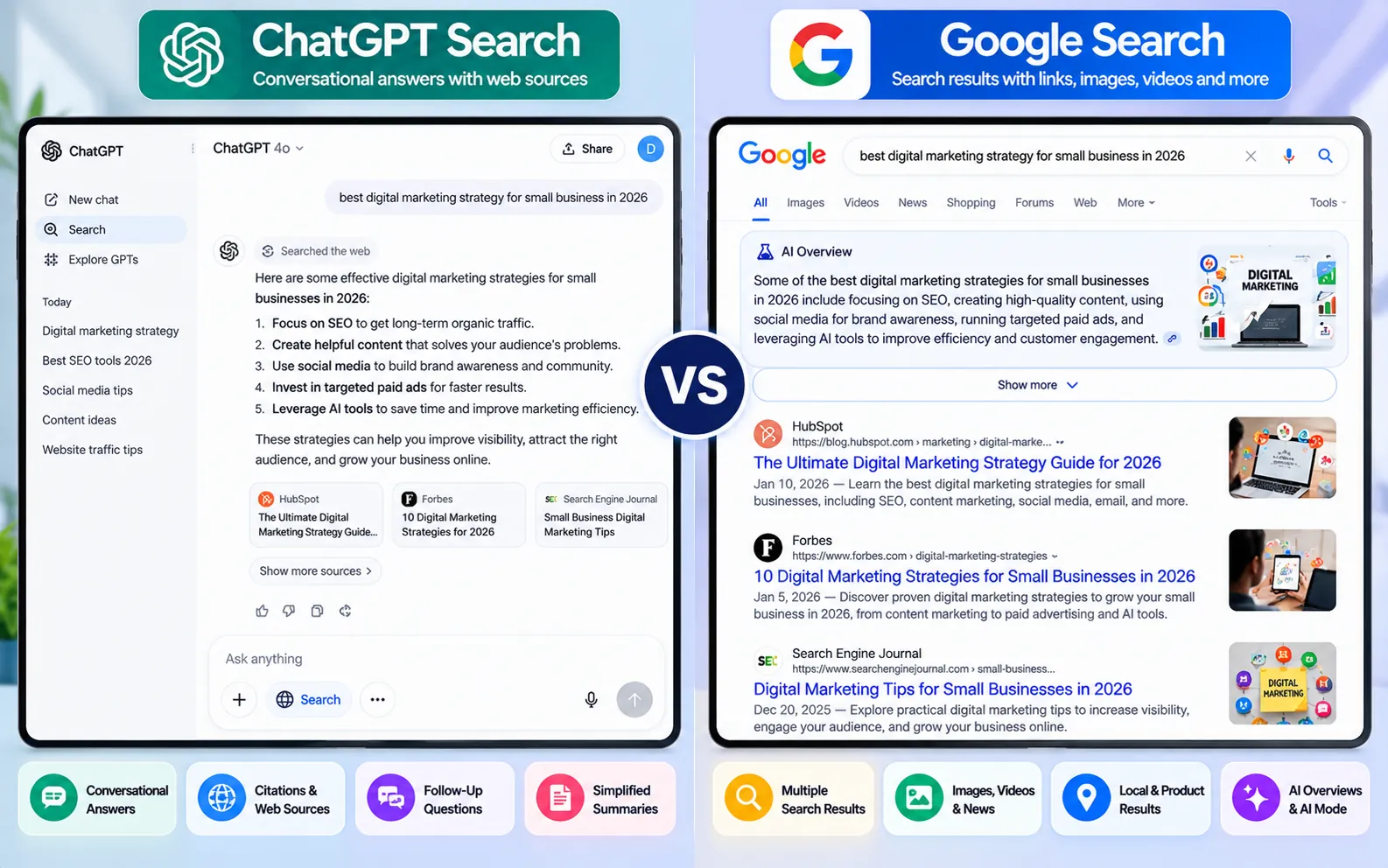
The main distinction is that ChatGPT Search emphasizes conversation, while Google Search offers a broader search results environment that also includes AI-powered experiences.
Neither platform is limited to a single type of query.
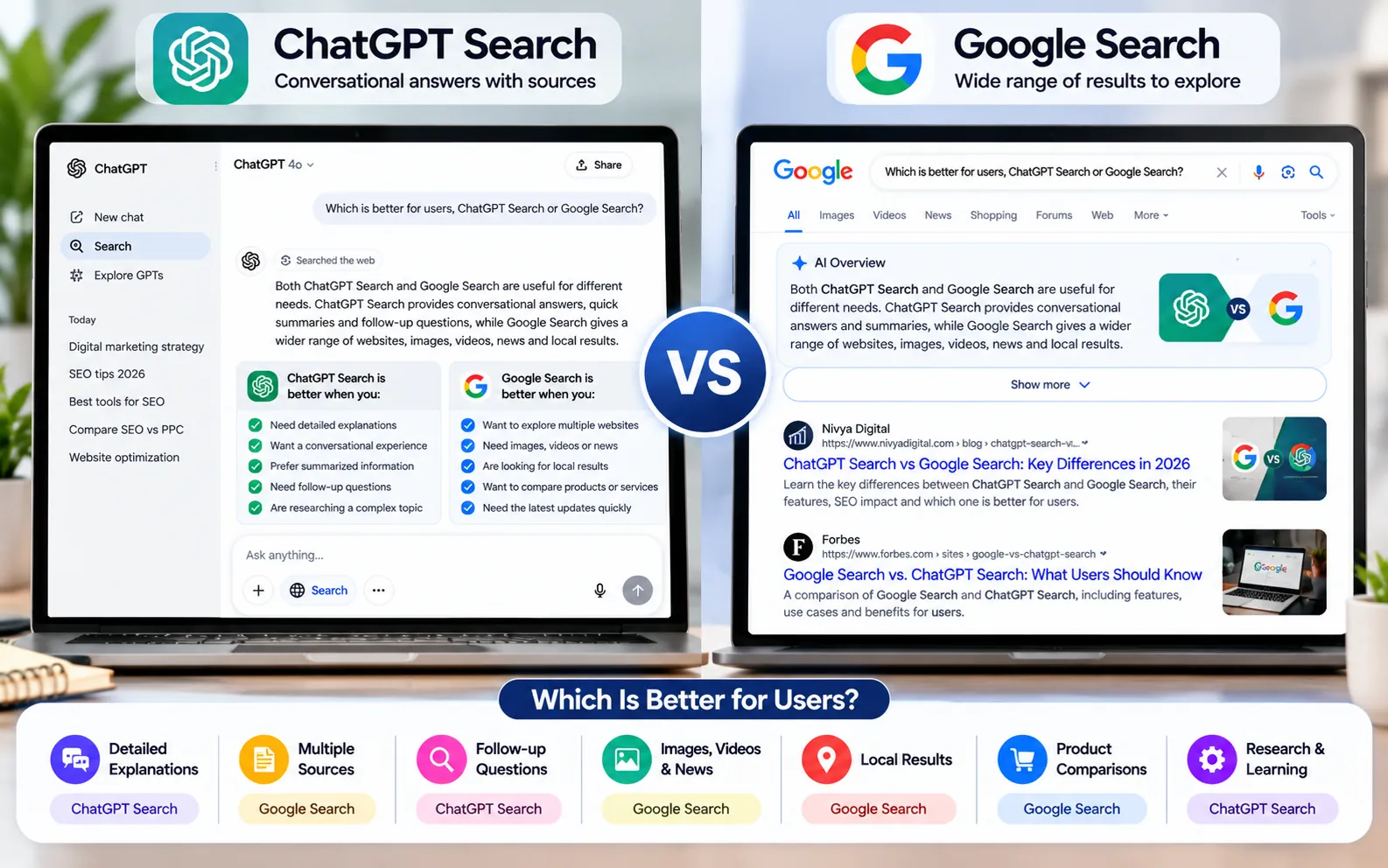
ChatGPT Search vs Google Search: Which Is Better for Users?
The answer depends on what someone wants to accomplish.
ChatGPT Search for Detailed Explanations
ChatGPT Search can be helpful when users need information explained in a structured, conversational way.
For example, someone researching SEO might ask:
"Explain technical SEO for a beginner and tell me which issues I should fix first."
They can then ask follow-up questions about indexing, page speed, or website architecture.
This makes ChatGPT useful for exploring a subject without repeatedly starting a new search.
Google Search for Broad Website Discovery
Google Search is useful when users want to browse different websites, compare sources, find local services, or navigate directly to a particular page.
For example, someone looking for digital marketing agencies may want to review company websites, service pages, portfolios, and contact details.
Google's results provide several ways to explore these options.
The better choice depends on search intent, not simply which platform uses more AI.
How Does ChatGPT Search Affect SEO in 2026?
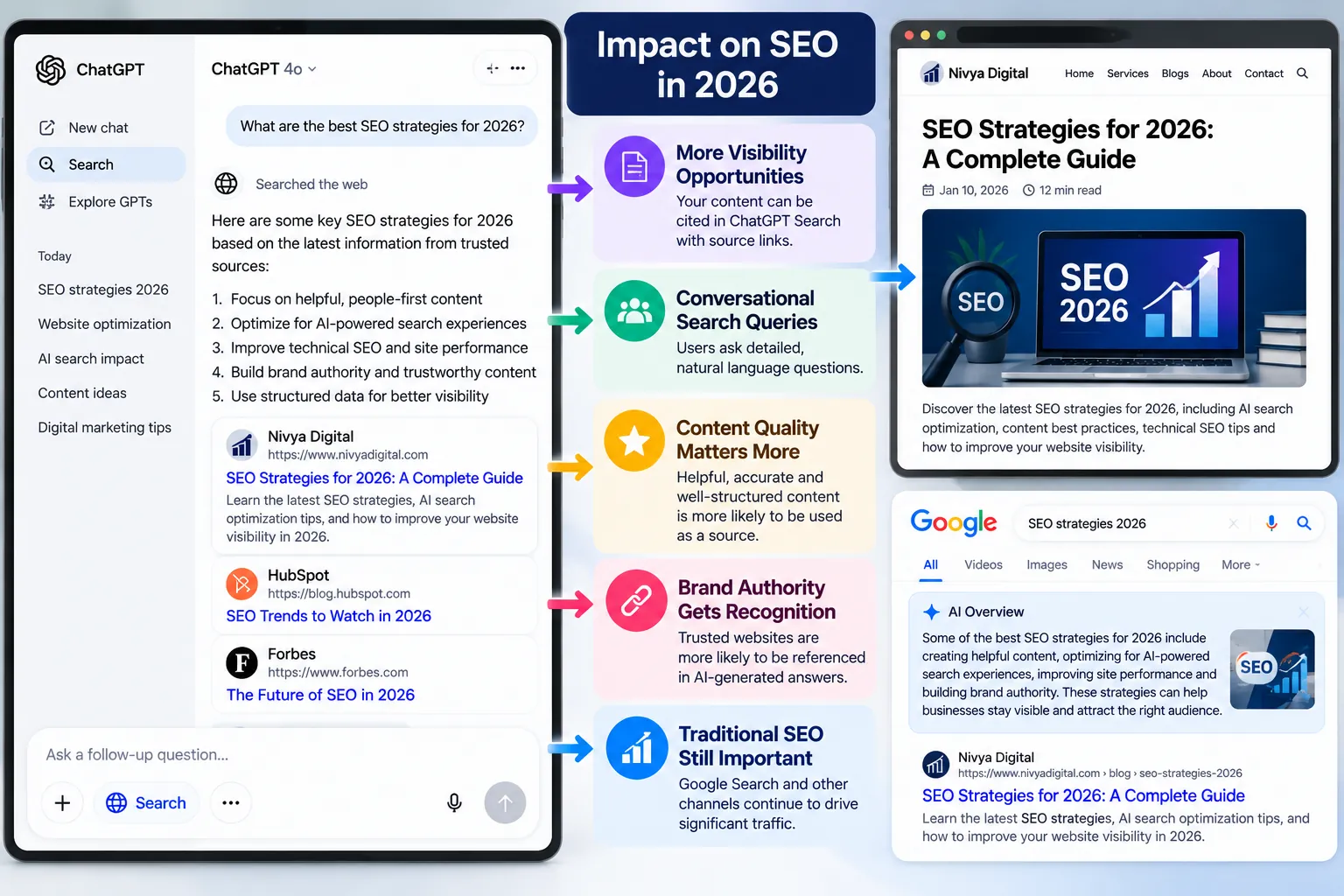
ChatGPT Search creates another possible discovery channel for businesses.
A website may be linked in an AI-generated answer when its content is relevant to the user's question and accessible to the search system.
However, inclusion is not guaranteed.
1. Search Visibility Is Expanding
Businesses increasingly need to think beyond traditional search engine rankings.
A potential customer may discover a company through a Google result, an AI-generated answer, or a supporting source link.
This makes visibility across multiple discovery channels worth monitoring.
2. Content Quality Becomes More Important
Helpful content remains valuable because users need accurate explanations, comparisons, and practical information.
Businesses should publish resources that answer genuine questions instead of creating pages solely to repeat keywords.
3. Conversational Search Queries Matter
Users can describe their needs in detail.
For example:
"Which is better for a new business with a limited marketing budget, SEO or paid advertising?"
A useful article explaining costs, advantages, limitations, and decision factors can address this type of question.
4. Traditional SEO Still Matters
ChatGPT Search does not eliminate the importance of Google SEO.
Businesses still benefit from crawlable websites, relevant content, internal linking, accessible pages, and clear site architecture.
A balanced strategy considers both traditional search and AI-assisted discovery.
How to Optimize Your Website for ChatGPT Search and Google Search
There is no guaranteed method for making your website appear in every AI-generated answer or at the top of Google.
However, several practical improvements can support online discoverability.
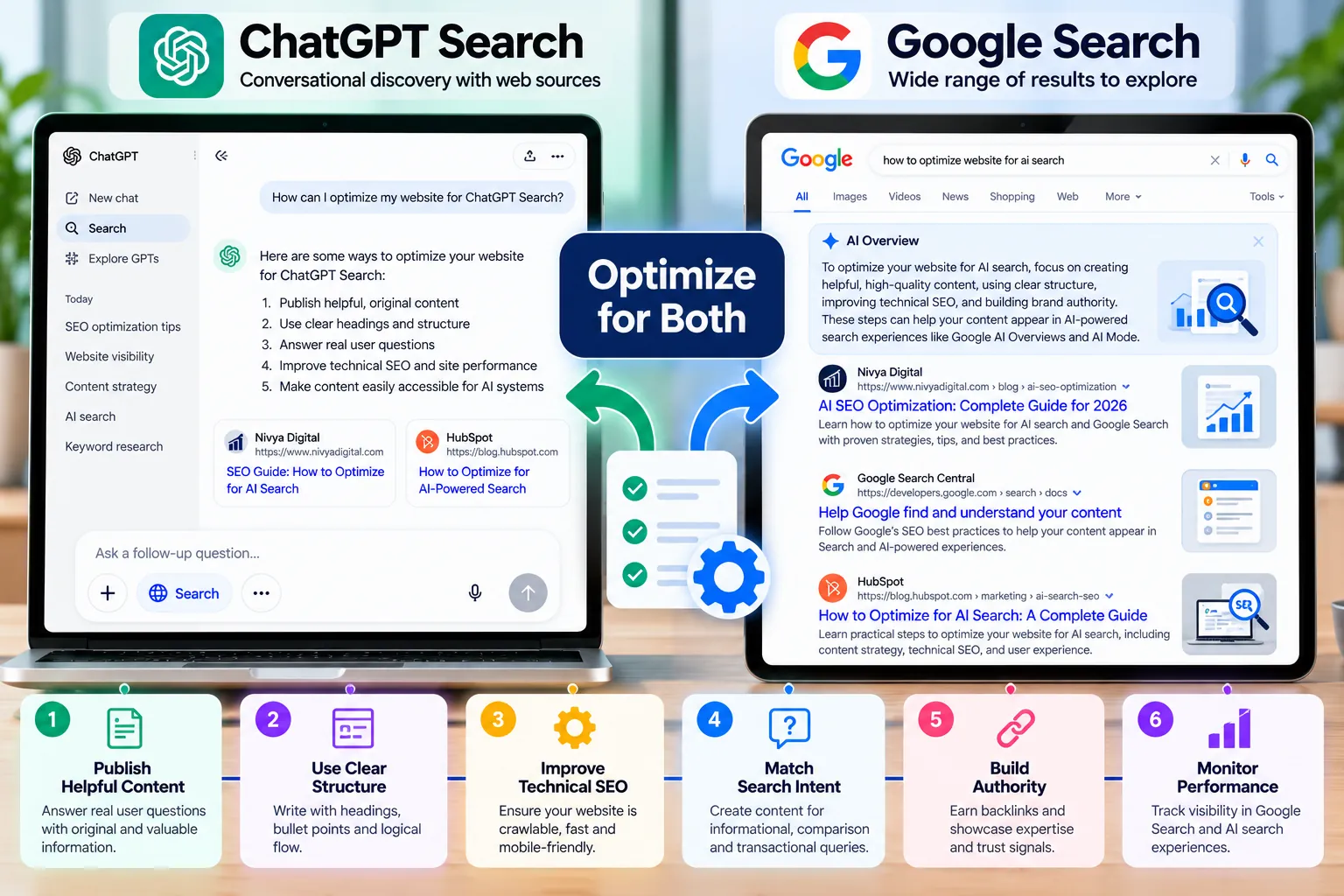
1. Publish Original, Helpful Content
Create articles that answer real customer questions.
Include accurate explanations, relevant examples, comparisons, and information that provides genuine value.
Avoid publishing repetitive content simply to target more keywords.
2. Improve Technical SEO
Make important pages accessible to search engines.
Review indexing problems, broken links, redirects, canonical tags, and site navigation.
For Google, use Google Search Console to monitor crawling and indexing.
For ChatGPT Search eligibility, OpenAI recommends allowing its OAI-Searchbot crawler and ensuring the hosting infrastructure does not block it.
3. Match Content to Search Intent
Understand whether users want to learn, compare, purchase, or contact a business.
A comparison query needs balanced information, while a service-related query may require pricing details, benefits, and a clear explanation of the service.
4. Use Clear Headings and Content Structure
Organize articles with descriptive headings and readable paragraphs.
Use tables where comparisons are helpful.
Good structure improves usability and makes important information easier for visitors to find.
5. Build Trust Through Accurate Information
Keep business details, service descriptions, and important claims accurate.
Where appropriate, identify authors, explain expertise, and reference reliable sources.
Avoid fabricated reviews, unsupported statistics, or misleading claims.
6. Strengthen Internal Linking
Connect related articles and service pages.
For example, a ChatGPT Search comparison article could link to guides about AI search optimization, Google AI Overviews, keyword research, and technical SEO.
This helps visitors discover relevant information across your website.
Can ChatGPT Search Replace Google Search?
ChatGPT Search and Google Search overlap in several areas, but they are not identical products.
ChatGPT Search emphasizes conversational assistance and synthesized answers. Google Search combines traditional web discovery with specialized results and AI features.
Some users may prefer conversational research, while others may want to browse websites directly.
Businesses should avoid assuming that one platform will completely replace the other.
A more practical approach is to understand how customers search and make useful information accessible wherever discovery happens.
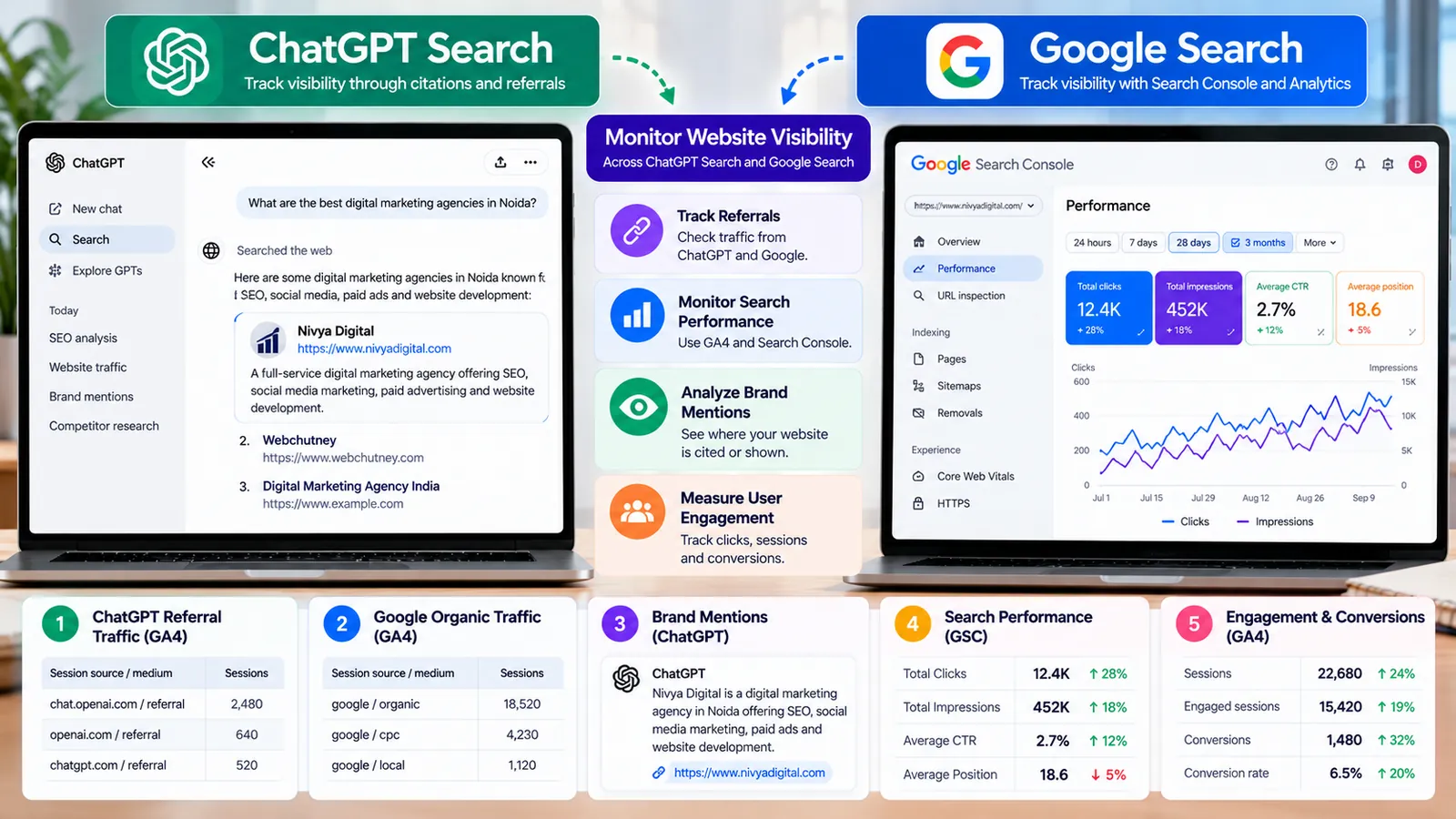
How to Measure Website Visibility Across Both Platforms
Businesses can use different tools to evaluate search performance.
Google Search Console helps monitor Google Search clicks, impressions, queries, and indexing.
Google Analytics 4 helps analyze website engagement, acquisition channels, and conversions.
Website owners can also review referral traffic from ChatGPT where referral information is available.
However, referral data does not capture every instance where an AI system mentions or uses information from a website.
Track meaningful outcomes such as enquiries, qualified leads, and conversions rather than focusing only on mentions.
Final Thoughts
The comparison between ChatGPT Search vs Google Search in 2026 highlights an important shift in online discovery.
ChatGPT Search offers a conversational approach to finding information, while Google Search provides broad website discovery alongside increasingly advanced AI features.
Both can influence how potential customers research products, services, and businesses.
For website owners, the most sustainable approach is to create accurate, original content, maintain strong technical SEO, and understand customer search intent.
At Nivya Digital, we believe businesses should build their search strategy around useful information and measurable customer outcomes—not shortcuts or promises of guaranteed AI visibility.
Comments (0)
No comments yet
Start the discussion by sharing your perspective