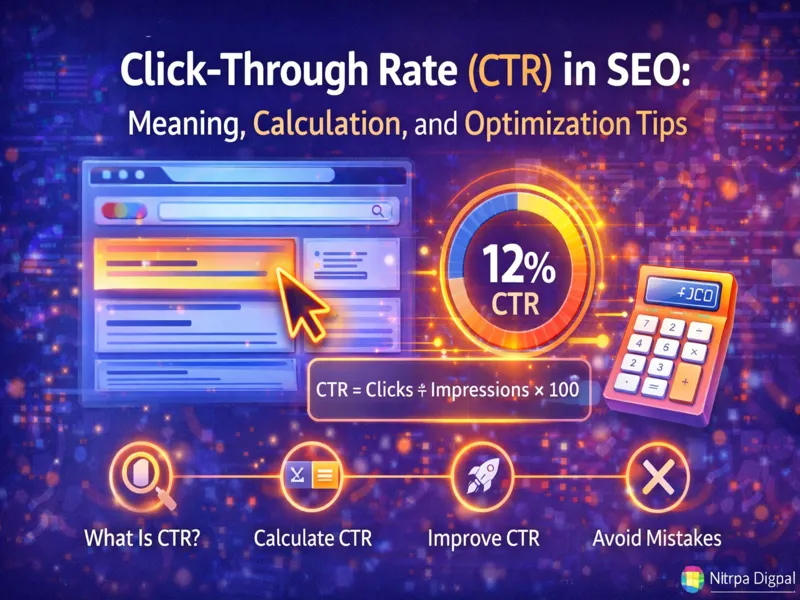
In the world of search engine optimization (SEO), getting your website to appear in search results is only half the battle. The real success comes when users actually click on your link. This is where Click-Through Rate (CTR) plays a crucial role.
CTR is one of the most important performance metrics in SEO because it directly reflects how attractive and relevant your content appears to users. Search engines like Google Search use CTR as a signal to evaluate whether your page satisfies user intent.
A higher CTR means more users are clicking on your website, which can lead to increased traffic, better rankings, and improved conversions. In this blog, we will explore the meaning of CTR, how to calculate it, and proven strategies to optimize it for better SEO performance.
Overview Table: CTR in SEO
| Aspect | Description | Benefit |
|---|---|---|
| CTR Meaning | Percentage of users who click your link | Measures attractiveness |
| CTR Formula | Clicks ÷ Impressions × 100 | Tracks performance |
| High CTR | Indicates relevant content | Improves rankings |
| Low CTR | Signals poor engagement | Needs optimization |
| Optimization | Improve titles & snippets | Boost traffic |
1. What Is Click-Through Rate (CTR)?
Click-Through Rate (CTR) is the percentage of users who click on your website link after seeing it in search engine results pages (SERPs). It measures how effective your listing is in attracting clicks.
For example, if your page appears 1,000 times in search results and receives 100 clicks, your CTR is 10%.
CTR is a key indicator of how well your title, meta description, and overall search appearance resonate with users. Even if your website ranks high, a low CTR means users are not finding your listing appealing enough to click.
Search engines analyze CTR to determine the relevance of your content. If users consistently click on your link, it signals that your page is useful and matches user intent.
Key Points
- CTR measures clicks vs impressions
- Indicates user interest
- Important SEO performance metric
- Affects traffic and engagement
- Reflects content relevance
2. How to Calculate CTR in SEO
CTR is calculated using a simple formula:
CTR = (Total Clicks ÷ Total Impressions) × 100
For example:
- Clicks = 200
- Impressions = 2,000
CTR = (200 ÷ 2000) × 100 = 10%
This percentage helps marketers understand how well their content performs in search results.
CTR data can be easily tracked using tools like Google Search Console, which provides insights into clicks, impressions, and average CTR for each page.
Regularly monitoring CTR helps identify which pages need optimization and which are performing well.
Key Points
- Simple formula for calculation
- Helps measure performance
- Available in Google Search Console
- Useful for identifying weak pages
- Supports data-driven decisions
3. Why CTR Is Important for SEO
CTR plays a significant role in SEO because it directly impacts website traffic and can influence search rankings.
When a page receives a high CTR, it indicates that users find it relevant and useful. Search engines may reward such pages with better rankings.
CTR also helps improve brand visibility. Even if users don’t click immediately, repeated exposure increases brand awareness.
Additionally, CTR provides insights into user behavior. By analyzing CTR, businesses can understand what type of content attracts clicks and optimize their strategies accordingly.
Key Points
- Drives website traffic
- Signals relevance to search engines
- Improves rankings
- Enhances brand visibility
- Provides user behavior insights
4. Factors That Affect CTR
Several factors influence CTR in SEO. Understanding these factors helps businesses optimize their search listings effectively.
The most important factor is the title tag. A compelling and keyword-rich title attracts more clicks.
The meta description also plays a crucial role by providing a brief summary that encourages users to click.
Other factors include URL structure, rich snippets, featured snippets, and search intent alignment.
Position in search results also affects CTR. Higher-ranking pages generally receive more clicks, but a well-optimized snippet can outperform even higher-ranked competitors.
Key Points
- Title tag optimization
- Meta description quality
- Search result position
- Use of rich snippets
- Relevance to user intent
5. Best Strategies to Improve CTR
Improving CTR requires a combination of creativity and optimization techniques.
Start by writing compelling and engaging titles that include power words and emotional triggers.
Optimize meta descriptions to clearly communicate value and include a call-to-action.
Use structured data to enable rich snippets such as ratings, FAQs, and images.
Focus on matching search intent so that users feel your content directly answers their query.
Testing different variations of titles and descriptions can also help identify what works best.
Key Points
- Write attractive titles
- Optimize meta descriptions
- Use structured data
- Match user intent
- Test and refine strategies
6. Common CTR Mistakes to Avoid
Many businesses fail to optimize CTR due to common mistakes.
Using generic or boring titles reduces click appeal. Ignoring meta descriptions can also hurt CTR.
Keyword stuffing makes titles look unnatural and less trustworthy.
Another mistake is not updating outdated content. Trends and user behavior change, so content should be refreshed regularly.
Avoid misleading titles, as they may increase clicks initially but harm user trust and engagement.
Key Points
- Avoid boring titles
- Don’t ignore meta descriptions
- Avoid keyword stuffing
- Update content regularly
- Maintain accuracy and trust
Conclusion
Click-Through Rate (CTR) is a powerful metric that determines how effectively your content attracts users in search results. By understanding its meaning, calculation, and optimization strategies, businesses can significantly improve their SEO performance.
With the help of tools like Google Search Console, marketers can track and optimize CTR to drive more traffic and achieve better rankings.
Focusing on CTR not only boosts visibility but also enhances user engagement and overall digital success.
Comments (0)
No comments yet
Start the discussion by sharing your perspective