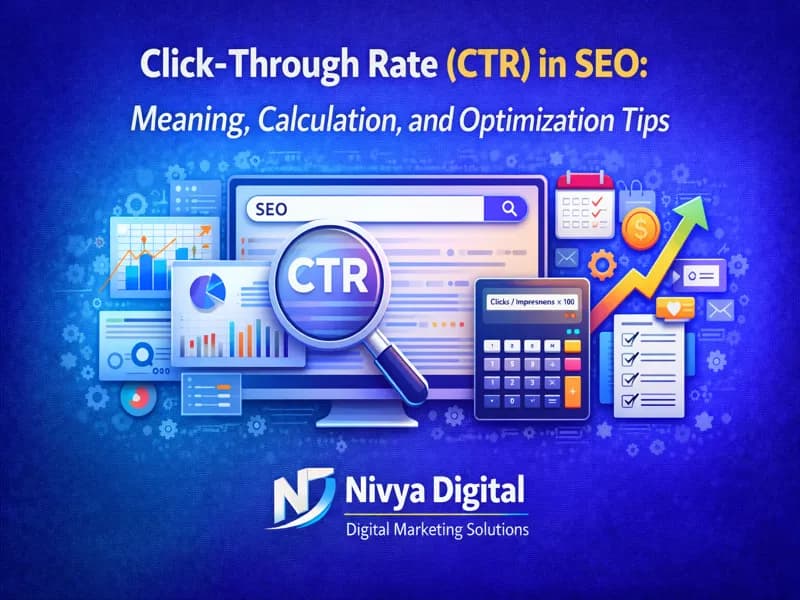
Scoring high on Google is not enough in today's competitive digital environment. What really counts for you is whether or not someone actually clicks into your website after having the impression in search results (how many of us have thoughts and questions get answered without ever leaving the SERPs?). And this is where the Click-Through Rate (CTR) is one of the most crucial SEO metrics. CTR is an indicator of how well you search, and how engaging your content is to the user.
At Nivya Digital (full service digital marketing agency), we specialize in helping businesses enhance not only their ranks, but also CTR — because more CTR equals more traffic, better engagement and higher conversions without the need to increase ad spend.
In this comprehensive extract, you will find out what CTR in SEO means, how to compute it and why it is important as well as tried-and-tested optimization tips that work.
What is Click-Through Rate (CTR) in SEO?
Click-Through Rate (CTR) in SEO is the percentage of users who click on your website link after seeing it on a search engine results page (SERP).
Put simply, CTR answers the question:
For all the people who Googled your site, how many of them decided to click on it?
Your CTR is an indication of the attractiveness to users of your Title Tag, Meta Description, URL and rich results.
Why is CTR Important for SEO?
CTR is important because it connects visibility with traffic. You may rank on page one, but if users don’t click your result, that ranking brings little value.
Benefits of a High CTR:
More organic traffic without extra cost
Better user engagement signals
Stronger brand visibility and trust
Higher chances of conversions
Better ROI from SEO efforts
At Nivya Digital, we’ve seen businesses increase organic traffic by over 30% just by improving CTR—without changing rankings.
How to Calculate Click-Through Rate (CTR)
CTR calculation is simple and can be tracked easily using Google Search Console.
CTR Formula:
CTR (%) = (Total Clicks ÷ Total Impressions) × 100
Example:
If your page appears 8,000 times in search results and gets 320 clicks:
CTR = (320 ÷ 8,000) × 100 = 4%
Average CTR by Google Ranking Position
Understanding industry benchmarks helps you identify underperforming pages.
| Google Ranking Position | Average CTR |
|---|---|
| Position 1 | 27–32% |
| Position 2 | 15–18% |
| Position 3 | 10–12% |
| Position 4 | 7–8% |
| Position 5 | 5–6% |
| Position 6–10 | 2–4% |
If your CTR is below average for your ranking position, optimization is required.
Key Factors That Affect CTR in SEO
Several elements influence whether users click your result or skip it.
1. Title Tags
A compelling, keyword-rich title increases curiosity and relevance.
2. Meta Descriptions
Meta descriptions act like ad copy. A clear benefit-driven description improves CTR significantly.
3. URL Structure
Short, clean, and readable URLs build trust.
4. Search Intent Match
If your content doesn’t match user intent, users won’t click—even if you rank high.
5. Rich Snippets & Schema Markup
FAQs, reviews, ratings, and sitelinks enhance visibility and attract clicks.
6. Brand Authority
Trusted brands naturally get higher CTR than unknown websites.
Proven CTR Optimization Tips (That Actually Work)
At Nivya Digital, we follow a data-driven CTR optimization strategy.
1. Write Power-Packed Titles
Use numbers (Top 7, 2025 Guide)
Add power words (Ultimate, Proven, Easy)
Include the primary keyword naturally
2. Optimize Meta Descriptions
Keep under 160 characters
Highlight solutions and benefits
Add a strong call-to-actio
3. Use Emotional & Action Words
Words like free, simple, complete, expert, and step-by-step increase clicks.
4. Leverage Schema Markup
FAQ, Review, and How-To schema boost SERP appearance and CTR.
5. Optimize for Featured Snippets
Use clear headings, bullet points, tables, and direct answers.
6. Improve Mobile CTR
Ensure titles and descriptions look perfect on mobile search results.
Tools to Measure and Improve CTR
| Tool | Purpose |
|---|---|
| Google Search Console | CTR, impressions & keyword data |
| Google Analytics | User behavior analysis |
| SEMrush / Ahrefs | SERP & competitor insights |
| Rank Math / Yoast | Title & meta optimization |
Common CTR Mistakes to Avoid
Writing generic titles
Keyword stuffing
Duplicate meta descriptions
Ignoring mobile users
Not testing different title variations
How Nivya Digital Improves CTR for Businesses
As a full-service digital marketing agency, Nivya Digital focuses on CTR-driven SEO strategies:
Keyword intent research
CTR-focused title & meta optimization
Schema implementation
Competitor SERP analysis
Monthly CTR performance tracking
Our goal is simple: turn impressions into clicks and clicks into customers.
Conclusion
CTR is one of the most effective SEO metrics that can increase your organic traffic and help grow your business. Through titles, descriptions and intent & SERP features optimization get more traffic without necessarily increasing your marketing costs.
Brands can leverage this based on expert advice from Nivya Digital to get more CTR, better engagement and attain SEO success in the long term.
Comments (0)
No comments yet
Start the discussion by sharing your perspective