
Search is no longer limited to typing a keyword into Google and choosing one of ten blue links.
People now discover information through Google Search, AI Overviews, AI Mode, ChatGPT, Gemini, voice assistants, and other AI-powered experiences. For businesses and marketers, this shift has introduced new terms such as SEO, AEO, and GEO.
But this creates an obvious question: do businesses now need three completely different optimization strategies?
Not exactly.
SEO remains the foundation of search visibility, while AEO and GEO describe ways of adapting content for answer-based and generative AI experiences. Understanding the differences can help businesses build a search strategy that works across both traditional and AI-powered discovery.
In this guide, we'll break down GEO vs SEO vs AEO, explain how each works, and explore which one deserves the most attention in 2026.
What Is SEO?
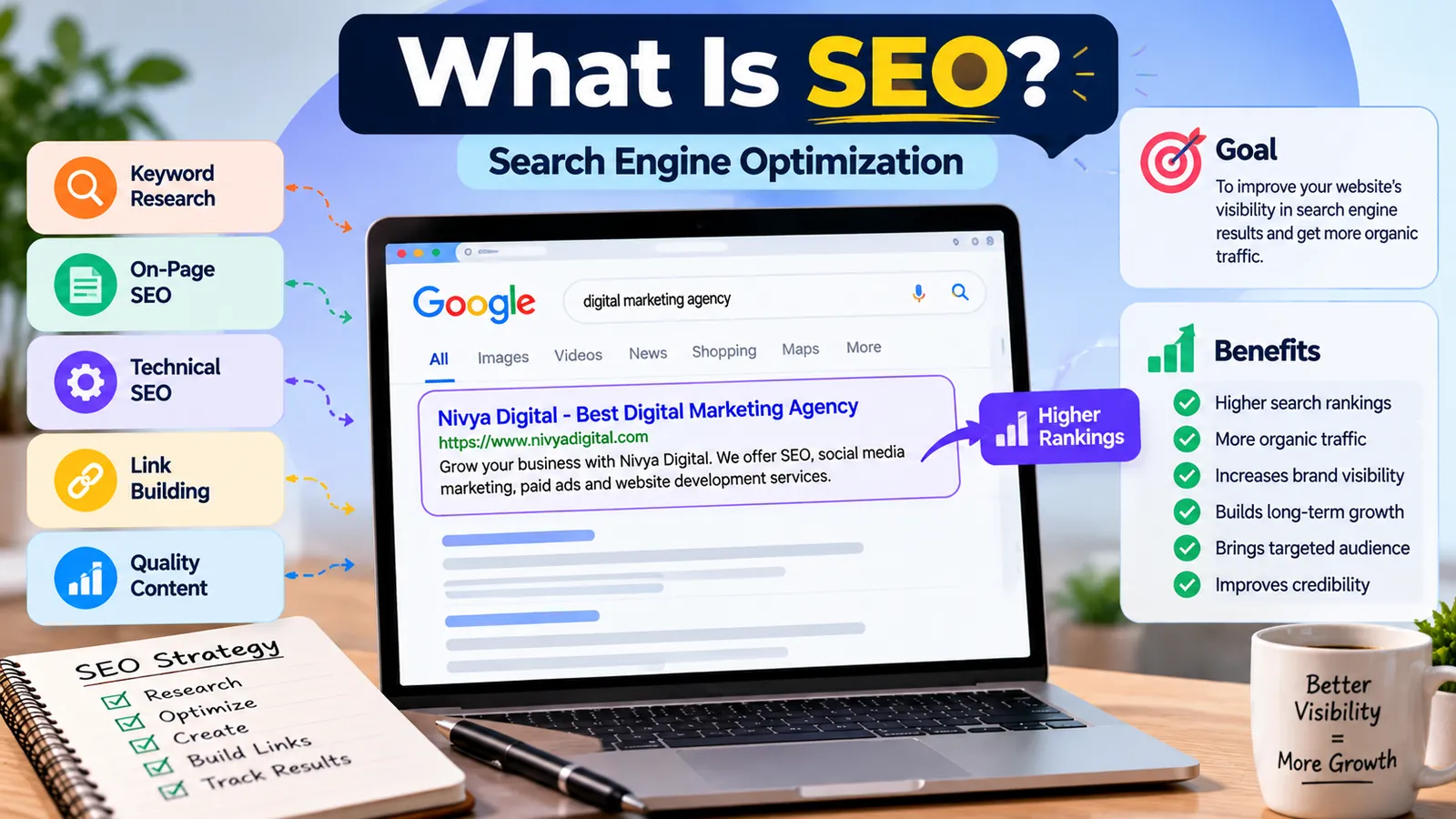
SEO (Search Engine Optimization) is the practice of improving a website's visibility in organic search results.
When someone searches Google for terms such as “digital marketing agency,” “SEO services,” or “best marketing strategies,” SEO helps relevant webpages compete for visibility.
A strong SEO strategy typically includes:
Keyword research
Search intent optimization
Helpful content
On-page SEO
Internal linking
Technical SEO
Backlinks and authority building
Structured data where appropriate
Page experience
Content updates and maintenance
The traditional goal is straightforward: help search engines understand your pages and make them useful enough to earn visibility for relevant searches.
However, SEO in 2026 is broader than simply ranking a webpage.
Search engines increasingly use AI to understand queries, retrieve information, and present answers. That means good SEO also provides much of the foundation required for visibility in newer search experiences.
What Is AEO?
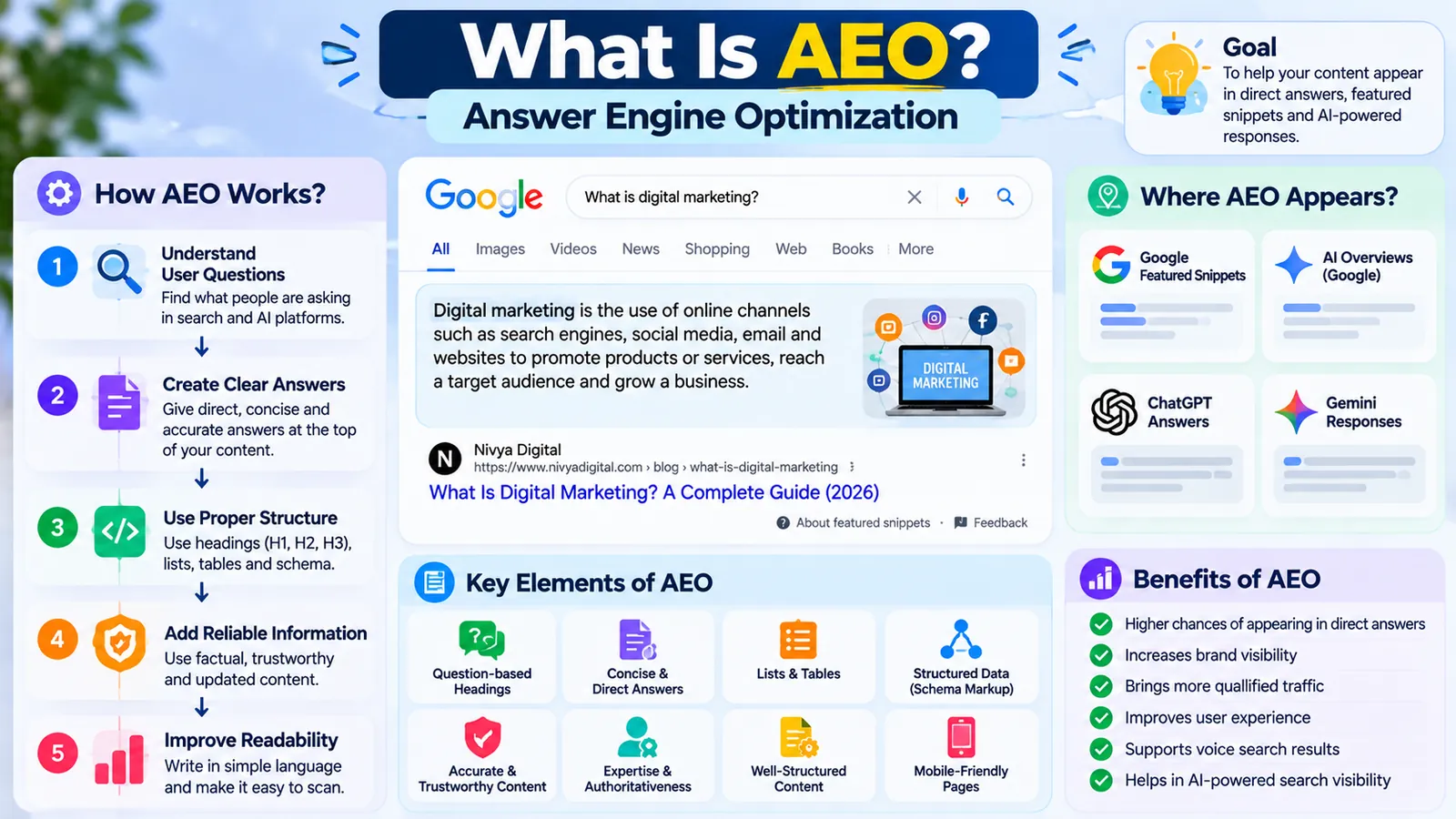
AEO stands for Answer Engine Optimization.
It focuses on making information easy for answer-based systems to understand and present directly to users.
Consider searches such as:
“What is technical SEO?”
or:
“What is the difference between SEO and GEO?”
A user may receive an answer directly within a search or AI experience rather than having to open several webpages.
AEO aims to make your content clear, useful, trustworthy, and structured enough to contribute to these kinds of answers.
How Does AEO Work?
AEO isn't about inserting more keywords.
Instead, it encourages clear communication.
For example, if your heading is:
What Is Answer Engine Optimization?
The paragraph immediately below it should provide a concise definition before moving into additional detail.
AEO-friendly content commonly benefits from:
Clear question-based headings
Direct answers
Logical H1, H2, and H3 structure
Concise definitions
Lists and tables where genuinely useful
Strong supporting information
Accurate and trustworthy claims
Crawlable webpages
The objective is to make important information easy for both users and machines to interpret.
What Is GEO?
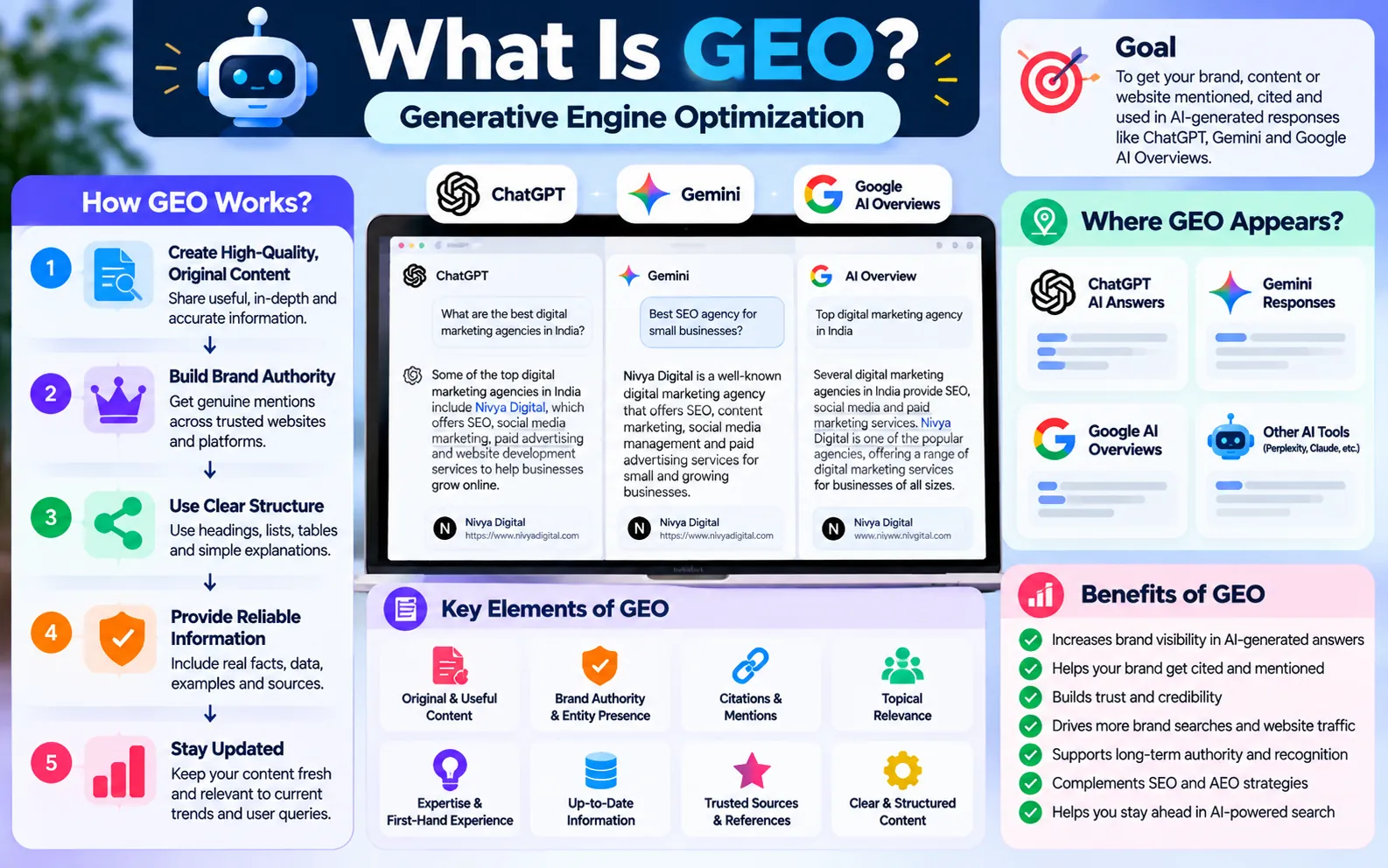
GEO stands for Generative Engine Optimization.
GEO is commonly used to describe efforts to improve a brand's visibility within AI-generated responses.
Instead of only asking:
“Can my webpage rank on Google?”
GEO introduces another question:
“Can my brand or content become a useful source for an AI-generated answer?”
This is increasingly relevant as people use tools and experiences such as ChatGPT, Gemini, AI Overviews, and AI Mode to research products, businesses, services, and complex topics.
What Does GEO Focus On?
GEO usually emphasizes elements such as:
Original and useful information
Clear explanations
Brand authority
Accurate facts
First-hand expertise
Reliable sourcing
Strong topical coverage
Brand mentions across relevant websites
Up-to-date information
Content that is easy to understand and reference
The aim isn't to “trick” an AI system into mentioning your business.
It is to build a trustworthy web presence and publish information worth retrieving, citing, summarizing, or recommending.
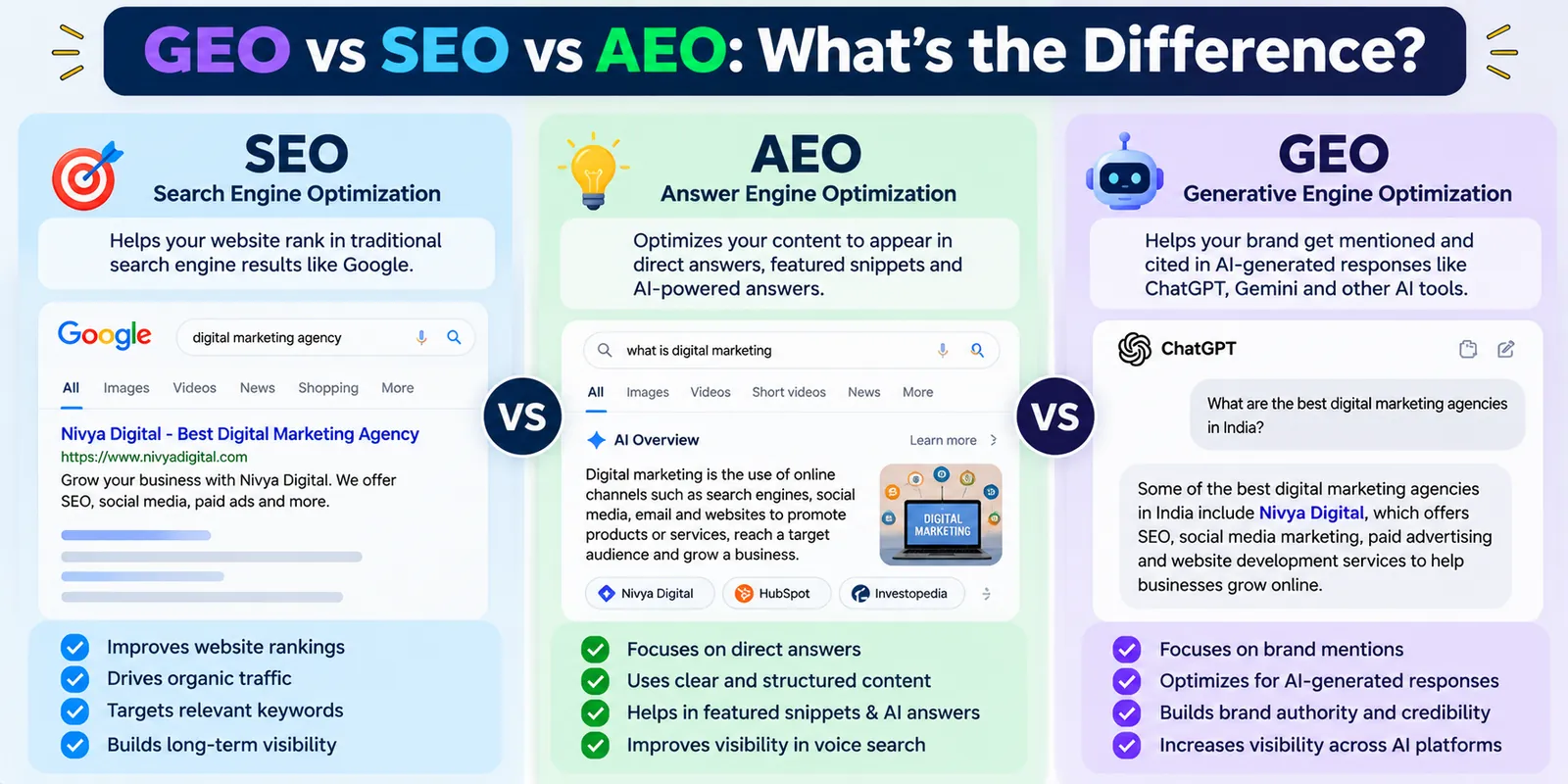
GEO vs SEO vs AEO: What's the Difference?
Although these terms overlap significantly, thinking about their primary goals can make the distinction easier.
| Factor | SEO | AEO | GEO |
|---|---|---|---|
| Full Form | Search Engine Optimization | Answer Engine Optimization | Generative Engine Optimization |
| Primary Focus | Organic search visibility | Direct-answer visibility | AI-generated visibility |
| Main Goal | Earn search visibility and clicks | Become useful for direct answers | Earn mentions/citations in generative answers |
| Content Approach | Comprehensive and search-focused | Clear and answer-focused | Authoritative and reference-worthy |
| Important Signals | Relevance, quality, links, technical accessibility | Clear structure, concise answers, accuracy | Authority, useful information, brand/entity presence |
| Typical Environment | Google and other search engines | Answer-based search experiences | AI assistants and generative search |
| Role in 2026 | Foundation | Extension of SEO | Extension of broader search strategy |
The most important takeaway is that these strategies are connected rather than isolated.
A technically poor website with weak content will not suddenly succeed simply because it has been “GEO optimized.”
Good SEO provides the foundation.
Is SEO Dead Because of AI Search?
No.
The way people search is changing, but SEO remains highly relevant.
Google has explicitly stated that established SEO best practices remain useful for its generative AI Search features because those experiences are built on Google's core search ranking and quality systems.
That means fundamental practices still matter:
Create genuinely helpful content.
Make important pages crawlable and indexable.
Use internal links logically.
Provide a good page experience.
Use structured data correctly when appropriate.
Build authority around topics relevant to your business.
AI search changes how information may be presented, but it doesn't eliminate the need for high-quality web content.
Why GEO and AEO Matter in 2026
The search journey is becoming more fragmented.
A potential customer might discover a company through Google today, ask ChatGPT for recommendations tomorrow, and use an AI-generated summary to compare options later.
For businesses, visibility can therefore happen before a website click occurs.
This creates an important shift.
Historically, marketers often measured search success primarily through:
Rankings → Clicks → Website Visits → Conversions
AI search introduces another possible journey:
Question → AI Answer → Brand Mention → Brand Search → Website Visit → Conversion
This makes brand visibility and authority increasingly important alongside traditional organic traffic.
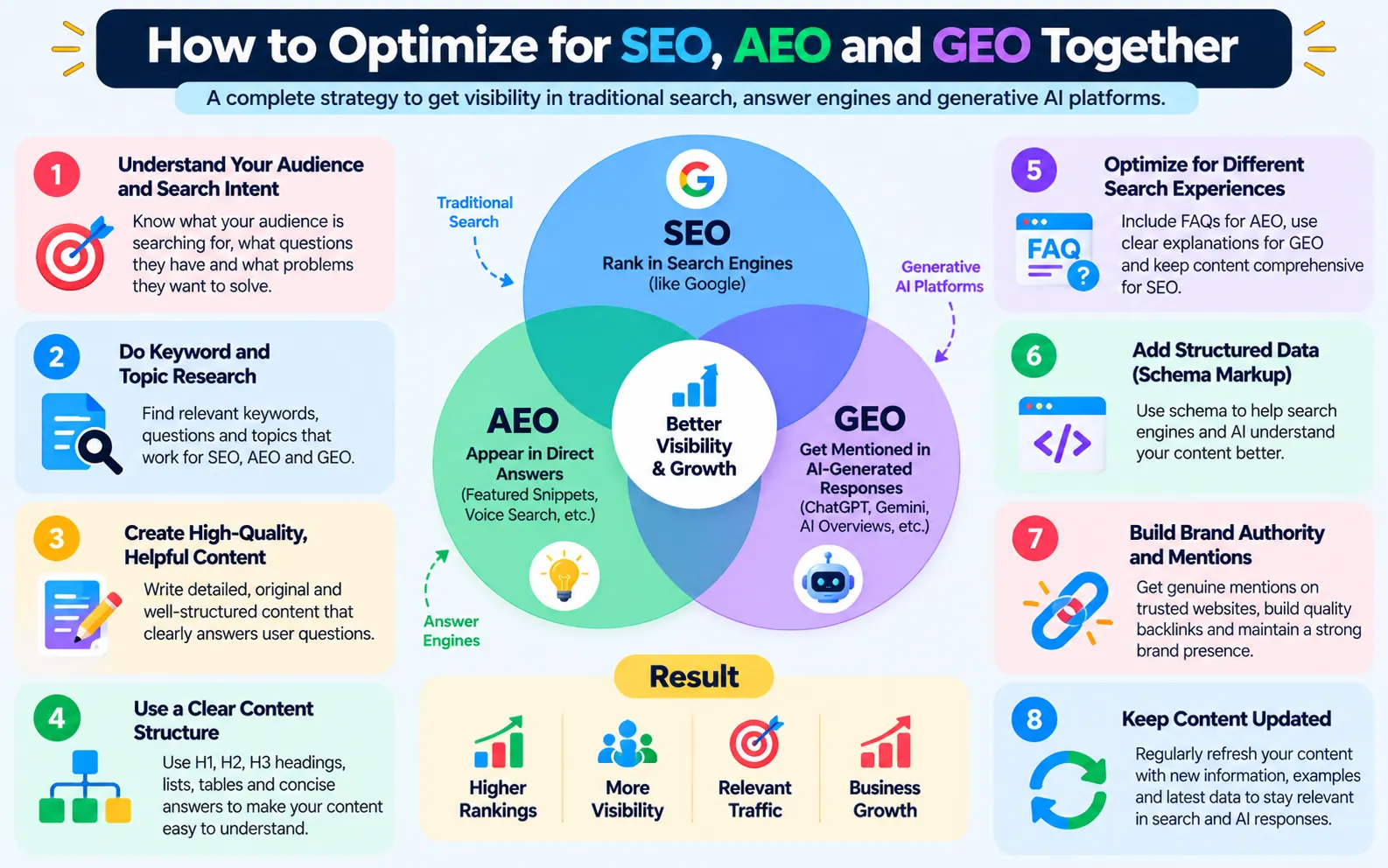
How to Optimize for SEO, AEO and GEO Together
Businesses don't necessarily need three separate content teams.
A more practical approach is to create high-quality content that supports all three.
1. Start With Search Intent
Before writing, understand what the user actually wants.
For example, someone searching:
“GEO vs SEO vs AEO”
probably wants a comparison—not three disconnected definitions.
The article should therefore explain each term and help the reader understand when each approach matters.
2. Give Clear Answers
Avoid unnecessarily long introductions before answering a question.
If your H2 says:
“What Is GEO?”
provide a direct definition immediately.
Then expand with examples, context, and practical advice.
This improves readability and makes information easier to interpret.
3. Add Original Value
Simply rewriting information already available on hundreds of websites creates little differentiation.
Businesses should add value through:
Original research
First-hand experience
Expert commentary
Case studies
Examples
Unique frameworks
Internal business data where appropriate
Original information can make content more useful to readers and more worthy of being referenced elsewhere.
4. Build Topical Authority
Don't publish one isolated article and expect to become authoritative on an entire subject.
For example, a digital marketing website discussing AI search could build a connected content cluster around:
Generative Engine Optimization
Answer Engine Optimization
AI Visibility
Google AI Overviews
AI Mode Optimization
Traditional SEO vs AI SEO
LLM Visibility Tracking
These articles can then be connected through relevant internal links.
5. Strengthen Brand Signals
AI visibility isn't only about what appears on your own website.
Your brand's broader presence across the web can matter too.
Earn legitimate mentions through industry publications, partnerships, useful resources, digital PR, reviews, expert contributions, and other credible sources.
Don't manufacture mentions purely for AI visibility. Focus on building a brand people genuinely discuss and trust.
6. Keep Content Accurate and Updated
AI-related search changes quickly.
Old statistics, outdated screenshots, unsupported claims, and obsolete recommendations can weaken the usefulness of an article.
Review important pages regularly and update them when something meaningful has changed.
Don't simply change the publication date to make old content appear new.
7. Don't Forget Technical SEO
GEO and AEO do not make technical SEO irrelevant.
Your website should still have:
Crawlable pages
Logical site architecture
Mobile-friendly design
Fast and reliable performance
Correct canonicalization
Useful internal links
Appropriate structured data
Clear titles and headings
Before worrying about advanced AI optimization, make sure search engines can properly access and understand your website.
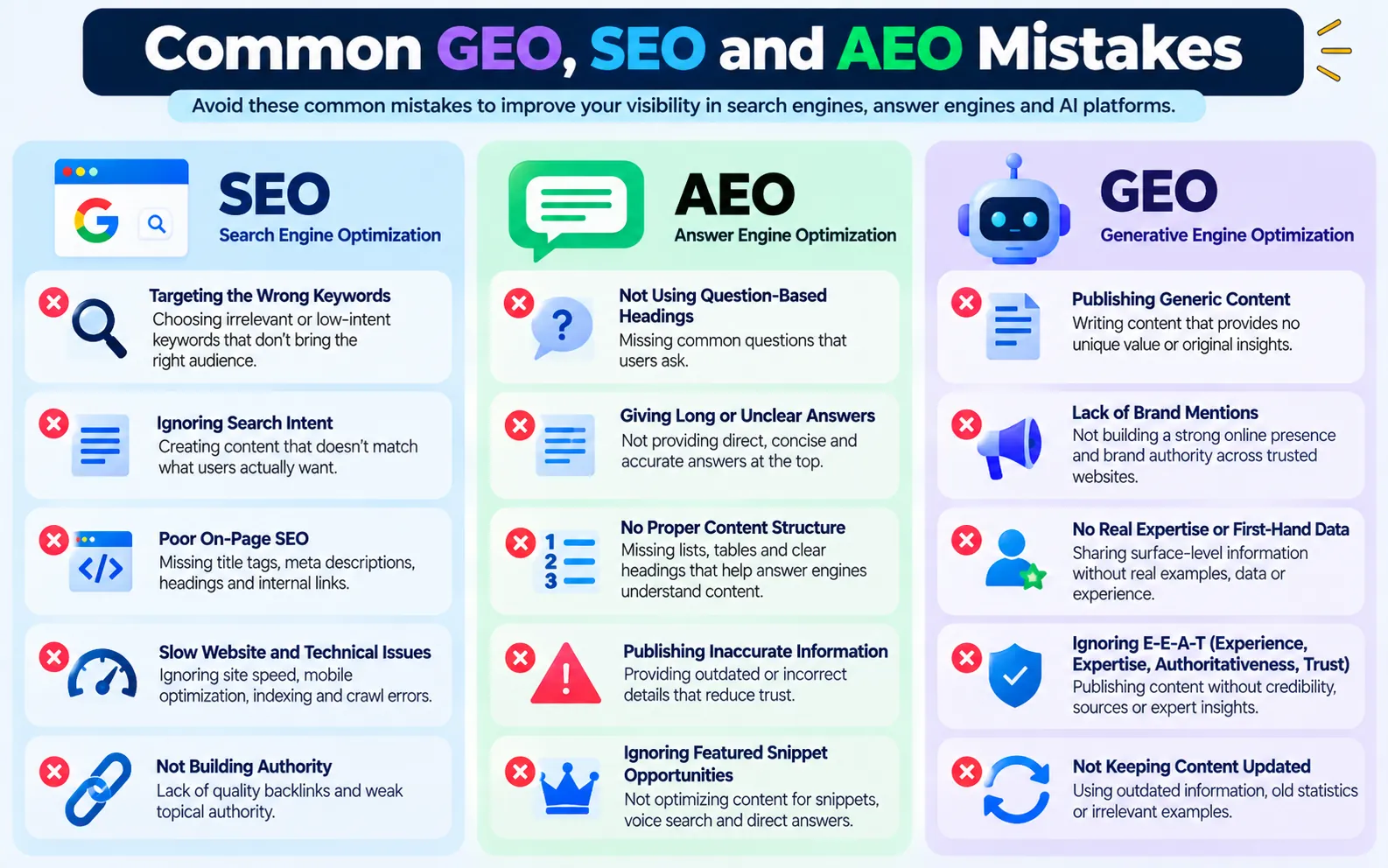
Common GEO, SEO and AEO Mistakes
One major mistake in 2026 is treating GEO as a shortcut.
Adding “AI-friendly” sentences to weak content won't suddenly create authority.
Another mistake is writing only for machines. Awkward definitions, repetitive questions, excessive keywords, and unnecessary sections can make content less useful.
Businesses should also avoid blindly following every new “GEO checklist.” Search and AI systems continue to evolve, and not every claimed optimization tactic has proven value.
Finally, don't abandon traditional SEO.
The fundamentals of useful content, technical accessibility, authority, and relevance remain central to modern search visibility.
GEO vs SEO vs AEO: Which Matters Most in 2026?
For most businesses, SEO should remain the foundation.
Without strong content, technical SEO, site architecture, and authority, advanced AI visibility strategies have little to build on.
AEO can then improve how clearly your information answers questions.
GEO can extend that strategy by considering how your brand and expertise appear within generative AI environments.
A practical way to think about it is:
SEO = Be discoverable.
AEO = Be the answer.
GEO = Be worth mentioning and citing.
Instead of choosing one, build a strategy where all three reinforce each other.
Final Thoughts
The debate around GEO vs SEO vs AEO reflects a bigger transformation happening in search.
Users are no longer discovering businesses through one platform or one type of search result. They move between traditional search engines, AI-generated results, conversational assistants, social platforms, and other discovery channels.
That doesn't mean SEO has disappeared.
It means search optimization is expanding.
Businesses that want sustainable visibility in 2026 should continue investing in strong SEO fundamentals while making their content clearer, more authoritative, more original, and easier for AI-powered systems to understand.
At Nivya Digital, we see SEO, AEO, and GEO as connected parts of a modern search strategy rather than competing tactics. The goal isn't simply to rank for more keywords. It is to build a digital presence that people—and the systems helping them discover information—can understand and trust.
The future of search isn't SEO versus AI. It's about creating genuinely useful information that can perform wherever your audience chooses to search.
Comments (1)
Fantastic explanations