
Every small business wants more customers. The difficult part is deciding where to spend its advertising budget.
Should you advertise on Google, where people are already searching for products and services? Or should you invest in Facebook and Instagram, where potential customers discover brands while scrolling?
This is why the Google Ads vs Meta Ads comparison matters so much in 2026.
Both advertising platforms can generate leads, sales, and brand awareness. However, they reach customers in different ways, and the results depend on your business type, target audience, budget, and campaign strategy.
For example, someone searching Google for “emergency plumber near me” probably needs a service immediately. Someone watching an Instagram Reel about home renovation may become interested in hiring a contractor later.
Both people could eventually become customers, but they are at different stages of the buying journey.
So, which advertising platform offers better lead quality, lower costs, and higher return on investment?
Let's compare Google Ads and Meta Ads using practical examples, published 2026 advertising benchmarks, and strategies that small businesses can actually use.
What Is Google Ads?
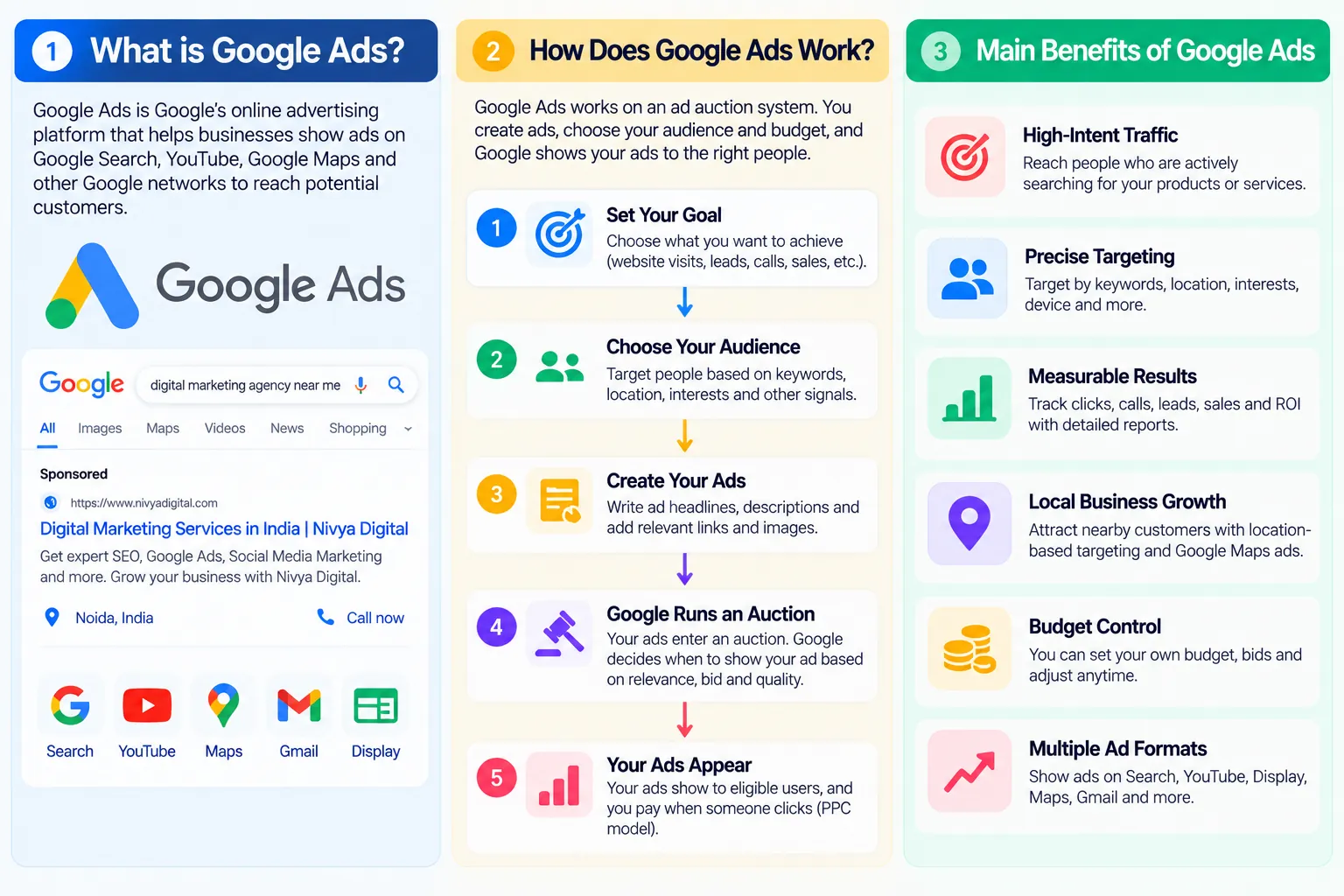
Google Ads is Google's online advertising platform that allows businesses to promote products and services across Google Search and other supported placements.
For small businesses, Search campaigns are particularly valuable because they can reach people who are actively looking for a solution.
Imagine you own a dental clinic in Delhi.
When someone searches for “dentist near me” or “teeth cleaning in Delhi,” a relevant Google Search ad may appear in the search results.
The person already has a specific requirement, making the interaction potentially valuable for your business.
How Does Google Ads Work?
Google Search advertising generally follows these steps:
A business selects relevant keywords and campaign goals.
It creates ads and chooses its targeting and budget.
Google determines when an ad is eligible to enter an auction.
Relevant ads may appear when users search for related products or services.
The advertiser pays according to the campaign's bidding and billing model.
Google Ads offers several campaign types, including Search, Shopping, Display, Video, Demand Gen, and Performance Max.
However, when comparing Google Ads with Meta Ads for lead generation, it is important to distinguish Google Search campaigns from Google's broader advertising ecosystem.
Main Benefits of Google Ads
High-intent search traffic: Search campaigns can reach people actively researching or looking to purchase a product or service.
Relevant keyword targeting: Businesses can focus on search terms related to their offerings.
Measurable performance: Advertisers can monitor conversions, calls, purchases, and other business actions when tracking is configured correctly.
Local business opportunities: Search ads can be useful for businesses targeting customers in specific cities or service areas.
Budget control: Businesses can set budgets and adjust bids, targeting, and campaign settings.
Limitations of Google Ads
Google Ads can become expensive in competitive industries.
Legal services, insurance, real estate, and some B2B services may face high costs per click.
A poorly structured campaign can also waste money on irrelevant searches.
Google Ads works best when advertisers pay attention to keyword intent, search terms, landing pages, and conversion quality.
What Are Meta Ads?
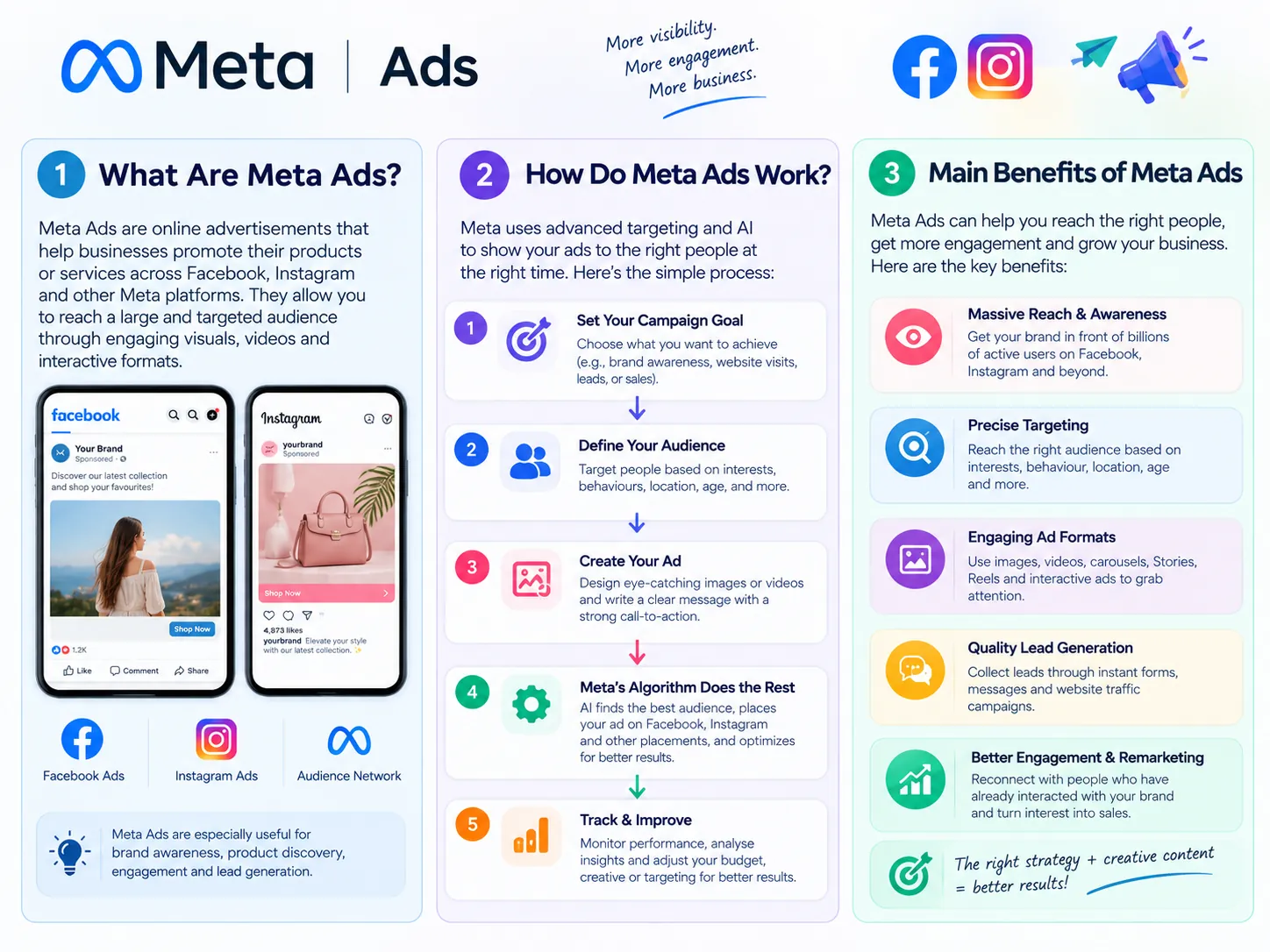
Meta Ads is the advertising system used to promote businesses across Facebook, Instagram, and other eligible Meta placements.
Unlike Google Search ads, which often respond to an existing search, Meta Ads can introduce products and services to people who were not actively looking for them.
For example, imagine a small clothing brand launching a new festive collection.
Potential customers may discover the collection through an Instagram Reel, carousel ad, or Facebook feed advertisement.
They might visit the website, explore the products, save the post, or make a purchase.
This discovery-driven experience makes Meta Ads useful for businesses with visually appealing products and services.
How Do Meta Ads Work?
Meta advertisers generally:
Select a campaign objective, such as awareness, traffic, leads, or sales.
Define campaign budgets and audience settings.
Create ad visuals, videos, and messaging.
Choose or allow eligible ad placements.
Monitor campaign performance and optimize based on results.
Meta uses its advertising delivery systems to find opportunities to achieve the selected campaign objective.
Businesses can also use lead forms, messaging experiences, and website conversion campaigns.
Main Benefits of Meta Ads
Visual storytelling: Images, videos, and Reels can demonstrate products and services.
Brand discovery: Businesses can introduce offers to people before they begin actively searching.
Flexible creative formats: Advertisers can test multiple visual concepts and messages.
Lead generation options: Instant forms and messaging can make it convenient for interested users to contact a business.
Remarketing opportunities: Businesses can reconnect with eligible audiences who previously interacted with their brand.
Limitations of Meta Ads
Not everyone who sees a Meta advertisement is ready to purchase.
A user may submit a lead form out of curiosity without being prepared to buy.
Campaign results also depend heavily on creative quality, audience relevance, and the offer.
That means a low cost per lead does not necessarily translate into profitable sales.
Google Ads vs Meta Ads: Key Differences in 2026
Although both platforms offer sophisticated advertising tools, their core strengths differ.
| Feature | Google Ads | Meta Ads |
|---|---|---|
| Main platforms | Google Search and other Google advertising placements | Facebook, Instagram, and eligible Meta placements |
| Primary strength | Capturing existing demand | Generating awareness and discovering potential customers |
| Common user behavior | Actively searching for information, products, or services | Browsing content and discovering brands |
| Targeting approach | Search intent, keywords, audiences, and other signals | Audience signals, engagement, and automated delivery |
| Popular formats | Search, Shopping, Display, Video, Performance Max | Image, video, carousel, Stories, Reels, lead ads |
| Lead generation | Calls, website forms, bookings, purchases | Instant forms, messages, website forms, purchases |
| Creative requirements | Search text and landing-page relevance are important | Visual content and messaging are especially important |
| Common challenge | Expensive competitive keywords | Inconsistent lead intent or quality |
| Suitable for | Search-driven services and existing demand | Visual products, brand discovery, and remarketing |
| Main success measure | Qualified leads, sales, acquisition cost, ROAS | Qualified leads, sales, acquisition cost, ROAS |
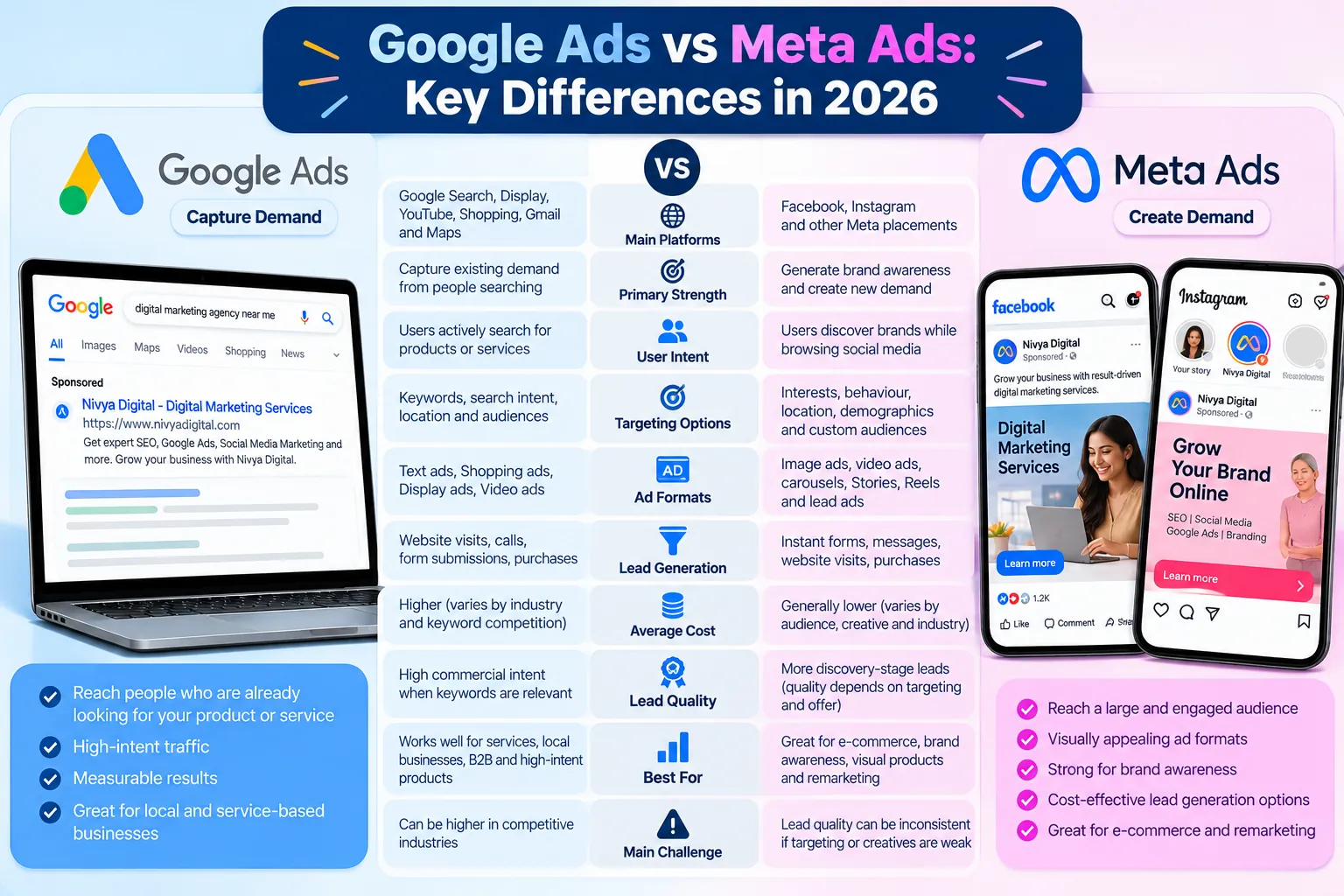
The biggest difference is customer intent.
Google Search Ads often help businesses capture demand that already exists. Meta Ads can help create interest before customers are ready to search.
Neither approach is automatically better.
The right platform depends on when and how your customers make buying decisions.
Google Ads vs Meta Ads Cost in 2026: Which Is Cheaper?
Advertising cost is usually the first concern for a small business owner.
However, there is no universal price for Google Ads or Meta Ads.
Costs vary according to industry, competition, location, targeting, bidding strategy, creative quality, and campaign objectives.
What Do the 2026 Benchmarks Show?
WordStream and LocaliQ published separate 2026 benchmark reports covering search advertising and Facebook advertising campaigns.
The following figures are from US-based campaign samples and are presented in US dollars.
| Metric | Google/Microsoft Search Ads Benchmark | Facebook Leads Campaign Benchmark |
|---|---|---|
| Average cost per click | $5.42 | $1.80 |
| Average conversion rate | 8.18% | 8.54% |
| Average cost per lead | $66.69 | $27.39 |
Sources: WordStream's Google Ads Benchmarks 2026 and Facebook Ads Benchmarks 2026.
These figures are not a direct, controlled comparison of identical advertisers. The reports use different campaign samples and measurement contexts, and the search report covers Google and Microsoft Ads.
They should be treated as broad reference points, not guaranteed costs or India-specific benchmarks.
Does a Lower Cost Per Lead Mean Better Performance?
Not necessarily.
Suppose a business generates 100 leads through Meta Ads and 40 leads through Google Ads.
At first glance, Meta appears more successful.
But what happens if only three Meta leads become paying customers while eight Google leads become customers?
Suddenly, the platform with fewer leads may deliver better business results.
This is why advertisers should compare more than CPC and CPL.
They should also evaluate lead quality, customer acquisition cost, revenue, and profitability.
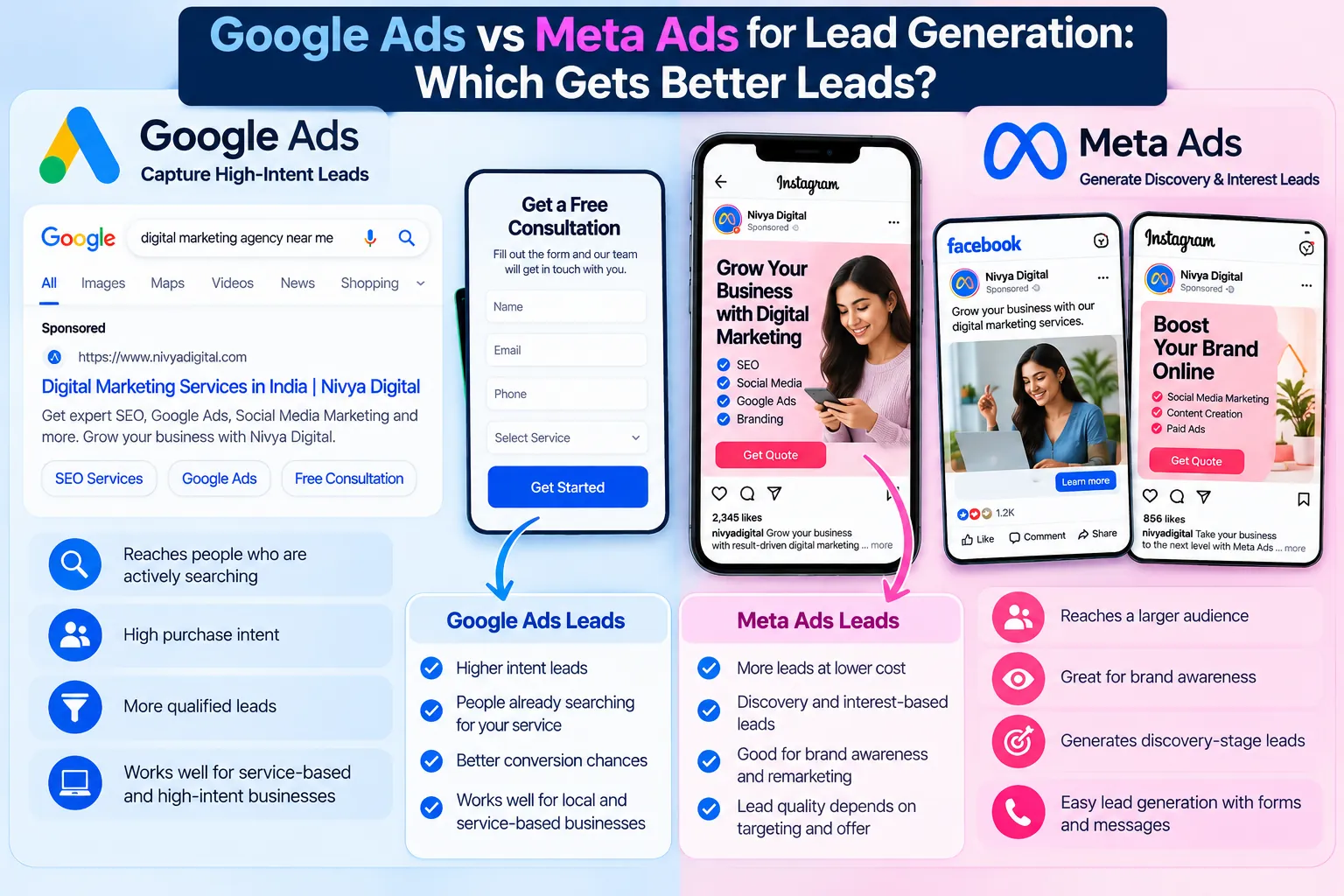
Google Ads vs Meta Ads for Lead Generation: Which Gets Better Leads?
Lead generation is not just about collecting phone numbers and email addresses.
A useful lead should have a genuine need, fit your service offering, and have a reasonable chance of becoming a customer.
Why Google Search Ads Can Attract High-Intent Leads
Google Search Ads can connect with people who are actively searching for a specific service.
Consider these searches:
“Best SEO agency for small business”
“Book a dentist appointment near me”
“Website development company in Noida”
“Emergency AC repair service”
These queries suggest an existing need.
A relevant ad can help the business appear when that need is being expressed.
However, not every Google click is high quality. Broad or poorly managed targeting can still attract irrelevant visitors.
Why Meta Ads Can Generate More Discovery-Stage Leads
Meta Ads can reach people who match a relevant audience or respond to a compelling creative.
For example, an online course provider may advertise a free webinar through Instagram.
People who register might be interested in learning more, but they may not be ready to purchase the full course.
Meta lead forms can make submitting information convenient, but businesses should qualify these leads before judging campaign success.
How to Improve Lead Quality on Both Platforms
For Google Ads, prioritize relevant search intent, suitable keyword match types, negative keywords where appropriate, and focused landing pages.
For Meta Ads, use clear offer details, useful qualifying questions, relevant creatives, and appropriate campaign optimization.
On both platforms, connect advertising results with actual sales outcomes.
The best lead is not always the cheapest lead. It is the lead most likely to become a profitable customer.
Google Ads vs Meta Ads ROI: Which Platform Generates More Profit?
Return on investment matters more than impressions, clicks, or form submissions alone.
A business could receive thousands of clicks and still lose money if those visitors do not convert into profitable customers.
Understanding ROI
A simplified marketing ROI calculation is:
ROI = [(Revenue Attributable to Advertising − Total Relevant Costs) ÷ Total Relevant Costs] × 100
For a more useful business-level calculation, include relevant costs such as advertising spend, agency fees, fulfillment, and other attributable expenses.
Another commonly used metric is return on ad spend.
ROAS = Revenue Attributed to Ads ÷ Advertising Spend
ROAS and ROI are not interchangeable.
ROAS measures advertising revenue relative to ad spend, while ROI considers profitability after the costs included in the calculation.
Example: Comparing Google Ads and Meta Ads
The following is a hypothetical example to demonstrate how lead quality changes campaign performance. It is not an actual client case study or industry benchmark.
| Metric | Google Ads | Meta Ads |
|---|---|---|
| Advertising spend | ₹20,000 | ₹20,000 |
| Leads generated | 40 | 100 |
| Cost per lead | ₹500 | ₹200 |
| Paying customers | 8 | 5 |
| Cost per acquired customer | ₹2,500 | ₹4,000 |
| Revenue per customer | ₹10,000 | ₹10,000 |
| Total attributed revenue | ₹80,000 | ₹50,000 |
| ROAS | 4.0× | 2.5× |
In this example, Meta Ads produces more leads at a lower CPL.
However, Google Ads generates more paying customers and a higher ROAS.
That does not mean Google Ads always wins.
A different business, offer, or audience could produce the opposite result.
The important lesson is to track how many leads become customers, not just how many people submit forms.
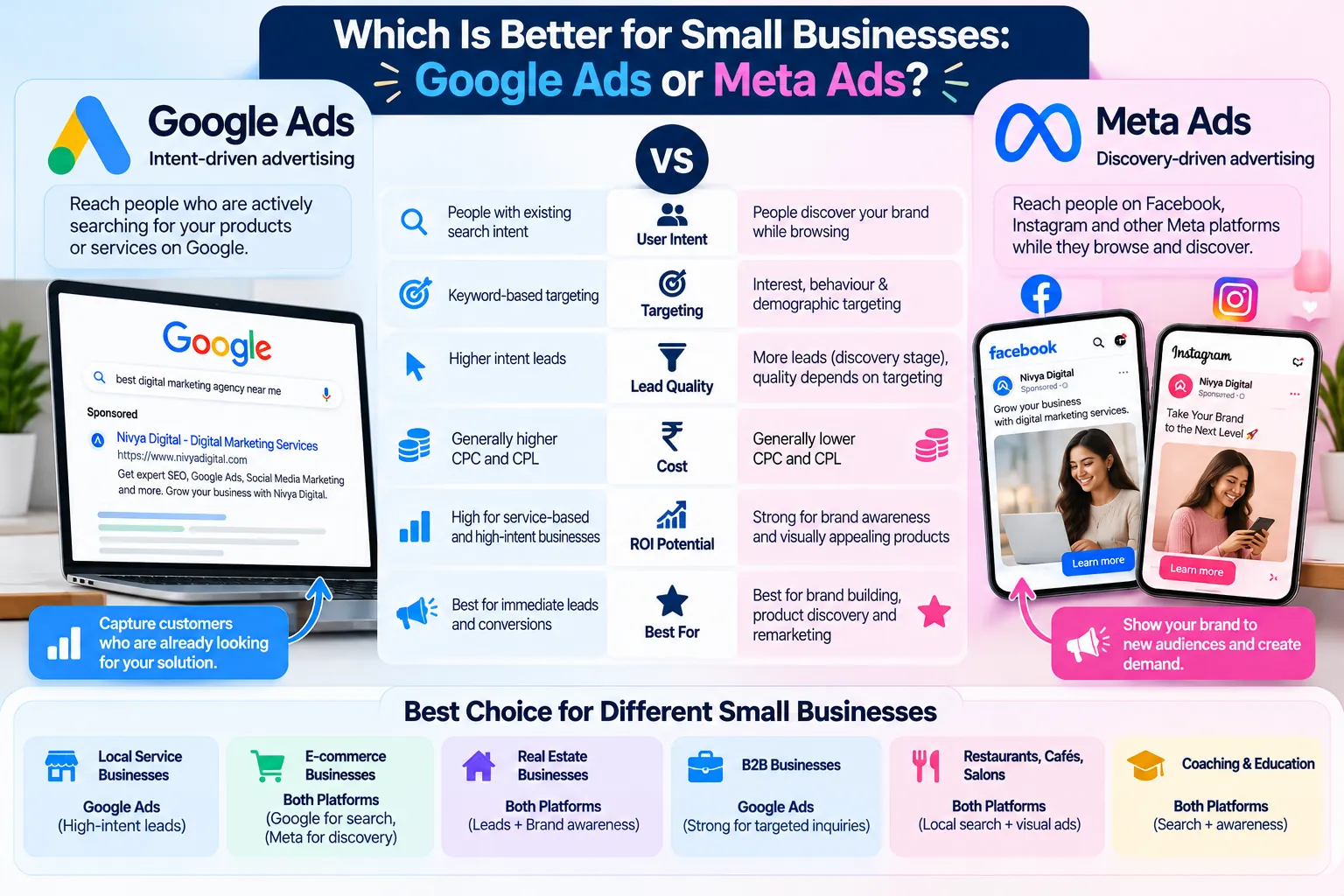
Which Is Better for Small Businesses: Google Ads or Meta Ads?
The answer becomes clearer when you consider your business model.
1. Local Service Businesses
Examples include electricians, plumbers, repair services, dental clinics, and local consultants.
Often worth testing first: Google Search Ads
Customers frequently search for these services when they need help.
A relevant search campaign can reach them close to the moment of need.
Meta Ads may still be useful for brand awareness, seasonal promotions, and remarketing.
2. E-commerce and Fashion Brands
Examples include clothing, jewelry, beauty products, and home decor.
Often worth testing: Meta Ads alongside Google Shopping or Search
Instagram and Facebook can help customers discover visually appealing products.
Google can reach shoppers who are already searching for specific products or brands.
The strongest combination depends on product margins, purchase frequency, and customer behavior.
3. Real Estate Businesses
Potentially useful: Both platforms
Google Search Ads can capture people searching for specific property locations, budgets, or project types.
Meta Ads can showcase property images, walkthrough videos, and project launches.
Lead qualification is especially important because property inquiries do not always translate into site visits or bookings.
4. B2B and Professional Services
Examples include software development, digital marketing, accounting, and IT services.
Often worth testing first: Google Search Ads
Search campaigns can reach businesses actively researching a solution.
Meta Ads can support awareness, educational content, and remarketing.
For longer B2B sales cycles, advertisers should track qualified opportunities and closed deals rather than form submissions alone.
5. Restaurants, Cafés, and Salons
Potentially useful: Both platforms
Google Ads can reach users searching for nearby services or places.
Meta Ads can promote attractive visuals, offers, new menus, and local awareness.
The right mix depends on whether the immediate goal is bookings, footfall, orders, or brand recognition.
6. Coaching and Education Businesses
Potentially useful: Both platforms
Google can reach users actively searching for courses and training programs.
Meta can promote webinars, trial classes, educational videos, and course launches.
Lead follow-up and qualification can strongly influence the final results.
Google Ads vs Meta Ads for Small Businesses in India
Indian small businesses often face an additional challenge: limited budgets combined with strong competition.
The best approach is not necessarily to advertise everywhere.
It is to identify where your most valuable customers are likely to respond.
For example, a local repair business may benefit from targeting specific high-intent Google searches.
A fashion startup may find more opportunities through Instagram videos and product-focused creative campaigns.
A B2B agency might use Google Search for service inquiries while using Meta for remarketing and educational content.
How Much Should a Small Business Spend on Ads?
There is no universal minimum budget that guarantees meaningful results.
Instead, estimate your testing budget using expected lead costs and the number of conversions you need to evaluate performance.
For example, if your estimated CPL is ₹500 and you want to test approximately 30 leads, the estimated media spend would be:
₹500 × 30 = ₹15,000
This is only a planning example.
Actual CPL may be higher or lower, and 30 leads may still be insufficient for a reliable conclusion if sales cycles are long or lead quality varies.
For small businesses, it is often more practical to test one focused campaign properly than divide a limited budget across too many campaigns.
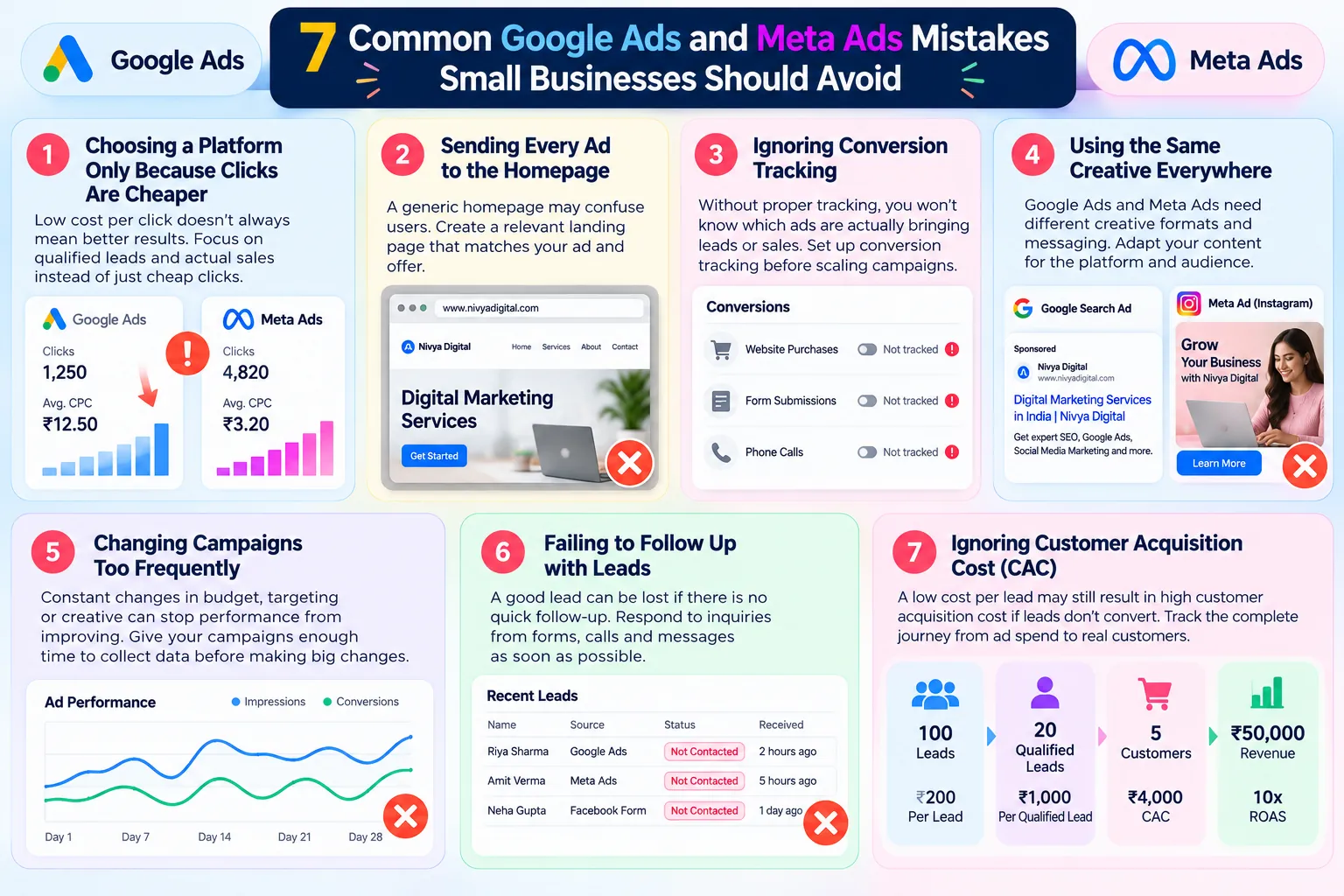
7 Common Google Ads and Meta Ads Mistakes Small Businesses Should Avoid
1. Choosing a Platform Only Because Clicks Are Cheaper
Cheap clicks do not guarantee customers.
A campaign should be evaluated according to qualified leads, purchases, or another meaningful business outcome.
2. Sending Every Ad to the Homepage
A generic homepage may not answer the specific question that motivated a user to click.
A focused landing page should match the advertisement and explain the offer clearly.
3. Ignoring Conversion Tracking
Without reliable tracking, businesses may optimize for clicks instead of actual results.
Set up appropriate conversion events and test them before increasing spending.
4. Using the Same Creative Everywhere
A search advertisement and an Instagram Reel serve different browsing experiences.
Adapt your message and format to the platform while keeping your offer consistent.
5. Changing Campaigns Too Frequently
Constantly changing budgets, targeting, or creative can make performance difficult to interpret.
Allow enough time and data for a useful comparison, while still addressing obvious problems promptly.
6. Failing to Follow Up with Leads
A qualified lead can lose interest if nobody responds.
Businesses should establish a clear follow-up process for inquiries received through forms, calls, and messages.
7. Ignoring Customer Acquisition Cost
A low CPL may hide poor lead-to-customer conversion rates.
Track the complete journey from advertising spend to customer acquisition and revenue.
How to Choose Between Google Ads and Meta Ads: A Practical Checklist
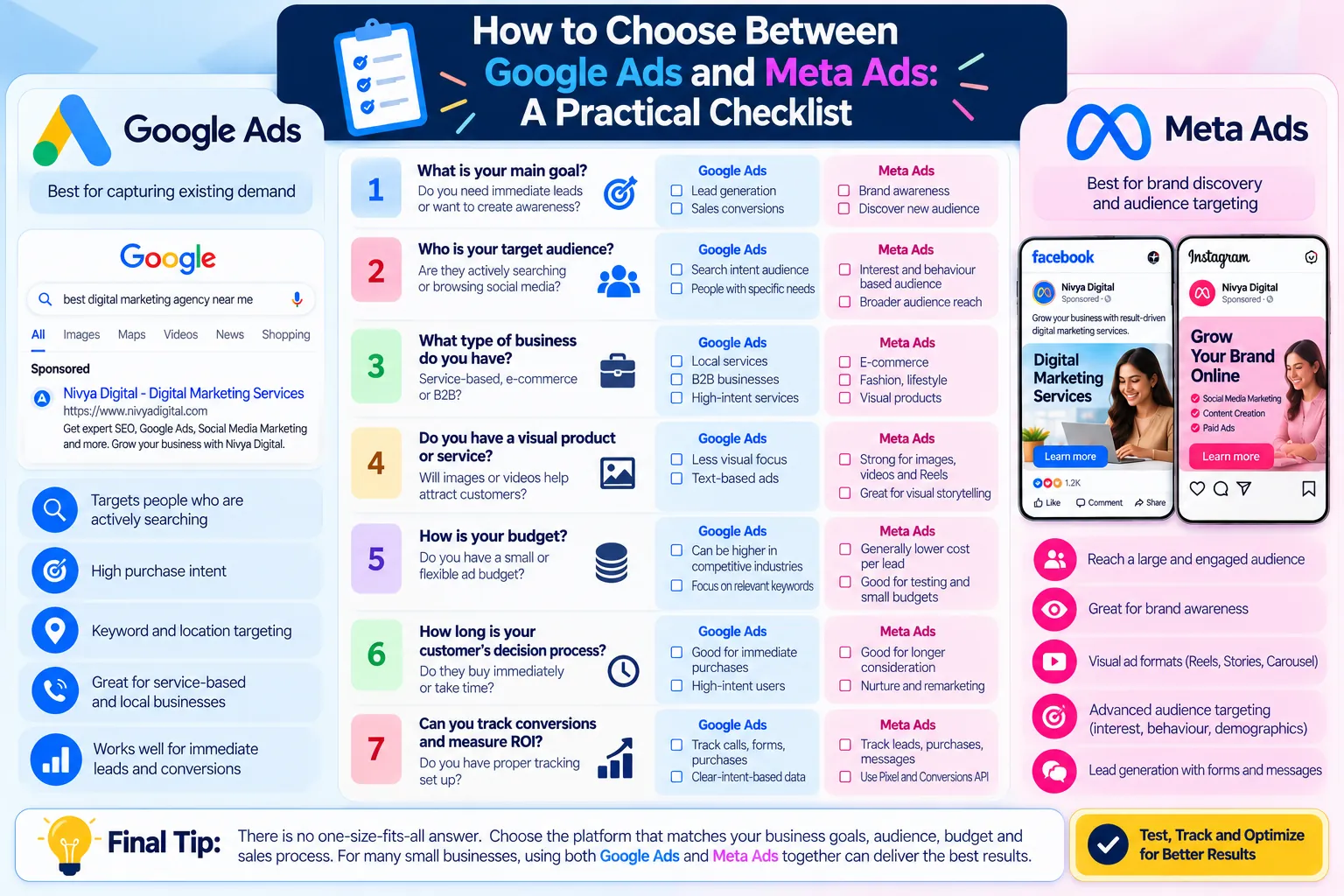
Before launching a campaign, answer the following questions.
What is your primary goal?
If you need inquiries from people actively looking for your service, Google Search Ads may be a suitable starting point.
If you want to introduce a product to new audiences, Meta Ads may be worth testing.
Is your product visually appealing?
Products that benefit from demonstrations, lifestyle images, or short videos may perform well in social advertising.
How long does your customer take to decide?
Urgent services and considered purchases require different advertising approaches.
What is your profit margin?
Your allowable customer acquisition cost should reflect how much profit each customer can generate.
Can you measure actual results?
If you cannot track conversions and sales outcomes, you may struggle to identify which platform is genuinely working.
Can Google Ads and Meta Ads Work Together?
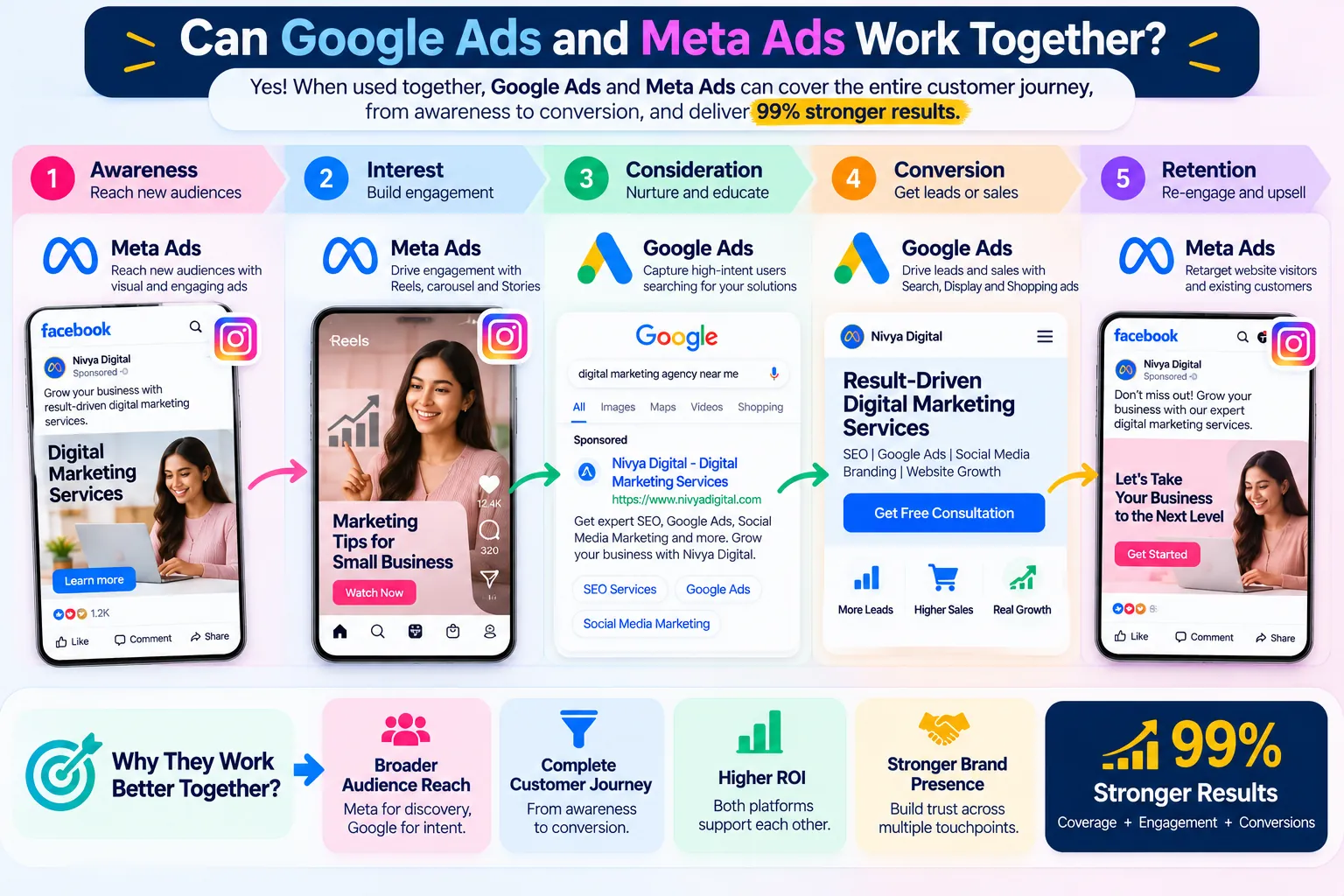
Yes. For many businesses, the platforms can complement each other.
Consider a small furniture brand.
A potential customer first discovers the brand through an Instagram advertisement.
They explore a few products but do not purchase.
Later, they search Google for the brand or a specific furniture category.
A relevant Search or Shopping ad may help them return and complete the purchase.
In this situation, Meta contributed to discovery while Google helped capture later demand.
The customer journey may involve several interactions, so attribution should be interpreted carefully.
A Simple Combined Advertising Strategy
Stage 1: Awareness
Use relevant Meta creative campaigns to introduce the brand or offer.
Stage 2: Consideration
Help interested users learn about products, services, benefits, and differentiators.
Stage 3: Conversion
Use suitable Google Search campaigns to capture existing search demand.
Stage 4: Remarketing
Reconnect with eligible previous visitors or engaged users using relevant messages.
Stage 5: Measurement
Compare qualified leads, customer acquisition costs, sales, and revenue across campaigns.
This framework is not mandatory for every business.
Smaller advertisers may achieve better results by mastering one platform before expanding to the other.
How AI Is Changing Google Ads and Meta Ads in 2026
Both platforms increasingly use AI-driven systems for bidding, audience discovery, creative support, and campaign delivery.
Google offers automated bidding and campaign solutions designed to help advertisers reach conversion goals.
Meta also uses automation to optimize advertising delivery and assist with campaign setup.
These systems can be useful, but automation does not eliminate the need for a clear business strategy.
Advertisers still need to provide accurate conversion signals, useful creative assets, realistic budgets, and relevant offers.
Poor tracking or weak messaging can limit performance even when campaigns use advanced automation.
For small businesses, the priority should be to improve the quality of the information and objectives supplied to the advertising platforms.
Final Verdict: Google Ads vs Meta Ads — Which Is Better in 2026?
There is no single winner for every business.
Choose Google Search Ads when:
Customers are actively searching for your products or services.
Your business depends on specific service inquiries.
You want to test keywords with clear commercial intent.
You can support clicks with relevant landing pages and follow-up.
Choose Meta Ads when:
Your product benefits from visual demonstrations.
You want to introduce your brand to new audiences.
Your offer can generate interest through videos or creative storytelling.
You want to test discovery-driven campaigns or relevant remarketing.
Consider both when:
You have enough budget to test each platform meaningfully.
Your customer journey includes both discovery and active research.
You can measure qualified leads and sales outcomes across channels.
Ultimately, the better platform is the one that helps your business acquire profitable customers at a sustainable cost.
Do not choose Google Ads only because search traffic can have high intent.
Do not choose Meta Ads only because some benchmarks show cheaper leads.
Choose based on your customers, your economics, and your actual campaign results.
Grow Your Business with Nivya Digital
Choosing between Google Ads and Meta Ads is only the beginning.
A successful advertising strategy also requires relevant targeting, compelling messaging, strong landing pages, accurate conversion tracking, and continuous optimization.
At Nivya Digital, we help businesses develop digital marketing strategies aligned with their goals.
Whether you want to improve lead generation, promote your products, or strengthen your online presence, the right advertising approach starts with understanding your audience and measuring what matters.
Explore our digital marketing services: https://nivyadigital.com
References and Further Reading
Google Ads — Search Advertising: https://business.google.com/in/ad-solutions/search/
Google Ads Help — About Keywords: https://support.google.com/google-ads/answer/1704371
Meta Blueprint — Audience Targeting and Lead Generation: https://metaspark.facebookblueprint.com/student/catalog/list?category_ids=7506-your-guide-to-audience-targeting
WordStream — Google Ads Benchmarks 2026: https://www.wordstream.com/blog/2026-google-ads-benchmarks
WordStream — Facebook Ads Benchmarks 2026: https://www.wordstream.com/blog/facebook-ads-benchmarks-2026
Editorial note: Benchmark figures refer to the cited US campaign samples, not guaranteed results for Indian advertisers. The ROI comparison is hypothetical and is included for educational purposes.
Comments (1)
An informative and practical guide for small businesses comparing Google Ads and Meta Ads in 2026. It explains how search intent, audience targeting, lead quality, advertising costs, and conversion tracking influence campaign performance and ROI. A useful resource for businesses looking to choose the right advertising strategy, generate qualified leads, and make better use of their marketing budget.