
Google Search is evolving beyond traditional search results. With artificial intelligence becoming part of how people research products, compare services, and make purchasing decisions, Google is introducing new advertising experiences within AI-powered search.
Google AI Mode Ads are an emerging opportunity for advertisers to reach potential customers during conversational searches. Instead of relying only on traditional keyword-based results, these advertising experiences can consider a user's broader question and the context of an AI-generated response.
At Google Marketing Live 2026, Google introduced new advertising formats powered by Gemini, including Conversational Discovery ads and Highlighted Answers. These formats aim to help businesses connect with people while they explore their options.
But how do Google AI Mode Ads work? Can advertisers create dedicated campaigns? And what should businesses do to prepare?
This guide from Nivya Digital explains the latest developments, potential benefits, limitations, and practical advertising strategies for 2026.
What Are Google AI Mode Ads?
Google AI Mode Ads are sponsored advertising experiences designed to appear within Google's conversational AI search environment.
AI Mode allows users to ask complex questions, explore recommendations, and continue conversations with follow-up queries.
For example, someone searching for the best laptop for graphic design might ask:
“Which laptop is suitable for professional design work, has good battery life, and costs under ₹90,000?”
Google's AI-powered experience can help the user compare options. Where eligible advertising opportunities are available, relevant sponsored content may appear alongside the response.
Unlike a traditional search ad that primarily responds to an individual search query, these experiences can use broader conversational context to present relevant information.
However, AI Mode advertising is still evolving, and not every announced format is generally available to advertisers.
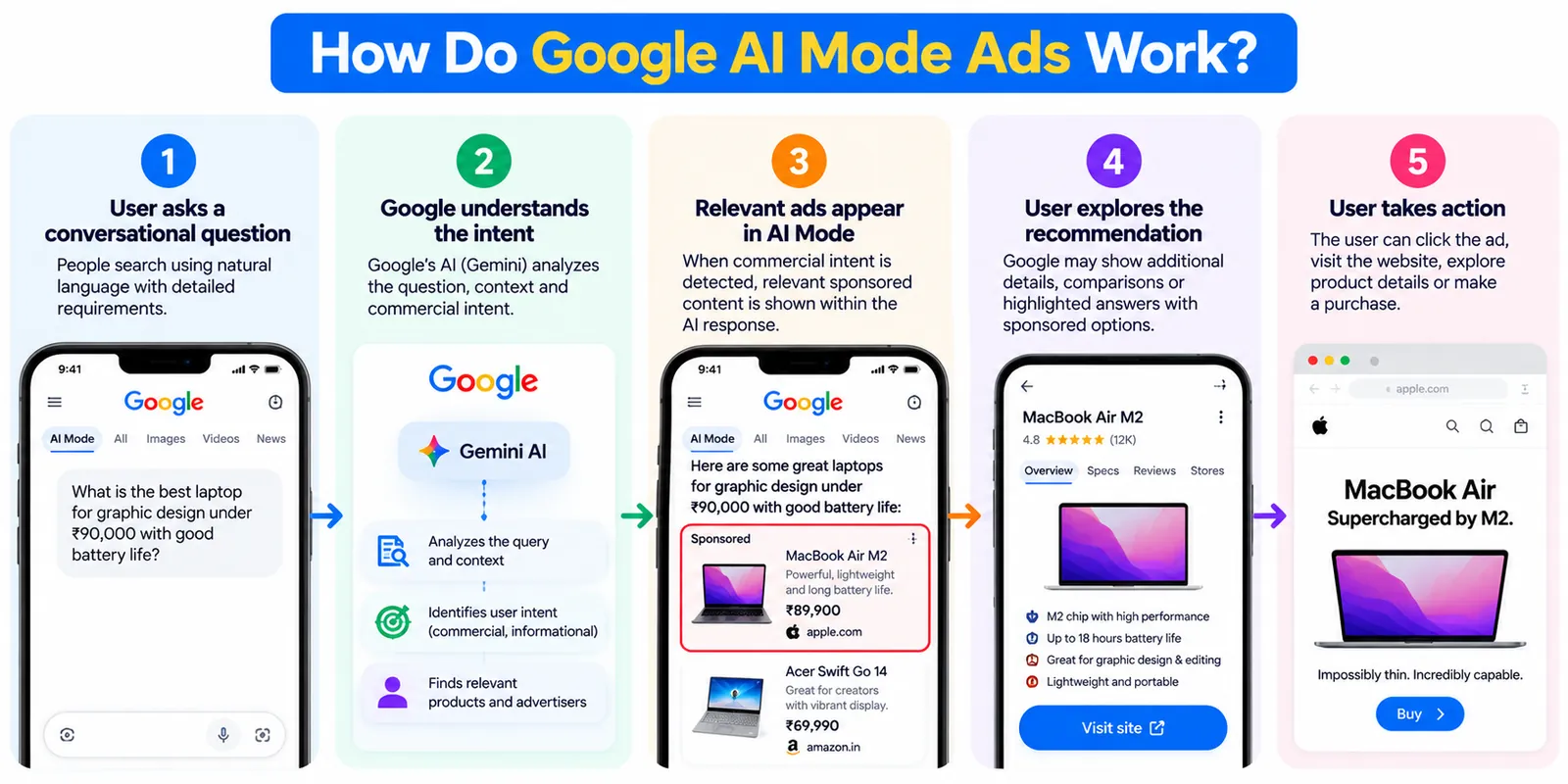
How Do Google AI Mode Ads Work?
Google is developing AI-powered advertising experiences that connect user intent, advertiser information, and Gemini-generated explanations.
1. Users Ask Conversational Questions
People can describe their needs in natural language instead of searching with short keywords.
For example:
“What is the best digital marketing solution for a small business with a limited budget?”
This gives Google additional context about the user's requirements.
2. Google Interprets Search Intent
Google's AI systems analyze the question and available context to understand what the user is trying to accomplish.
When commercial intent is present, eligible advertisements may be considered.
3. Relevant Sponsored Content Appears
Google is testing formats that combine advertiser creative with AI-generated explanations.
These advertisements are intended to remain clearly identifiable as sponsored content.
4. Users Explore or Take Action
Depending on the format, users may visit an advertiser's website, explore product details, evaluate an offer, or interact with a lead-generation experience.
The goal is to connect relevant businesses with customers during research and decision-making.
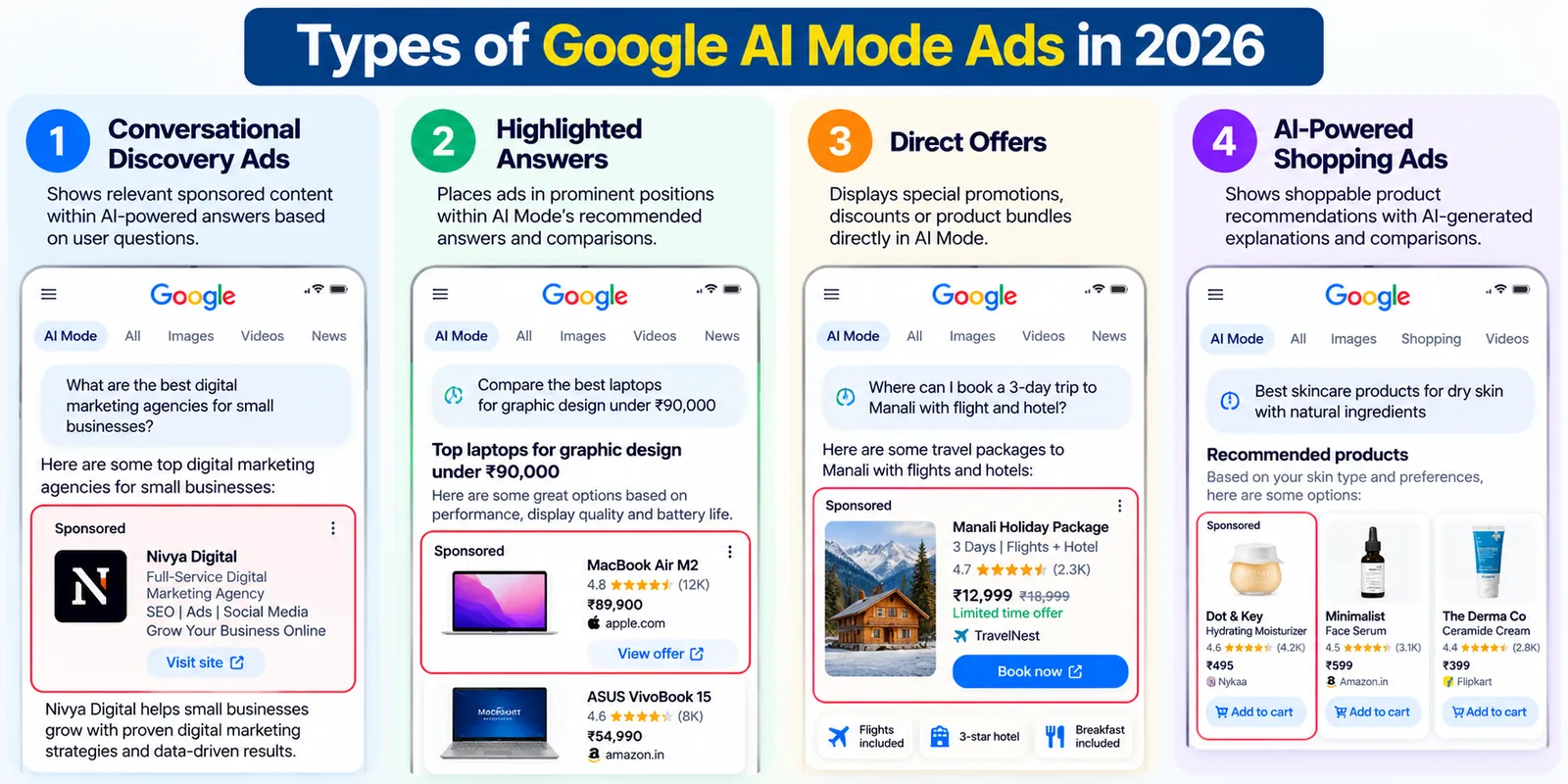
Types of Google AI Mode Ads in 2026
Google has announced several AI-powered advertising formats, although availability differs by product and testing stage.
1. Conversational Discovery Ads
Conversational Discovery ads are designed to address a user's specific question.
Google uses Gemini to help generate contextually relevant creative and supporting explanations based on the advertiser's information.
For example, someone researching home fragrance products might receive a sponsored recommendation that explains why a particular product matches their preferences.
These formats are being tested rather than offered as a universally available standalone campaign type.
2. Highlighted Answers
Highlighted Answers are designed for situations where AI Mode presents a list of recommendations.
Highly relevant advertisements may become eligible for prominent placement within that recommendation experience.
For example, a person comparing language-learning applications might encounter a sponsored option relevant to their requirements.
Google has described this as an experimental advertising format.
3. Direct Offers
Direct Offers allow eligible businesses to present relevant promotions during AI-assisted shopping journeys.
Google has discussed expanding this initiative to include additional promotional options, such as product bundles and special offers.
In October 2026, industry reporting also identified a beta Direct Offer asset appearing in some Google Ads accounts.
This does not mean every advertiser currently has access.
4. AI-Powered Shopping Ads
Google is also introducing Shopping experiences that use Gemini to explain why a product may fit a customer's needs.
These formats can help users understand product features during comparison and research.
Advertisers should distinguish these Shopping developments from standard AI Mode text advertising.
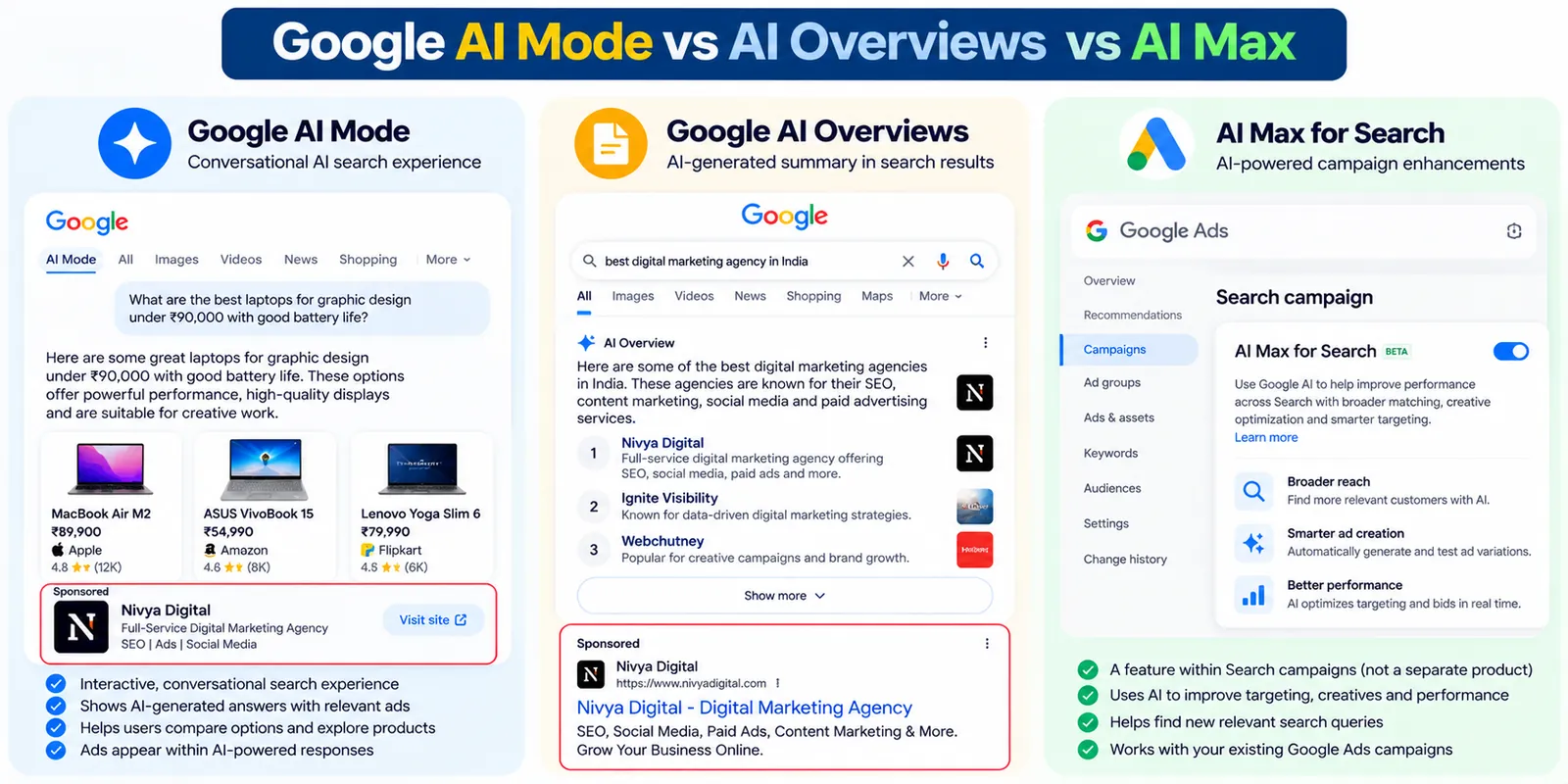
Google AI Mode vs AI Overviews vs AI Max
These terms sound similar but represent different Google products or capabilities.
| Feature | Google AI Mode | Google AI Overviews | AI Max for Search |
|---|---|---|---|
| Main purpose | Conversational AI search | AI summaries within Search | AI-powered Search campaign enhancements |
| User experience | Interactive questions and follow-ups | Summary alongside search results | Existing Google Ads campaign workflow |
| Advertising | Emerging and experimental placements | Eligible ads above, below, or within summaries | Helps improve targeting and creative |
| Separate campaign type | No | No | No; enabled within eligible Search campaigns |
| Primary audience | Search users | Search users | Advertisers |
Important: Enabling AI Max does not give advertisers a separate switch to select AI Mode placements.
AI Max for Search is a collection of campaign enhancements, while AI Mode is a user-facing search experience.
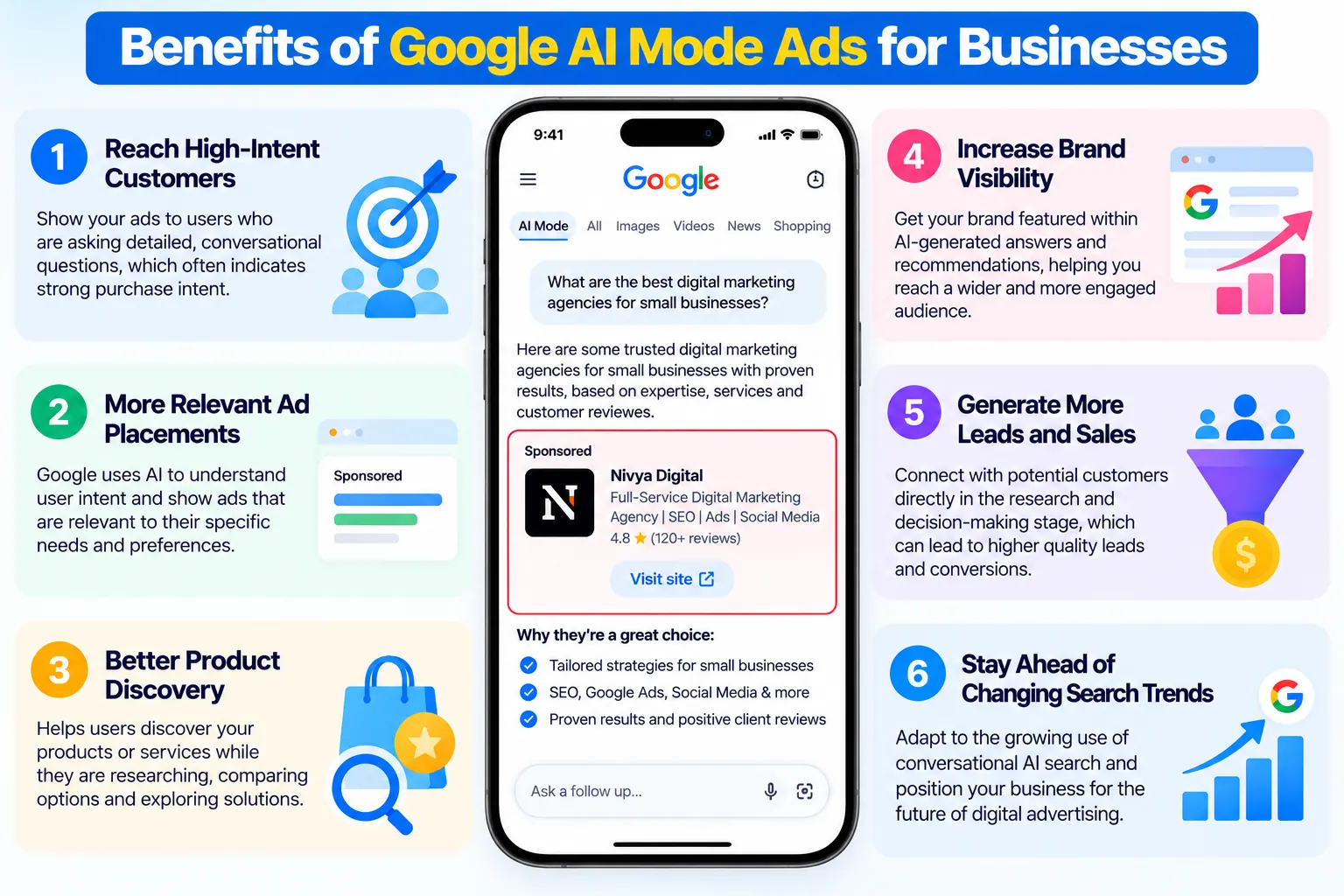
Benefits of Google AI Mode Ads for Businesses
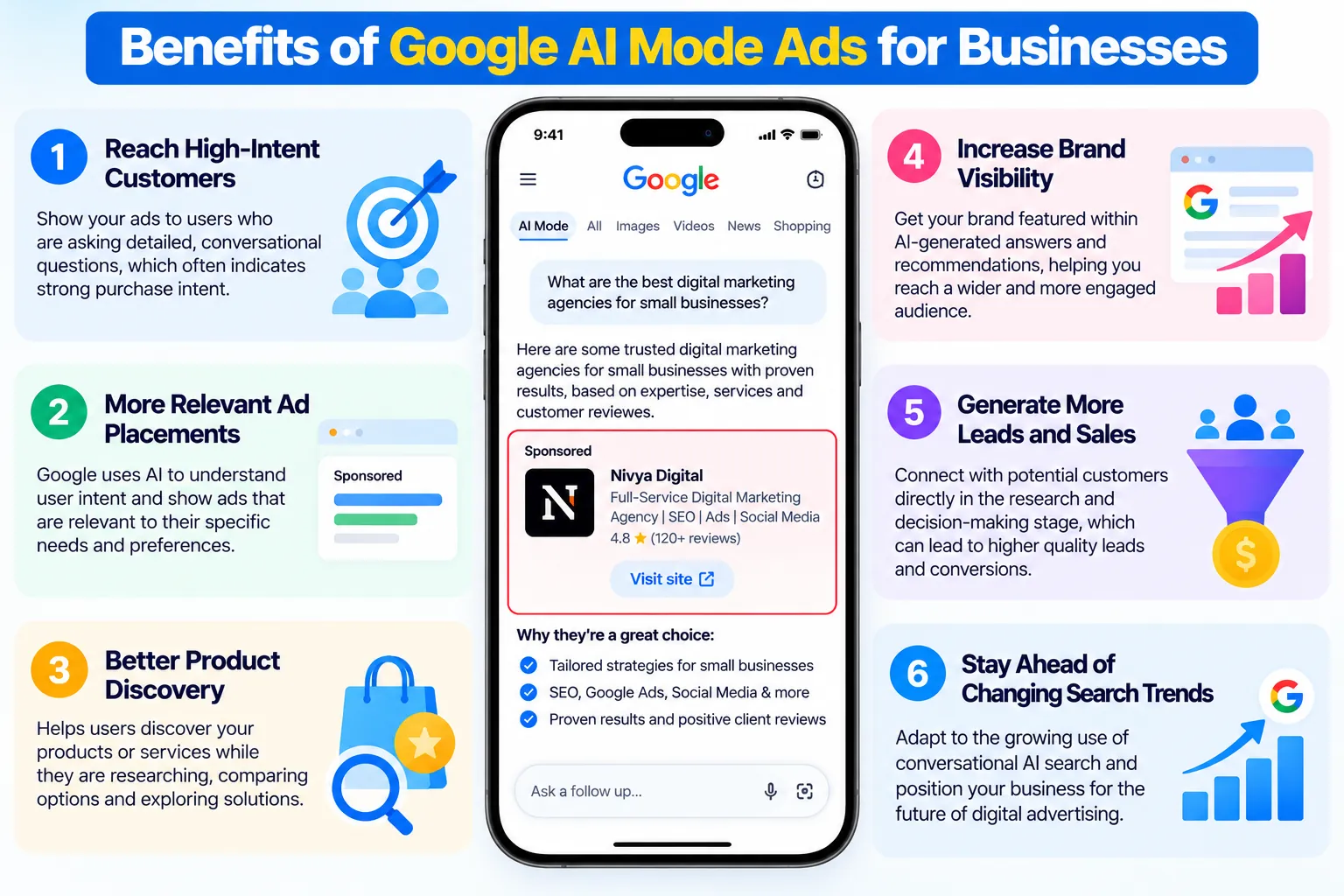
Reach Customers During Product Research
Conversational searches often reveal detailed preferences, problems, and requirements.
Relevant advertisements may help businesses reach people while they compare options, rather than only when they search for a specific product name.
Improve Advertising Relevance
AI-powered systems can use additional context to better understand a searcher's needs.
This creates opportunities for more relevant advertising messages, although results depend on campaign quality and eligibility.
Support Product Discovery
Businesses offering products or services that require research may benefit from advertising experiences that provide additional explanations.
For example, a software provider could help customers understand how its product addresses a particular business problem.
Create More Opportunities for Leads
Google has also introduced Business Agent for Leads, a Gemini-powered conversational experience designed to help potential customers get answers and connect with businesses.
Such features may eventually complement conventional lead forms and website enquiries.
Adapt to Changing Search Behaviour
As people use more conversational search experiences, advertisers need to understand how their customers discover products and services.
Preparing campaigns for AI-powered search can support a broader digital marketing strategy.
How to Prepare Your Google Ads Campaigns for AI Mode
There is currently no universal standalone AI Mode campaign setup. However, advertisers can strengthen their existing campaigns.
Step 1: Review Your Search Campaigns
Start by evaluating your current Search campaigns.
Check whether your targeting, ads, landing pages, and conversion tracking align with your business objectives.
Avoid making major changes simply because a new advertising format has been announced.
Step 2: Explore AI Max for Search
AI Max provides AI-powered targeting and creative capabilities within eligible Search campaigns.
Businesses can assess whether these enhancements are suitable for their advertising goals.
Review available controls and test changes carefully before expanding them across campaigns.
Step 3: Improve Landing Page Quality
Create landing pages that clearly explain your products or services.
Include accurate pricing information where appropriate, relevant features, customer support details, and clear calls to action.
A strong landing page supports both customer understanding and advertising performance.
Step 4: Use Accurate Product and Business Information
For ecommerce advertisers, maintain reliable product information and relevant Merchant Center data.
For service businesses, keep descriptions, offers, and contact details current.
Avoid misleading claims or outdated promotional information.
Step 5: Strengthen Conversion Tracking
Make sure important actions are measured correctly.
Depending on your business, these may include purchases, qualified leads, phone calls, or consultation bookings.
Reliable conversion data helps advertisers evaluate campaign performance and make informed optimization decisions.
Step 6: Monitor Performance Before Scaling
Compare campaign results before and after significant changes.
Review conversion volume, cost per acquisition, return on ad spend, and lead quality.
Do not assume that every performance improvement or decline is caused by AI Mode placements.
Can Advertisers Track Google AI Mode Ads Separately?
Measurement is one of the biggest challenges with emerging AI advertising placements.
As of October 2026, Google Ads does not provide a universal dedicated AI Mode campaign type or comprehensive placement-level reporting for all AI Mode ad impressions.
This means advertisers may not be able to isolate every AI Mode ad interaction from their broader campaign performance.
Businesses should continue monitoring established Google Ads metrics while following Google's announcements about future reporting capabilities.
Avoid claiming that a campaign generated a specific number of AI Mode conversions unless the available reporting supports that conclusion.
Challenges Advertisers Should Consider
Limited Access to Experimental Formats
Some newly announced features are available only through testing programs or selected accounts.
Businesses should verify availability rather than assuming every new feature can be activated immediately.
Reduced Placement Transparency
Advertisers may have limited visibility into exactly where certain AI-powered advertisements appeared.
This makes careful performance analysis especially important.
AI-Generated Messaging
AI-powered creative can help adapt advertising messages, but businesses must still maintain accurate product information and responsible advertising claims.
Changing Advertising Experiences
Google continues to develop AI-powered Search products.
Campaign strategies that work today may require adjustments as new formats, controls, and reporting features become available.
Best Practices for Google AI Mode Advertising in 2026
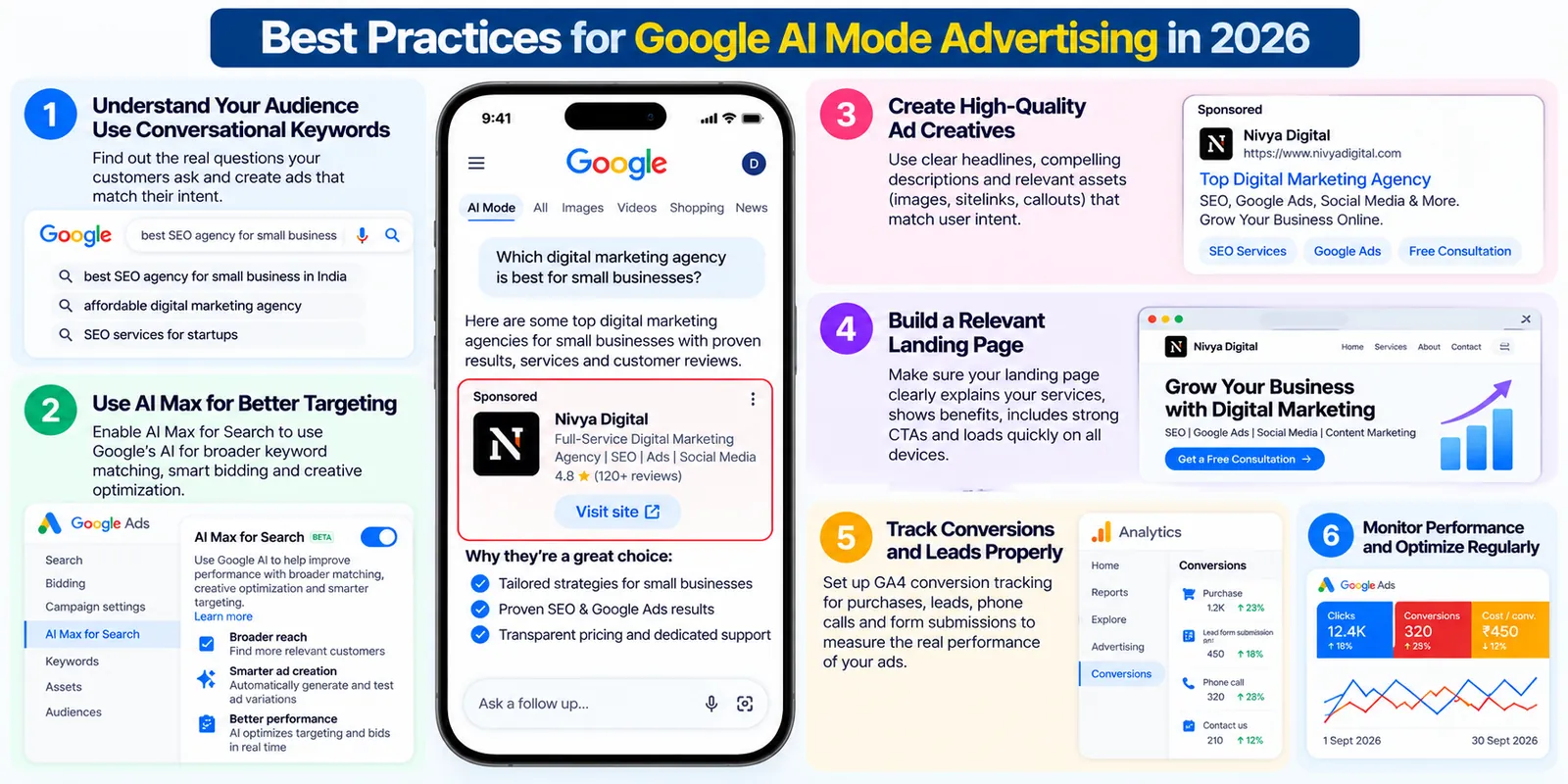
Advertisers should focus on sustainable practices instead of attempting to force placements within AI-generated answers.
Prioritize user intent: Understand the questions customers ask before purchasing.
Maintain strong campaign fundamentals: Use relevant advertising messages, clear landing pages, and accurate conversion tracking.
Test AI-powered features carefully: Evaluate AI Max and other eligible enhancements against measurable business goals.
Keep product information updated: Ensure advertisements accurately represent current products, services, and offers.
Monitor official announcements: Review new format availability, restrictions, and measurement capabilities before making changes.
The strongest approach is to combine reliable advertising fundamentals with informed experimentation.
The Future of Google AI Mode Ads
Google's 2026 announcements indicate a growing focus on conversational advertising, AI-assisted product discovery, and more personalized shopping experiences.
Formats such as Conversational Discovery ads, Highlighted Answers, and Direct Offers suggest that advertising may become more closely integrated with how users research and compare options.
However, the future performance, availability, and adoption of these formats remain uncertain.
Businesses should prepare for new opportunities without assuming that AI-powered advertising will automatically outperform traditional Search campaigns.
Final Thoughts
Google AI Mode Ads in 2026 represent an important development in search advertising.
Google is experimenting with ways to connect businesses and customers through conversational questions, relevant sponsored recommendations, and AI-generated explanations.
For advertisers, the priority should be understanding these changes, maintaining high-quality campaigns, and testing new features when they become available.
At Nivya Digital, we help businesses understand evolving digital marketing trends and develop strategies focused on meaningful performance.
As AI-powered search continues to develop, combining strong Google Ads fundamentals with accurate measurement and thoughtful experimentation will remain essential for sustainable growth.
Comments (0)
No comments yet
Start the discussion by sharing your perspective