
Choosing the right SEO agency can be one of the most important marketing decisions for your business. Whether you operate a small business in the United States, an ecommerce store in the United Kingdom, a startup in India, or a growing company serving international customers, your website needs to reach the right audience.
However, hiring an SEO agency is not simply about finding someone who promises higher Google rankings.
A reliable SEO partner should understand your business goals, identify opportunities to improve search visibility, address technical website issues, create useful content, and help you measure meaningful business results.
With traditional search results, AI-powered search experiences, and changing customer expectations shaping digital marketing in 2026, businesses need to evaluate SEO providers carefully.
In this guide, you will learn how to hire an SEO agency, which 12 questions to ask, what warning signs to avoid, and how to choose a partner that fits your business and budget.
What Does an SEO Agency Actually Do?
An SEO agency helps businesses improve their websites' visibility in organic search results.
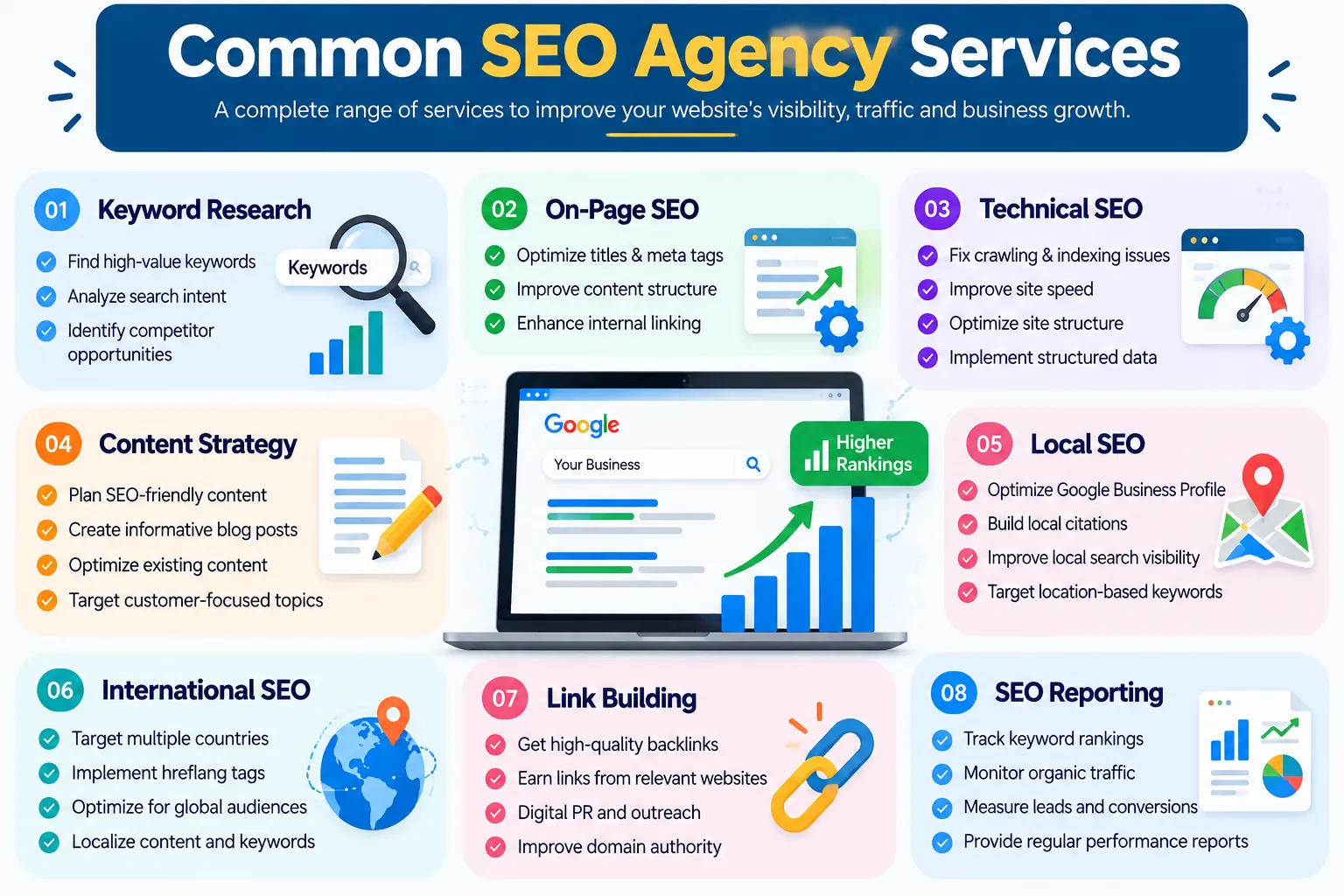
Depending on the business, an agency's work may include keyword research, technical optimization, content strategy, on-page SEO, website improvements, local SEO, international SEO, and performance reporting.
Common SEO Agency Services
| SEO Service | What It Includes | Business Benefit |
|---|---|---|
| Keyword Research | Identifying relevant search terms and user intent | Reaching potential customers |
| On-Page SEO | Improving titles, headings, content, and internal links | Better page relevance |
| Technical SEO | Addressing crawling, indexing, site speed, and structural issues | Improved website accessibility |
| Content Strategy | Planning useful service pages and articles | Building topical relevance |
| Local SEO | Improving local search visibility where eligible | Reaching nearby customers |
| International SEO | Supporting different countries, languages, and regions | Reaching overseas markets |
| SEO Reporting | Tracking search performance and conversions | Measuring progress |
Not every business needs every service immediately. A good agency should prioritize work based on your website's current condition, competition, and business objectives.
Why Hiring the Right SEO Agency Matters in 2026
Search engine optimization is no longer just about placing keywords into articles.
Businesses need websites that are technically accessible, useful to visitors, easy to navigate, and aligned with what their customers are searching for.
AI-powered search experiences have also introduced additional questions about how businesses present clear, reliable, and discoverable information online.
However, AI search optimization should not replace the fundamentals of SEO.
A dependable SEO agency should combine established optimization practices with thoughtful evaluation of emerging search experiences.
For example, an ecommerce business may need category-page optimization and technical improvements, while a B2B service company may benefit more from commercial landing pages, detailed service content, and lead conversion tracking.
The best SEO strategy depends on the business—not on a universal package.
12 Questions to Ask Before Hiring an SEO Agency
Before signing an agreement, schedule a discovery call and ask these questions.
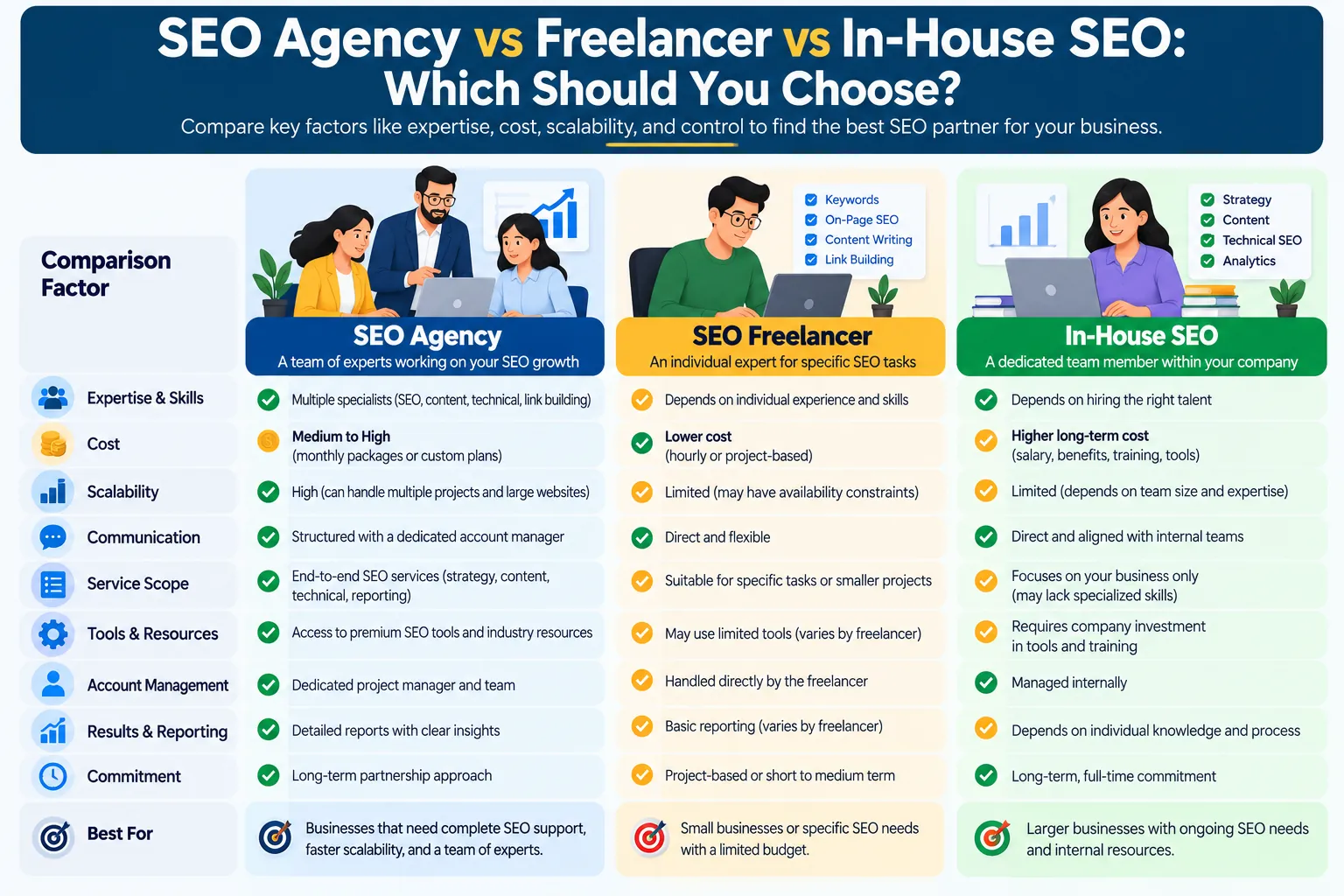
1. What Experience Do You Have With Businesses Like Mine?
Industry experience can be useful because different businesses have different customer journeys.
A local service provider, SaaS company, ecommerce brand, and professional consultancy may require different approaches to keyword research and conversion optimization.
Ask the agency:
Have you worked with similar business models?
What SEO challenges have you handled?
Can you explain how you would approach my industry?
Can you share relevant, verifiable examples?
An agency without direct experience in your niche may still be a good fit if it demonstrates strong research skills and a thoughtful approach.
2. How Will You Understand My Business Goals?
SEO should support business objectives rather than exist as an isolated marketing activity.
For example, your priority might be generating consultation bookings, increasing product sales, reaching international buyers, or improving visibility for high-value services.
A capable agency should ask about your ideal customers, geographic markets, competitors, sales process, and existing marketing performance.
What to look for: An agency that discusses business outcomes before proposing keywords or deliverables.
3. How Do You Conduct Keyword Research?
Effective keyword research involves more than choosing terms with high estimated search volumes.
An agency should consider:
Search intent
Geographic relevance
Keyword competition
Business value
Existing website authority
The type of pages already ranking
Potential conversion opportunities
For example, a business targeting customers in the USA may need different keyword priorities from a company focused on India.
A high-volume informational keyword may attract readers, while a lower-volume service keyword could bring visitors who are closer to making a purchase.
Ask how the agency balances traffic potential with commercial relevance.
4. What Is Your Technical SEO Process?
Technical SEO helps search engines access and understand website content.
Ask whether the agency evaluates crawling and indexing, redirects, canonical tags, mobile usability, site performance, internal linking, structured data, and XML sitemaps.
The agency should explain which issues matter most and why.
Not every warning reported by an SEO tool is a critical problem. A reliable provider should prioritize genuine issues instead of presenting a long automated audit as a complete strategy.
5. How Will You Improve My Website Content?
High-quality SEO content should answer real customer questions and support relevant search intent.
Ask how the agency researches topics, checks factual accuracy, incorporates business expertise, and improves existing pages.
For example, a business offering WordPress development may benefit from articles explaining website development costs, platform comparisons, redesign decisions, and hiring considerations.
These topics can support relevant service pages and help potential customers make informed decisions.
Avoid agencies that promise to publish large quantities of generic articles without discussing content quality or business relevance.
6. Do You Follow Google's Search Guidelines?
This is one of the most important questions when choosing an SEO agency.
Ask whether the agency follows Google Search Essentials and can explain its approach to content, links, and technical optimization.
Be cautious about promises involving guaranteed first-place rankings, secret ranking methods, or paid arrangements supposedly offering special access to Google's organic results.
Google explicitly warns that no SEO provider can guarantee a number-one ranking.
A trustworthy agency should be comfortable explaining its methods and the reasoning behind its recommendations.
7. How Do You Approach AI SEO and AI Search Visibility?
In 2026, businesses may also want to understand how their content appears in AI-powered search experiences.
Ask the agency how it approaches clear website structure, reliable information, useful content, brand consistency, and search performance measurement.
You can also ask whether it uses AI tools for research, analysis, or workflow support—and how it verifies AI-generated outputs.
Be careful with agencies that guarantee inclusion in AI-generated answers or claim access to a secret AI ranking formula.
AI-related services should be evaluated against established search guidance and the actual needs of your business.
8. How Do You Build Backlinks and Improve Website Authority?
Relevant links from trustworthy websites can help people discover a business and may contribute to its search presence.
Ask the agency how it earns links and promotes content.
Potential approaches include useful original resources, digital PR, industry relationships, and relevant editorial contributions.
Avoid providers that rely on mass link exchanges, automated link networks, or unexplained bulk backlink packages.
A sustainable strategy should prioritize relevance and editorial value over impressive-looking link counts.
9. How Will You Measure SEO Success?
An agency should explain how it measures progress before work begins.
Common SEO metrics include organic clicks, search impressions, rankings for relevant queries, engagement, conversions, and qualified inquiries.
For businesses selling services, leads and sales opportunities may matter more than total website traffic.
For ecommerce companies, organic revenue and conversion performance may be particularly important.
Ask whether the agency uses Google Search Console, Google Analytics 4, and appropriate conversion tracking.
A useful SEO report should explain what changed, why it matters, and what happens next.
10. What Results Can I Realistically Expect, and When?
SEO usually requires ongoing work, testing, and evaluation.
The timeline depends on factors such as website history, competition, technical issues, available resources, and the scope of improvements.
Some changes may become visible relatively quickly, while meaningful progress in competitive markets can take considerably longer.
An experienced agency should explain realistic milestones without guaranteeing rankings, traffic, or sales.
Ask for a proposed first 90-day plan and how the agency will evaluate early progress.
11. What Is Included in Your SEO Pricing?
Before comparing agencies, understand what each proposal actually includes.
Ask whether the price covers:
Initial SEO audit
Keyword and competitor research
On-page optimization
Technical recommendations or implementation
Content planning and writing
Reporting and meetings
Outreach or digital PR
Additional development work
Clarify whether content production, website changes, and third-party software subscriptions cost extra.
A lower-priced proposal is not automatically better if it excludes the work your website needs.
12. Who Will Manage My Project, and How Will We Communicate?
Communication matters, particularly when hiring an SEO agency in another country.
Ask who your main contact will be, how frequently progress will be discussed, and which communication channels will be used.
For international projects, confirm working hours, meeting availability, reporting language, and turnaround expectations.
You should also know who owns the website content, analytics accounts, and other business assets.
A professional arrangement should provide transparency, clearly defined responsibilities, and appropriate account access.
SEO Agency vs Freelancer vs In-House SEO: Which Should You Choose?
Businesses can approach SEO in several ways.
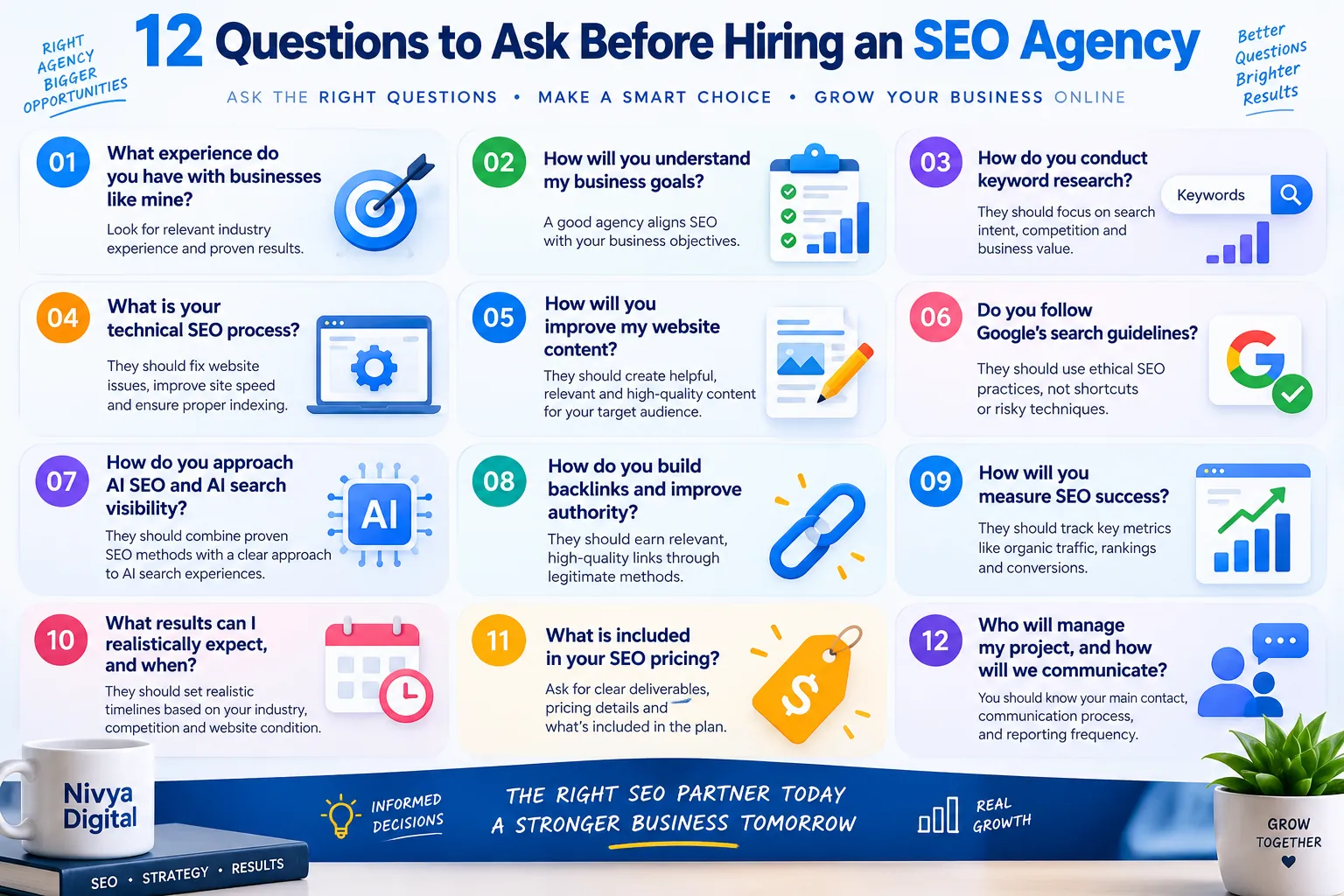
| Factor | SEO Agency | SEO Freelancer | In-House SEO |
|---|---|---|---|
| Expertise | May offer multiple specialists | Depends on individual skills | Depends on team experience |
| Scalability | Often suitable for multiple workstreams | Depends on availability | Requires hiring and resources |
| Communication | Usually structured through an account contact | Often direct | Direct internal collaboration |
| Cost structure | Service agreement or project fee | Hourly or project fee | Salary and operating costs |
| Best fit | Businesses needing coordinated SEO support | Businesses with focused requirements | Businesses needing continuous internal ownership |
An agency may be suitable when a business needs coordinated technical SEO, content strategy, reporting, and ongoing optimization.
A freelancer can be effective for a defined project or specialized task.
An in-house professional may be preferable when SEO requires close daily coordination across several departments.
The right choice depends on budget, complexity, internal resources, and long-term objectives.
How to Hire an SEO Agency for International SEO
Businesses targeting multiple countries should ask additional questions.
A company serving customers in India, the United States, the United Kingdom, Canada, Australia, or the UAE may face differences in customer terminology, buying behavior, competition, and local expectations.
An international SEO strategy may include country-specific keyword research, regionally relevant content, appropriate URL structure, and language or regional targeting where necessary.
Key International SEO Considerations
Country-specific keyword research: Evaluate relevant searches in each target market rather than assuming one keyword strategy will work everywhere.
Localized content: Adapt examples, terminology, currencies, and customer information when relevant.
Technical setup: Review whether regional page versions need separate URLs and appropriate hreflang annotations.
Conversion experience: Make it easy for overseas customers to contact your business and understand service availability.
Performance measurement: Review organic visibility and conversions separately for each priority country.
An SEO agency does not necessarily need a physical office in every country it serves. What matters is whether it can demonstrate a credible strategy, clear communication, and the ability to support the target audience.
7 Red Flags to Avoid When Choosing an SEO Agency
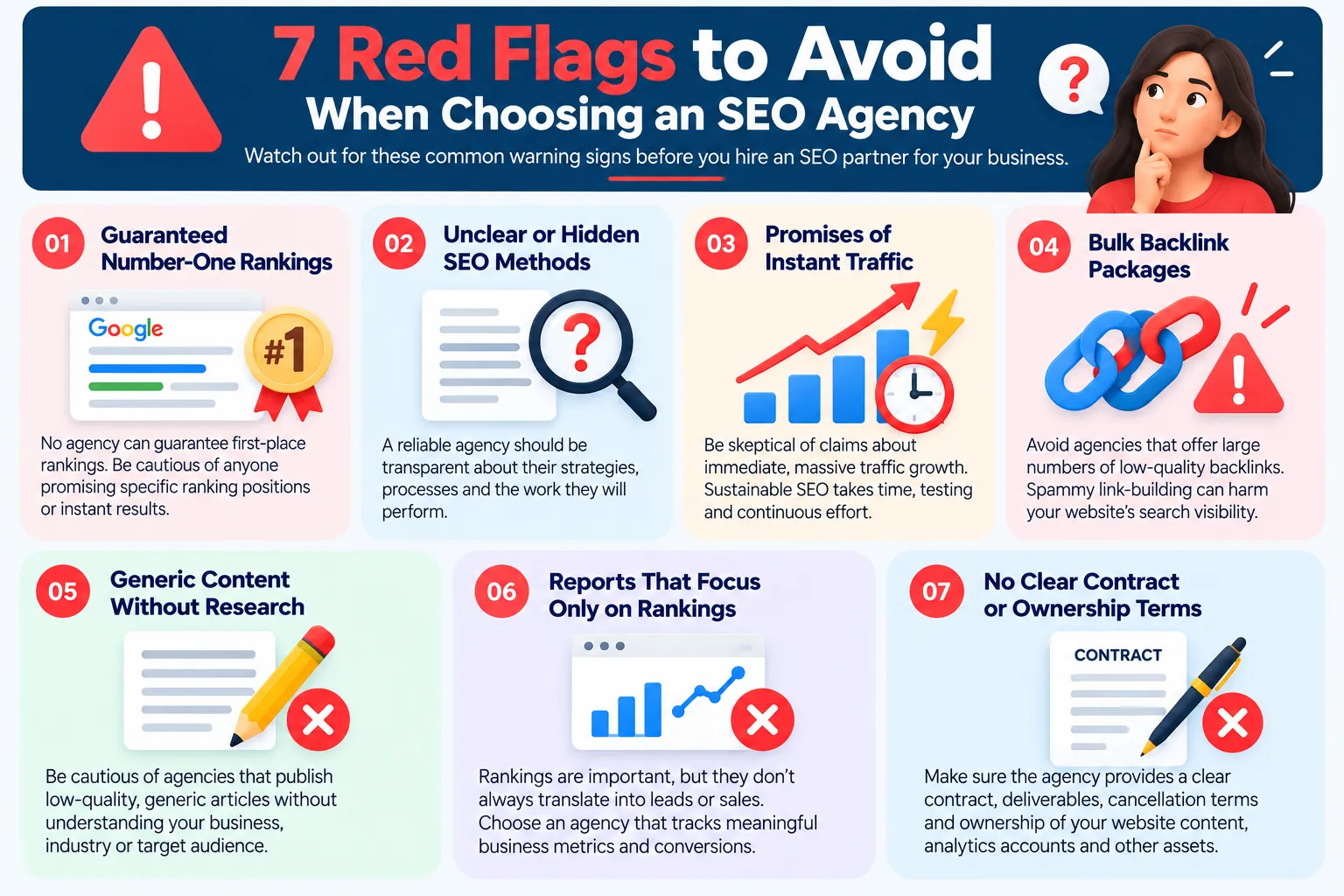
1. Guaranteed Number-One Google Rankings
No agency controls Google's organic ranking systems. Guaranteed rankings should be treated with skepticism.
2. Unclear SEO Methods
An agency should be able to explain the work it plans to perform.
3. Promises of Instant Organic Traffic
Be cautious about unrealistic claims of immediate, sustained growth without supporting evidence.
4. Bulk Backlink Packages
Large numbers of low-quality links can create risks rather than meaningful business value.
5. Generic Content Without Business Research
Publishing articles without understanding your audience or services may attract irrelevant traffic.
6. Reports That Focus Only on Rankings
Rankings can be useful, but they do not automatically translate into inquiries or revenue.
7. No Clear Contract or Ownership Terms
Clarify deliverables, cancellation conditions, account ownership, and access before starting work.
What Should an SEO Agency Do in the First 90 Days?
A structured onboarding process helps establish priorities and expectations.
| Period | Suggested Activities | Expected Deliverables |
|---|---|---|
| Days 1–30 | Website audit, business discovery, competitor research, keyword analysis | Audit findings and prioritized SEO roadmap |
| Days 31–60 | Technical fixes, page optimization, content improvements | Implemented improvements and progress report |
| Days 61–90 | Supporting content, internal links, measurement review, further optimization | Performance review and next-quarter plan |
This is an illustrative planning framework, not a promise of ranking or traffic improvements within 90 days.
Some businesses may need more time for technical fixes, website development, or content production.
How to Compare SEO Agency Proposals
Before choosing a provider, compare proposals using consistent criteria.
Consider assigning each agency a score from one to five for business understanding, technical expertise, content strategy, transparency, relevant experience, communication, and pricing clarity.
Do not make the decision based only on the lowest quote.
A proposal that clearly explains priorities and deliverables may provide more value than one offering a long list of activities without a coherent strategy.
Practical SEO Agency Hiring Checklist
The agency understands my business goals.
Its proposed keywords match my target customers.
It explains its technical SEO approach.
It follows Google's published search guidance.
It can explain its content and link-building methods.
It provides realistic expectations.
It measures conversions as well as search visibility.
It has clear pricing and deliverables.
It explains reporting and communication.
It provides transparent contract and account ownership terms.
Why Businesses Should Focus on Qualified Leads, Not Just Rankings
A website can rank for many informational keywords and still struggle to generate inquiries.
For example, a digital marketing company may receive visits from people researching free SEO tools. Those visitors may find the content useful, but many will not be looking to hire an agency.
In contrast, visitors searching for how to choose an SEO agency, SEO service pricing, or professional website optimization may be further along in the buying process.
This is why an effective SEO strategy should connect relevant content with service pages, clear calls to action, and measurable conversion goals.
The objective is not simply to attract more visitors. It is to attract the right visitors and make it easier for them to take the next step.
Looking for an SEO Partner? Explore Nivya Digital
Choosing an SEO agency requires careful research, clear goals, and realistic expectations.
At Nivya Digital, we provide digital marketing solutions including SEO, Google Ads, content marketing, website development, and related services.
Whether your business serves customers in India or targets international markets, an effective digital strategy should begin with understanding your audience, website challenges, and growth objectives.
If you are reviewing SEO options for your business, Nivya Digital can be one of the providers you evaluate.
Ready to discuss your website's SEO needs?
Visit Nivya Digital to explore our services and get in touch about your business goals.
Final Thoughts
Hiring an SEO agency in 2026 requires more than comparing prices or listening to ranking promises.
The right SEO partner should understand your customers, explain its methods, follow responsible practices, and connect search optimization with meaningful business goals.
Whether you are a small business owner in India, a startup founder in the United States, or a company expanding into new international markets, use these 12 questions to evaluate potential providers confidently.
The goal is not simply to find an agency that promises more traffic. It is to find a partner that understands how search visibility can support your business.
Comments (1)
A practical guide for businesses looking to hire the right SEO agency in 2026. It highlights the key questions to ask about SEO strategy, technical audits, keyword research, reporting, realistic timelines, and measurable results before choosing an agency. A valuable resource for small business owners and marketing teams who want to avoid common SEO mistakes, set clear expectations, and invest in sustainable organic growth. Nivya Digital is the right choice.