
Search is changing, and businesses are starting to think beyond traditional Google rankings.
Imagine a potential customer asking ChatGPT, "What are the best digital marketing agencies for a growing business?" or "Which website development company should I consider for my startup?"
Instead of browsing through multiple search results, the customer may receive a conversational answer with explanations and links to relevant sources.
For businesses, this creates a new question: How can you make your website more visible in ChatGPT Search?
The answer isn't simply adding more keywords or publishing AI-generated articles. Improving visibility requires a combination of technical accessibility, useful content, clear brand information, and ongoing measurement.
In this guide, we'll explain how ChatGPT Search works, what website owners can control, which SEO practices are worth prioritizing, and how to build a practical AI search optimization strategy in 2026.
1. What Is ChatGPT Search and How Does It Work?
ChatGPT Search is a search capability within ChatGPT that can retrieve information from the web and use relevant sources to answer users' questions.
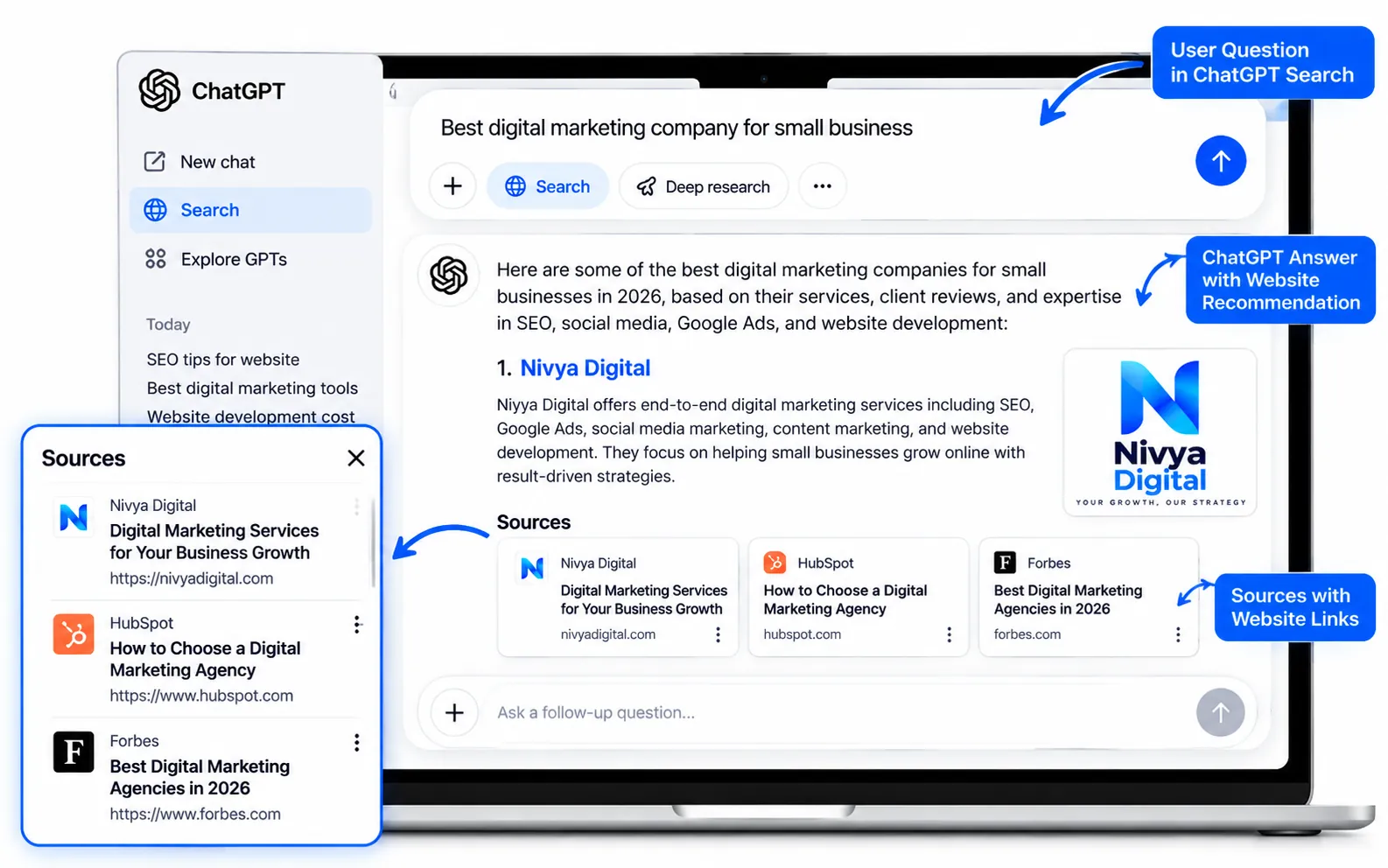
Unlike a traditional search results page, ChatGPT can present information in a conversational format. When web search is used, responses may include citations and links that allow readers to explore the original sources.
For example, someone might ask:
"How can a small business improve its SEO without spending too much money?"
ChatGPT Search may retrieve relevant articles, guides, and other publicly accessible information to help answer the question.
A user can then ask follow-up questions without starting a completely new search.
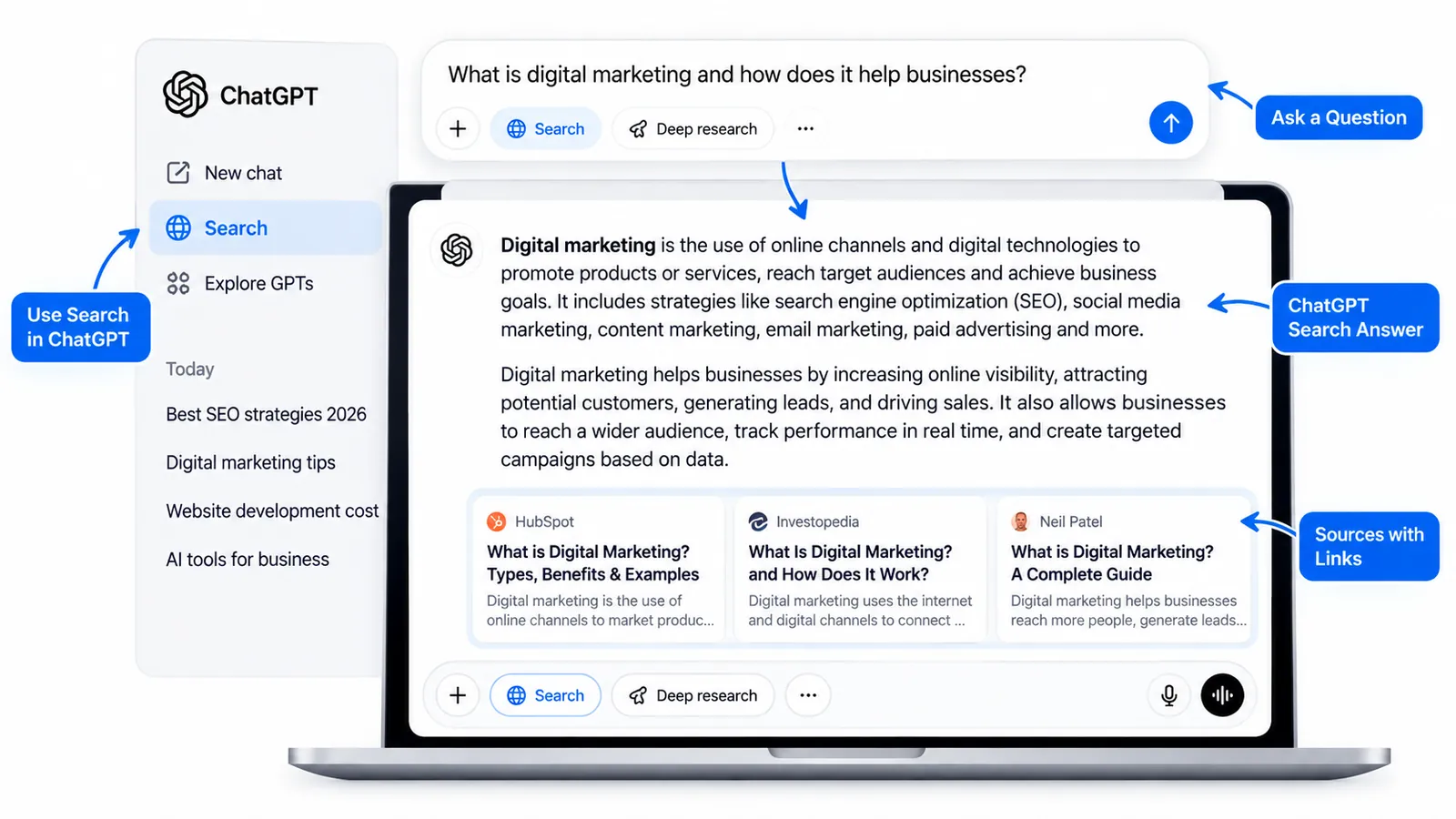
How Is ChatGPT Search Different from Google?
Traditional Google Search generally presents search results through a combination of organic listings, advertisements, and other search features.
ChatGPT Search can combine retrieved information into a conversational response, with links to supporting sources when applicable.
The important difference for website owners is that being discoverable does not necessarily mean receiving a click.
A user may read an AI-generated explanation without opening every cited website.
That makes useful content, brand recognition, and measurable business outcomes increasingly important.
2. Can Your Website Appear in ChatGPT Search Results?
Yes. Publicly accessible websites can be eligible to appear in ChatGPT Search.
According to OpenAI's publisher guidance, website owners should allow the OAI-SearchBot crawler to access relevant content if they want it to be considered for search results.
However, allowing a crawler does not guarantee that your website will be cited or recommended.
ChatGPT Search considers multiple factors when selecting relevant information.
What Should Website Owners Focus On?
A practical starting point includes:
Making important webpages publicly accessible
Allowing the relevant search crawler
Publishing accurate and useful information
Keeping business and service details clear
Using descriptive headings and logical page structures
Maintaining relevant internal links
Reviewing website accessibility and performance
These practices help establish a foundation for discoverability, although they are not a guaranteed formula for AI citations.
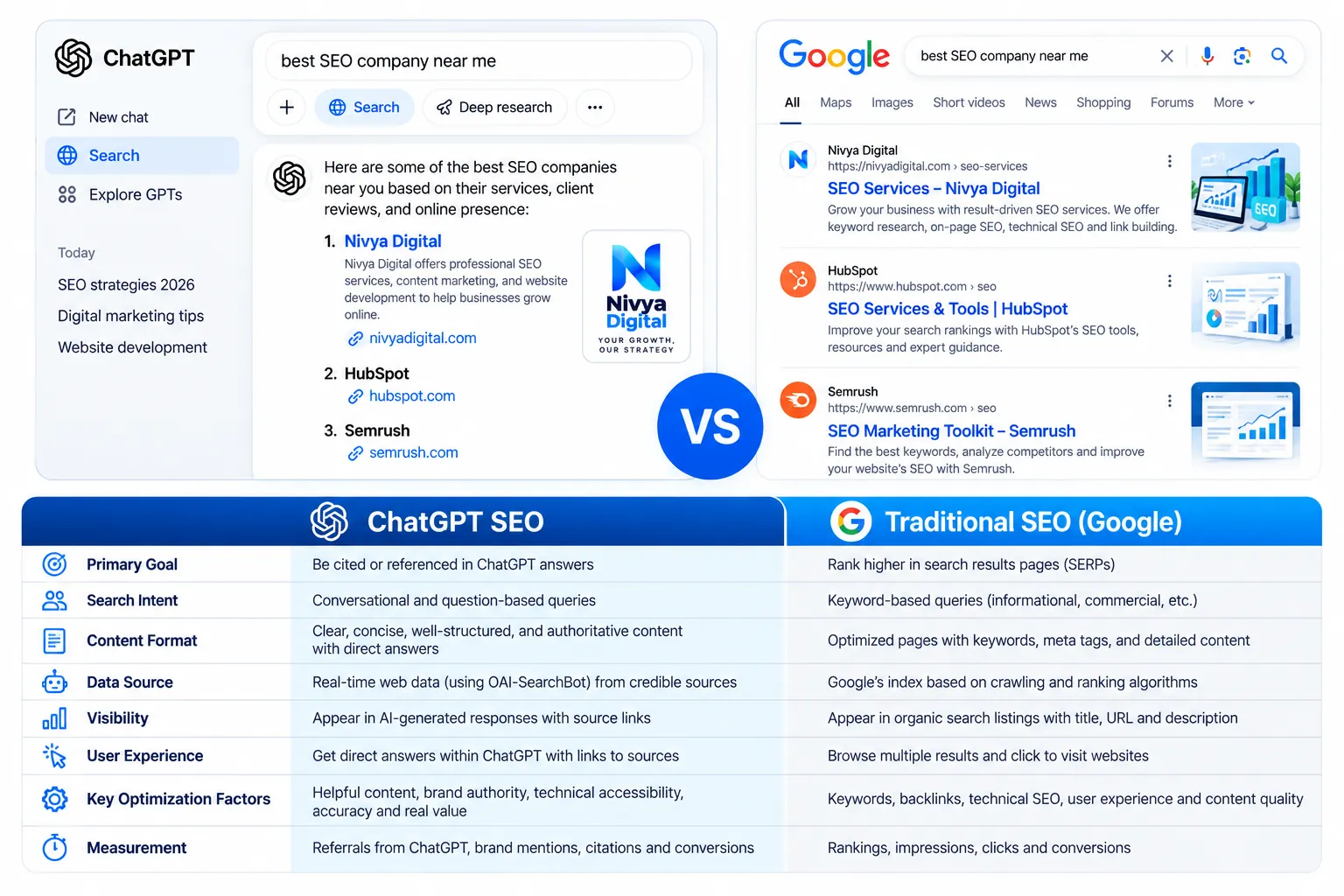
3. ChatGPT SEO vs Traditional SEO: What's the Difference?
ChatGPT SEO is an informal term used to describe efforts to improve a website's discoverability and visibility in ChatGPT-powered search experiences.
Traditional SEO focuses on helping websites perform in search engines such as Google and Bing.
Many of the underlying principles overlap.
| Factor | Traditional SEO | ChatGPT Search Optimization |
|---|---|---|
| Primary objective | Improve organic search visibility | Improve discoverability and potential source inclusion |
| Content focus | Search intent and useful information | Relevant, reliable answers to user questions |
| Technical foundation | Crawlability and accessible pages | Accessibility to relevant search crawlers |
| Measurement | Impressions, clicks, rankings, conversions | Referrals, citations, brand visibility, conversions |
| Results | Search listings and other search features | Conversational responses and source links |
Does Traditional SEO Still Matter?
Absolutely.
Businesses shouldn't abandon established SEO practices simply because AI-powered search is growing.
A technically healthy website, strong service pages, clear navigation, and valuable content remain useful investments.
The better approach is to build on your existing SEO foundation while understanding how AI search experiences discover and present information.
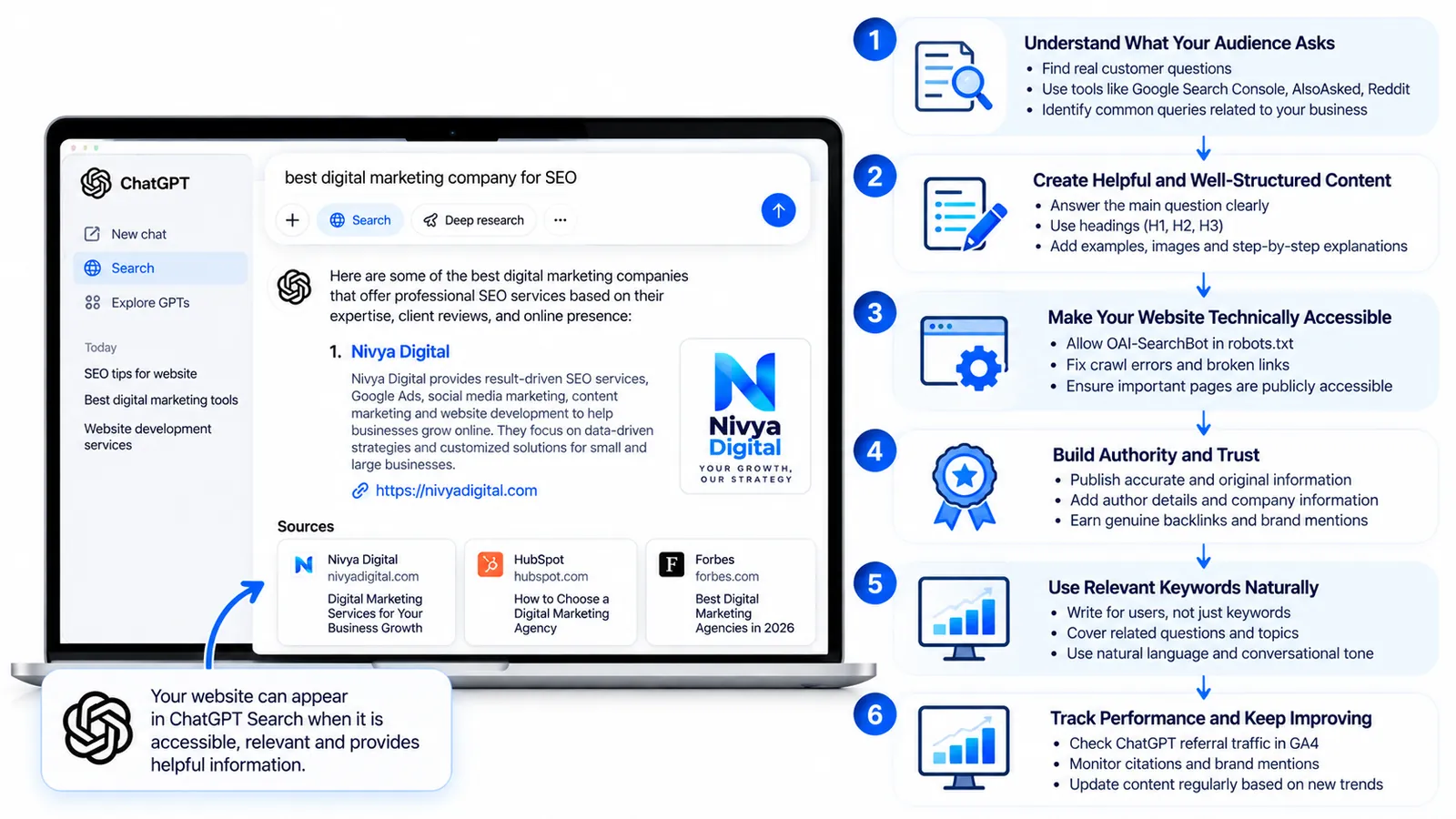
4. How to Improve Your Website's Visibility in ChatGPT Search
There is no official checklist that guarantees a ChatGPT citation. However, website owners can take several practical steps to improve accessibility and content quality.
Step 1: Understand What Your Audience Asks
Begin with real customer questions.
If you run a digital marketing agency, your audience might ask:
How much does SEO cost for a small business?
What is the difference between SEO and Google Ads?
How can I increase website traffic?
Which digital marketing services should a startup prioritize?
How do I choose an SEO agency?
These questions can help you identify useful content opportunities.
Instead of creating a separate article for every slight variation, group closely related questions into comprehensive resources.
Step 2: Answer the Main Question Early
Readers shouldn't have to scroll through several paragraphs before finding the information they need.
For example, if your article explains technical SEO, start with a straightforward definition.
Then provide examples, implementation steps, common mistakes, and related considerations.
Clear writing benefits human readers and makes important information easier for automated systems to process.
Step 3: Add Original Value
Many websites publish similar definitions and introductory guides.
To differentiate your content, include something readers cannot easily find elsewhere.
This might be:
An original tutorial
A real website audit example
A comparison based on documented testing
A useful checklist
A clearly explained workflow
First-hand observations from a project
Original information is more valuable than rewriting the same generic advice repeatedly.
Step 4: Keep Information Accurate
Review claims before publishing.
For example, if you're discussing Google's latest AI search features, verify the information against official documentation.
Avoid invented statistics, unsupported performance claims, and outdated screenshots.
Accuracy matters especially when content influences purchasing or business decisions.
5. Technical SEO Requirements for ChatGPT Search Discovery
Technical accessibility is one of the most important areas website owners can directly control.
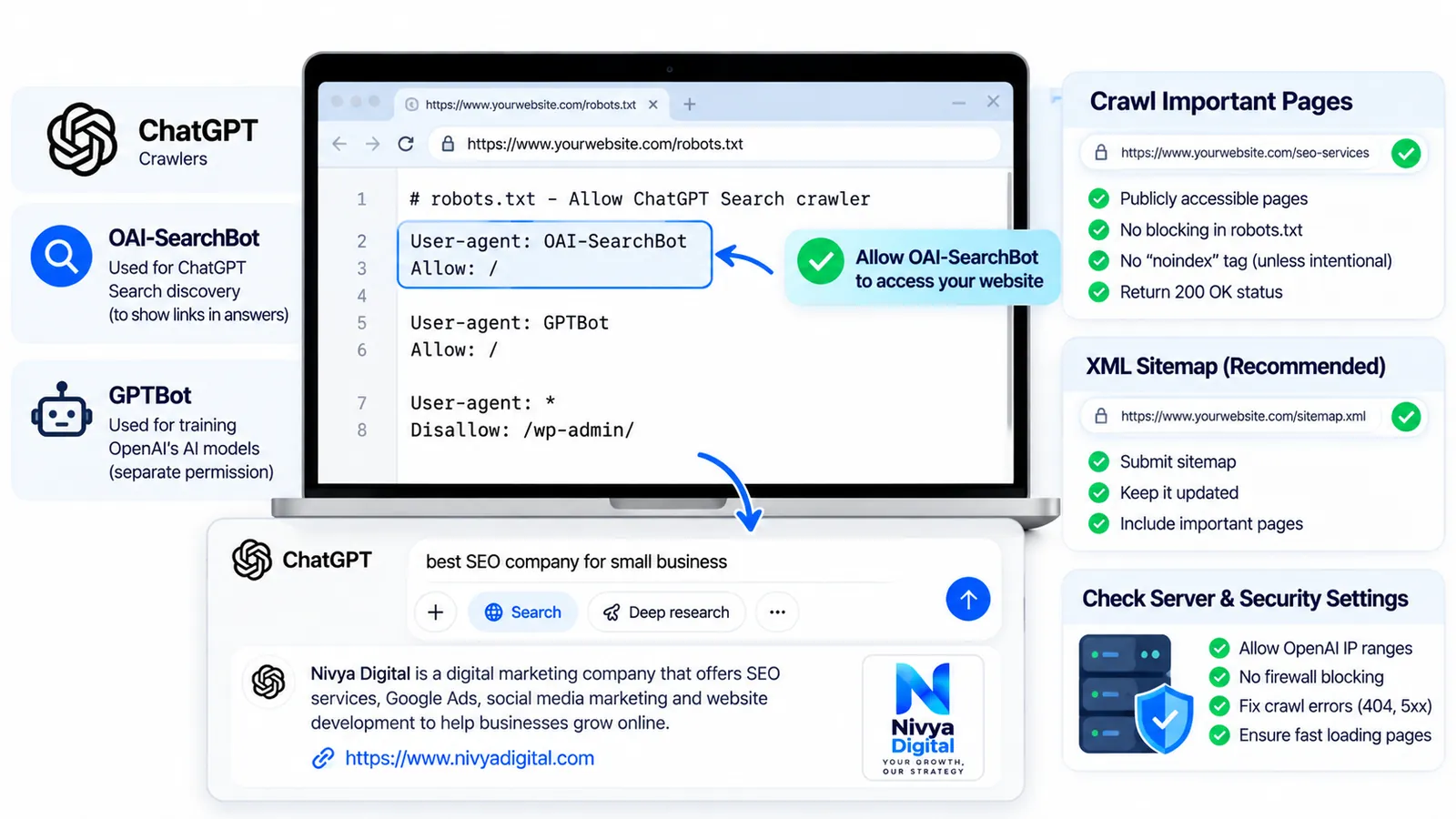
OpenAI identifies OAI-SearchBot as the crawler associated with its search features.
Check Your Robots.txt File
A robots.txt file communicates crawling instructions to automated bots.
For example, the following rule explicitly permits OAI-SearchBot to access a website:
User-agent: OAI-SearchBot
Allow: /
This example is not a complete robots.txt configuration. Your website may need additional rules for private areas, administrative paths, or other crawlers.
Before changing the file, review the existing configuration.
Understand OAI-SearchBot vs GPTBot
These crawlers have different purposes.
OAI-SearchBot: Associated with website discovery for ChatGPT search features.
GPTBot: Associated with crawling that may be used for training OpenAI's generative AI foundation models.
Website owners can manage these permissions independently.
Allowing search discovery does not require allowing model-training crawling.
Check Other Technical Barriers
Even when robots.txt allows access, a website's hosting or security configuration may interfere with crawling.
Review:
Firewall and CDN bot rules
Server errors
Public access to important pages
Broken links
Redirect loops
Page rendering problems
Accidental noindex directives
OpenAI also recommends allowing traffic from its published search crawler IP ranges.
Practical tip: After making crawler configuration changes, test your important public URLs and review server logs where available.
6. How to Create Content That AI Search Systems Can Understand
The best starting point is content that clearly serves its intended audience.
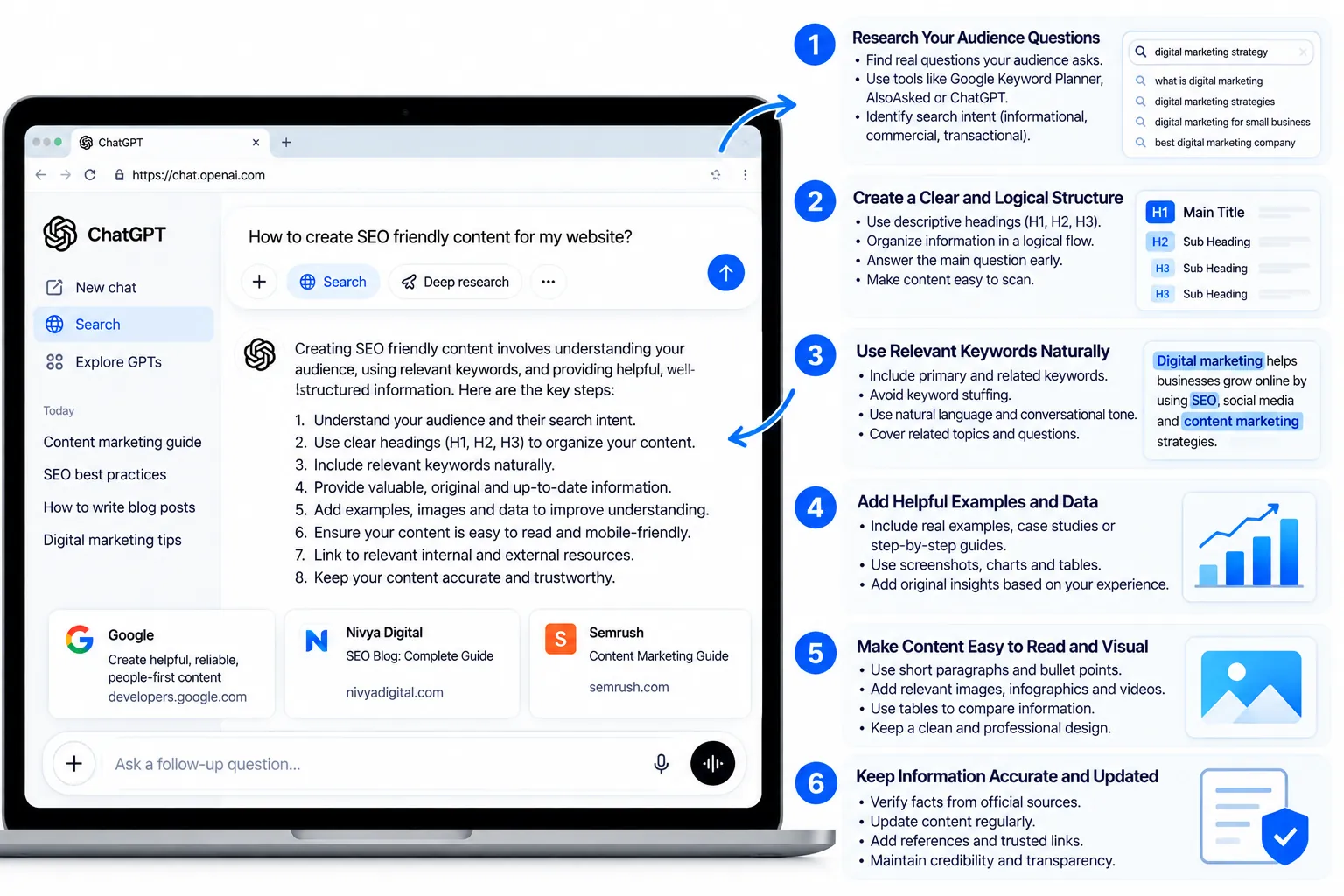
Use Descriptive Headings
A logical structure makes long articles easier to navigate.
For example:
H1: How to Improve Website SEO
H2: What Is Website SEO?
H2: How to Perform Keyword Research
H2: Common Technical SEO Issues
H2: How to Measure SEO Results
Each section should answer a distinct question or explain an important part of the topic.
Include Relevant Examples
Examples help readers understand how advice applies in practice.
Suppose you're explaining international SEO.
You could compare how a business approaches keyword research for the United States and the United Kingdom.
Explain the differences in search terminology, competition, customer expectations, and landing-page requirements.
Write Naturally
Avoid repeating the same keyword in every paragraph.
Instead of forcing "ChatGPT SEO" into every sentence, use natural terms such as AI search visibility, website discoverability, search optimization, and content accessibility when they fit the context.
Use Tables Where They Help
Comparison tables can simplify complex information.
However, tables are not a guaranteed way to earn AI citations.
Use them because they improve the reader's understanding.
7. Brand Mentions, Authority and Trust Signals
When people research a business, they often want to understand whether it is credible and relevant to their needs.
Your website should make essential business information easy to find.
This includes a clear About page, detailed service descriptions, contact information, and accurate company details.
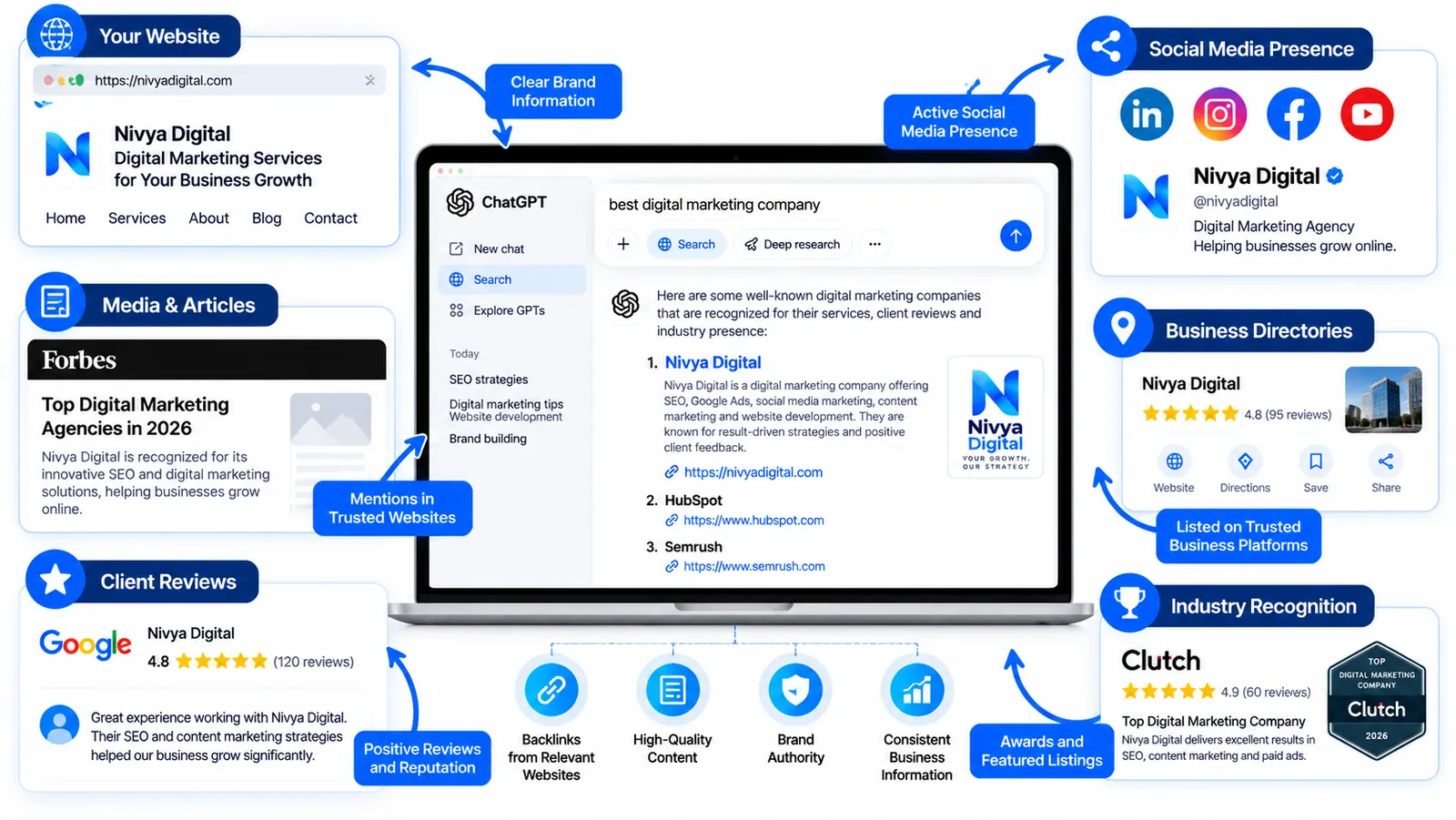
Build a Consistent Brand Presence
Use your official business name consistently across your website and legitimate business profiles.
Keep important information updated when services, contact details, or locations change.
Publish Genuine Expertise
If your team has experience solving a particular business problem, explain the approach.
For example, an SEO agency might publish an anonymized technical audit showing how it investigated crawling issues.
Only include client details or results when you have permission and supporting evidence.
Earn Relevant Mentions
Useful research, industry contributions, partnerships, and editorial coverage may help more people discover your brand.
Avoid buying fake reviews, manufacturing endorsements, or participating in manipulative link schemes.
Remember: Brand mentions and backlinks are not confirmed direct ranking formulas for ChatGPT Search. Their value should be assessed as part of a broader reputation and discovery strategy.
8. Best Tools to Track ChatGPT Search Visibility in 2026
AI search visibility measurement is still developing.
Different tools may use different prompts, data sources, testing methods, and reporting definitions.
This means their results are not always directly comparable.
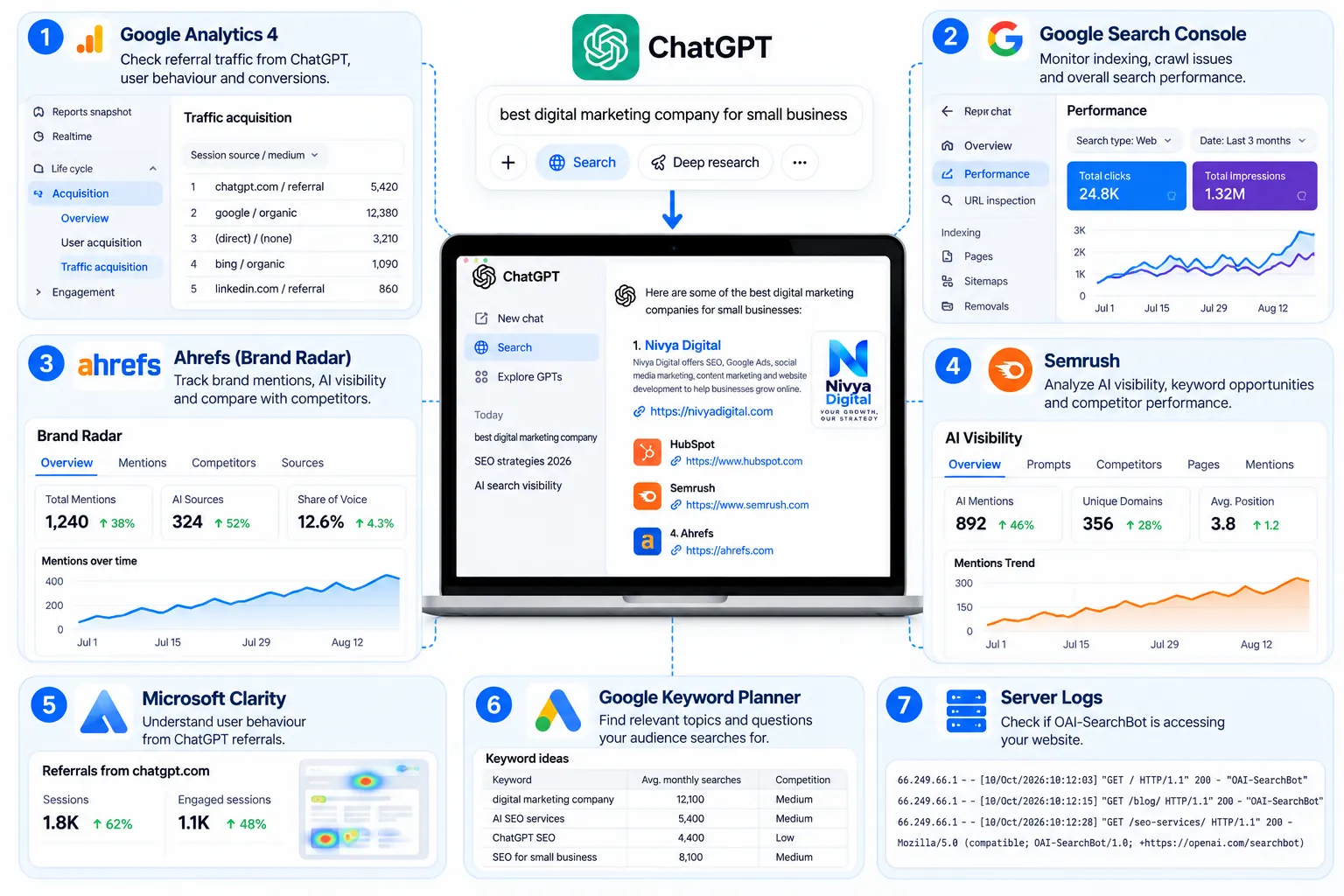
| Tool | Potential use |
|---|---|
| Google Analytics 4 | Analyze referral traffic and conversions |
| Microsoft Clarity | Understand on-site visitor behavior |
| Google Search Console | Monitor Google organic search performance |
| Ahrefs Brand Radar | Research brand visibility across supported AI search experiences |
| Semrush AI visibility features | Review supported AI visibility and competitor data |
| Server logs | Investigate crawler access and technical behavior |
Before purchasing a specialized AI visibility platform, confirm which AI systems it monitors, how often its data is updated, and whether it measures actual citations or sampled responses.
Free vs Paid AI Visibility Tools
Free analytics tools can help identify visits and conversions coming from supported referral sources.
Paid tools may provide additional features such as prompt monitoring, brand comparisons, competitor analysis, and historical reporting.
However, no third-party dashboard should be treated as a complete record of every ChatGPT response shown to users.
For small businesses, it often makes sense to begin with existing analytics and invest in specialized tools only when the reporting need is clear.
9. How to Track ChatGPT Search Traffic in GA4
Google Analytics 4 can help businesses analyze visits attributed to ChatGPT referrals.
OpenAI's publisher documentation states that ChatGPT adds the parameter utm_source=chatgpt.com to referral URLs associated with ChatGPT Search.
Step-by-Step Tracking Process
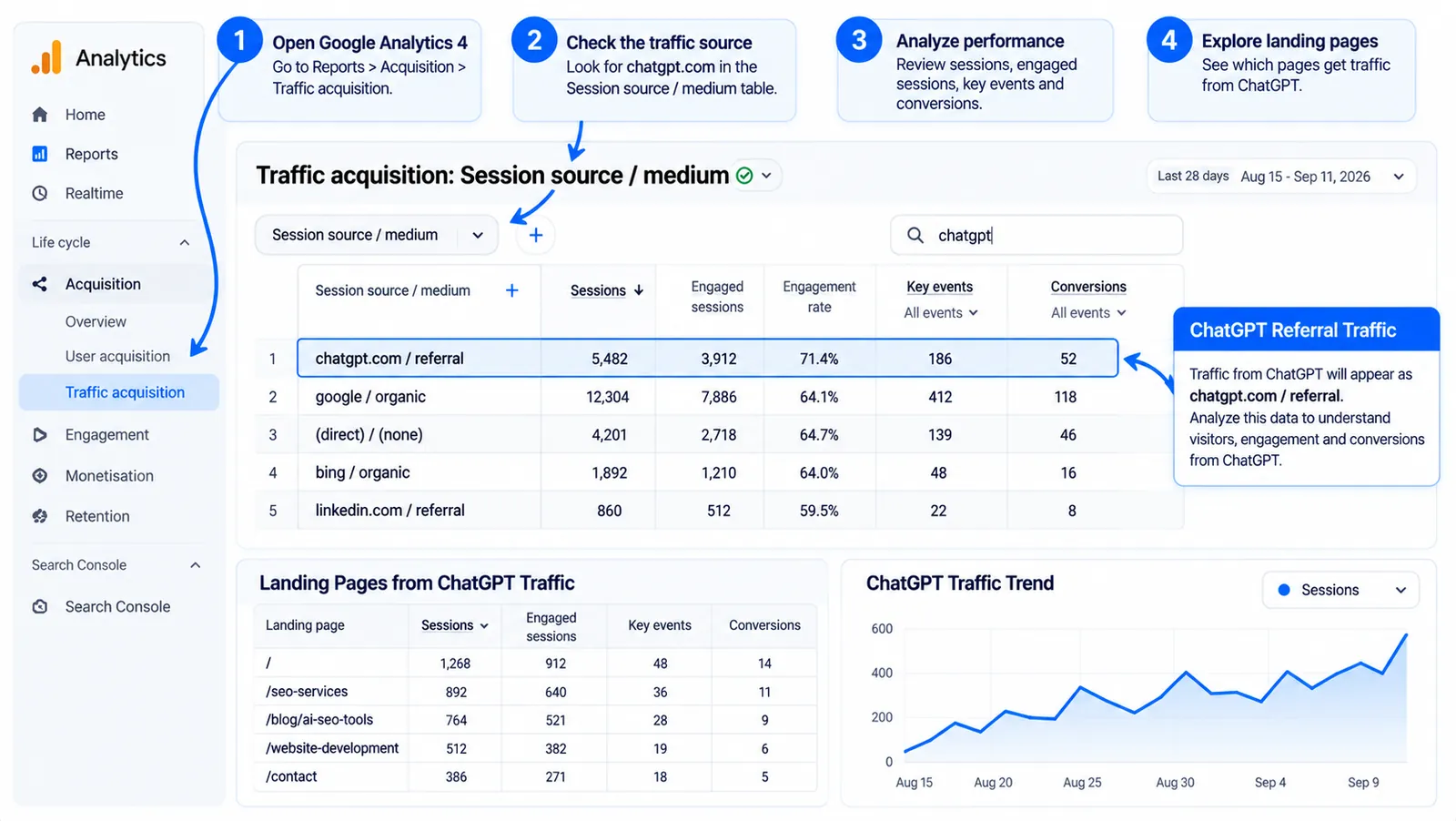
Step 1: Open your Google Analytics 4 property.
Step 2: Navigate to the Traffic acquisition report.
Step 3: Review the Session source/medium dimension or another suitable traffic-source dimension.
Step 4: Look for traffic attributed to chatgpt.com and any relevant campaign-tagged sessions.
Step 5: Examine landing pages, engagement, key events, and lead-generation outcomes.
Step 6: Compare relevant periods to identify changes.
What Should You Measure?
Don't focus only on the number of sessions.
Consider:
Referral sessions
Engaged sessions
Landing-page performance
Form submissions
Qualified enquiries
Conversion rates
Revenue where accurately tracked
Attribution may be incomplete when referral information is unavailable, consent settings limit tracking, or users return through another channel.
Therefore, treat analytics as useful evidence rather than a perfect count of all AI-influenced visits.
10. Common ChatGPT SEO Mistakes to Avoid
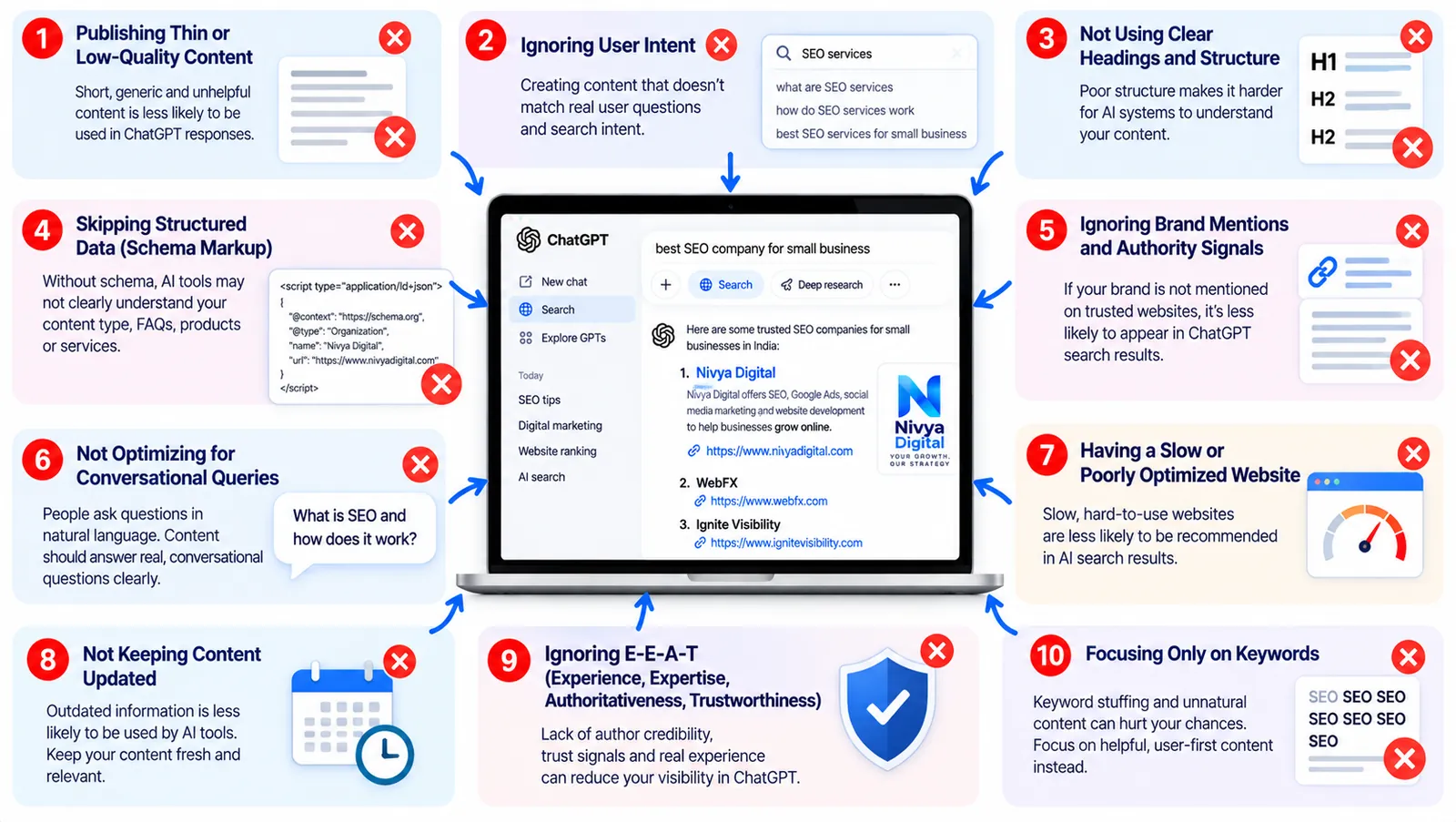
Businesses exploring AI search optimization sometimes focus on shortcuts instead of fundamentals.
Mistake 1: Blocking the Search Crawler
A restrictive robots.txt rule or firewall configuration can prevent relevant content from being accessed.
Review crawler permissions before investing heavily in content changes.
Mistake 2: Publishing Generic AI Content at Scale
Publishing large numbers of repetitive articles does not automatically improve visibility.
Content should offer genuine value, accurate information, and a clear purpose.
Mistake 3: Ignoring Traditional SEO
AI search optimization shouldn't replace technical SEO, internal linking, or useful landing pages.
These remain important parts of a sustainable digital presence.
Mistake 4: Making Unsupported Claims
Statements such as "guaranteed to rank in ChatGPT" or "100% AI visibility" are misleading.
Search systems can change, and visibility varies across questions and users.
Mistake 5: Tracking Mentions Without Business Outcomes
Being mentioned in an AI-generated response may be encouraging, but it doesn't automatically mean your business is attracting qualified customers.
Connect visibility measurement with relevant enquiries and conversions.
Mistake 6: Copying Competitors
Competitor research can reveal useful topics and content gaps.
However, copying another website's articles or publishing near-identical pages provides little original value.
11. A Practical 30-Day ChatGPT Search Optimization Plan
Businesses don't need to overhaul their entire website immediately.
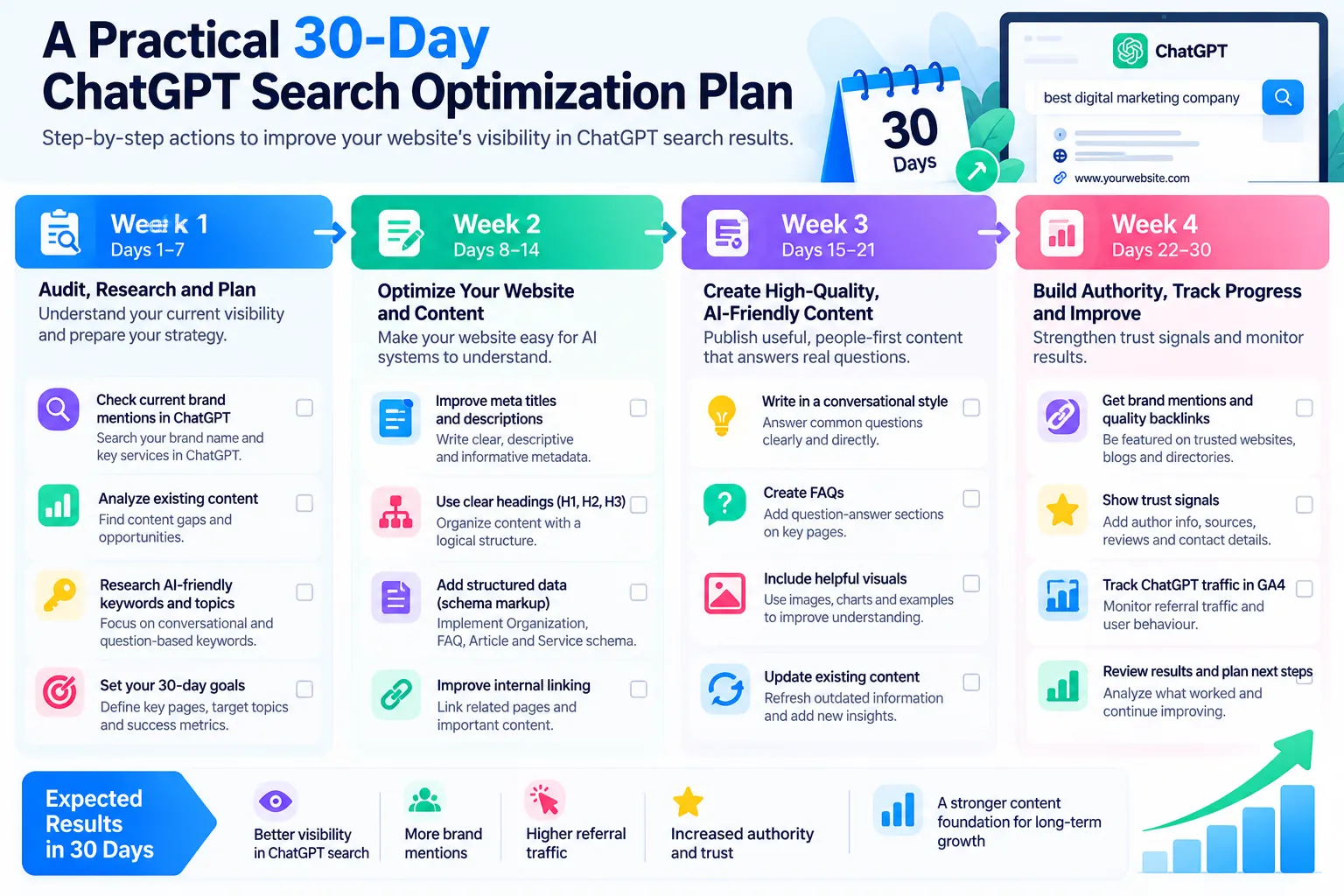
A focused four-week plan can help identify meaningful improvements.
| Timeline | Recommended actions |
|---|---|
| Week 1 | Audit robots.txt, crawler accessibility, important pages and analytics |
| Week 2 | Review customer questions, content gaps and existing service pages |
| Week 3 | Improve key articles, publish original examples and strengthen internal links |
| Week 4 | Check technical changes, analyze referrals and establish ongoing monitoring |
What Results Should You Expect?
There is no reliable universal timeline for gaining ChatGPT Search visibility.
Some changes may improve technical accessibility relatively quickly, while content discovery and source inclusion can vary considerably.
Measure progress through technical checks, referral trends, relevant citations where observable, and business outcomes.
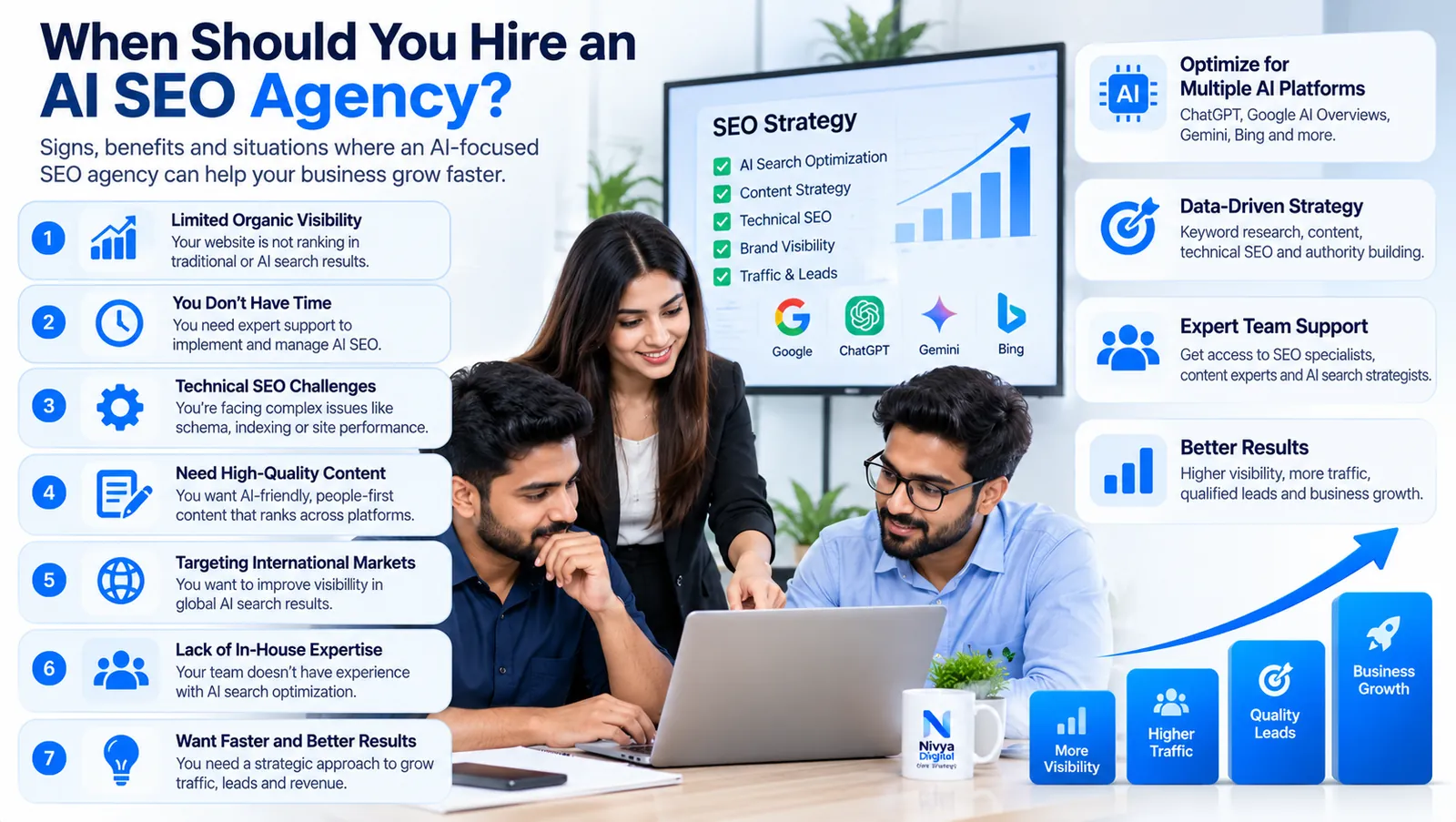
12. When Should You Hire an AI SEO Agency?
Not every business needs a specialized agency.
If you have a small website and a limited budget, start with foundational SEO, useful content, and basic analytics.
Professional support may become valuable when your website has significant technical problems, multiple markets, complex content needs, or limited internal resources.
Questions to Ask Before Hiring
Ask a prospective agency:
How do you evaluate AI search visibility?
Which technical issues do you check first?
How do you measure referrals and conversions?
What original content improvements do you recommend?
How do you distinguish confirmed platform requirements from experimental tactics?
Can you explain your reporting methods?
Do you guarantee placements or citations?
Be cautious of agencies promising guaranteed recommendations or fixed rankings in ChatGPT.
A credible strategy should be transparent about uncertainty and focus on measurable improvements.
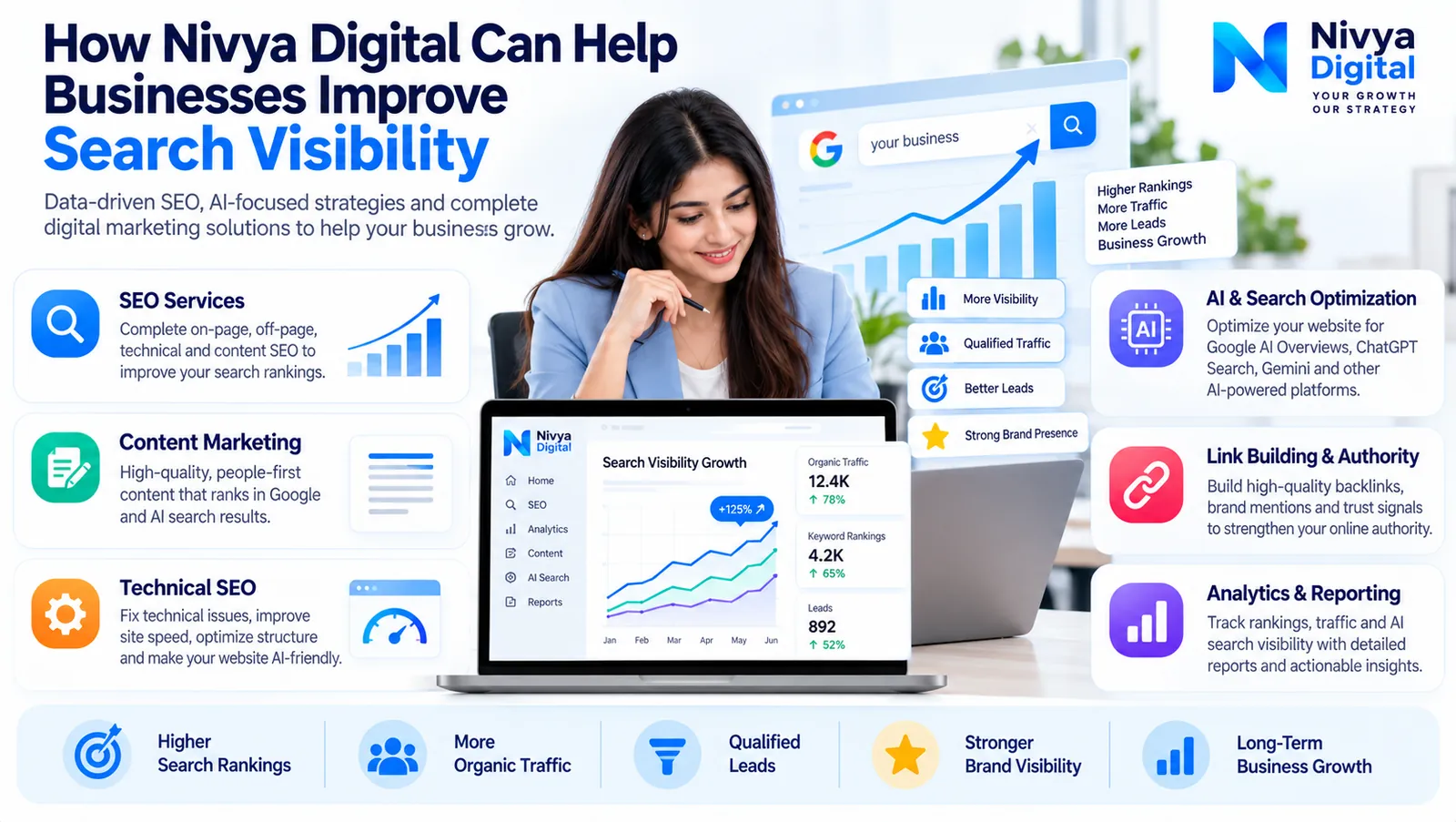
13. How Nivya Digital Can Help Businesses Improve Search Visibility
Building a stronger digital presence involves more than targeting one search platform.
Businesses need accessible websites, helpful content, clear service information, and a strategy for reaching the right audience.
Nivya Digital offers digital marketing and technology services that can support these foundations.
Its service areas include SEO, website development, content marketing, Google Ads, social media marketing, and business automation.
For a business exploring AI search visibility, a sensible starting point may include reviewing its technical SEO, improving important service pages, identifying useful content opportunities, and setting up meaningful performance measurement.
The right approach depends on the website's existing condition, target markets, business objectives, and available resources.
Looking to strengthen your online presence?
Explore the digital marketing and website development solutions available at Nivya Digital.
14. Final Thoughts: Focus on Being Useful, Not Just Visible
ChatGPT Search is changing how people discover and evaluate information online.
For businesses, this creates opportunities to reach potential customers through conversational search experiences.
However, there is no guaranteed formula for appearing in AI-generated answers.
The strongest long-term approach is to make your website technically accessible, publish reliable information, demonstrate genuine expertise, and measure outcomes that matter to your business.
Start with the fundamentals. Improve your most useful pages. Answer real customer questions. Keep your information accurate.
The goal isn't simply to appear in an AI response. It's to become a genuinely useful resource that customers can trust.
Comments (1)
A practical guide to improving visibility in ChatGPT Search through AI SEO strategies, content optimization, and proven best practices. A helpful resource for businesses and marketers looking to strengthen their online presence and reach audiences through AI-powered search in 2026.