
A Keyword Density Checker is an SEO tool that measures how often a word or phrase appears in a piece of content and calculates its frequency as a percentage of the total word count.
For example, if a 1,000-word article contains a target keyword 10 times, its keyword density is 1%.
Keyword density can be useful when reviewing SEO content because it helps you spot excessive repetition, missing target terms, and possible keyword stuffing. However, there is no single keyword density percentage that guarantees higher Google rankings. The metric is best used as a content-checking tool rather than a number you need to hit.
What Is a Keyword Density Checker?
A keyword density checker analyzes your text or webpage to determine how frequently specific words and phrases appear.
Depending on the tool, it may show:
Total word count
Keyword frequency
Keyword density percentage
Frequently used words
Two-word and three-word phrases
Target keyword occurrences
Repeated phrases
Possible keyword stuffing
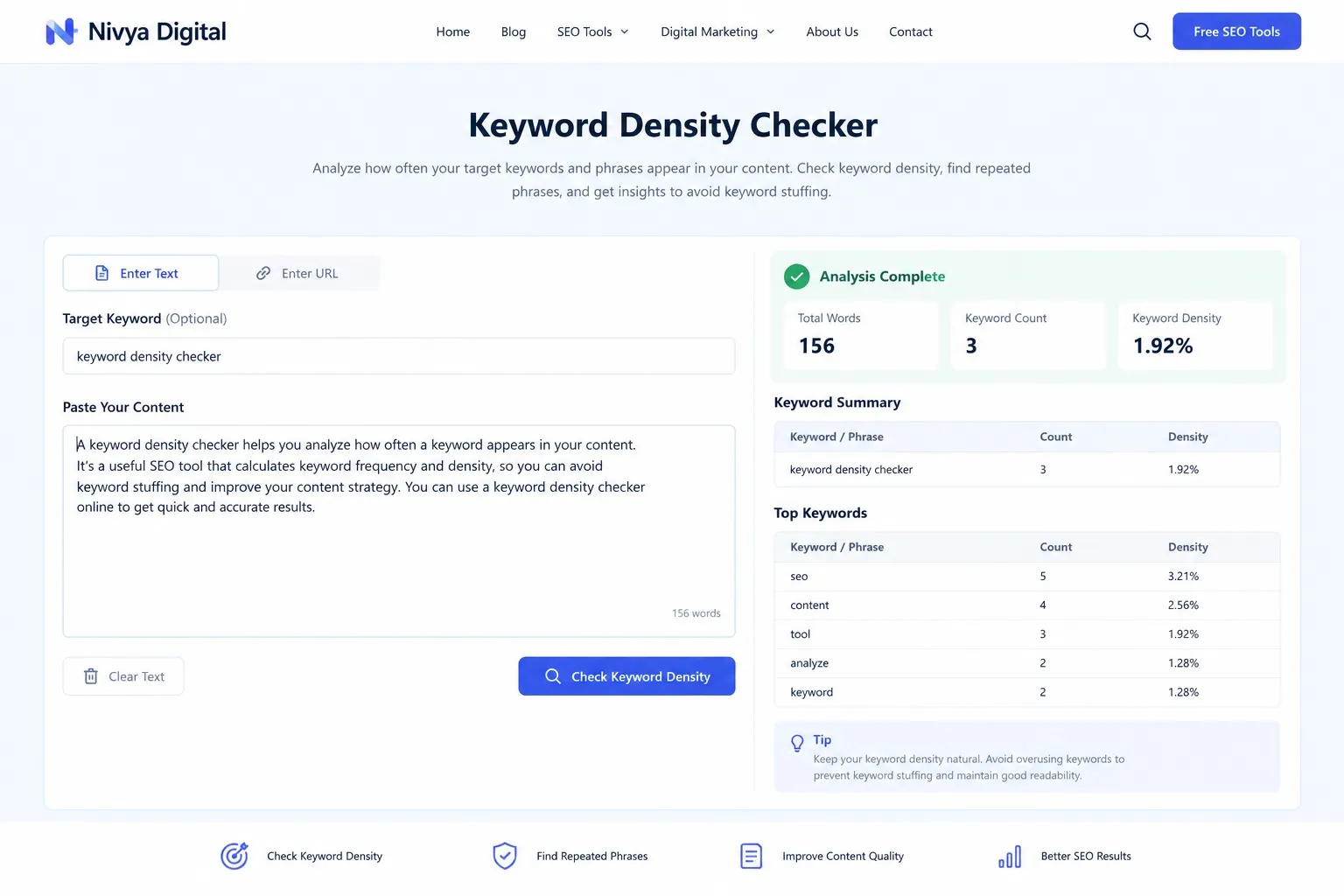
For SEO writers, bloggers, marketers, and website owners, this information can provide a quick way to review how a page uses important terms before publishing it.
Instead of manually counting every occurrence of a keyword, you can use a keyword density tool to analyze the content in seconds.
What Is Keyword Density?
Keyword density is the percentage of times a particular keyword appears compared with the total number of words in a piece of content.
The basic formula is:
Keyword Density = (Keyword Count ÷ Total Words) × 100
For example, suppose your article has 800 words and your target phrase appears 8 times.
(8 ÷ 800) × 100 = 1%
The keyword density is therefore 1%.
This calculation is simple, but the number should not be treated as a ranking score.
A page can have a particular keyword density and still fail to satisfy the searcher's intent. Likewise, useful content does not need to reach a specific percentage to be relevant.
Why Use a Keyword Density Checker?
A keyword density checker can help you review your content before publishing it.
One of its main benefits is that it removes some of the guesswork from keyword usage.
For example, you may think you have mentioned your target phrase five times, but a content analysis could reveal that it appears fifteen times because it is also present in headings, introductions, examples, and other sections.
The opposite can happen too. You may assume that a topic is clearly represented, but the actual text may barely mention the main concept.
A checker can help identify these patterns.`
1. Find Repeated Keywords
A keyword density analysis can show which words and phrases appear most frequently.
This can help you identify accidental repetition that isn't obvious while writing.
2. Check Your Target Keyword
If you have a primary keyword, you can check how frequently it appears in your content.
The goal isn't to maximize the number. Instead, use the result as a signal to review whether the keyword usage feels natural.
3. Detect Possible Keyword Stuffing
Excessive repetition can make content difficult to read.
A density checker can highlight unusually frequent words or phrases so you can manually review them.
4. Analyze Long-Form Content
Long articles can contain hundreds or thousands of words, making manual analysis time-consuming.
A tool makes it easier to review the overall distribution of important terms.
5. Review Content Before Publishing
Running a final keyword analysis can be useful as part of an SEO editing process.
You can identify repetitive phrases and make improvements before the page goes live.
How to Use a Keyword Density Checker
Using a keyword density checker is usually straightforward.
Step 1: Prepare Your Content
Copy the text you want to analyze.
This could be:
A blog post
Website content
A landing page
Product copy
A service page
An article draft
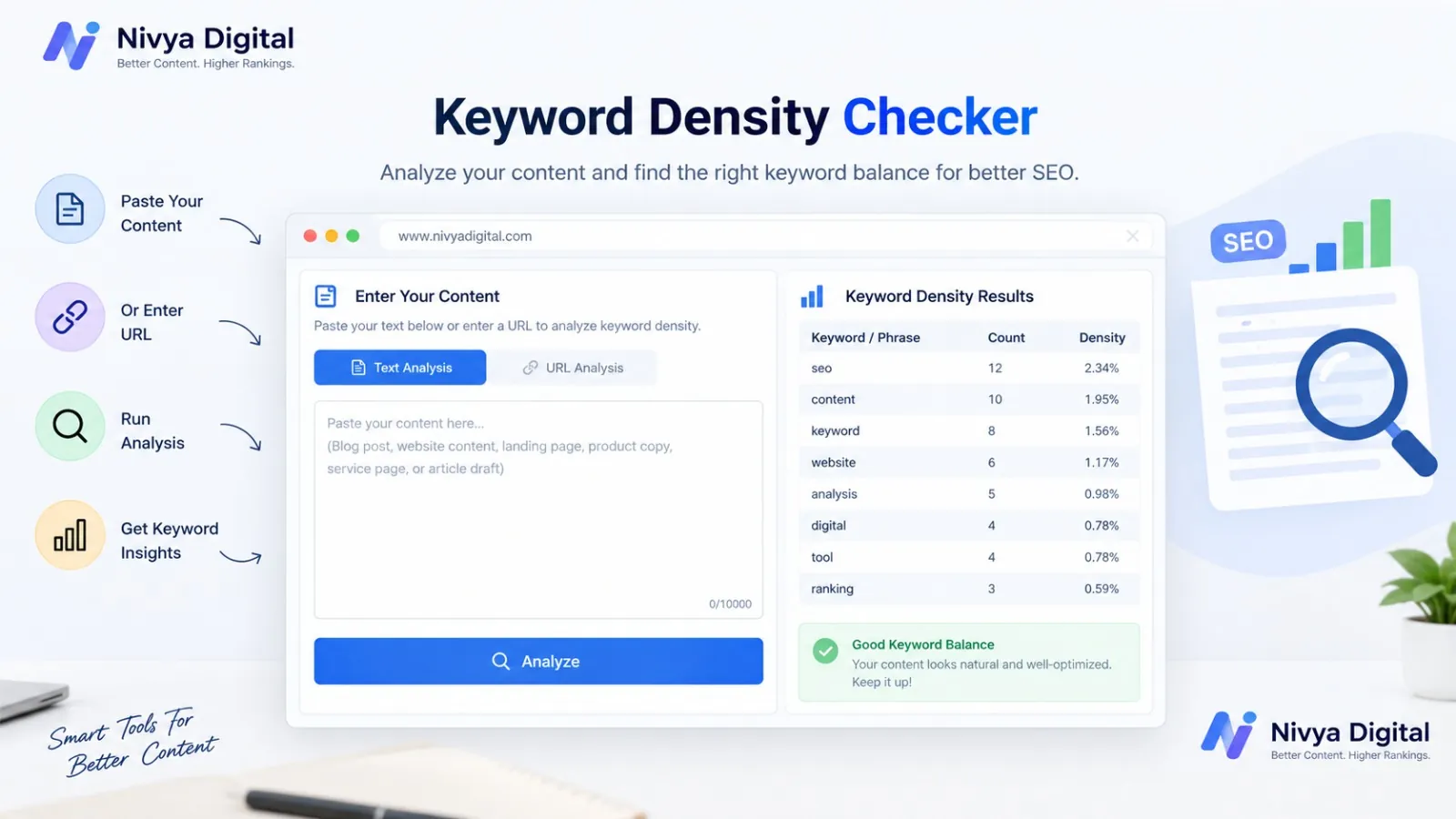
Step 2: Paste the Content Into the Tool
Open your Keyword Density Checker and paste your content into the analysis field.
If the tool supports URL analysis, you may also be able to enter a webpage address instead of manually copying the text.
Step 3: Run the Analysis
Start the analysis.
The tool processes your content and identifies frequently occurring words and phrases.
Step 4: Review the Results
Look at the keywords, their occurrence counts, and their density percentages.
Don't focus only on the highest number.
Consider whether the frequently appearing terms actually belong to the main topic of the page.
Step 5: Improve the Content if Necessary
If a phrase appears repeatedly in a way that sounds unnatural, rewrite some sentences.
You might replace repeated phrases with:
Pronouns
Natural variations
Related terminology
More descriptive wording
The objective is better content, not simply a lower percentage.
What Is a Good Keyword Density for SEO?
There is no official keyword density percentage that Google requires for ranking.
You may see SEO tools and articles recommending ranges such as 0.5%, 1%, 2%, or 3%, but these should not be treated as universal Google rules. Current keyword-density tools increasingly frame density as a diagnostic measure rather than a target to maximize.
For example, imagine two articles:
Article A:
A 1,000-word article uses a keyword 10 times.
Article B:
A 1,000-word article uses the keyword 20 times.
You cannot conclude that Article B is automatically better optimized.
If those 20 uses make the writing repetitive, reducing some of them may improve the article.
On the other hand, if a term naturally needs to appear frequently because it is central to the subject, forcing it out simply to reach a lower percentage would also make little sense.
The better question is:
Does the keyword appear naturally where it helps explain the topic?
Is Keyword Density a Google Ranking Factor?
Keyword density should not be treated as a direct ranking formula.
Modern search systems can understand content through context, related concepts, entities, phrases, and the overall meaning of a page. Several current keyword-density resources therefore describe density as a diagnostic or editorial metric rather than a number that predicts rankings.
This doesn't mean keywords are irrelevant.
Search engines still need to understand what a page is about.
The important difference is between using relevant language naturally and repeating an exact phrase simply to increase its count.
What Is Keyword Stuffing?
Keyword stuffing means filling content with keywords or phrases in an unnatural way, generally to manipulate search visibility.
For example:
Our keyword density checker is a keyword density checker for checking keyword density. Use our keyword density checker to check keyword density with a keyword density checker.
The phrase may be relevant to the page, but the repetition makes the content uncomfortable to read.
A better version would communicate the same idea naturally:
Use a keyword density checker to review how frequently important terms appear in your content and identify unnecessary repetition before publishing.
The second version is clearer and provides information without forcing the exact phrase into every sentence.
Keyword Density vs. Keyword Frequency
Keyword density and keyword frequency are closely related, but they are not exactly the same.
Keyword frequency is the number of times a keyword appears.
Keyword density expresses that frequency as a percentage of the total word count.
For example:
Total words: 1,000
Keyword occurrences: 15
Keyword frequency: 15
Keyword density: 1.5%
A keyword density checker may display both values so you can understand how frequently a term occurs and how significant that frequency is relative to the size of the content.
| Feature | Keyword Density | Keyword Frequency |
|---|---|---|
| Meaning | Percentage of a keyword in the content | Number of times a keyword appears |
| Focus | Keyword usage compared to total words | Total keyword occurrences |
| Example | 10 uses in 1,000 words = 1% | Keyword appears 10 times |
| Purpose | Helps analyze keyword usage | Shows how often a keyword is used |
Keyword Density Checker vs. Keyword Density Calculator
A keyword density calculator generally focuses on the mathematical calculation.
A keyword density checker can provide a broader content analysis.
For example, a checker may show:
Keyword frequency
Density percentage
Common words
Common phrases
Repeated terms
Multiple-word phrases
Some modern tools also analyze one-, two-, and three-word phrases instead of looking only at individual keywords.
This can be useful because keyword stuffing isn't always obvious when you look at individual words.
A two- or three-word phrase may reveal repetition that a single-word analysis doesn't show.
| Feature | Keyword Density Checker | Keyword Density Calculator |
|---|---|---|
| Main Purpose | Analyzes keyword usage | Calculates keyword density |
| Shows | Keyword count, density, and frequency | Mainly density percentage |
| Best For | Detailed content analysis | Quick calculations |
| Input | Text or URL | Word and keyword count |
How to Check Keyword Density Online
If you want to check keyword density online, the process is usually simple.
Open an online keyword density checker.
Paste your content into the tool.
Enter your target keyword if the tool provides a target-keyword option.
Start the analysis.
Review keyword frequency and density.
Check repeated phrases.
Edit unnatural repetition if necessary.
For a draft that hasn't been published yet, text-based analysis is convenient because you can make changes immediately.
For an existing webpage, a URL-based checker can be useful if the tool supports URL analysis.
What Should You Check Besides Keyword Density?
Keyword density is only one part of content analysis.
When reviewing an SEO article, also consider:
Search Intent
Does the page answer the reason someone searched for the keyword?
For example, someone searching for keyword density checker may be looking for an actual tool, not just a definition.
Content Relevance
Does the article cover the important aspects of the subject?
Readability
Can visitors understand the content easily?
Headings
Do your H1, H2, and H3 headings create a logical structure?
Internal Links
Does the page link to other useful and relevant pages on your website?
Keyword Variations
Have you naturally covered relevant terminology rather than repeating one exact phrase throughout the article?
User Experience
Can visitors quickly find the information or tool they came for?
These factors provide much more useful context than a single density percentage.
How to Avoid Keyword Stuffing
You don't need to remove every repeated keyword from your content.
Instead, review the context in which the keyword appears.
Here are a few practical ways to avoid unnecessary repetition.
Write the First Draft Naturally
Don't interrupt your writing to count keywords after every paragraph.
Write the article for the reader first.
Review Frequency After Writing
Once the article is complete, use a keyword density checker as an editing tool.
This lets you identify patterns you may not have noticed.
Use Natural Variations
Instead of repeating one exact phrase, use relevant variations when they make sense.
For example, depending on the context, you might use:
keyword analysis tool
SEO content checker
keyword frequency tool
keyword analysis
content analysis
Don't add these terms just because they are keywords. Use them when they genuinely improve the explanation.
Remove Forced Repetition
If a sentence sounds unnatural when you read it aloud, rewrite it.
Good SEO content should sound like something a person would actually want to read.
Can a Keyword Density Checker Help Improve SEO Content?
Yes, when used correctly.
A keyword density checker can help you identify content patterns that may otherwise be difficult to see.
For example, it can reveal that:
Your target phrase appears much more often than expected.
A particular phrase is repeated in several consecutive sections.
Your content relies heavily on one exact-match term.
Important terminology is missing.
A common phrase is dominating the article unnecessarily.
The tool doesn't decide whether your article is good.
It gives you data that can support the editing process.
Why Phrase Frequency Matters
Looking only at one-word keyword density can sometimes provide an incomplete picture.
Consider the difference between:
SEO
and:
SEO content strategy
A page could have a reasonable density for the word "SEO" while repeatedly using the longer phrase "SEO content strategy."
That's why some keyword density tools analyze n-grams, including two-word and three-word phrases. This can make repetition patterns easier to identify.
Phrase frequency is especially useful when checking long-form content and commercial landing pages.
Common Keyword Density Mistakes
| Common Mistake | Why It’s a Problem | What to Do Instead |
|---|---|---|
| Chasing a Specific Percentage | Writing can sound unnatural | Focus on natural keyword use |
| Repeating the Exact Keyword | Makes content repetitive | Use keywords naturally |
| Ignoring Search Intent | Content may not answer the user’s needs | Match the content to search intent |
| Removing Useful Information | Valuable content may be lost | Review the context before editing |
| Using Irrelevant Keywords | Can reduce content quality | Use only relevant keywords |
| Treating Results as a Ranking Score | Density is not a Google ranking score | Use it as a content analysis metric |
Final Takeaway
A Keyword Density Checker helps you understand how frequently words and phrases appear in your content.
It can be useful for finding repeated terms, checking target keyword usage, identifying possible keyword stuffing, and reviewing content before publication.
But the goal of SEO should not be to achieve a particular keyword density percentage.
Write naturally, cover the topic thoroughly, match search intent, and use keywords where they genuinely help the reader. Then use a keyword density checker as a final content-analysis and editing tool rather than a number generator for rankings.
If you want to review your content before publishing, use the Nivya Digital Keyword Density Checker to analyze your keyword usage and identify unnecessary repetition.
Comments (0)
No comments yet
Start the discussion by sharing your perspective