
Search is changing rapidly. People no longer use Google only to find websites. They also ask detailed questions and expect direct answers from AI-powered search experiences, voice assistants, and conversational tools.
This shift has increased interest in SEO vs AEO, two approaches that help businesses improve their online visibility.
Search Engine Optimization (SEO) focuses on making websites discoverable and useful in search engines. Answer Engine Optimization (AEO) focuses on making information clear, reliable, and suitable for systems that provide direct answers.
But does AEO replace SEO? And which approach should businesses prioritize in 2026?
In this guide, Nivya Digital explains the differences between SEO and AEO, how they work, and how businesses can combine them to build a stronger search strategy.
What Is SEO (Search Engine Optimization)?
Search Engine Optimization is the process of improving a website's visibility in unpaid search results.
SEO helps search engines discover, understand, and present relevant web pages to people searching for information, products, or services.
A successful SEO strategy typically includes keyword research, content optimization, technical improvements, and website usability.
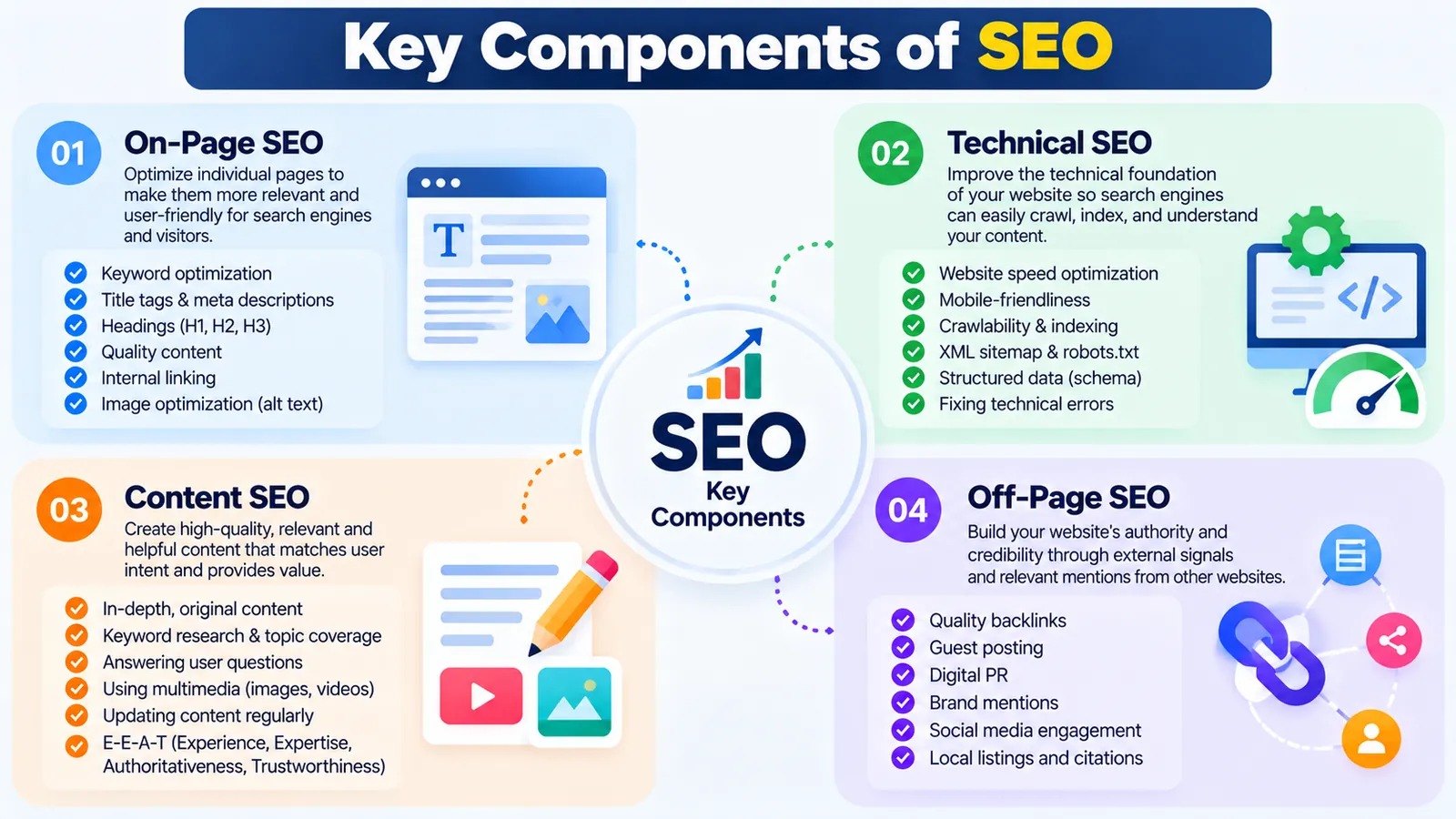
Key Components of SEO
1. On-Page SEO
On-page SEO involves improving page titles, headings, internal links, content structure, and other elements that help users and search engines understand a page.
2. Technical SEO
Technical SEO focuses on crawlability, indexing, mobile usability, site architecture, and other technical foundations.
3. Content SEO
Content SEO involves creating original, accurate, helpful content that addresses search intent and provides value to readers.
4. Off-Page SEO
Off-page SEO includes earning relevant mentions and backlinks through legitimate activities such as digital PR, partnerships, and publishing useful resources.
Example of SEO
Imagine someone searches Google for:
"Best SEO services for small businesses"
A digital marketing agency may appear in the organic search results if its website is relevant, accessible, and competitive for that query.
SEO helps the agency improve its chances of being discovered through those results.
What Is AEO (Answer Engine Optimization)?
Answer Engine Optimization is an approach to making content easier for answer-focused systems to understand, retrieve, and present in response to user questions.
These systems may include AI-powered search experiences, conversational assistants, and other tools that provide direct answers.
Unlike traditional keyword-focused content planning, AEO places particular emphasis on clear explanations, question-based information, factual accuracy, and useful context.
However, AEO is an industry term rather than a separate Google ranking system with its own officially defined checklist.
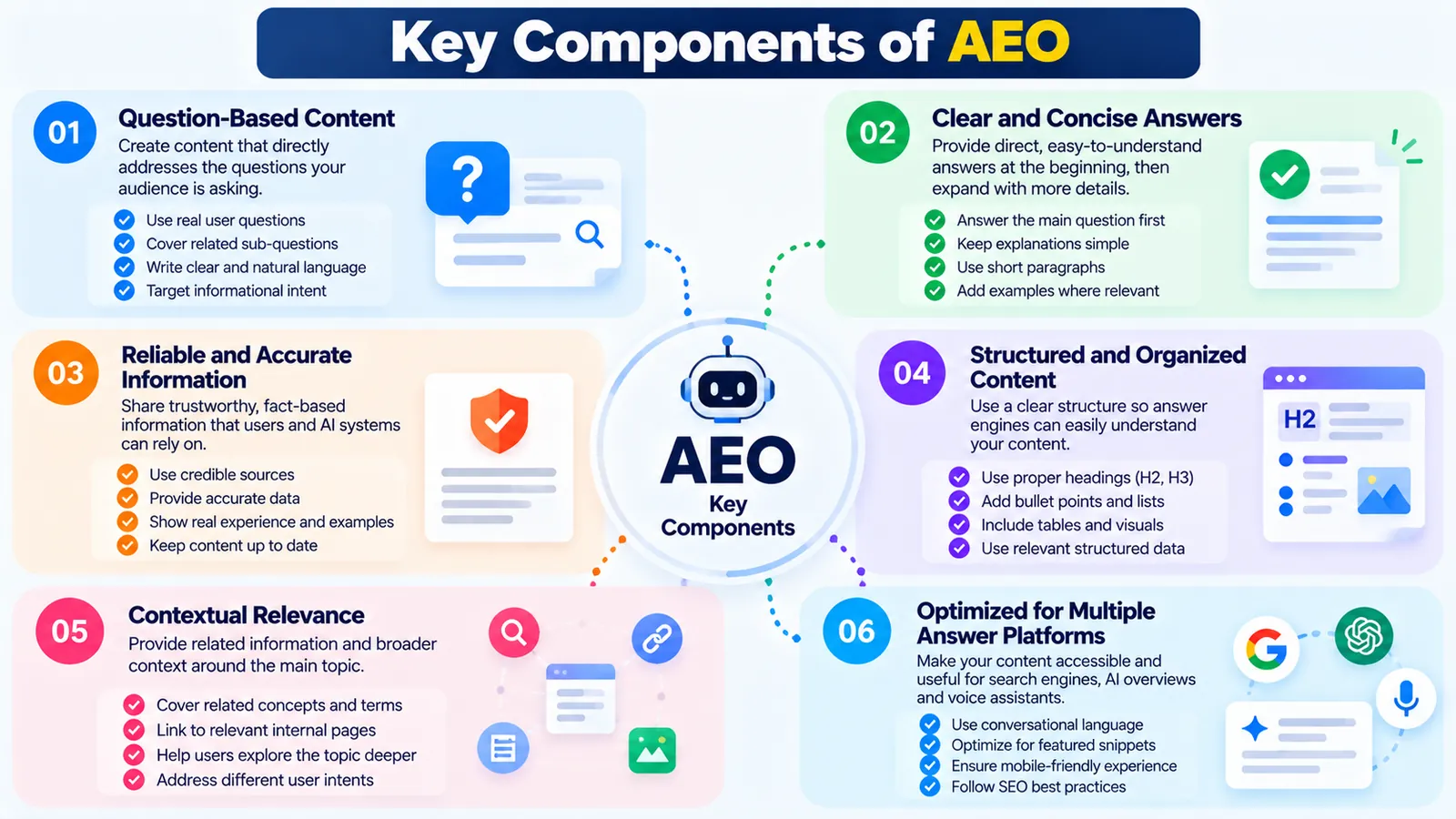
Key Components of AEO
1. Question-Based Content
Create content that directly addresses questions people ask about your industry.
2. Clear and Concise Answers
Provide useful answers near relevant headings before expanding with examples and supporting details.
3. Reliable Information
Support important claims with accurate facts, credible references, and original expertise where appropriate.
4. Structured Content
Use descriptive headings, readable paragraphs, relevant tables, and structured data when it accurately represents eligible content.
5. Contextual Relevance
Explain related concepts and terminology so readers can understand the broader topic.
Example of AEO
Suppose someone asks an AI-powered search tool:
"What is the difference between SEO and AEO?"
A well-written article explaining both concepts, their differences, and practical applications may be useful to the system when it generates an answer.
However, appearing in an AI-generated response is not guaranteed.
SEO vs AEO: Key Differences in 2026
SEO and AEO share important principles, but their emphasis differs.
| Comparison Factor | SEO | AEO |
|---|---|---|
| Full form | Search Engine Optimization | Answer Engine Optimization |
| Main objective | Improve visibility in organic search | Improve usefulness and discoverability for direct-answer experiences |
| Primary focus | Search relevance, accessibility, and user experience | Clear answers, context, and reliable information |
| Typical content | Service pages, guides, blogs, product pages | Direct explanations, FAQs, guides, comparisons |
| Keyword strategy | Search intent and relevant keywords | Natural-language questions and related topics |
| Technical foundation | Crawling, indexing, architecture, performance | Accessible content and established technical SEO fundamentals |
| Common measurements | Organic clicks, impressions, conversions | AI referrals where identifiable, citations where observable, and business outcomes |
| Main challenge | Competing for organic visibility | Limited transparency into answer selection and attribution |
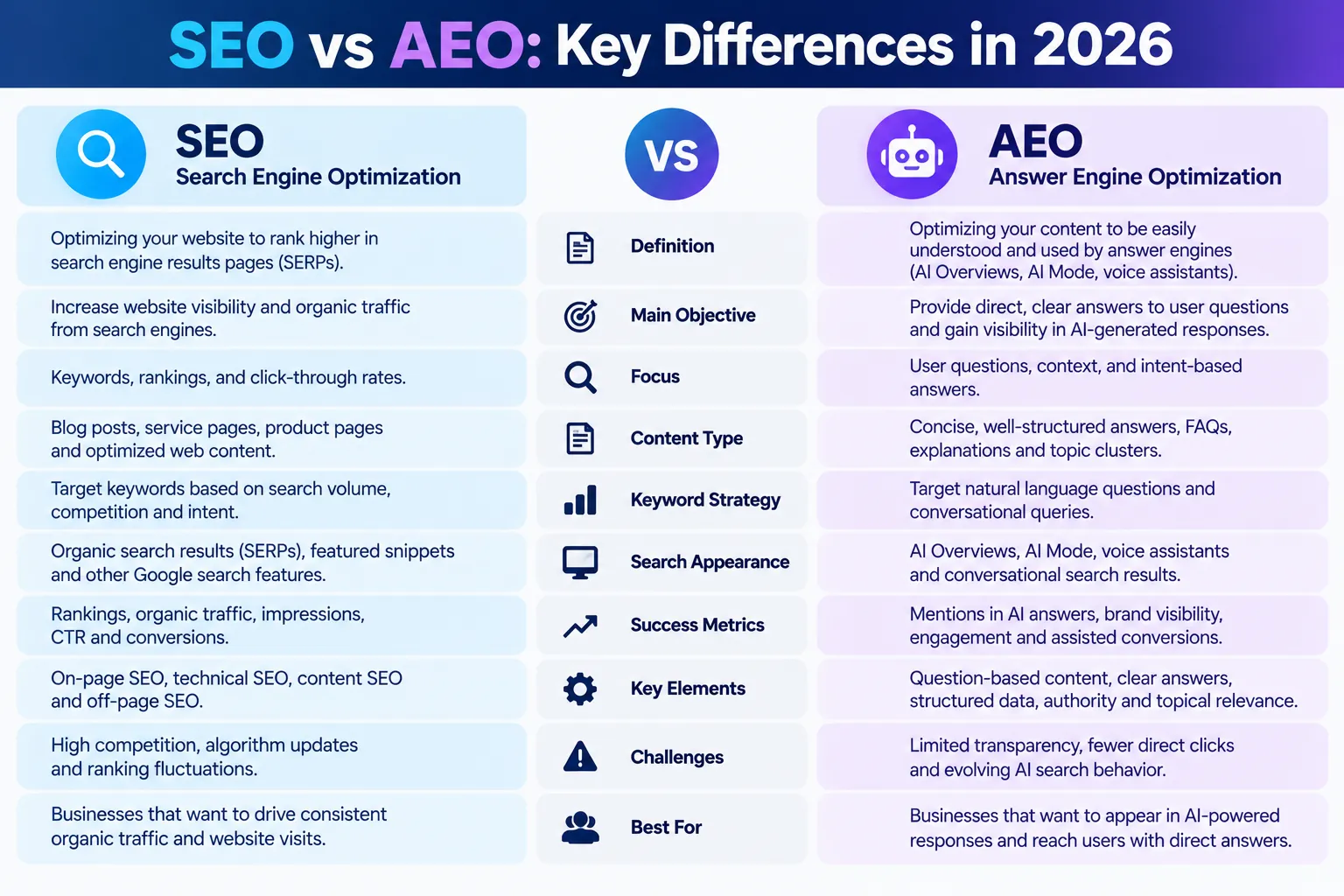
The most important distinction is that SEO supports search discoverability, while AEO emphasizes answering questions effectively.
In practice, the two approaches overlap significantly.
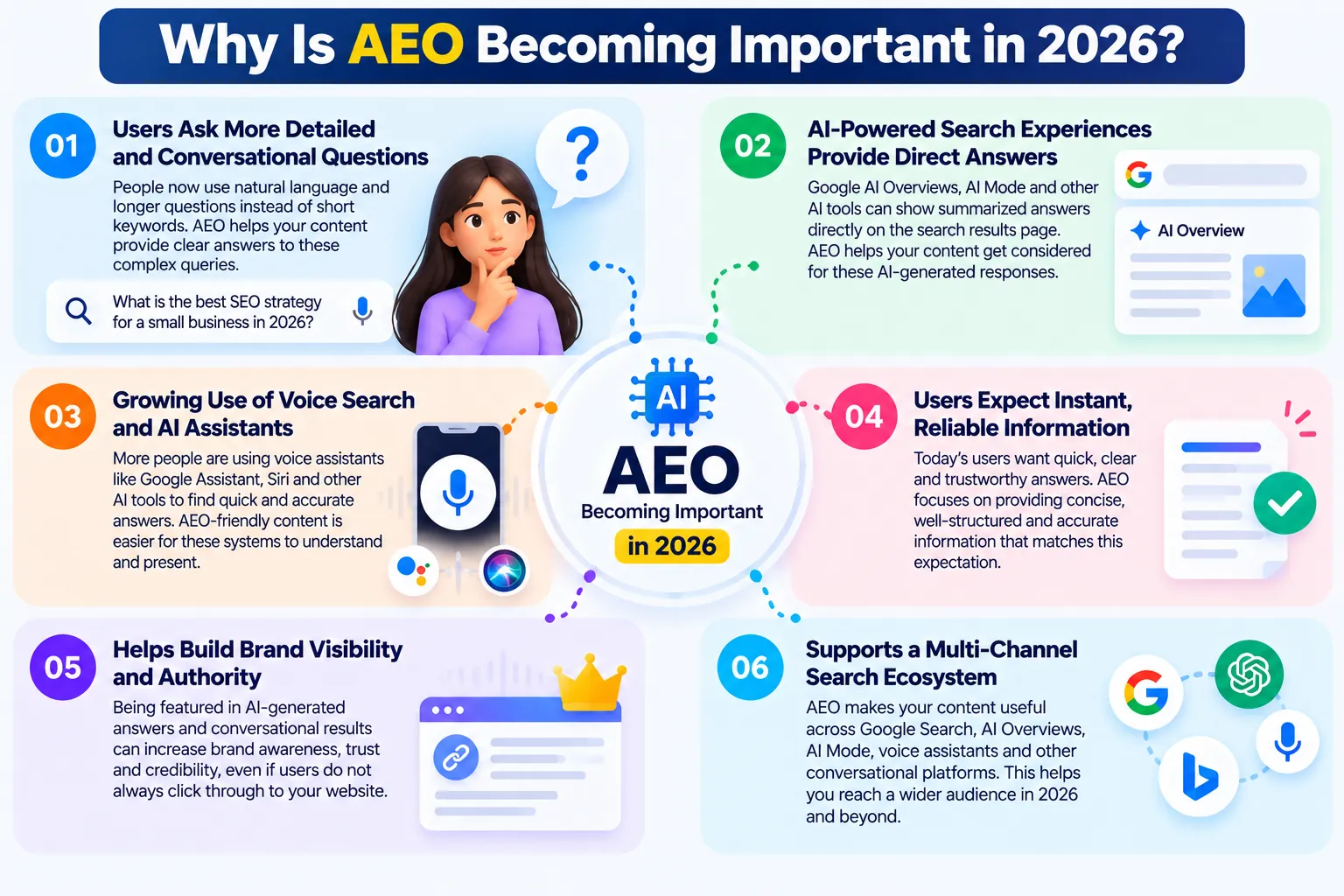
Why Is AEO Becoming Important in 2026?
AI-powered search experiences are influencing how people discover and evaluate information.
Google AI Overviews and AI Mode can provide synthesized answers and links to supporting sources.
This makes clear, reliable, well-organized information valuable for businesses that want to remain discoverable across different search experiences.
1. Users Ask More Detailed Questions
People increasingly use conversational questions rather than relying only on short keyword phrases.
For example:
"Which digital marketing strategy is suitable for a small business with a limited budget?"
Content that addresses the complete question can be more useful than a page that simply repeats the phrase "digital marketing services."
2. Search Experiences Can Provide Direct Answers
AI-powered systems can summarize information and help users explore topics without immediately visiting a website.
Businesses therefore need to think about visibility and credibility alongside traditional click-based performance.
3. Helpful Information Supports Multiple Channels
A useful explanation can serve readers arriving through organic search, social media, email, and AI-powered discovery tools.
This is a practical reason to invest in content quality rather than optimizing exclusively for one search interface.
Does AEO Replace Traditional SEO?
No. AEO does not replace SEO.
Google's official guidance for AI features continues to emphasize foundational SEO practices, including accessible content, indexing eligibility, helpful information, and technical best practices.
A website that cannot be crawled or whose important pages are excluded from indexing may face discoverability limitations in Google Search.
AEO should therefore be treated as a complementary content strategy.
For example, an article about website optimization should still have a descriptive title, logical headings, useful internal links, and accurate information.
Adding a direct answer to a common question can improve the article's usefulness, but it does not eliminate the need for SEO.
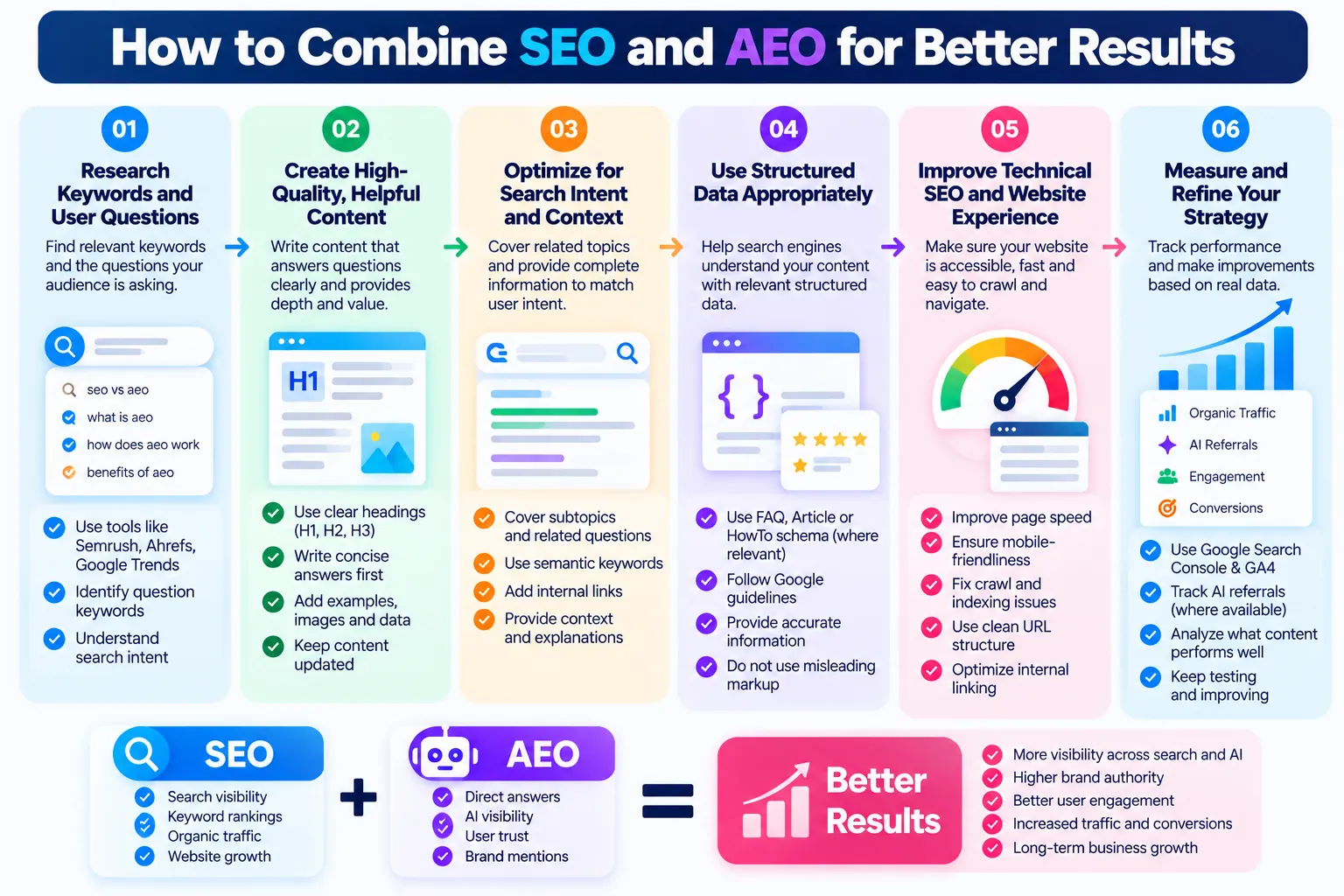
How to Combine SEO and AEO for Better Results
Businesses do not need separate, competing strategies. They can integrate both approaches into their existing content workflows.
1. Research Keywords and User Questions
Begin with relevant keywords using tools such as Google Search Console, Google Trends, Ahrefs, or Semrush.
Then identify questions people ask around those topics.
For example, the keyword "local SEO" might connect to questions such as:
What is local SEO?
How does local SEO work?
How can small businesses improve local rankings?
What is the difference between local SEO and traditional SEO?
Use these questions to develop useful sections rather than creating repetitive pages.
2. Write Direct Answers Under Relevant Headings
Use descriptive H2 and H3 headings.
For example:
What Is the Difference Between SEO and AEO?
SEO helps improve a website's visibility in organic search, while AEO emphasizes presenting information clearly for systems that deliver direct answers. Both depend on useful, trustworthy content.
After the direct explanation, provide examples and practical guidance.
3. Strengthen Content Credibility
Publish information that readers can verify.
Include original examples, genuine experience, accurate sources, and clear explanations.
If discussing performance results, use real data and explain how it was measured.
Avoid unsupported claims about guaranteed rankings or AI citations.
4. Use Structured Data Appropriately
Structured data can help Google understand eligible content and enable supported search features.
However, Google does not require special AI-specific schema markup for AI Overviews or AI Mode.
Do not assume adding FAQ schema automatically makes a page appear in an AI-generated answer.
5. Improve Technical SEO and Internal Linking
Ensure important pages are accessible, mobile-friendly, and connected through useful internal links.
Related articles should help readers explore topics naturally.
For example, an SEO vs AEO article could link to guides about keyword research, technical SEO, Google AI Mode, and content optimization.
6. Measure Outcomes Beyond Rankings
Track organic performance using Google Search Console and user behavior using Google Analytics 4.
Where identifiable, examine referral traffic from AI-powered platforms.
Also measure business outcomes such as inquiries, qualified leads, purchases, and consultation bookings.
Do not assume every traffic change is caused by AI search.
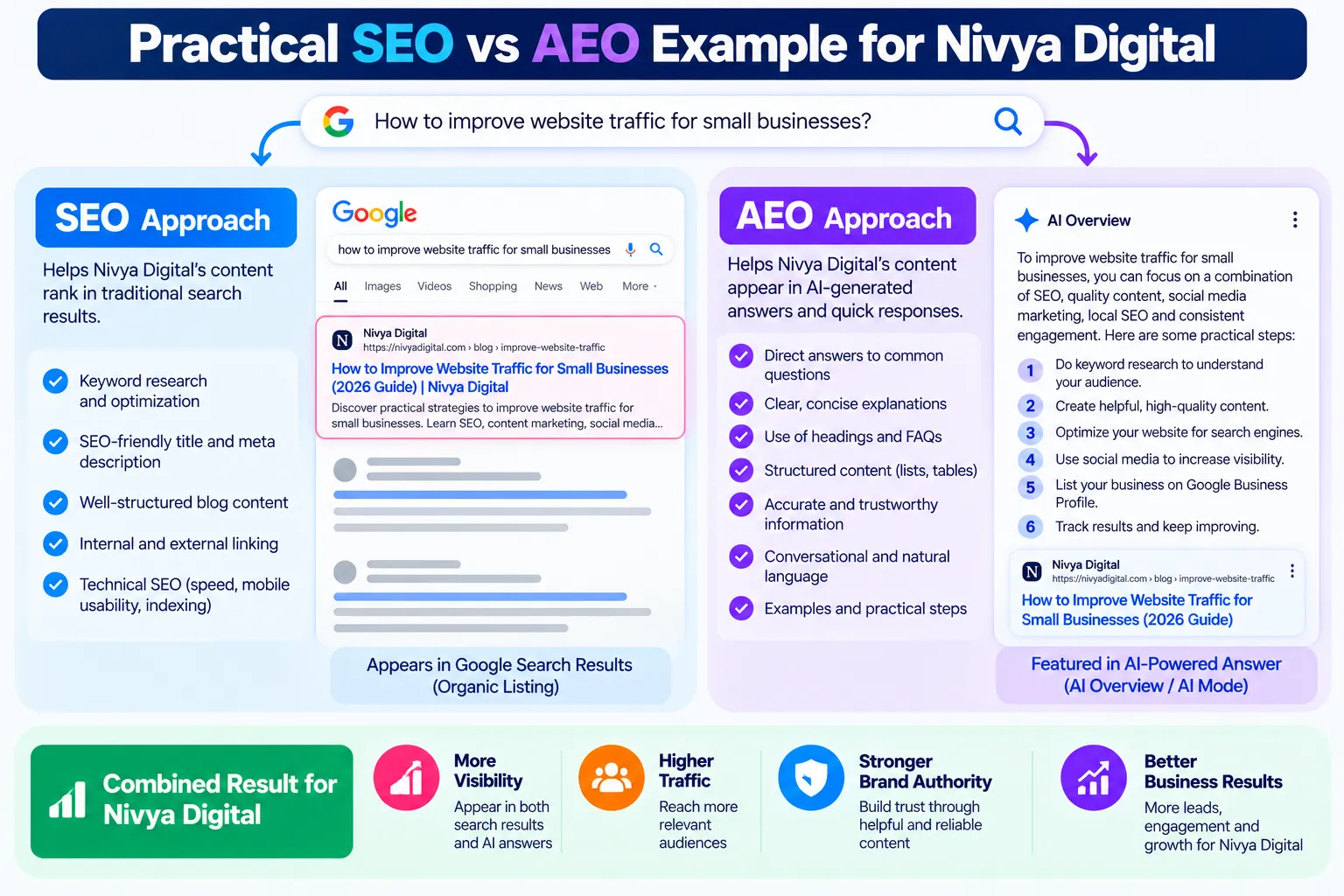
Practical SEO vs AEO Example for Nivya Digital
Imagine Nivya Digital publishes a guide titled:
"How to Improve Website Traffic for Small Businesses"
A traditional SEO approach would include keyword research, an optimized title, helpful content, internal links, and technical improvements.
An AEO-focused approach would strengthen the same article by answering questions such as:
Why is my website traffic decreasing?
How can I increase organic traffic?
How long does SEO take?
What is the difference between SEO and paid advertising?
The article could also include a comparison table, a practical checklist, and links to reliable resources.
Together, these improvements create a more comprehensive experience for readers.
The goal is not to force AI systems to cite the page. It is to publish information that genuinely helps people make decisions.
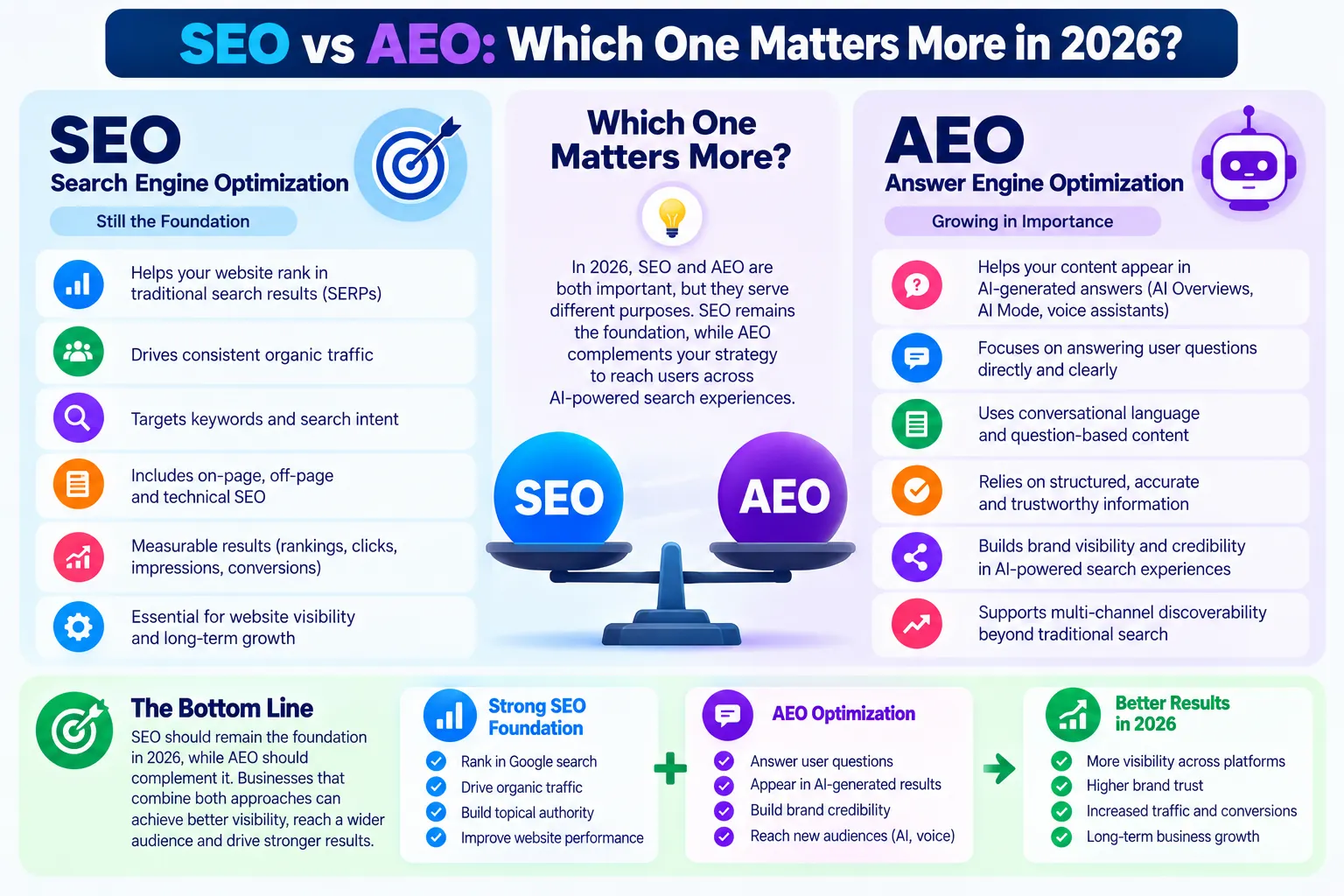
SEO vs AEO: Which One Matters More in 2026?
For most businesses, SEO should remain the foundation, while AEO should complement it.
SEO supports website accessibility, organic discoverability, and long-term content performance.
AEO encourages businesses to make their information easier to understand and more useful for question-driven search experiences.
The right balance depends on the business model.
An e-commerce website may prioritize product discoverability, technical SEO, and conversion-focused content.
A consulting business may benefit from detailed explanations, service comparisons, and expert answers to common questions.
Both can benefit from integrating SEO and AEO.
Common SEO and AEO Mistakes to Avoid
Businesses should avoid treating AEO as a shortcut to AI visibility.
Common mistakes include:
Publishing repetitive AI-generated content without meaningful review
Ignoring traditional SEO fundamentals
Adding unsupported claims or invented statistics
Stuffing questions and keywords into every heading
Using misleading structured data
Measuring success only through unverified AI visibility scores
A strong strategy prioritizes helpful content, technical accessibility, and measurable business outcomes.
The Future of SEO and AEO
Search experiences will continue evolving as AI-powered tools become more capable.
However, the fundamental purpose of search remains consistent: helping people find useful, relevant, and reliable information.
SEO professionals will need to combine keyword research with deeper understanding of customer questions, content quality, and user journeys.
Rather than choosing between SEO and AEO, businesses should build flexible strategies that serve readers across multiple discovery channels.
Final Thoughts
The SEO vs AEO discussion is not about choosing one strategy and abandoning the other.
SEO helps websites become discoverable in organic search, while AEO emphasizes clear, accurate answers that are useful in AI-powered and question-driven experiences.
In 2026, businesses should focus on combining both approaches through high-quality content, relevant keyword research, technical optimization, and meaningful performance measurement.
At Nivya Digital, we help businesses understand evolving search trends and develop practical digital marketing strategies designed around their customers' needs.
Comments (0)
No comments yet
Start the discussion by sharing your perspective