
Every business wants to attract the right customers, increase website traffic, and generate more leads. But when it comes to search engine marketing, one question often comes up:
Should you invest in SEO or Google Ads in 2026?
Search engine optimization (SEO) helps businesses improve their visibility in organic search results. Google Ads allows advertisers to compete for paid placements and reach relevant audiences through advertising campaigns.
Both strategies can support business growth, but they differ in cost, speed, targeting, long-term value, and measurement.
Whether you run a startup in India, an ecommerce business in the United States, or a service company targeting customers across the UK, Canada, Australia, or other international markets, understanding these differences can help you make a more informed marketing decision.
In this guide, we compare SEO vs Google Ads in 2026, including costs, traffic, leads, return on investment (ROI), and the situations where using both may be the better choice.
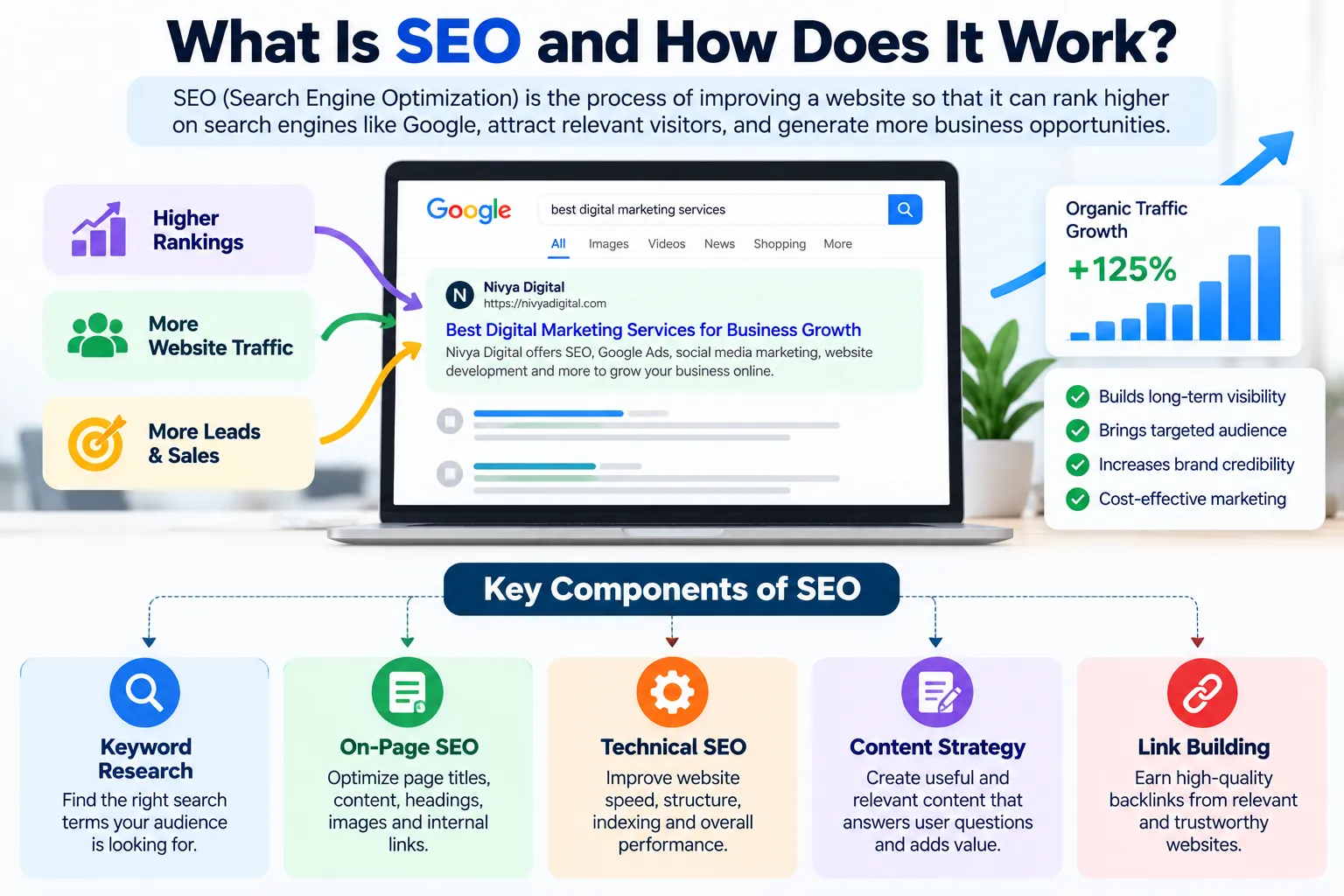
What Is SEO and How Does It Work?
Search engine optimization is the process of improving a website so search engines can better understand its content and people can discover relevant pages through organic search.
SEO typically involves keyword research, technical improvements, content optimization, internal linking, and ongoing performance analysis.
Key Components of SEO
Keyword research: Identifying relevant searches and understanding what users want.
On-page SEO: Improving page titles, headings, content, and internal links.
Technical SEO: Addressing crawling, indexing, site architecture, and website performance.
Content strategy: Creating useful pages that answer customer questions and support business goals.
Local and international SEO: Adapting search strategies to relevant geographic markets.
SEO does not require paying Google for each organic click. However, professional SEO still requires time, expertise, content production, and sometimes development resources.
Example
A website development agency may optimize its service page for searches such as "WordPress website development services" and publish helpful articles about hiring developers and comparing website platforms.
Over time, these pages may attract visitors looking for relevant information or services.
However, rankings and traffic are never guaranteed.
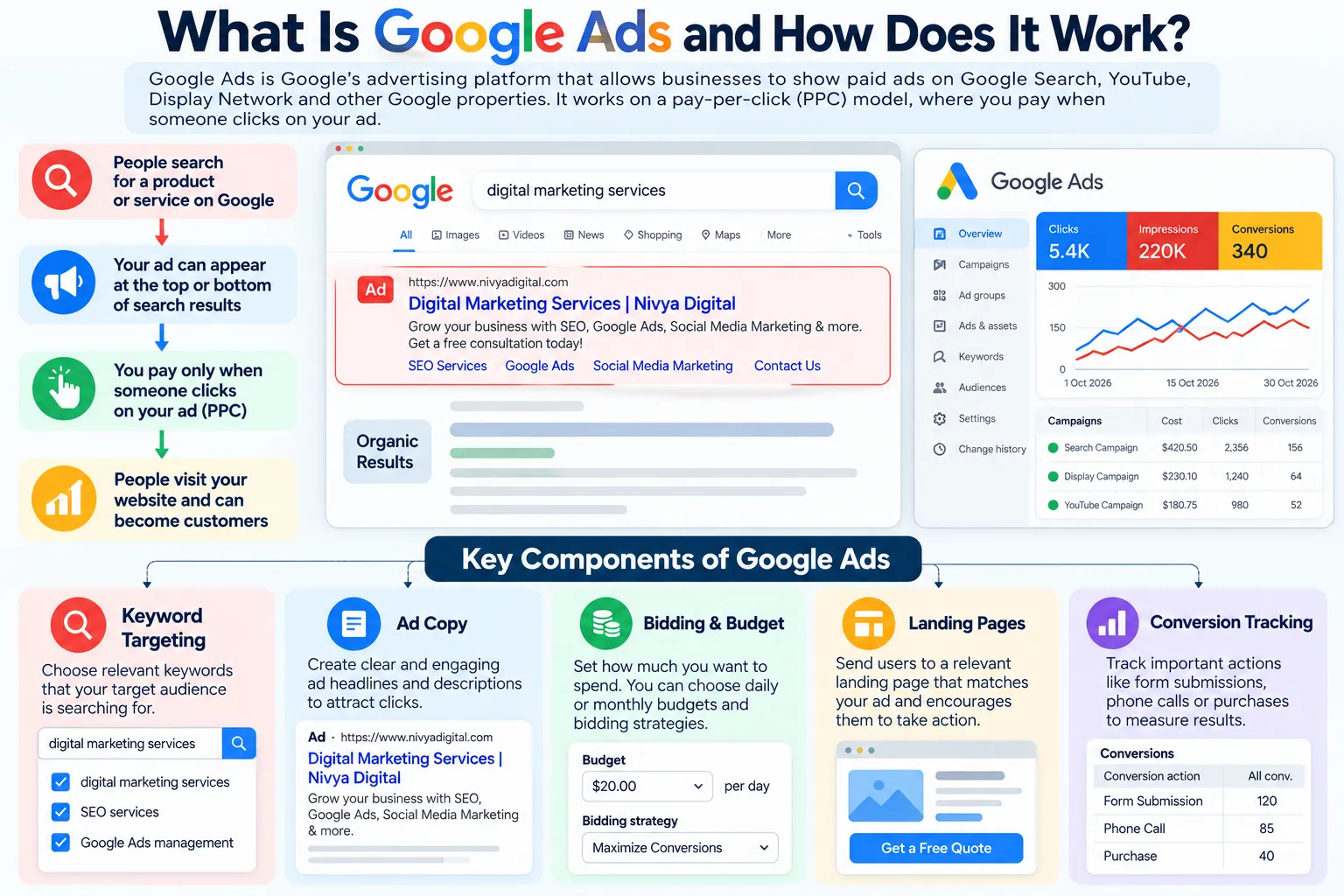
What Is Google Ads and How Does It Work?
Google Ads is Google's advertising platform, allowing businesses to create campaigns that reach people across eligible Google advertising placements.
For Search campaigns, advertisers can target relevant search queries and compete in an ad auction.
Google Ads uses factors such as bids, ad quality, and relevance to determine which ads appear and where.
Key Components of Google Ads
Keyword targeting: Reaching people searching for relevant terms.
Ad copy: Creating clear messages that encourage appropriate actions.
Bidding and budgets: Managing how much a business is willing to spend.
Landing pages: Sending visitors to relevant pages designed around their needs.
Conversion tracking: Measuring actions such as purchases, form submissions, and qualified inquiries.
Example
A digital marketing company might run Search ads targeting "SEO services for small businesses."
When someone searches for that service, the business may become eligible to show an ad.
The advertiser can begin receiving traffic once an approved campaign starts serving, but visibility, clicks, and leads are not guaranteed.
SEO vs Google Ads: Key Differences at a Glance
| Factor | SEO | Google Ads |
|---|---|---|
| Traffic Source | Organic search | Paid advertising |
| Payment Model | SEO work and operational costs | Advertising spend, plus any management costs |
| Speed | Usually gradual | Can generate traffic after campaign activation |
| Visibility | Depends on organic search systems | Depends on auction, eligibility, targeting, and budget |
| Targeting | Search intent and content relevance | Campaign settings, audiences, keywords, and locations |
| Long-Term Value | Useful pages may continue attracting visitors | Paid traffic generally declines when ads stop |
| Main Risk | Uncertain rankings and time to results | Advertising costs without sufficient conversions |
| Measurement | Search visibility, organic leads, revenue | CPC, CPA, conversions, ROAS |
| Best Use | Building ongoing organic visibility | Testing demand and pursuing near-term opportunities |
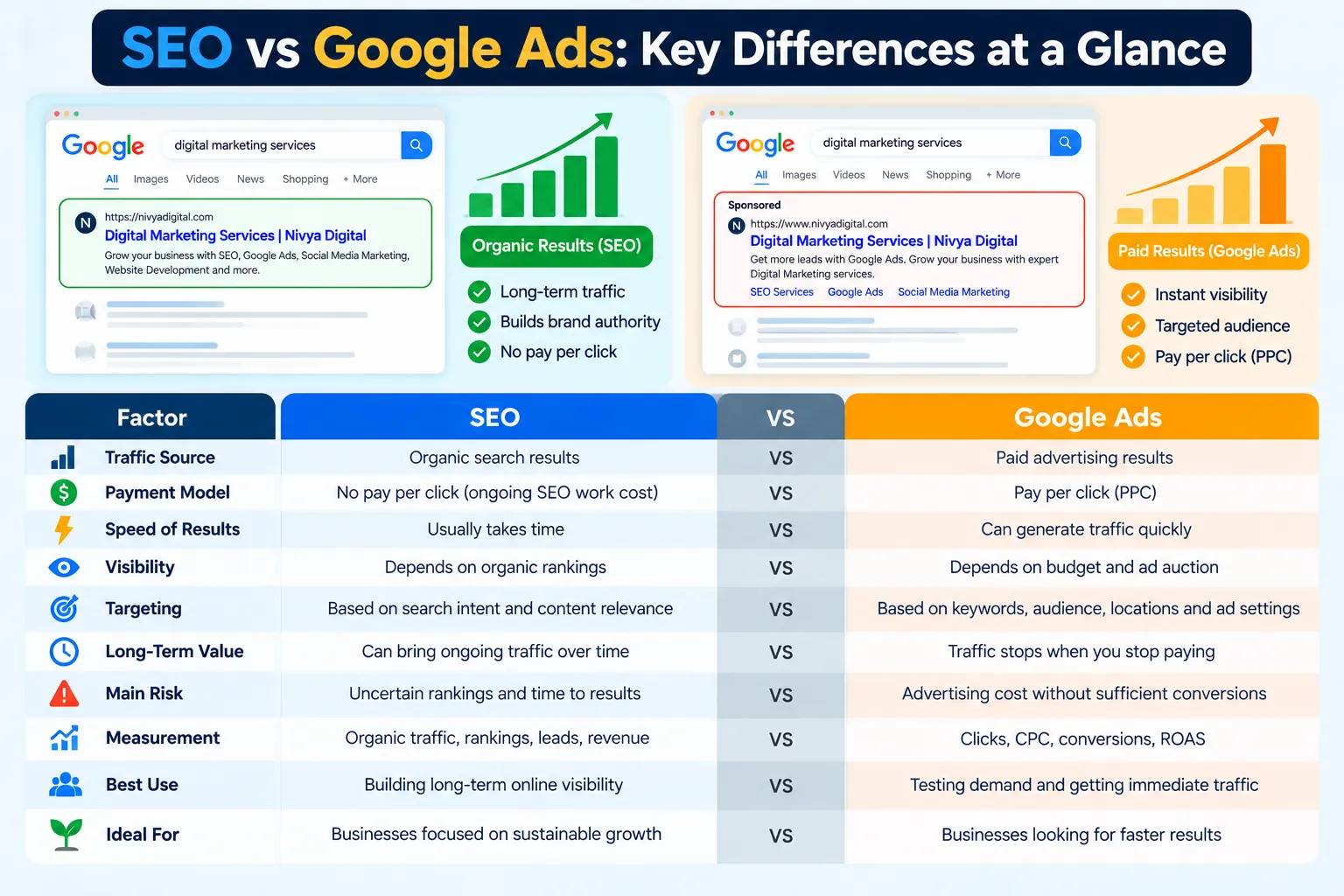
Neither channel is universally better. The right choice depends on your goals and resources.
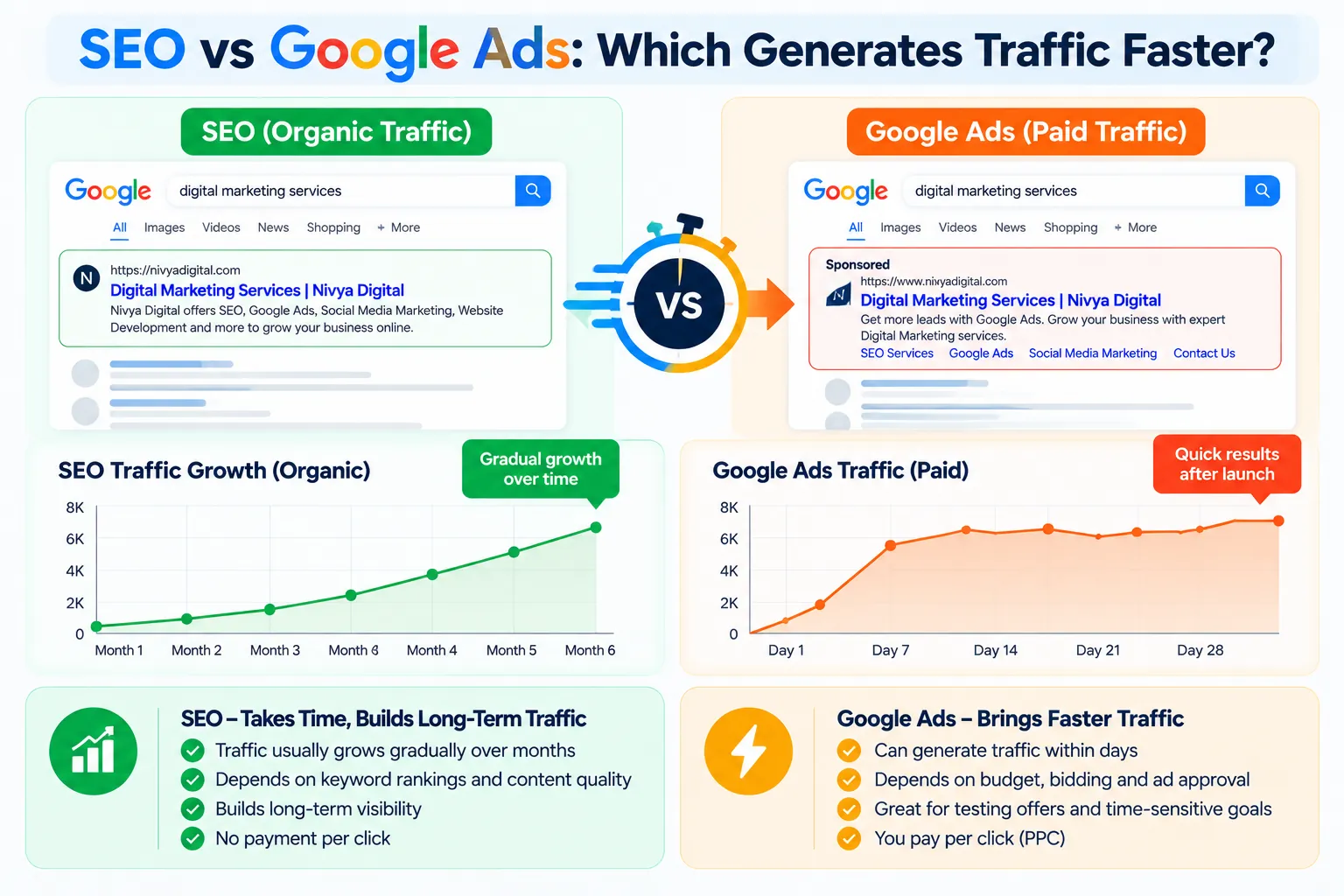
SEO vs Google Ads: Which Generates Traffic Faster?
Google Ads can generate traffic sooner because eligible campaigns can start serving after setup and approval.
SEO generally requires more time to implement improvements, publish useful content, and allow search engines to discover and evaluate pages.
For a newly launched website, organic visibility may develop gradually.
An established website with strong existing pages may see improvements sooner.
When Google Ads May Be Better
Google Ads can be useful for:
New product launches
Seasonal promotions
Time-sensitive offers
Testing landing pages
Reaching high-intent search audiences
When SEO May Be Better
SEO can be useful for:
Building a long-term content library
Improving service-page visibility
Answering recurring customer questions
Supporting brand discovery
Reducing dependence on a single paid traffic channel
Verdict: Google Ads generally offers faster opportunities for paid traffic, while SEO is better suited to building organic visibility over time.
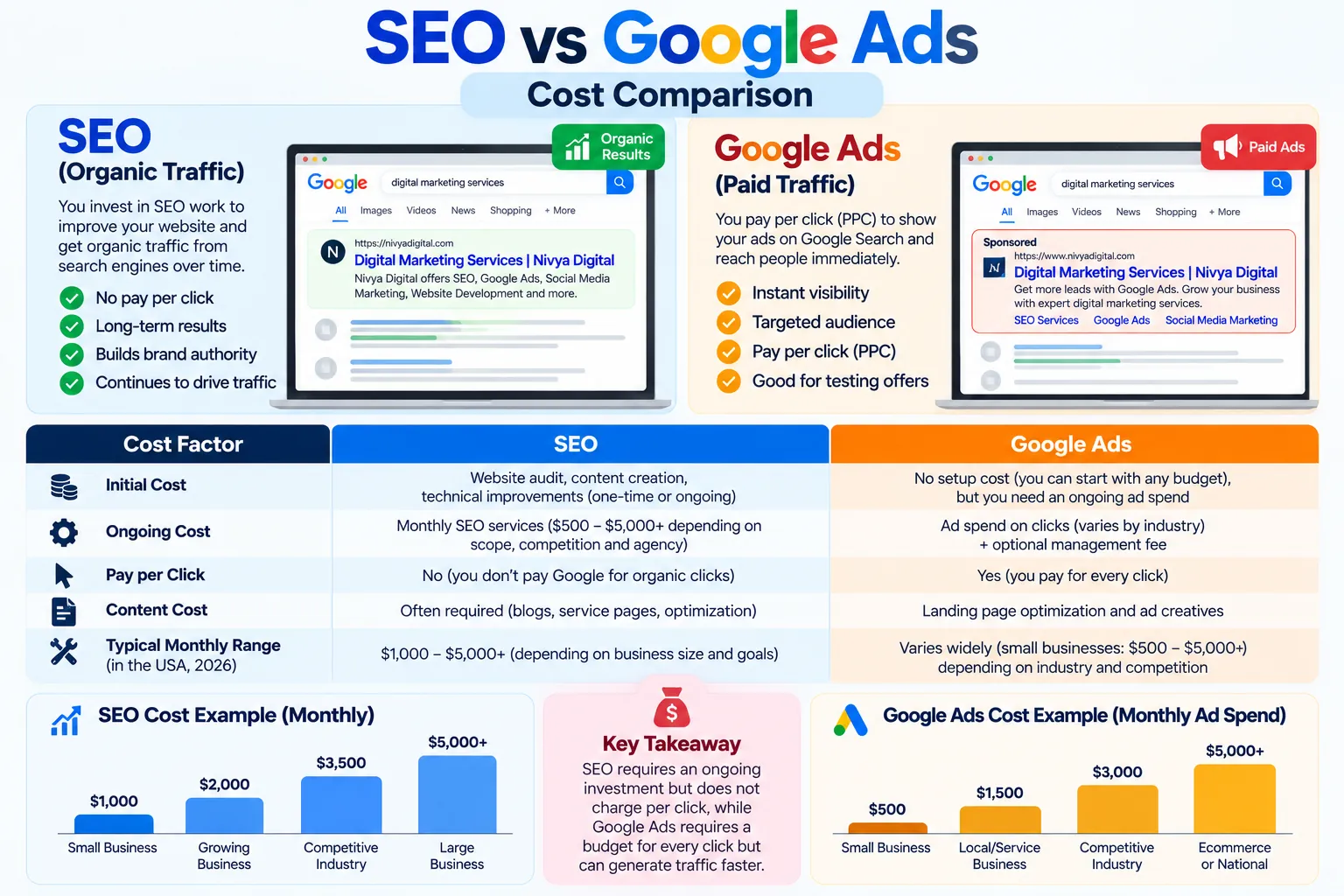
SEO vs Google Ads Cost in 2026: Which Is More Affordable?
The cost comparison is more complicated than "SEO is free and Google Ads is expensive."
SEO does not charge businesses per organic click, but creating and maintaining an effective SEO program requires resources.
Google Ads involves advertising spend and may also require management fees, landing-page development, and conversion tracking.
Understanding SEO Costs
SEO expenses may include:
Agency or consultant fees
Content creation
Technical improvements
Website development
Analytics and SEO software
Ongoing optimization
Understanding Google Ads Costs
Google Ads expenses may include:
Advertising budget
Campaign management
Creative production
Landing-page improvements
Tracking implementation
Search campaign costs often use a cost-per-click model, although Google Ads supports other pricing models depending on the campaign type.
SEO vs Google Ads Cost Comparison
| Cost Factor | SEO | Google Ads |
|---|---|---|
| Pay Google per organic click | No | Not applicable to paid clicks |
| Professional management | Optional but often useful | Optional but often useful |
| Content or landing-page work | Often required | Often required |
| Ongoing investment | Usually needed | Needed while campaigns run |
| Cost predictability | Depends on scope | Budgets can be set, but results vary |
Illustrative Example
Imagine a business has a monthly marketing budget of $2,000.
It might allocate $1,200 to SEO work and $800 to advertising spend.
This is only an example of budget allocation, not a recommended split for every company.
A business operating in a highly competitive advertising market may need a different approach.
Verdict: Neither strategy is automatically cheaper. Compare total costs against qualified leads, customer value, and business outcomes.
SEO vs Google Ads for Lead Generation: Which Performs Better?
Lead generation depends on the quality of your audience, offer, website experience, and follow-up process.
SEO can attract potential customers through service pages, comparison articles, and helpful content.
Google Ads can reach people searching for specific products or services and direct them to relevant landing pages.
Example: SEO Lead Generation
A company publishes an article titled "How to Hire an SEO Agency in 2026."
The article helps business owners evaluate providers and links to a relevant SEO service page.
Visitors who are actively considering SEO services may submit an inquiry.
Example: Google Ads Lead Generation
The same company runs a Search campaign for relevant commercial keywords.
Visitors reach a dedicated landing page with a clear offer and contact form.
Some may become qualified leads.
What Actually Determines Lead Quality?
Lead quality depends on several factors:
Search intent
Geographic targeting
Service relevance
Landing-page experience
Pricing expectations
Trust and credibility
Conversion tracking
Sales follow-up
Verdict: Both channels can generate qualified leads. Businesses should compare lead quality and acquisition cost rather than assuming one channel always converts better.
SEO vs Google Ads ROI: Which Offers Better Long-Term Value?
Return on investment measures the relationship between the financial value generated and the cost of an activity.
For marketing, businesses should distinguish revenue from profit and consider all relevant expenses.
SEO ROI Considerations
SEO may create assets that continue providing value after the initial work.
A useful service page or article may attract relevant visitors over an extended period.
However, organic performance can fluctuate, and content may need ongoing updates.
Google Ads ROI Considerations
Google Ads provides campaign-level performance data that can support budget decisions.
Businesses can review conversion costs, revenue attribution, and return on ad spend.
However, ad spend must continue for paid campaigns to keep generating traffic.
Example: Comparing Acquisition Costs
Consider this hypothetical scenario:
| Metric | SEO | Google Ads |
|---|---|---|
| Monthly Channel Cost | $1,500 | $1,500 |
| Qualified Leads | 15 | 20 |
| Cost per Qualified Lead | $100 | $75 |
In this illustration, Google Ads has the lower cost per qualified lead.
But this does not automatically mean it delivers better profitability.
If SEO leads close at a higher rate or generate greater customer value, the final outcome could be different.
Businesses should evaluate:
Customer Acquisition Cost = Total Relevant Acquisition Costs ÷ New Customers Acquired
They should also consider customer lifetime value, gross profit, and attribution limitations.
Verdict: The better ROI depends on actual business performance, not the marketing channel alone.
SEO vs Google Ads for Small Businesses
Small businesses often have limited marketing resources and need to prioritize carefully.
Choose SEO When:
Your services have recurring search demand.
You can invest in improving your website over time.
You want to build a library of useful content.
Your business relies on ongoing search visibility.
Choose Google Ads When:
You need to test demand for a new offer.
You have a clear landing page and conversion goal.
Your business has sufficient budget for experimentation.
You want to evaluate specific high-intent keywords.
Choose Both When:
You need near-term traffic and long-term organic visibility.
You can measure leads and customer acquisition costs.
You have enough resources to manage both effectively.
A small business should avoid spreading its budget too thinly across channels that it cannot properly maintain.
SEO vs Google Ads for Ecommerce Businesses
Ecommerce companies can benefit from both strategies.
SEO may help improve product-category pages, buying guides, and other relevant content.
Google Ads may help promote products through eligible Search, Shopping, and other advertising campaigns.
For example, an online furniture store could use SEO to develop useful category pages and guides about choosing furniture.
At the same time, it could run relevant product advertising campaigns.
The business should compare organic revenue, paid campaign profitability, customer acquisition costs, and repeat purchases.
The best approach depends on product margins, competition, inventory, and customer demand.
SEO vs Google Ads for International Businesses
Companies targeting multiple countries need to consider more than traffic volume.
Customer behavior, terminology, search demand, advertising competition, and conversion expectations may differ between markets.
International SEO Considerations
Businesses should evaluate country-specific keyword research, relevant content, regional landing pages where appropriate, and international website structure.
International Google Ads Considerations
Advertisers can configure geographic and language targeting, but should review location settings, audience relevance, local competition, and campaign performance carefully.
Example
A company providing website development services to businesses in the USA, UK, Canada, Australia, and India may need different landing-page messaging and pricing explanations.
It should not assume that a campaign or keyword strategy performing well in one country will produce the same results elsewhere.
Verdict: International businesses can use both SEO and Google Ads, but each target market needs appropriate research and performance evaluation.
How AI Is Changing SEO and Google Ads in 2026
AI-powered features are influencing how search information is presented and how advertising campaigns are managed.
For SEO, businesses should continue focusing on useful, reliable, accessible content and clear website structure.
For Google Ads, automated bidding and AI-assisted campaign features can support campaign management.
However, automation does not eliminate the need for accurate conversion tracking, relevant creative assets, appropriate budgets, and human oversight.
Businesses should avoid assuming that AI guarantees better rankings or advertising results.
A strong marketing strategy uses technology to support clear business objectives rather than relying on automation alone.
Can SEO and Google Ads Work Together?
Yes. In many cases, using both channels can provide complementary benefits.
Google Ads can help businesses test demand and messaging, while SEO can support ongoing organic visibility.
A Practical Combined Strategy
Step 1: Identify commercial keywords. Research searches related to your products and services.
Step 2: Improve your landing pages. Make sure visitors can understand your offer and take the next step.
Step 3: Launch a focused advertising test. Start with clearly defined conversion goals and an appropriate budget.
Step 4: Build supporting SEO content. Create useful service pages, comparison guides, and educational resources.
Step 5: Measure results. Review qualified leads, customer acquisition costs, and conversion performance.
Step 6: Adjust your investment. Allocate resources based on evidence rather than assumptions.
Insights from paid search may inform content priorities, but advertising does not directly improve organic Google rankings.
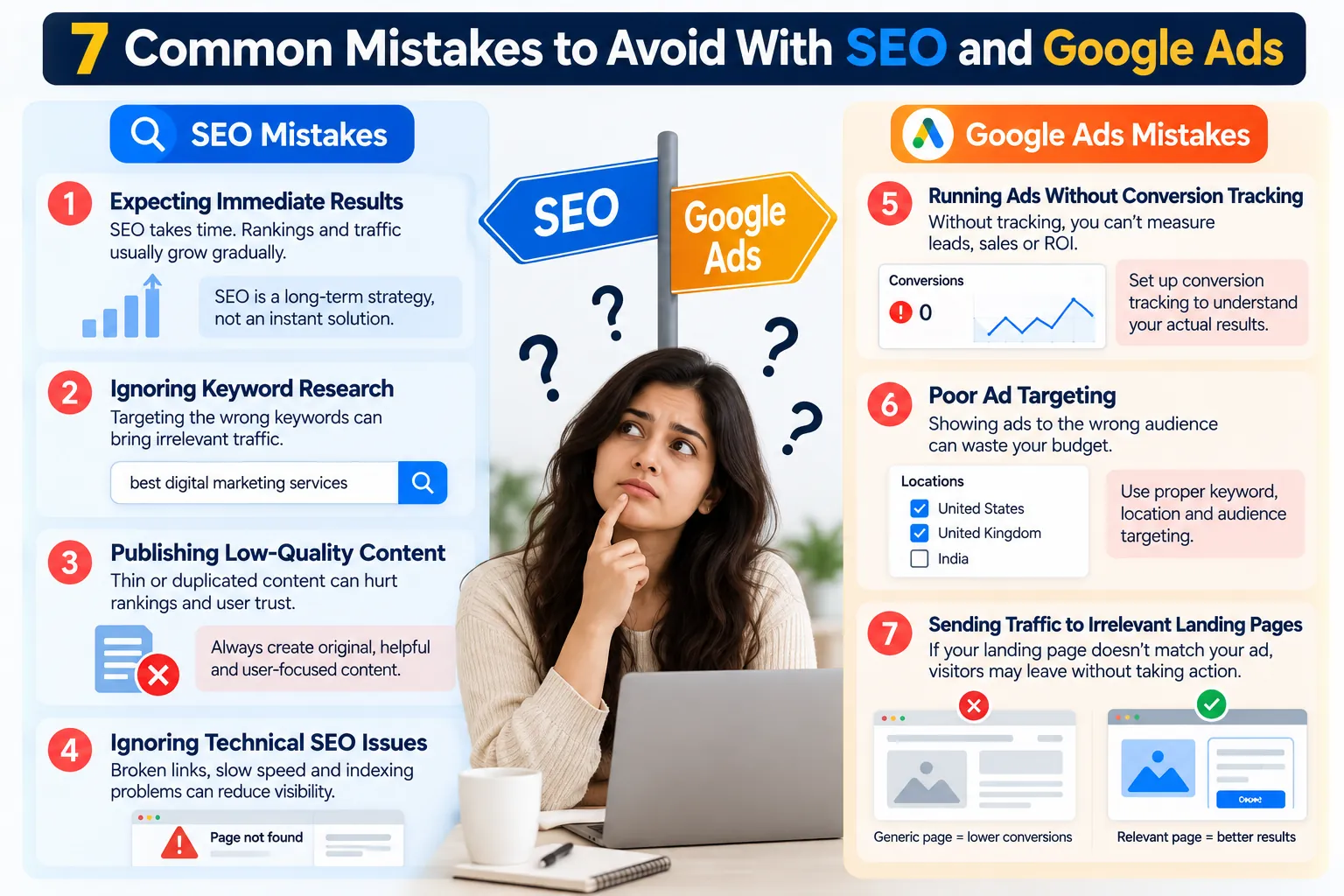
7 Common Mistakes to Avoid With SEO and Google Ads
1. Expecting Immediate SEO Results
SEO usually requires ongoing work and patience.
2. Running Ads Without Conversion Tracking
Without reliable tracking, it becomes difficult to understand campaign performance.
3. Targeting Irrelevant Keywords
Traffic from the wrong audience may produce few meaningful inquiries.
4. Ignoring Landing-Page Quality
A poor website experience can reduce the value of both organic and paid visits.
5. Comparing Traffic Instead of Qualified Leads
More visitors do not necessarily mean more customers.
6. Stopping SEO After Initial Improvements
Organic performance needs monitoring and occasional updates.
7. Assuming Paid Ads Improve Organic Rankings
Google keeps paid advertising and organic search ranking separate.
SEO vs Google Ads: Which Should You Choose in 2026?
The right decision depends on your business situation.
| Business Goal | Strategy to Consider |
|---|---|
| Build long-term organic visibility | SEO |
| Test a new offer quickly | Google Ads |
| Improve existing service pages | SEO |
| Promote a time-sensitive campaign | Google Ads |
| Reduce dependence on paid traffic | SEO |
| Reach specific commercial search audiences | Google Ads |
| Support both immediate and long-term goals | SEO + Google Ads |
There is no universal winner.
Businesses should choose based on their budget, competition, timeline, and ability to measure meaningful outcomes.
How Nivya Digital Can Help
At Nivya Digital, we offer SEO, Google Ads, content marketing, website development, and other digital marketing services.
Businesses often need support deciding how to allocate their marketing budgets and which improvements to prioritize.
Whether you are targeting customers in India or exploring international markets, a suitable strategy should begin with your business goals, website condition, and target audience.
If you are comparing SEO and Google Ads for your business, Nivya Digital can help you discuss your requirements and explore available service options.
Looking for SEO or Google Ads support?
Visit Nivya Digital to explore our services and request a consultation.
Final Thoughts
The SEO vs Google Ads debate is not about choosing a universally superior marketing channel.
SEO helps businesses develop organic search visibility, while Google Ads offers paid advertising opportunities with controllable budgets and measurable campaign performance.
For some companies, SEO will be the priority. Others may benefit from Google Ads first. Businesses with sufficient resources may find that combining both approaches supports a more balanced strategy.
The best decision is the one that fits your customers, budget, goals, and actual results.
If you need help evaluating your search marketing strategy, visit Nivya Digital to discuss your business requirements.
Comments (1)
A helpful comparison of SEO and Google Ads for businesses looking to increase traffic, generate quality leads, and improve ROI in 2026. A practical read for choosing the right digital marketing strategy.