
Last updated: October 22, 2026
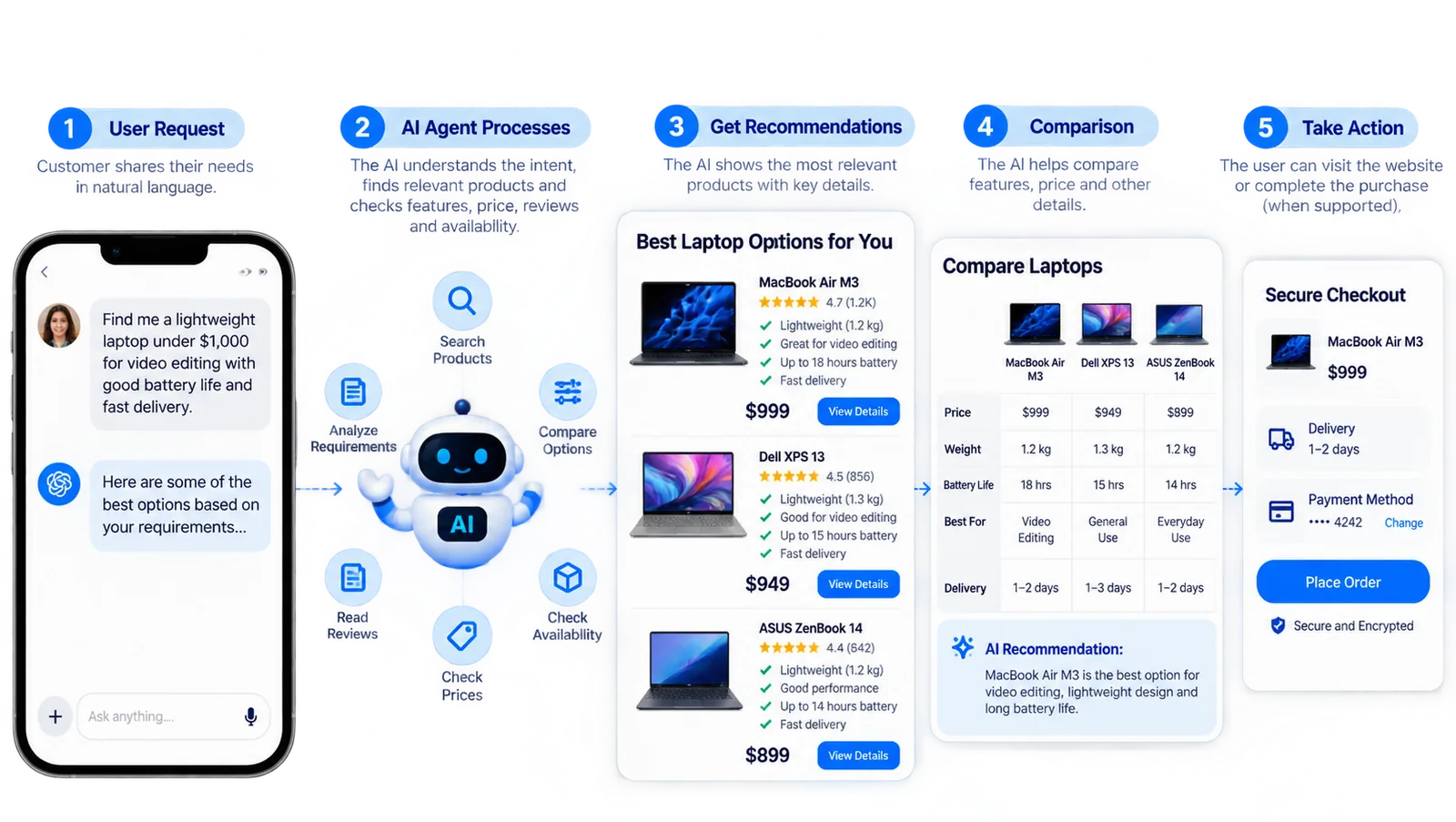
Imagine telling an AI assistant:
"Find me a lightweight laptop under $1,000, compare the best options for video editing, check delivery availability, and help me choose the right one."
Instead of opening multiple websites, reading dozens of product reviews, and manually comparing specifications, you could receive a personalized shortlist within a single conversation.
This is the direction ecommerce is moving toward with agentic commerce.
AI-powered shopping assistants are changing how consumers discover products, compare brands, and make purchasing decisions. For online businesses, this creates an important question: What happens when an AI assistant influences which products customers see before they visit a website?
Traditional search engine optimization remains valuable, but businesses increasingly need to think about product data, AI discovery, accurate inventory information, and customer trust.
In this guide, we'll explore what agentic commerce means in 2026, how AI shopping agents work, how they differ from traditional ecommerce, and what businesses can do to prepare.
1. What Is Agentic Commerce?
Agentic commerce is an approach to online shopping in which artificial intelligence systems help users complete shopping-related tasks, potentially including product research, comparisons, recommendations, and purchasing actions.
Unlike a traditional search engine that primarily returns results for users to explore, an AI shopping agent can interpret a broader request and assist with multiple steps.
For example, someone might ask:
"Find running shoes suitable for beginners, under $120, with good cushioning and delivery available this week."
An AI shopping assistant may help identify relevant products, compare their features, and direct the shopper toward an available purchase option.
More advanced systems may support additional actions through authorized merchant integrations.
However, not every AI shopping assistant can complete purchases autonomously. Capabilities vary by platform, retailer, country, and supported integrations.
What Makes Agentic Commerce Different?
Agentic commerce brings several capabilities together:
Conversational product discovery
Personalized product comparisons
Multi-step shopping assistance
Access to structured product information
Availability and pricing checks where supported
Assisted checkout or purchasing workflows where available
The objective is to make shopping more convenient while helping customers make informed decisions.
2. How Do AI Shopping Agents Work?
AI shopping agents combine conversational interfaces with product information and, in some cases, external tools or commerce integrations.
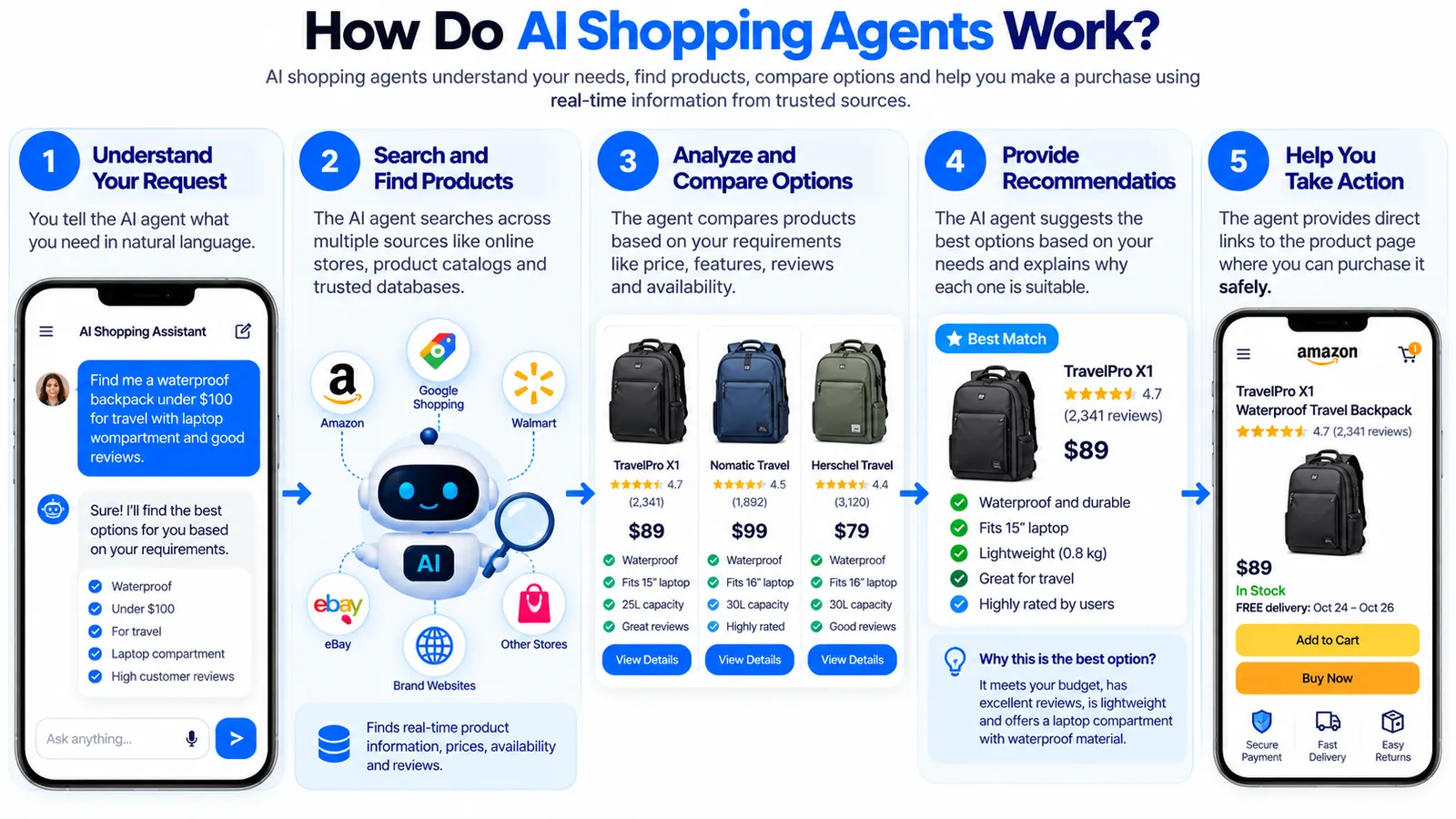
The process can be understood through five stages.
Step 1: Understanding Customer Intent
The user describes what they need in natural language.
For example:
"I need a waterproof backpack for international travel, with laptop protection and a budget of $100."
The assistant identifies relevant requirements, such as price, size, purpose, and product features.
Step 2: Finding Relevant Products
The system may retrieve information from product catalogs, merchant feeds, supported integrations, or other available sources.
The quality and availability of this information depend on the platform.
Step 3: Comparing Available Options
The assistant can organize products according to the user's preferences.
Instead of simply listing items, it may explain differences in features, suitability, pricing, and limitations.
Step 4: Helping Customers Make Decisions
Users can ask follow-up questions, refine their preferences, and request alternative recommendations.
For example:
"Which option would be better for a 15-inch laptop?"
Step 5: Supporting a Purchase
Depending on the platform, the customer may be directed to a retailer's website or an integrated purchasing experience.
The important distinction is that AI assistance and autonomous purchasing are not the same thing.
3. Agentic Commerce vs Traditional Ecommerce
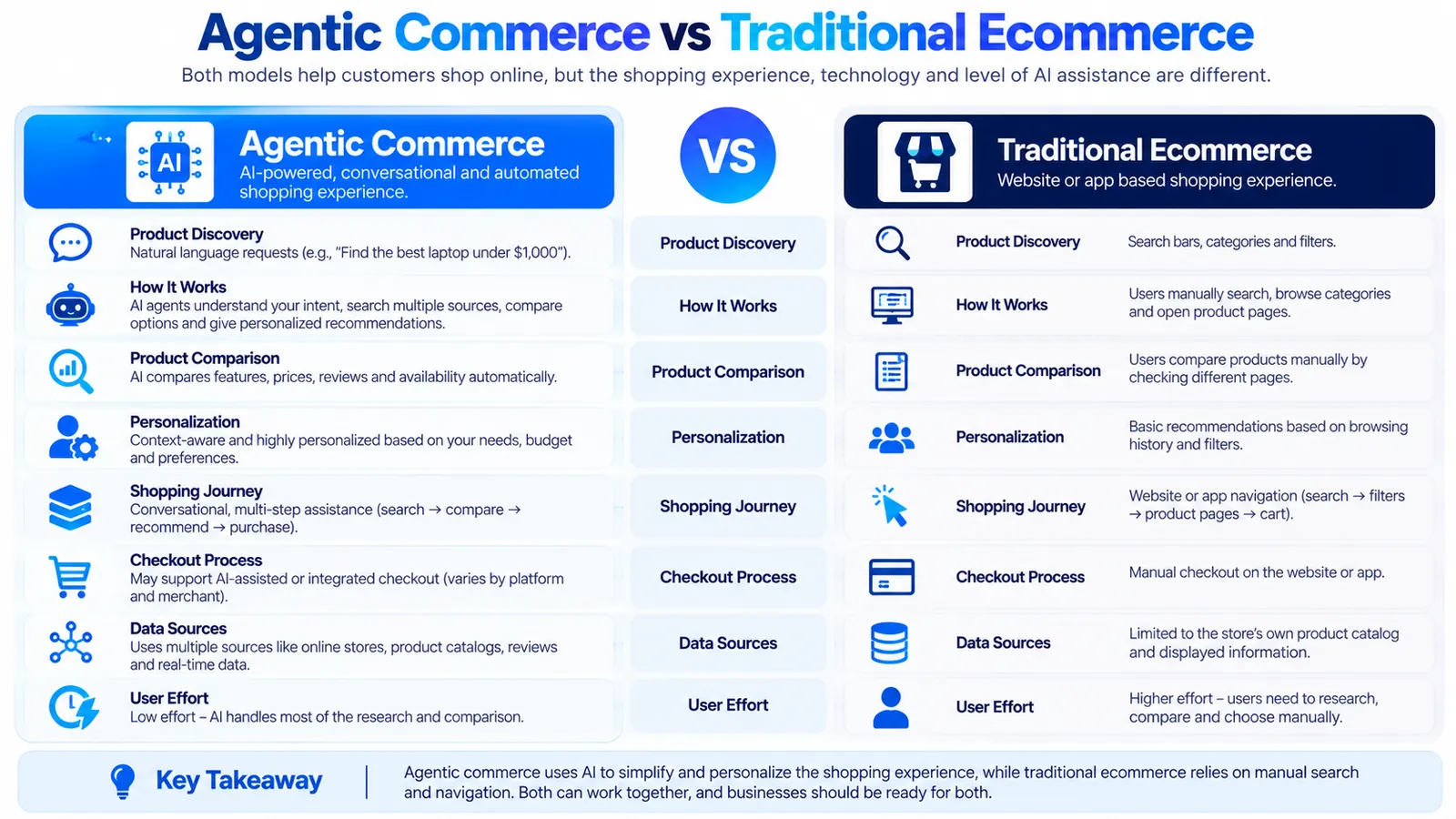
Traditional ecommerce generally requires customers to navigate product categories, apply filters, read descriptions, and compare options manually.
Agentic commerce introduces conversational assistance into that process.
| Feature | Traditional ecommerce | Agentic commerce |
|---|---|---|
| Product discovery | Search bars and categories | Conversational requests |
| Product comparison | Often manual | AI-assisted comparisons |
| Personalization | Filters and recommendations | Contextual assistance |
| Shopping journey | Website or app navigation | Potentially multiple connected services |
| Product information | Product pages | Product pages, feeds, and integrations |
| Checkout | Website or app | Merchant checkout or supported integrations |
| Customer control | Direct navigation | User-directed assistance and authorization |
These approaches are not mutually exclusive.
A customer might discover a product through an AI assistant but visit the retailer's website to verify information and complete the purchase.
For businesses, the objective should be to support customers wherever their buying journey begins.
4. Why Is Agentic Commerce Trending in 2026?
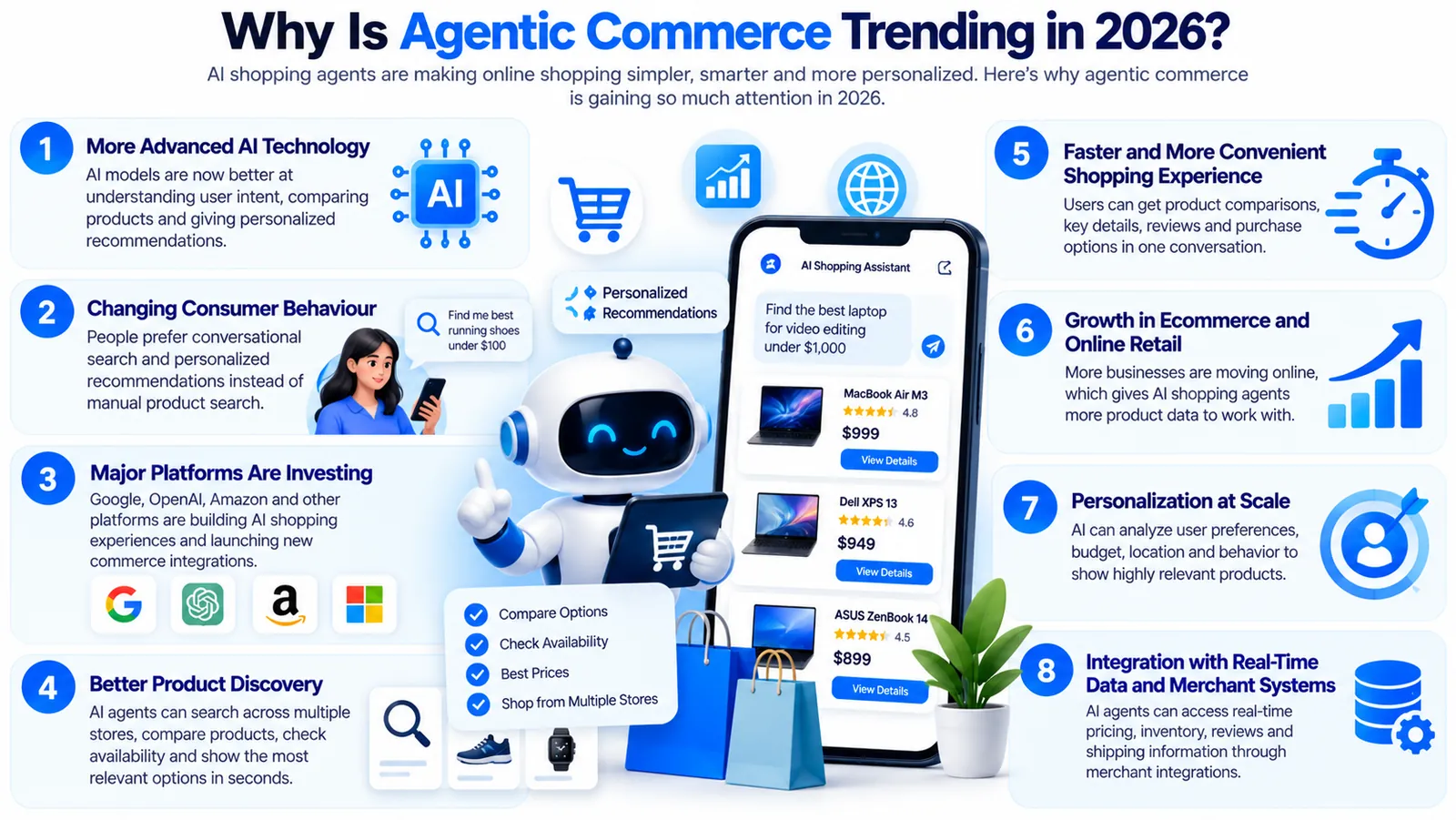
Agentic commerce has moved beyond a theoretical discussion because major technology and ecommerce companies are investing in the infrastructure needed for AI-assisted shopping.
AI Product Discovery Is Becoming More Advanced
Shopping assistants can help customers compare products through conversational questions.
This is particularly useful for purchases involving multiple specifications, preferences, or constraints.
Commerce Platforms Are Building New Integrations
Google introduced its Universal Commerce Protocol in January 2026 to support interactions across the shopping journey.
OpenAI has also expanded its Agentic Commerce Protocol to support structured product discovery.
These developments indicate that product data and merchant connectivity are becoming important parts of AI-powered commerce.
Retailers Are Preparing for Change
A Boston Consulting Group report published on October 21, 2026, found that 68% of surveyed retailers expect agentic commerce to have a significant or transformational effect within two years.
This is a survey finding, not a guarantee that all retailers will experience the same impact.
Product Discovery May Become More Distributed
Customers may begin researching products through traditional search engines, marketplaces, social media, or AI assistants.
That means ecommerce businesses should avoid depending entirely on one discovery channel.
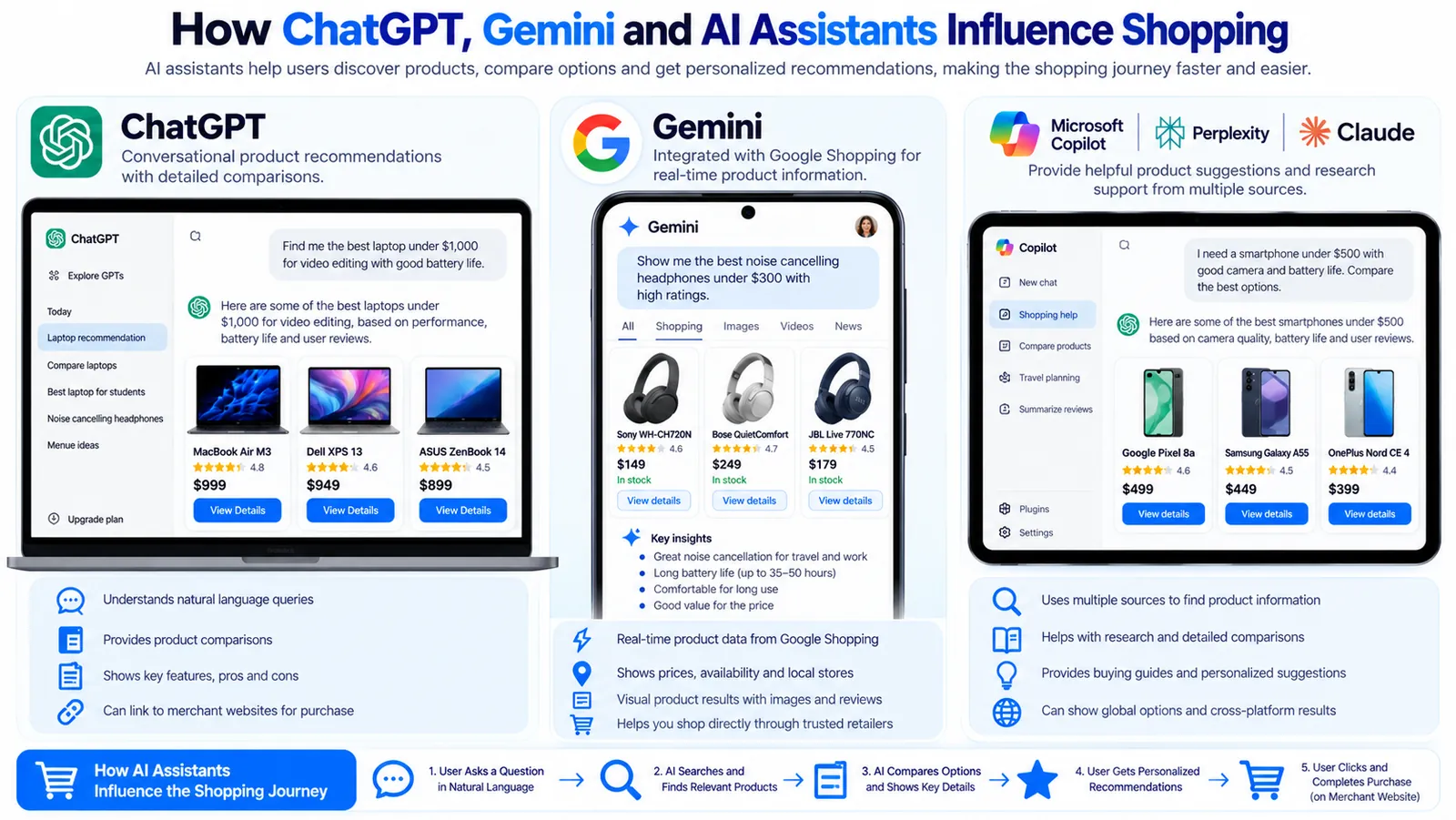
5. How ChatGPT, Gemini and AI Assistants Influence Shopping
AI-powered platforms are introducing different approaches to product discovery and commerce.
ChatGPT and Product Discovery
ChatGPT supports conversational product research and comparisons.
OpenAI has described how structured merchant catalog information can improve product discovery through its Agentic Commerce Protocol.
For merchants, accurate product descriptions, variants, availability, and other relevant catalog information can help supported systems understand their offerings.
Businesses should consult current platform documentation before assuming a particular checkout or merchant integration is available.
Google AI Mode and Gemini
Google has introduced commerce initiatives designed to connect AI shopping experiences with retailers.
Its Universal Commerce Protocol supports a framework for interactions involving discovery, purchasing, and post-purchase processes.
Availability depends on the participating platform, merchant, and market.
Ecommerce Platform Integrations
Platforms such as Shopify are developing ways for merchants to participate in AI shopping experiences.
For retailers, this creates a reason to maintain high-quality product information rather than relying exclusively on promotional content.
Key takeaway: Businesses should prepare for multiple AI discovery channels rather than optimizing their entire strategy around one assistant.
6. How Agentic Commerce Is Changing SEO
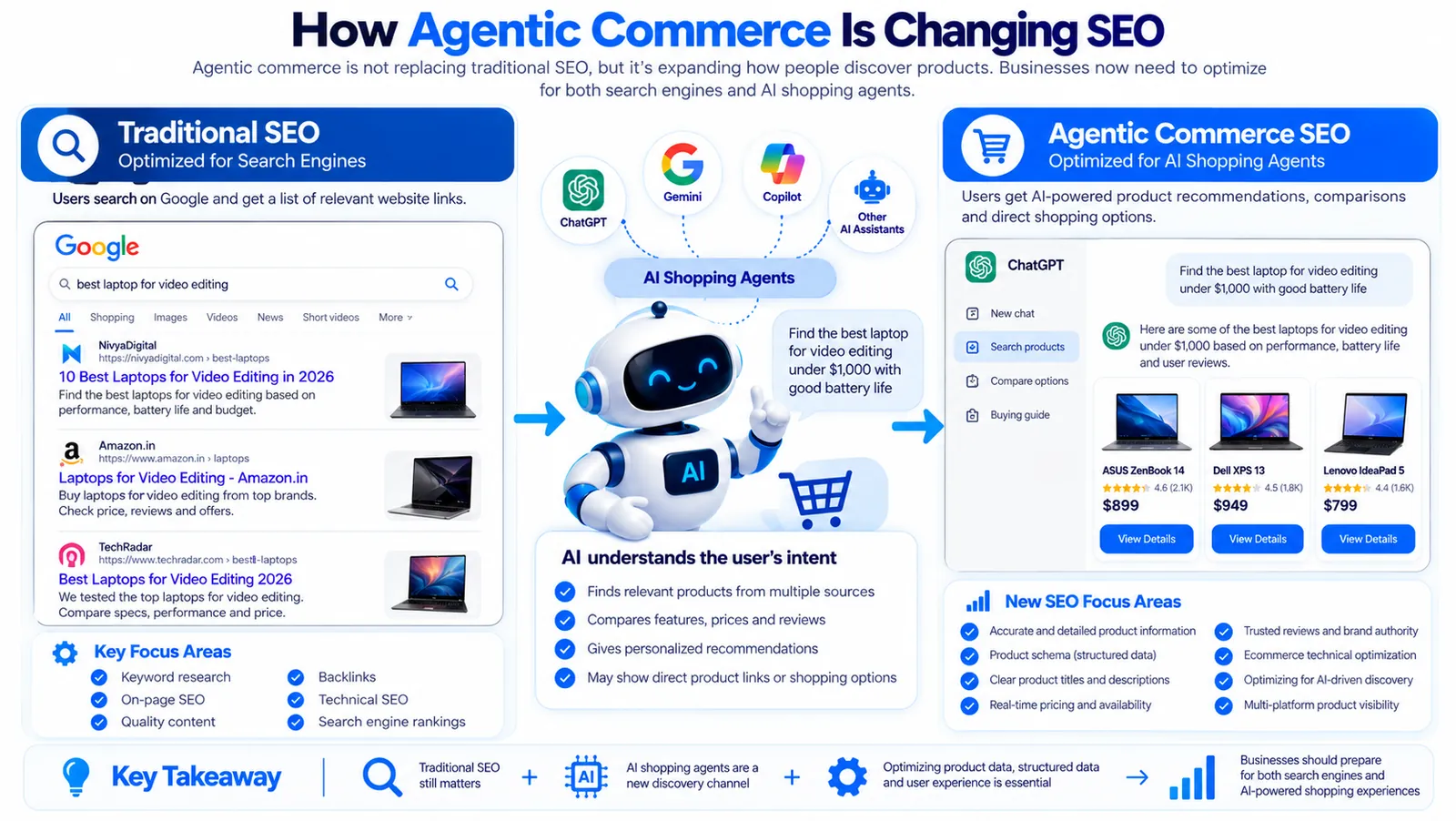
Traditional SEO focuses on helping search engines discover, understand, and present relevant web pages.
Agentic commerce adds another consideration: whether AI-enabled shopping systems can access accurate information about products.
This doesn't mean traditional SEO is becoming obsolete.
Instead, ecommerce businesses may need to improve both their website visibility and product data quality.
Product Information Becomes More Important
A product page should clearly explain what the product is, who it is suitable for, and what differentiates it from alternatives.
For example, a product titled "Premium Backpack" provides less useful information than:
"Waterproof 25L Travel Backpack with 15-Inch Laptop Compartment"
The second description communicates meaningful product characteristics.
Technical Accessibility Still Matters
Search engines and supported discovery systems need reliable access to relevant information.
Important considerations include:
Crawlable product pages
Appropriate indexing controls
Clear website architecture
Accurate canonical URLs
Mobile-friendly product experiences
Functional product links
Structured Data Supports Product Understanding
Product structured data can communicate information such as product names, offers, prices, and availability to supported search systems.
However, structured data does not guarantee inclusion in AI recommendations or special search features.
Brand Trust Remains Essential
Customers still need confidence that a retailer will deliver the promised product.
Clear return policies, reliable support, accurate product information, and authentic reviews contribute to that confidence.
7. How to Optimize Your Ecommerce Website for AI Shopping Agents
Businesses can begin preparing for AI-assisted shopping without rebuilding their entire ecommerce infrastructure.
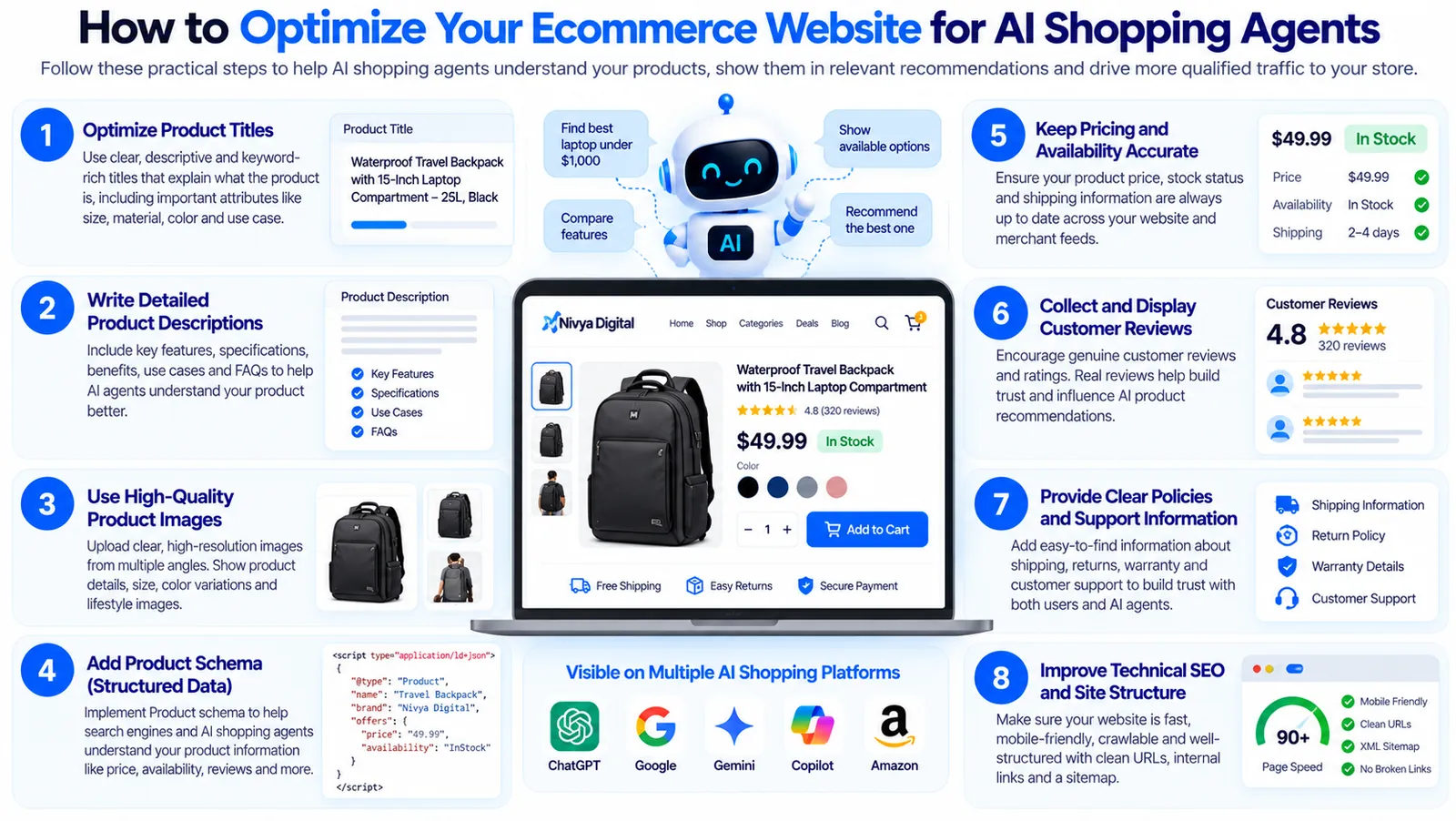
1. Improve Product Titles
Use clear titles that accurately identify the product.
Include meaningful attributes where relevant, such as material, size, compatibility, or intended use.
Avoid repetitive keyword stuffing.
2. Write Detailed Product Descriptions
Explain:
Main features
Product specifications
Suitable use cases
Materials and dimensions
Compatibility information
Important limitations
Good descriptions should answer the questions real customers are likely to ask.
3. Keep Pricing and Availability Accurate
Outdated prices or incorrect inventory information can create poor shopping experiences.
Maintain consistency between product pages and any feeds or integrations your business uses.
4. Use High-Quality Product Images
Show products clearly and from relevant angles.
For clothing, include useful details such as fabric, fit, and sizing.
For electronics, show ports, dimensions, and relevant product features.
5. Improve Product Reviews
Encourage genuine customer feedback.
Don't create fabricated testimonials or manipulate review ratings.
6. Maintain Clear Policies
Make delivery information, returns, warranties, and customer support easy to find.
7. Monitor Merchant Integrations
If your ecommerce platform supports AI shopping integrations, review its documentation and configuration options.
Not every merchant needs a custom integration.
8. Product Schema, Structured Data and AI Discovery
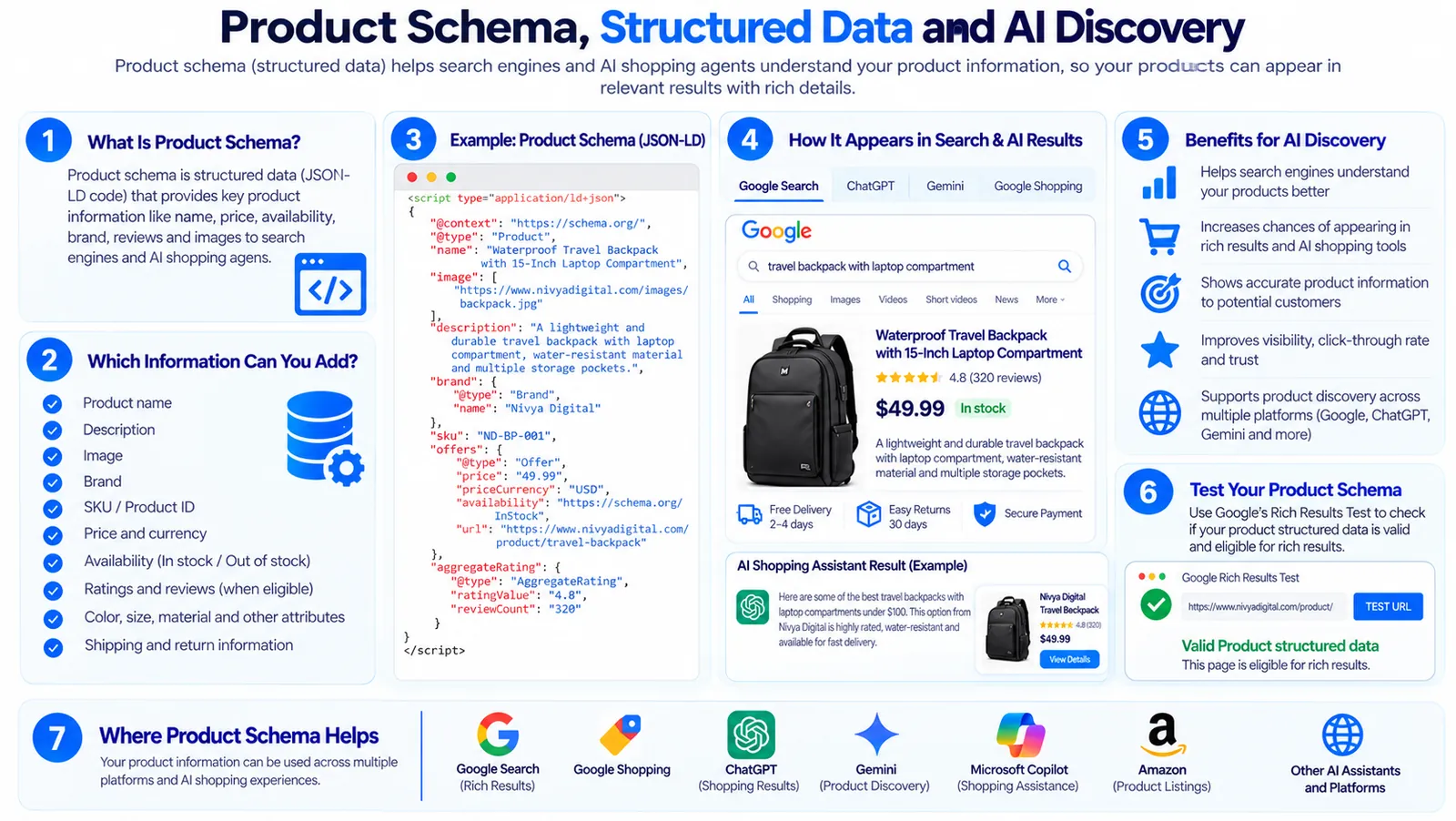
Structured data is one of the most practical technical areas for ecommerce businesses to review.
Google supports Product and Offer structured data for eligible merchant listing experiences.
Depending on the product and implementation, this information can describe:
Product name
Description
Image
Brand
Price
Currency
Availability
Shipping information
Return policies
Example: A Product Information Checklist
Before publishing a product page, check that it includes:
| Product field | Example |
|---|---|
| Product name | Waterproof Travel Backpack |
| Brand | Example Brand |
| Price | $89 |
| Currency | USD |
| Availability | In stock |
| Color | Navy blue |
| Capacity | 25 liters |
| Main feature | Padded laptop compartment |
| Return policy | Clearly linked policy |
This table is an illustrative example, not live product information.
How to Check Structured Data
Use Google's Rich Results Test to identify supported structured data errors and warnings.
You can also review relevant reports in Google Search Console.
Structured data should accurately reflect information visible to customers.
Avoid adding unsupported ratings, misleading prices, or false availability claims.
9. Best AI Commerce Tools and Platforms to Explore in 2026
Different tools support different parts of the AI commerce ecosystem.
| Tool or platform | Primary purpose |
|---|---|
| Google Merchant Center | Manage product information for supported Google shopping experiences |
| Google Search Console | Monitor organic search visibility and indexing |
| Google Analytics 4 | Analyze website traffic and conversions |
| Shopify | Ecommerce store management and supported commerce integrations |
| OpenAI Agentic Commerce Protocol | Structured merchant catalog connectivity for supported experiences |
| Google Universal Commerce Protocol | Commerce integration framework |
| Google Rich Results Test | Validate eligible structured data |
| Microsoft Clarity | Analyze visitor interactions and website usability |
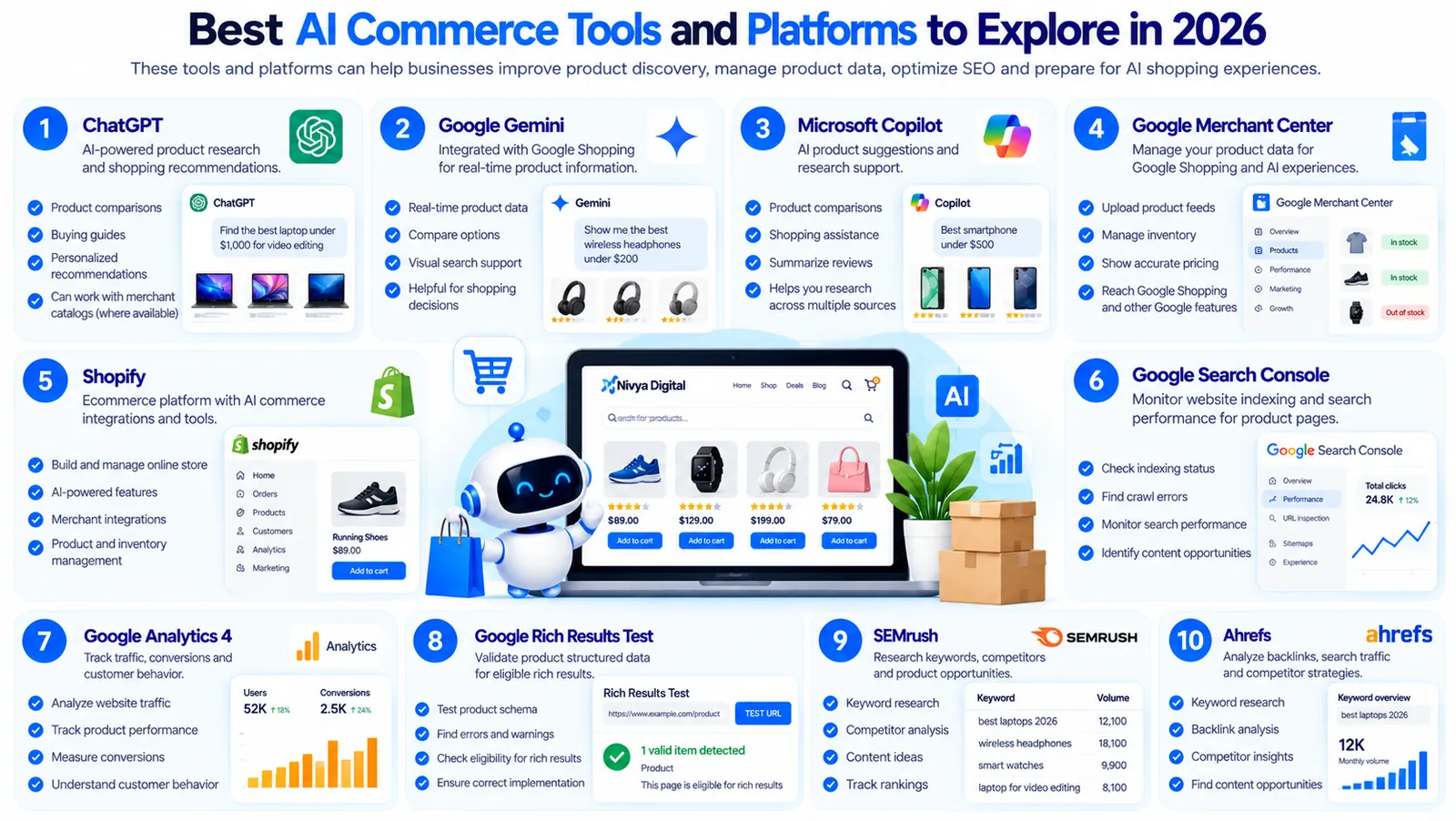
Not every tool is an AI shopping agent.
Some provide the technical infrastructure, analytics, or product data management needed to support ecommerce discovery.
Choose tools based on your existing platform, business requirements, and integration availability.
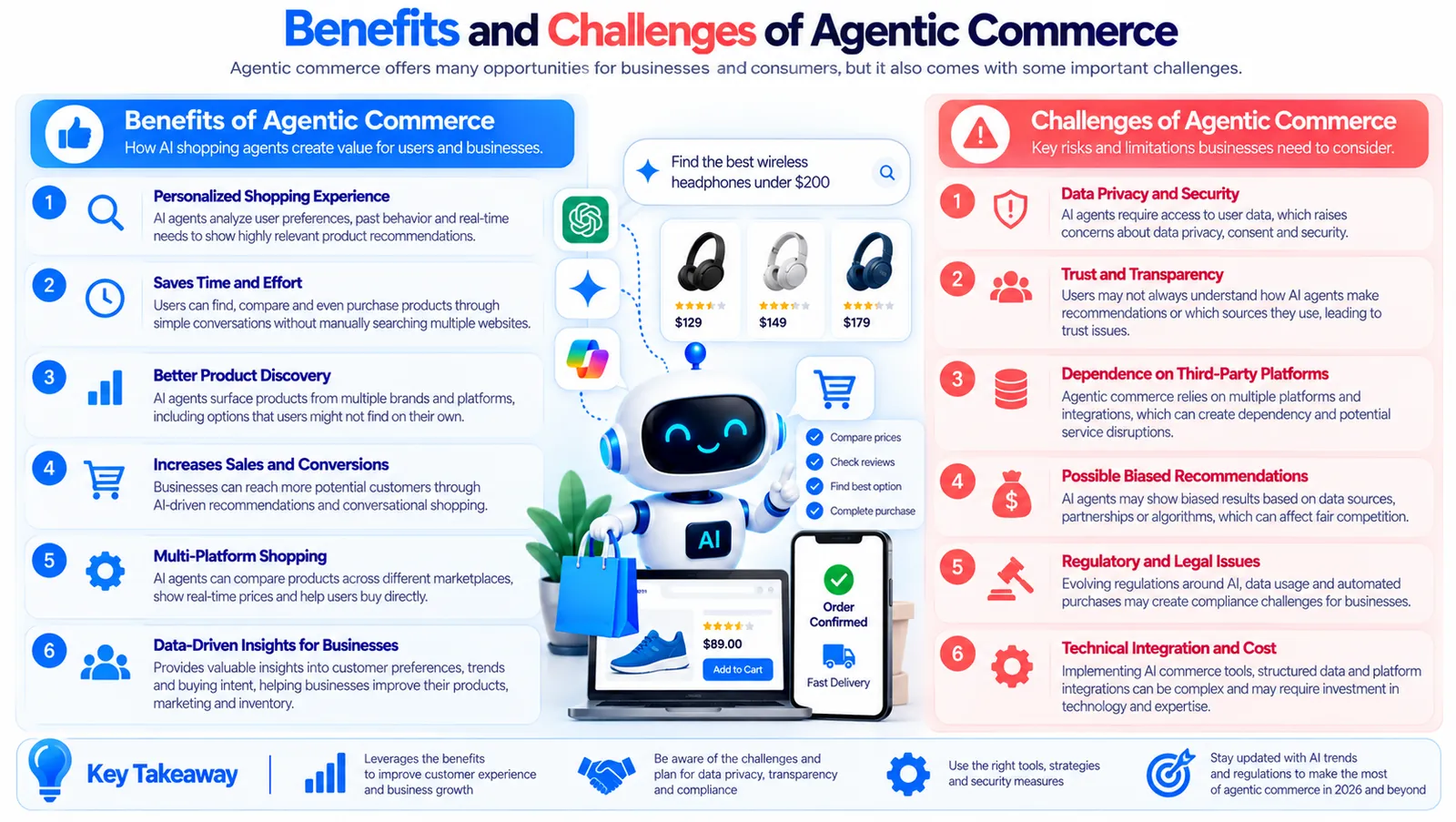
10. Benefits and Challenges of Agentic Commerce
Agentic commerce offers potential opportunities, but it also introduces operational and technical challenges.
Potential Benefits
More relevant product discovery: Customers can describe their needs in greater detail than a typical short search query.
Simplified comparisons: AI assistance can reduce the effort required to compare product specifications.
New discovery opportunities: Smaller or specialized retailers may have opportunities to reach relevant shoppers through supported channels.
Improved customer convenience: Conversational assistance can help customers narrow down choices.
Potential Challenges
Product data accuracy: Incorrect information may lead to unsuitable recommendations.
Limited merchant control: Businesses may not control how every AI platform presents their products.
Attribution difficulties: Some AI-influenced purchases may be difficult to identify through traditional analytics.
Privacy and security: Customer information, permissions, and payment processes require appropriate safeguards.
Platform dependency: Integration rules and supported features may change.
Businesses should evaluate these factors before making major investments.
11. Agentic Commerce for Small Businesses
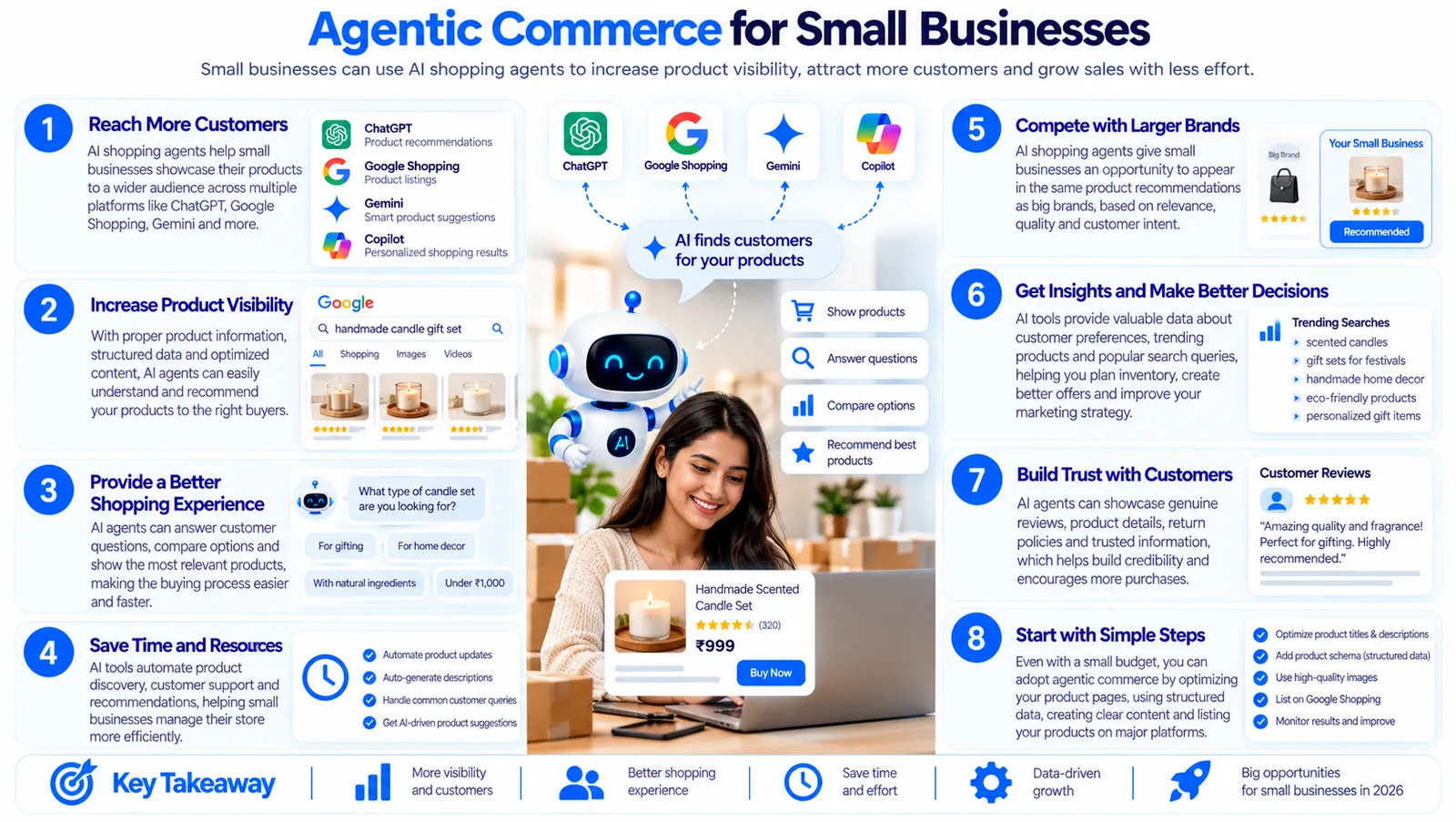
Agentic commerce isn't relevant only to large retailers.
Small ecommerce businesses can also prepare by improving their existing product information and website experience.
Consider a small online store selling handmade home decor.
Instead of targeting only broad keywords such as "home decoration," the business could publish detailed product information covering materials, dimensions, styles, care instructions, and shipping availability.
This helps customers evaluate whether the products match their needs.
The same information may also support discovery through search engines and compatible AI shopping systems.
A Practical Starting Checklist
Review your most important product pages.
Update incomplete product descriptions.
Verify prices and stock availability.
Check product structured data.
Improve mobile usability.
Publish clear shipping and return information.
Monitor relevant product discovery channels.
These improvements are useful even if AI shopping does not immediately become a major traffic source for your business.
12. How to Prepare Your Website for AI-Powered Shopping
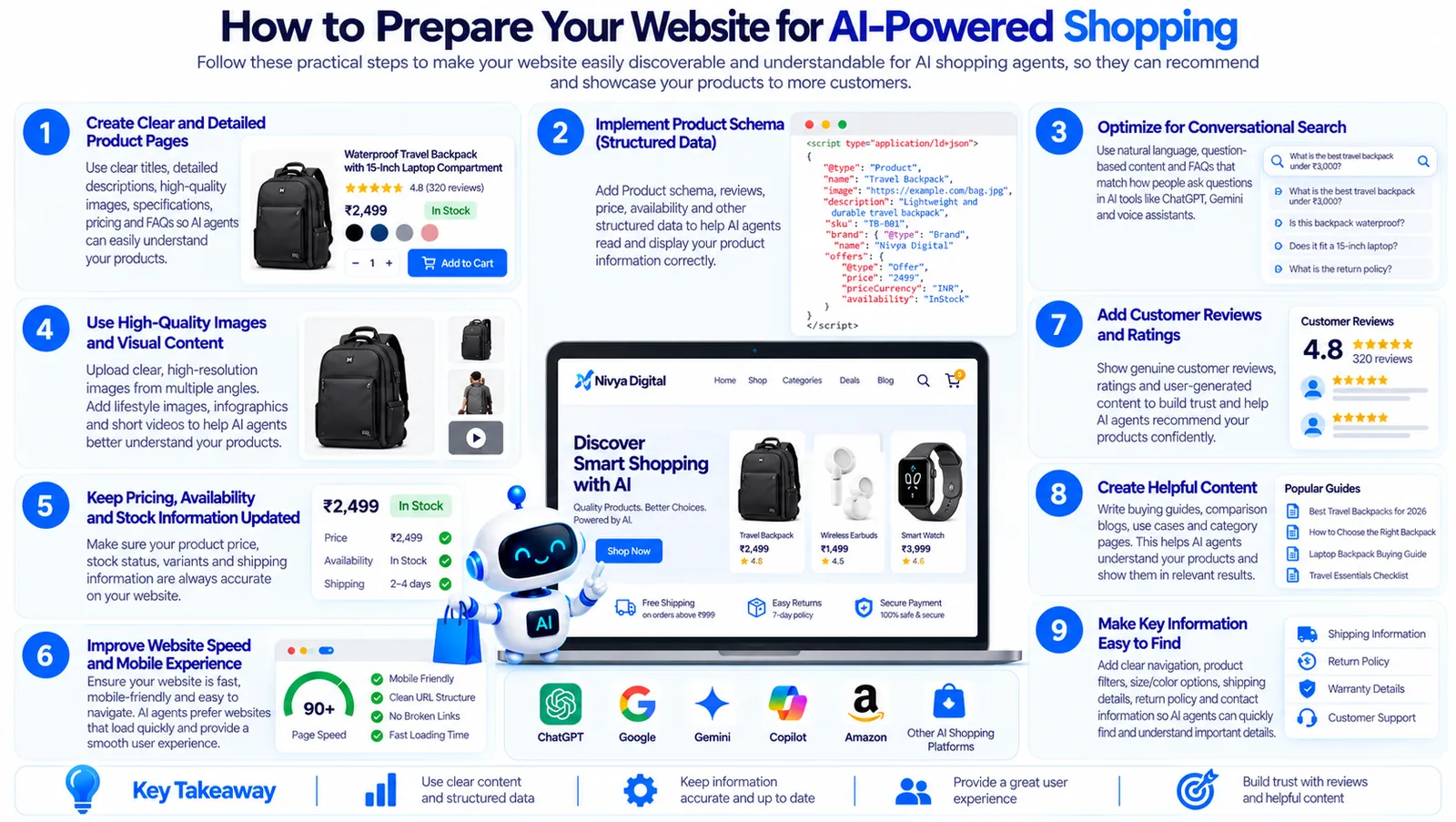
A practical preparation strategy should focus on business fundamentals rather than speculative optimization tricks.
Phase 1: Audit Your Ecommerce Website
Review indexing, product pages, technical performance, and structured data.
Identify incomplete information and broken customer journeys.
Phase 2: Improve Product Information
Prioritize best-selling and strategically important products.
Update descriptions, specifications, images, and availability.
Phase 3: Strengthen Customer Trust
Review return policies, customer support information, and authentic reviews.
Phase 4: Explore Supported Integrations
Investigate whether your ecommerce platform offers relevant merchant feeds or AI commerce capabilities.
Evaluate security, cost, maintenance, and operational requirements before enabling them.
Phase 5: Measure Results
Track organic traffic, product page engagement, qualified referrals, completed purchases, and conversion rates.
Where possible, review referral traffic from AI platforms, but remember that analytics attribution may be incomplete.
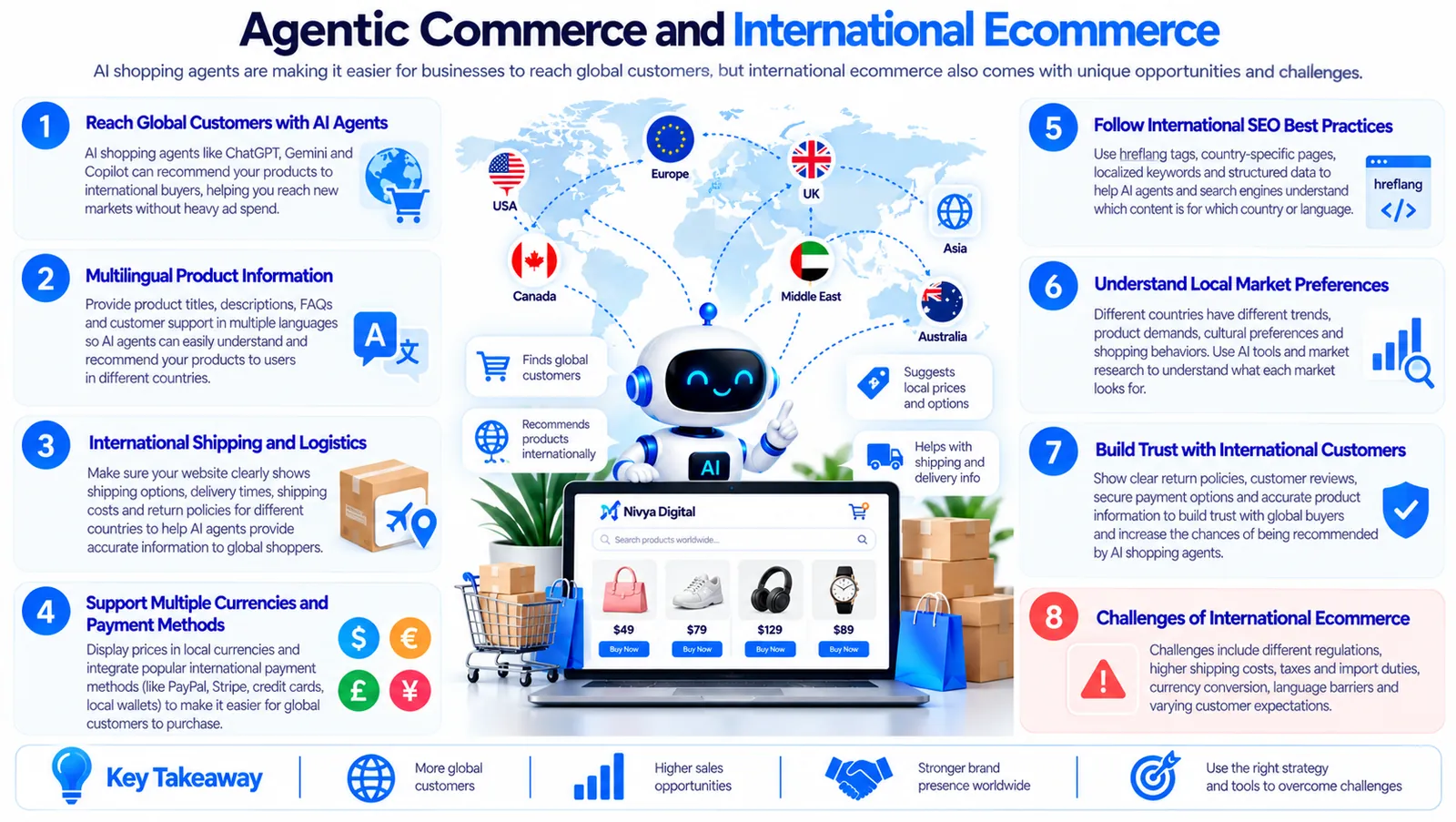
13. Agentic Commerce and International Ecommerce
AI-powered shopping creates interesting opportunities for businesses serving customers across different countries.
However, international discovery requires more than making a website available globally.
Localize Product Information
Customers in different markets may use different terminology, sizing standards, and purchasing preferences.
For example, clothing retailers should clearly explain size conversions where appropriate.
Display Relevant Currencies
Where supported, show accurate currency information and clarify whether taxes, duties, or additional charges apply.
Explain International Shipping
Make delivery locations, estimated timelines, and shipping restrictions easy to understand.
Review Language Targeting
Businesses maintaining multiple language or regional website versions should review their international SEO implementation.
Hreflang annotations may be useful when appropriate alternate versions exist.
Build Trust Across Markets
Clearly explain international customer support, returns, and payment options.
Don't claim local offices or regional services that your business doesn't actually provide.
14. How Nivya Digital Can Help Businesses Prepare for AI Commerce
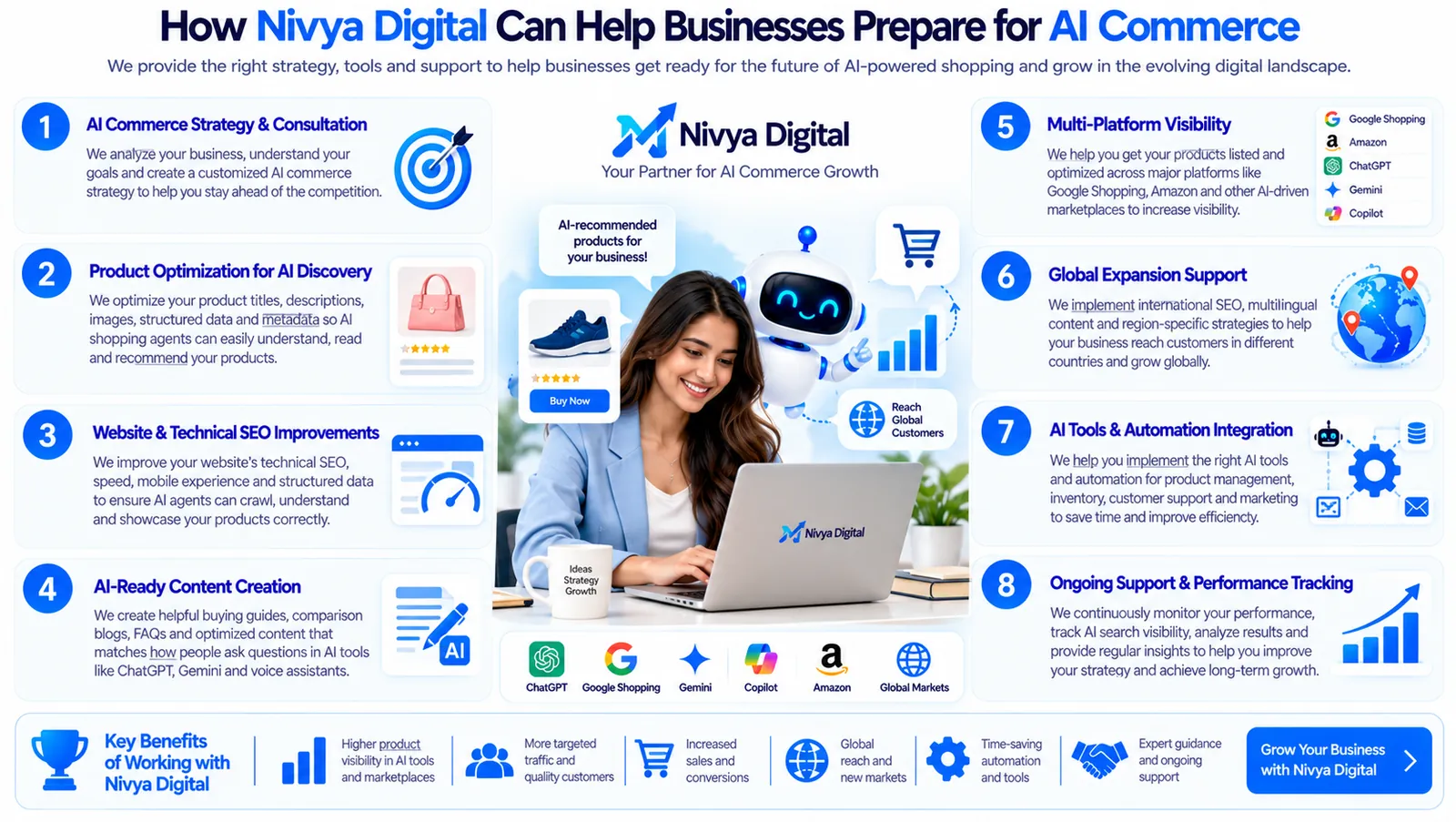
Preparing for AI-powered product discovery involves more than adding a new plugin or changing a few keywords.
Businesses need reliable websites, useful content, accurate product information, and a clear digital growth strategy.
Nivya Digital offers digital marketing and technology services that can support several parts of this process.
SEO Services
Search engine optimization helps businesses improve website accessibility, content relevance, and organic discoverability.
For ecommerce businesses, this may include technical reviews, keyword research, and product page optimization.
Website Development
A well-structured ecommerce website makes it easier for customers to navigate products and complete purchases.
Website development also supports the implementation of appropriate technical features and integrations.
Content Marketing
Helpful buying guides, product comparisons, and educational articles can address questions customers ask before purchasing.
Business Automation
Businesses exploring automated workflows should evaluate opportunities carefully, considering reliability, privacy, security, and compatibility with their existing systems.
Digital Marketing Strategy
A balanced strategy can combine SEO, content marketing, paid advertising, analytics, and conversion optimization.
Rather than focusing only on AI shopping trends, businesses should identify which channels are delivering meaningful results.
Want to prepare your website for changing search and shopping experiences?
Explore the digital marketing and website development services available at Nivya Digital.
16. Final Thoughts: The Future of Ecommerce Is Becoming More Conversational
Agentic commerce represents an important development in online shopping.
Customers are beginning to use AI assistants not only to find information, but also to compare products and navigate purchasing decisions.
For businesses, this doesn't mean abandoning existing digital marketing strategies.
It means strengthening the foundations that make products understandable, accessible, and trustworthy across multiple channels.
Start with accurate product data, useful content, strong technical SEO, and a reliable customer experience.
Then explore AI commerce integrations that genuinely fit your business needs.
The businesses best prepared for AI-powered shopping will be those that make it easy for both people and supported digital systems to understand what they offer.
Visit Nivya Digital to explore SEO, website development, content marketing, and digital growth solutions.
Comments (1)
This article helped me understand agentic commerce and how AI shopping agents are changing the way people discover and purchase products. I especially liked the insights on SEO, ecommerce optimization, and adapting digital marketing strategies for AI-driven shopping experiences. A useful read for business owners and marketers!