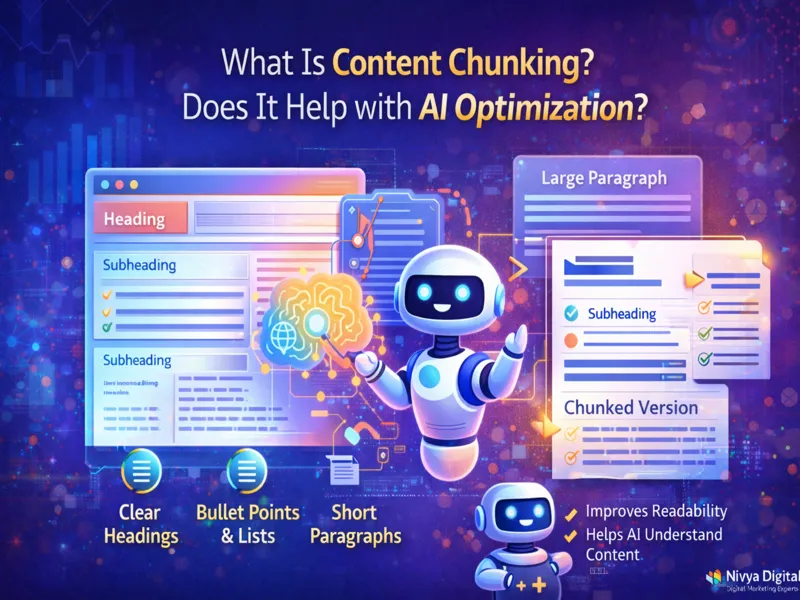
In the rapidly evolving world of digital marketing and AI-powered search engines, content structure plays a crucial role in improving visibility and readability. One technique that has gained significant importance is content chunking. Content chunking refers to breaking large blocks of information into smaller, easily digestible sections that improve user experience and help AI systems understand the content more effectively.
Modern search technologies powered by artificial intelligence tools such as ChatGPT and Google Search prioritize well-structured and clearly organized content. When information is presented in smaller chunks, it becomes easier for both readers and AI algorithms to interpret, summarize, and display relevant results.
Content chunking is particularly important for AI optimization, where search engines and AI assistants analyze content in segments rather than scanning entire pages at once. This structured approach improves readability, boosts engagement, and increases the chances of content being featured in AI-generated answers.
In this article, we will explore what content chunking is, why it matters, and how it helps optimize content for AI-driven search results.
Overview Table: Content Chunking and AI Optimization
| Aspect | Description | Benefit |
|---|---|---|
| Content Chunking | Dividing content into smaller sections | Improves readability |
| Structured Headings | Using clear headings and subheadings | Helps AI understand context |
| Bullet Points & Lists | Presenting information in lists | Easy for AI to extract answers |
| Short Paragraphs | Avoiding large text blocks | Better user engagement |
| Semantic Structure | Logical content organization | Improves SEO and AI ranking |
1. What Is Content Chunking?
Content chunking is the process of dividing large pieces of information into smaller sections or “chunks.” These chunks typically include headings, subheadings, bullet points, short paragraphs, and visual elements that help readers consume information more easily.
When content is presented in long paragraphs, readers often struggle to process the information. Chunking breaks the content into manageable pieces that improve readability and comprehension. This approach is widely used in education, user interface design, and digital marketing.
In the context of digital content, chunking also improves how search engines and AI tools interpret information. AI systems process data in smaller segments, making it easier to extract meaningful insights when content is clearly structured.
For example, a blog post with well-organized headings and concise paragraphs is easier for both users and AI systems to analyze compared to a page filled with long blocks of text.
Content chunking also helps readers scan information quickly. Many online users prefer skimming content rather than reading every word. Chunked content allows them to find relevant information quickly without feeling overwhelmed.
Key Points
Content chunking divides information into smaller sections
Improves readability and user experience
Helps users scan information quickly
Makes content easier for AI to interpret
Enhances overall content structure
2. Why Content Chunking Is Important for Modern SEO
Search engine optimization has evolved significantly over the years. Traditional SEO focused mainly on keywords and backlinks, but modern SEO also emphasizes content quality, readability, and structure.
Content chunking helps search engines understand the context and hierarchy of information. When content is organized with clear headings and logical sections, search algorithms can easily identify key topics and relationships between ideas.
For example, search engines often extract answers from well-structured content to display in featured snippets or AI-generated responses. Chunked content increases the chances of being selected for these positions.
Additionally, well-structured content improves dwell time and reduces bounce rates. When users find content easy to read and navigate, they are more likely to stay on the page and engage with the information.
Content chunking also improves accessibility, making it easier for users with different reading abilities to understand the information.
Key Points
Helps search engines understand content better
Improves chances of featured snippets
Increases user engagement
Reduces bounce rates
Supports accessibility and readability
3. How Content Chunking Helps AI Optimization
AI-powered search tools analyze content differently from traditional search engines. Instead of simply matching keywords, AI systems interpret the meaning and context of information.
When content is chunked into clear sections, AI tools can quickly identify important ideas and summarize them effectively. For example, tools like ChatGPT analyze structured content to generate accurate responses to user queries.
Chunking also helps AI systems extract relevant information from specific sections of a webpage. If each section focuses on a single topic, AI can easily determine which part of the content answers a particular question.
This structured format also improves the chances of appearing in AI-generated search results and voice search responses.
As AI-driven search continues to evolve, content chunking will become a critical strategy for businesses that want their content to remain discoverable.
Key Points
Helps AI understand context and structure
Improves chances of AI-generated answers
Makes content easier to summarize
Supports voice search optimization
Enhances AI search visibility
4. Best Practices for Effective Content Chunking
To implement content chunking effectively, businesses should follow a few key best practices. The goal is to organize content in a way that is both user-friendly and AI-friendly.
First, use clear headings and subheadings to separate different sections of the content. This helps readers quickly understand what each section is about.
Second, keep paragraphs short and focused on a single idea. Large blocks of text should be avoided because they make content harder to read.
Third, use bullet points and numbered lists when presenting multiple ideas or steps. Lists make it easier for readers to scan information and for AI systems to extract key points.
Visual elements such as tables, images, and infographics can also enhance content chunking by breaking up text and presenting information visually.
Key Points
Use clear headings and subheadings
Keep paragraphs short
Use bullet points and lists
Add tables or visuals where needed
Focus each section on one main idea
5. Common Mistakes to Avoid in Content Chunking
While content chunking offers many benefits, it must be implemented carefully. Overusing headings or breaking content into too many small sections can make the page look cluttered.
Another common mistake is creating sections that do not provide meaningful information. Each chunk should contain valuable content that contributes to the overall topic.
Businesses should also avoid repeating the same information in multiple sections. This can confuse both readers and search algorithms.
Consistency is also important. Using a logical structure throughout the content helps maintain clarity and professionalism.
By avoiding these mistakes, businesses can create chunked content that is both effective and engaging.
Key Points
Avoid excessive headings
Ensure each section provides value
Do not repeat information unnecessarily
Maintain consistent formatting
Focus on clarity and organization
Conclusion
Content chunking is a powerful strategy for improving both user experience and AI optimization. By dividing large pieces of information into smaller, structured sections, businesses can create content that is easier to read, understand, and analyze.
As AI-powered search tools continue to evolve, structured content will play an increasingly important role in determining search visibility. Platforms like ChatGPT rely on clear content organization to generate accurate responses and summaries.
By adopting content chunking techniques, businesses can improve SEO performance, increase user engagement, and enhance their chances of appearing in AI-driven search results.
Comments (0)
No comments yet
Start the discussion by sharing your perspective