**
Content is one of the most valuable tools available to digital marketers today, and in the fast-paced environment of marketing online, it’s an essential tool for organic search traffic, leads and brand authority. But lately, there’s one problem that lingers and is certainly no stranger to a lot of businesses (yes, even full-service digital marketing agencies like Nivya Digital) — Content decay.
You put out an amazing blog post. It ranks well. Traffic flows in. Leads increase. But a few months in, traffic begins to dry up. Rankings fall. Engagement decreases. What happened?
This decrease in activity over time is referred to as content decay.
In this comprehensive guide, we will explore:
What content decay is
Why it happens
How to identify it
How to fix it
How to prevent it in the future
Let’s dive in.
What Is Content Decay?
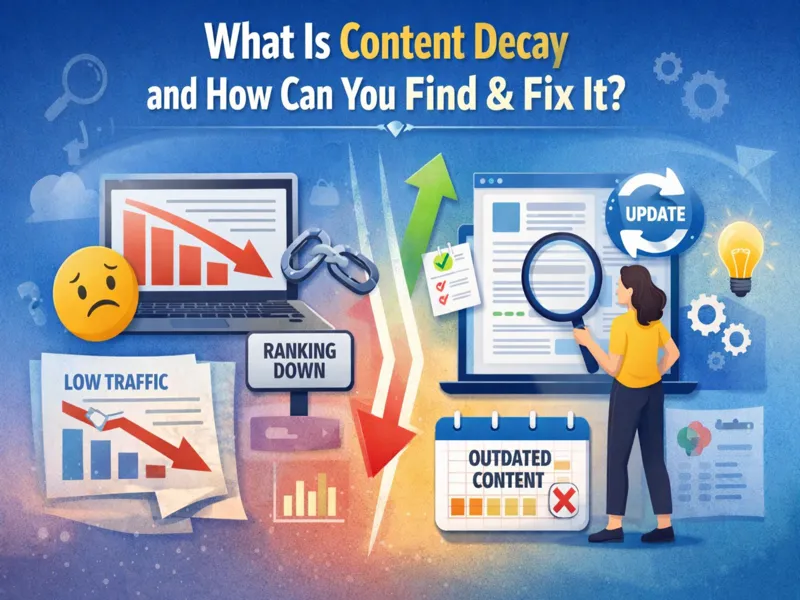
Content decay refers to the gradual decline in organic traffic, rankings, and engagement of a web page over time.
In simple terms:
When your blog post or landing page starts losing search visibility and traffic after performing well initially, it is experiencing content decay.
This decline can affect:
Search engine rankings
Organic traffic
Click-through rates (CTR)
Conversions
Overall ROI from content marketing
Content decay is a natural phenomenon in SEO, but if not addressed, it can significantly impact your website’s performance.
Why Does Content Decay Happen?
There isn’t just one reason for content decay. It usually happens due to a combination of factors. Let’s examine them in detail.
1. Freshness Factor (Google Prefers Updated Content)
Search engines like Google prioritize fresh and updated content for many queries. If competitors continuously update their articles while yours remains unchanged, your rankings may drop.
For example:
“Best SEO tools in 2024” will eventually lose relevance in 2025.
Outdated statistics reduce trust and authority.
2. Increased Competition
Over time, more websites publish content on the same topic. If competitors create:
More comprehensive guides
Better-structured content
Updated examples
Stronger backlinks
Your content may lose its competitive edge.
3. Algorithm Updates
Search engine algorithms are constantly evolving. What worked a year ago may not work today.
Changes in:
E-E-A-T signals
Content quality standards
Core updates
Helpful content updates
can cause sudden ranking shifts.
4. Outdated Information
Content with old data, broken links, or irrelevant tools loses credibility.
Users notice:
Expired tools
Old case studies
Irrelevant screenshots
Dead external links
This impacts both user experience and SEO performance.
5. Keyword Intent Shift
Search intent changes over time. For example:
Earlier, people searching “digital marketing” might have wanted definitions. Now they may want:
Strategies
Pricing models
Case studies
Agency comparisons
If your content doesn’t match the updated intent, rankings drop.
6. Weak Internal Linking Structure
As you publish new content, older posts may lose internal link equity. Without proper internal linking, search engines may consider older pages less important.
Signs That Your Content Is Decaying
You must identify decay early to fix it effectively. Below are key signs to watch:
| Indicator | What It Means | Tools to Check |
|---|---|---|
| Drop in Organic Traffic | Fewer users from search engines | Google Analytics |
| Ranking Decline | Position shifting from Page 1 to Page 2+ | Google Search Console |
| Lower CTR | Impressions stable but clicks reduced | Search Console |
| Increased Bounce Rate | Users not finding value | Google Analytics |
| Decreased Conversions | Leads or sales dropping | CRM / Analytics |
Monitoring these metrics monthly helps detect decay early.
How to Find Content Decay (Step-by-Step Process)
Let’s break down a practical approach.
Step 1: Use Google Search Console
Check:
Pages with declining impressions
Pages losing clicks
Queries dropping in position
Sort by:
- Compare last 3 months vs previous 3 months
Look for pages with:
High impressions but falling clicks
Ranking drop of 3–10 positions
These are strong decay candidates.
Step 2: Analyze Google Analytics
Go to:
Behavior → Site Content → Landing Pages
Check:
Pages with traffic drop over time
Year-over-year performance
Identify:
- Pages that once performed well but are declining steadily
Step 3: Conduct a Content Audit
Create a spreadsheet with:
URL
Publish date
Last updated date
Traffic trend
Ranking trend
Conversion data
Word count
Target keyword
This helps prioritize which pages need updates first.
Step 4: Identify Decay Patterns
Ask these questions:
Is the information outdated?
Are competitors offering better content?
Is the keyword intent changed?
Is the page thin or lacking depth?
Are there broken links?
Answering these helps determine the right fix.
How to Fix Content Decay
Fixing content decay is not just about adding a few lines. It requires strategic improvement.
1. Update and Refresh the Content
This is the most effective solution.
What to update:
Add latest statistics
Include new examples
Update screenshots
Replace outdated tools
Improve formatting
Pro Tip: Change the “Last Updated” date after meaningful improvements.
2. Improve Content Depth
Google now favors comprehensive and helpful content.
Enhance by:
Adding FAQs
Including case studies
Adding real-world examples
Expanding sections
Covering related subtopics
If competitors have 1500 words and yours has 900, expand it meaningfully.
3. Optimize for Current Search Intent
Analyze top-ranking competitors and check:
Are they list-based?
Are they guides?
Are they comparison articles?
Are they transactional?
Modify your structure accordingly.
4. Re-Optimize Keywords
Update:
Title tag
Meta description
H1 and H2 structure
Keyword placement
Include:
Secondary keywords
Semantic keywords
Long-tail variations
Avoid keyword stuffing.
5. Improve Internal Linking
Link from:
High-authority pages
Recent blog posts
Relevant service pages
Internal links help redistribute authority and signal importance.
6. Add Visual Elements
Enhance user experience by adding:
Infographics
Charts
Updated images
Embedded videos
Better engagement improves dwell time and reduces bounce rate.
7. Fix Technical Issues
Check:
Page speed
Mobile-friendliness
Broken links
Indexing errors
Schema markup
Technical improvements can significantly boost rankings.
8. Build Fresh Backlinks
Sometimes decay happens due to backlink loss.
Strategies:
Guest blogging
Digital PR
Outreach campaigns
Updating broken link opportunities
Fresh backlinks can revive rankings.
Content Decay Fix Strategy Table
Below is a simplified strategy table for quick reference:
| Problem Identified | Root Cause | Recommended Fix | Priority Level |
|---|---|---|---|
| Ranking Drop | Competitor improvement | Expand and update content | High |
| Traffic Drop | Search intent shift | Re-optimize for intent | High |
| Low CTR | Weak title/meta | Rewrite meta description | Medium |
| High Bounce Rate | Poor UX | Improve formatting & visuals | Medium |
| Lost Backlinks | Authority decline | Run backlink campaign | High |
| Outdated Info | Old statistics/tools | Refresh content | High |
How Often Should You Check for Content Decay?
A structured schedule works best:
Monthly: Monitor traffic and ranking trends
Quarterly: Run content performance comparison
Bi-annually: Conduct full content audit
Annually: Refresh top-performing content
For agencies like Nivya Digital, maintaining a content refresh calendar ensures long-term SEO stability.
How to Prevent Content Decay
Prevention is better than cure. Here’s how:
1. Create Evergreen Content
Focus on:
Foundational guides
How-to tutorials
Strategy-based content
Avoid:
- Highly time-sensitive content unless updated regularly.
2. Schedule Regular Updates
Set reminders:
Update statistics yearly
Review examples every 6 months
Re-check tools and references
3. Monitor Competitors
Keep tracking:
Competitor content improvements
New keyword targeting
SERP changes
Being proactive prevents sudden decay.
4. Strengthen Authority Signals
Improve:
Author bios
Case studies
Testimonials
Real examples
Experience-driven content
Google values experience and credibility.
5. Maintain Strong Internal Architecture
Ensure:
New content links to old relevant posts
Old posts are not isolated
Pillar-cluster structure is maintained
This improves content longevity.
Real-World Example Scenario
Let’s say your blog on “SEO Services Pricing Guide” ranked #3 last year.
After 8 months:
New agencies published updated pricing
Google rolled out an algorithm update
Your data became outdated
Result:
Ranking dropped to #9
Traffic reduced by 40%
Leads declined
Solution:
Update pricing tables
Add new industry data
Include case study
Improve title tag
Add FAQs
Within weeks, rankings can recover significantly.
Final Thoughts
Content decay is not a failure — it is a natural part of content marketing.
The key difference between average websites and high-performing digital marketing agencies like Nivya Digital lies in how quickly they detect and fix decay.
To summarize:
Monitor performance regularly
Identify decline early
Update strategically
Improve depth and user value
Strengthen SEO signals
Maintain a refresh calendar
Content is not “publish and forget.” It is “publish, monitor, optimize, and grow.”
If you treat your content as a living asset — not a static page — you will consistently win in search rankings, traffic growth, and lead generation.
**
Comments (0)
No comments yet
Start the discussion by sharing your perspective