
Query fan-out in SEO is changing how businesses approach keyword research and content optimization. With the growth of Google AI Mode and AI Overviews, search is no longer limited to matching a single query with a list of relevant websites.
Today, Google's AI-powered search experiences can explore multiple related questions, retrieve information from different sources, and generate comprehensive answers.
This development creates new opportunities for businesses to reach people researching complex topics. However, it also raises an important question: How should SEO strategies adapt to query fan-out in 2026?
In this guide, we'll explain how query fan-out works, why it matters for SEO, and how to develop an effective keyword research strategy for AI-powered search.
What Is Query Fan-Out in SEO?
Query fan-out is a search technique in which an AI system generates multiple related queries from a user's original question to retrieve relevant information.
Google officially describes query fan-out as a process that allows its AI search systems to explore different subtopics and information sources before generating a response.
Instead of relying on one search, the system can conduct several related searches simultaneously.
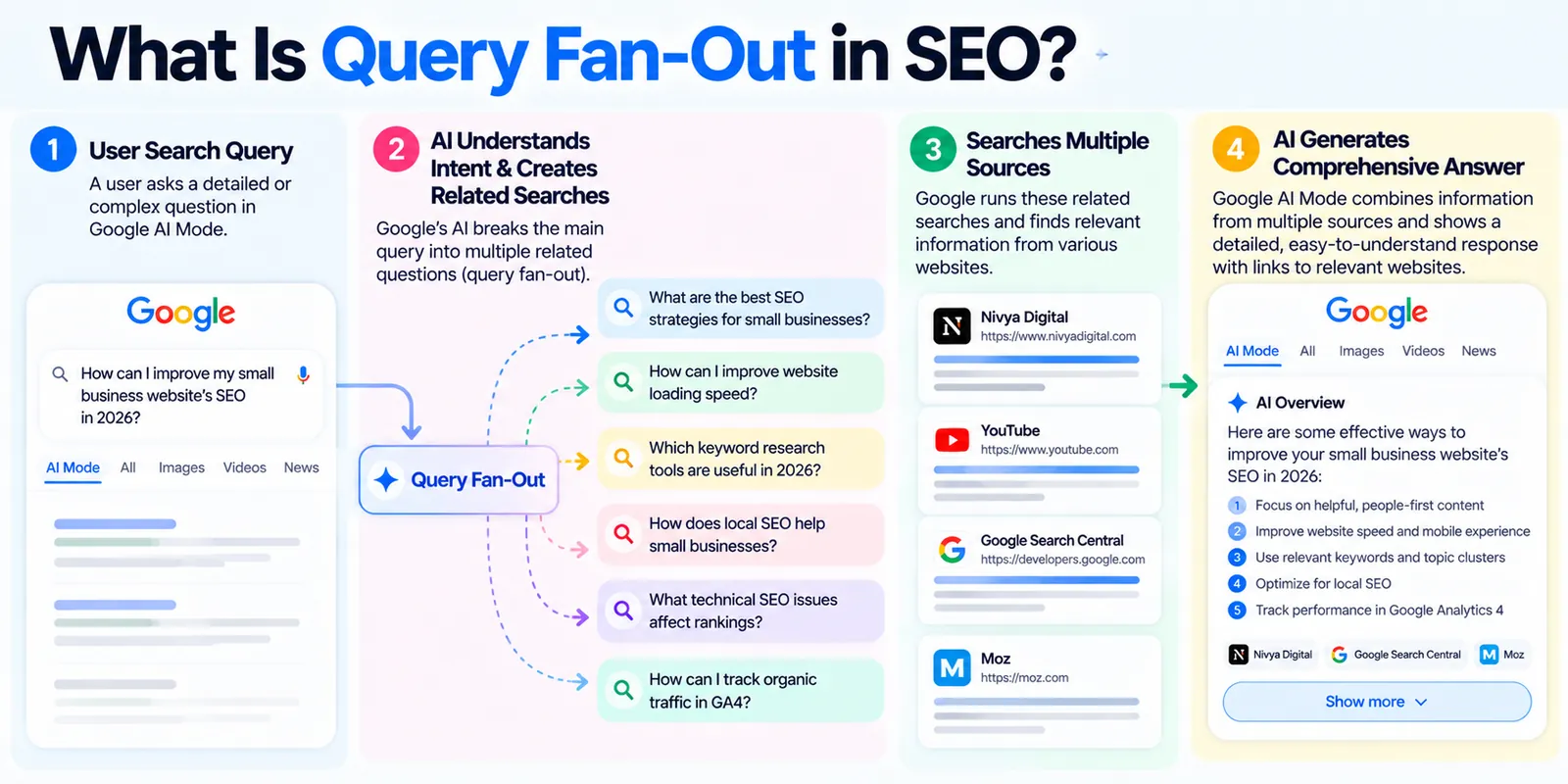
Example of Query Fan-Out
Imagine a user searches:
"How can I improve my small business website's SEO in 2026?"
Google AI Mode might explore related questions such as:
What are the best SEO strategies for small businesses?
How can businesses improve website loading speed?
Which keyword research tools are useful?
How does local SEO help small businesses?
What technical SEO issues affect rankings?
How can businesses measure organic traffic?
These are hypothetical examples illustrating the process, not confirmed internal Google queries.
The AI system may use relevant information from multiple sources to create a more useful response.
For businesses, this means content covering important related questions can become relevant to a wider range of search journeys.
How Does Query Fan-Out Work in Google AI Mode?
Google AI Mode combines AI-powered reasoning with Google's search infrastructure to help users explore complicated questions.
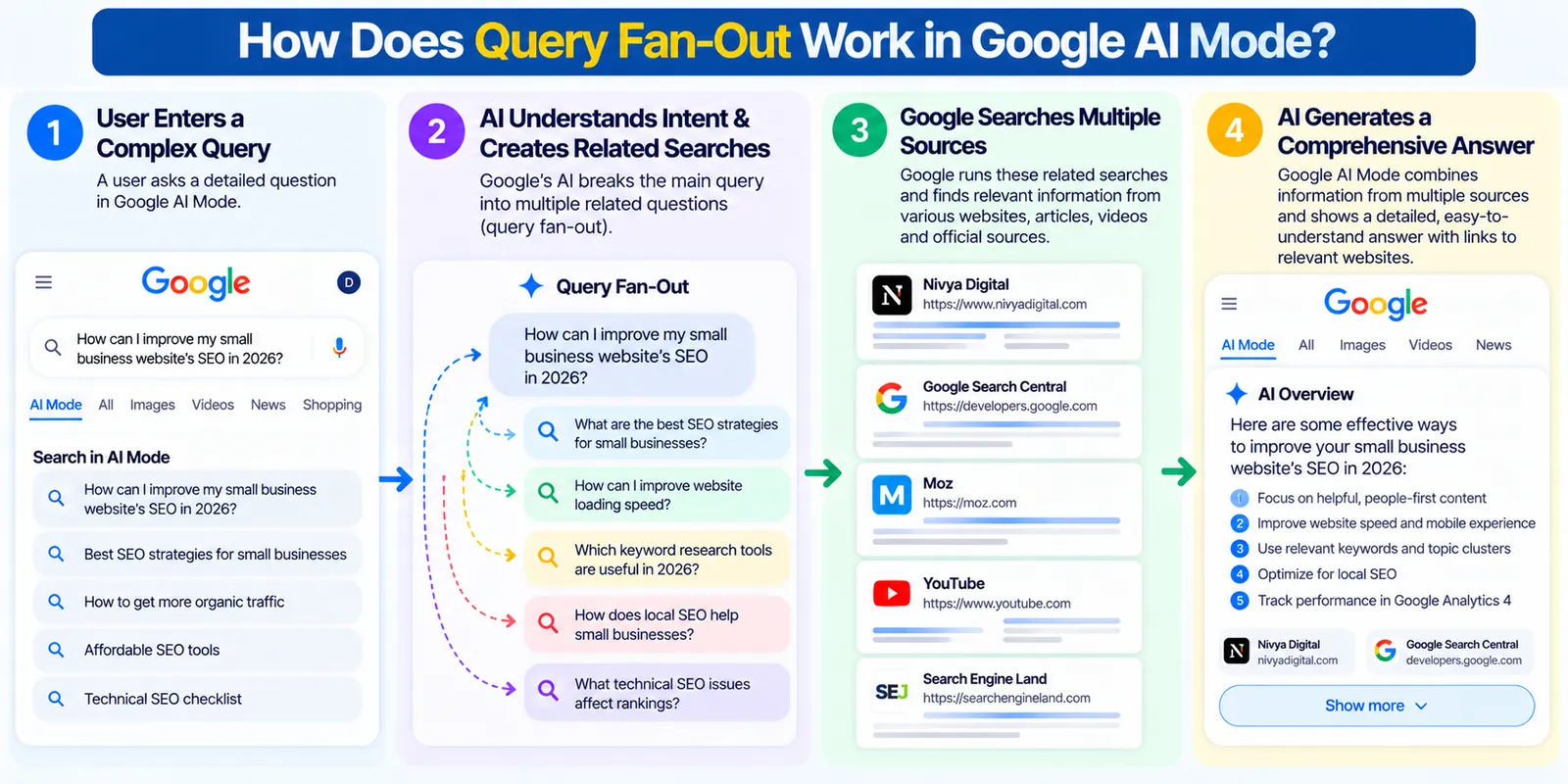
The query fan-out process can be explained in four stages.
1. Google Understands the User's Search Intent
The process begins when someone enters a detailed question into Google AI Mode.
For example:
"What is the best digital marketing strategy for a new e-commerce business?"
Google interprets the question and identifies relevant aspects, such as customer acquisition, marketing channels, budgets, and business goals.
2. AI Generates Multiple Related Searches
Google's AI systems can divide the original question into several subtopics.
Possible related searches might include:
SEO strategies for e-commerce websites
Google Ads for online stores
Social media marketing for new brands
E-commerce conversion optimization
Email marketing for customer retention
The system uses these searches to explore different parts of the user's question.
3. Google Retrieves Information From Relevant Sources
Google's search systems retrieve information that may help answer the related questions.
This process draws on Google's existing search infrastructure and ranking systems.
Relevant websites may be used as supporting sources when their content helps address the user's needs.
4. AI Mode Generates a Comprehensive Response
Finally, AI Mode combines retrieved information into an AI-generated answer.
The response may include explanations, comparisons, recommendations, and links to supporting websites.
Users can also ask follow-up questions without starting their research from scratch.
This is one reason conversational AI search differs from traditional keyword-based search experiences.
Traditional Keyword Research vs Query Fan-Out SEO
Traditional keyword research remains important, but query fan-out encourages SEO professionals to consider the broader context behind a search.
| Factor | Traditional Keyword Research | Query Fan-Out SEO |
|---|---|---|
| Main focus | Individual keywords | Related questions and subtopics |
| User queries | Often short or specific | Frequently detailed and conversational |
| Content planning | Keyword-focused pages | Comprehensive topical coverage |
| Research methods | Search volume, difficulty, intent | Intent, context, related questions |
| Content structure | Targeted keyword sections | Connected topics and explanations |
| SEO measurement | Rankings, impressions, clicks | Organic performance and AI search visibility |
| Main objective | Answer a relevant query | Help users explore a complete topic |
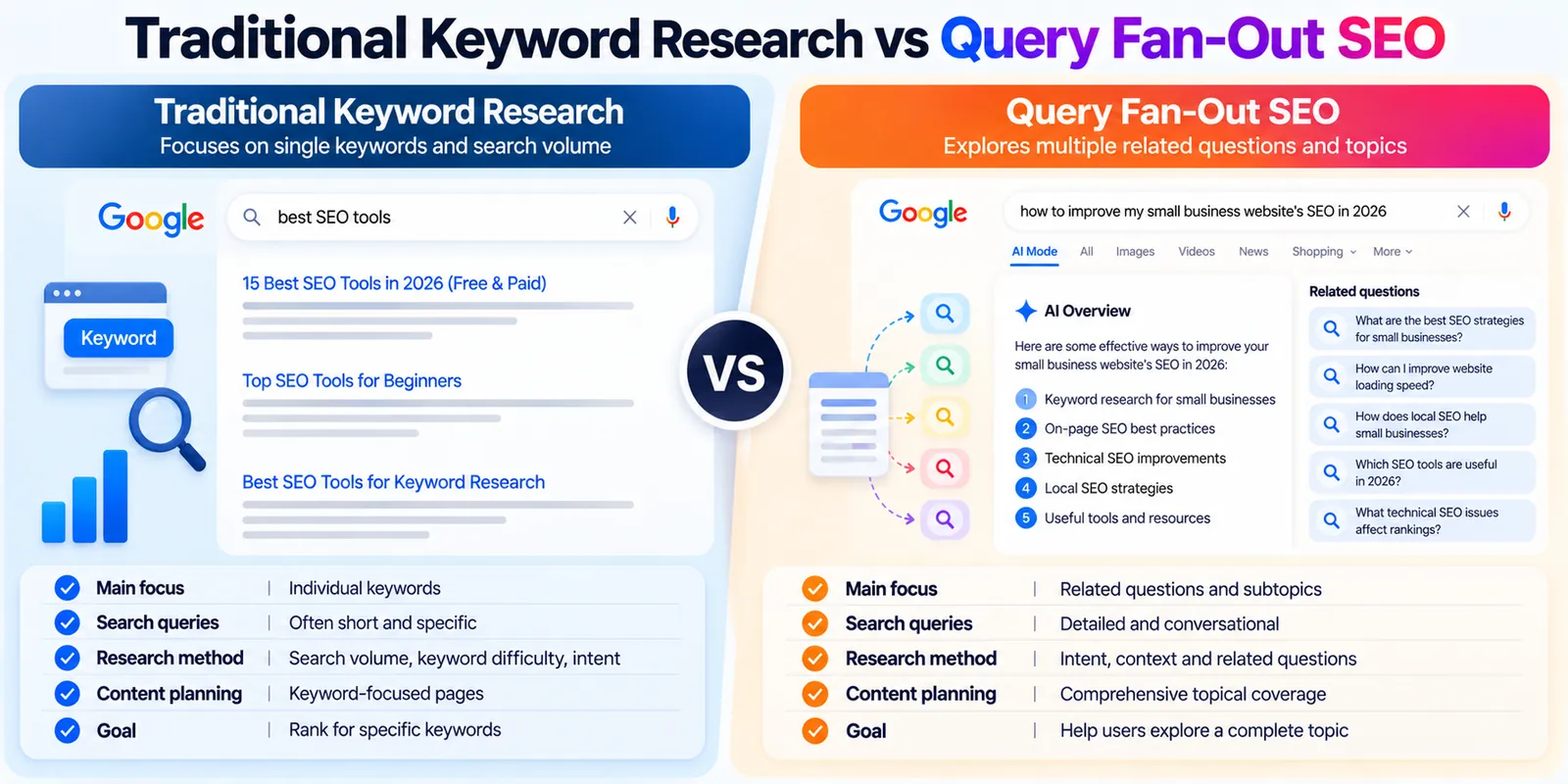
These approaches should work together rather than compete.
Search volume and keyword difficulty remain useful for prioritization, while related questions help identify what readers genuinely need to know.
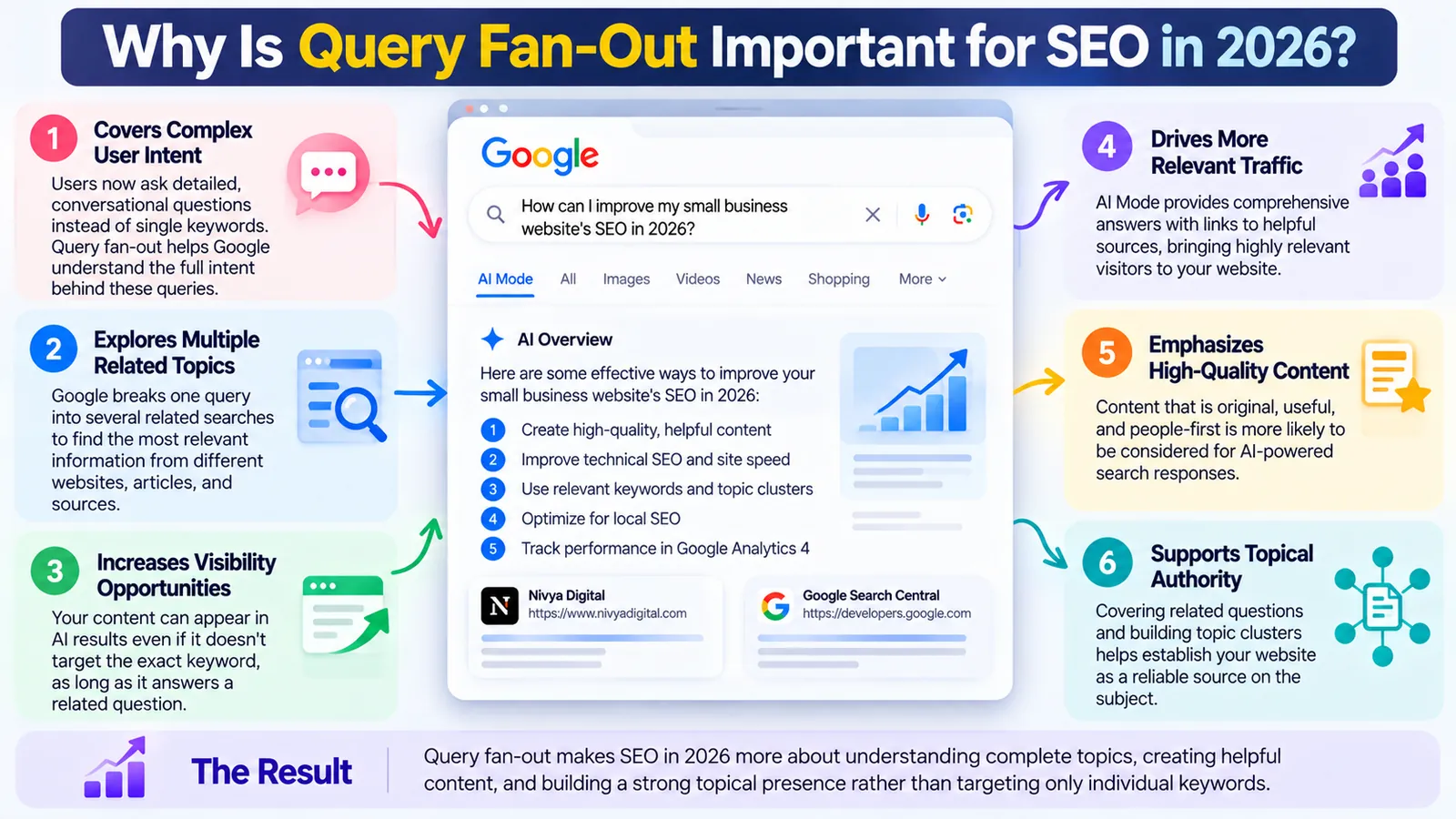
Why Is Query Fan-Out Important for SEO in 2026?
Query fan-out is important because it changes how AI-powered search systems explore information.
1. Long-Tail and Conversational Queries Matter
Users can ask detailed questions containing multiple requirements.
For example, instead of searching for "SEO tools," someone might ask:
"Which affordable SEO tools can help a small business improve technical SEO and keyword rankings?"
This provides more context about the user's needs.
SEO professionals should consider these questions when planning content.
2. Related Content Can Support Broader Search Journeys
A website might offer valuable information about one part of a complex question.
For example, an article about technical SEO audits could help someone researching how to improve an e-commerce website.
However, Google does not guarantee that publishing related content will result in AI Mode citations or rankings.
3. Helpful Content Remains Essential
Google's guidance emphasizes original, reliable, people-first content.
Businesses should focus on answering real questions, sharing practical examples, and providing accurate information.
Simply repeating keywords or producing large quantities of similar articles is not an effective long-term strategy.
4. Topic Organization Improves User Experience
Organizing related articles through logical internal links helps visitors find additional information.
A website covering SEO could connect articles about keyword research, on-page SEO, technical SEO, and performance measurement.
This makes the website easier to navigate and supports a more complete learning experience.
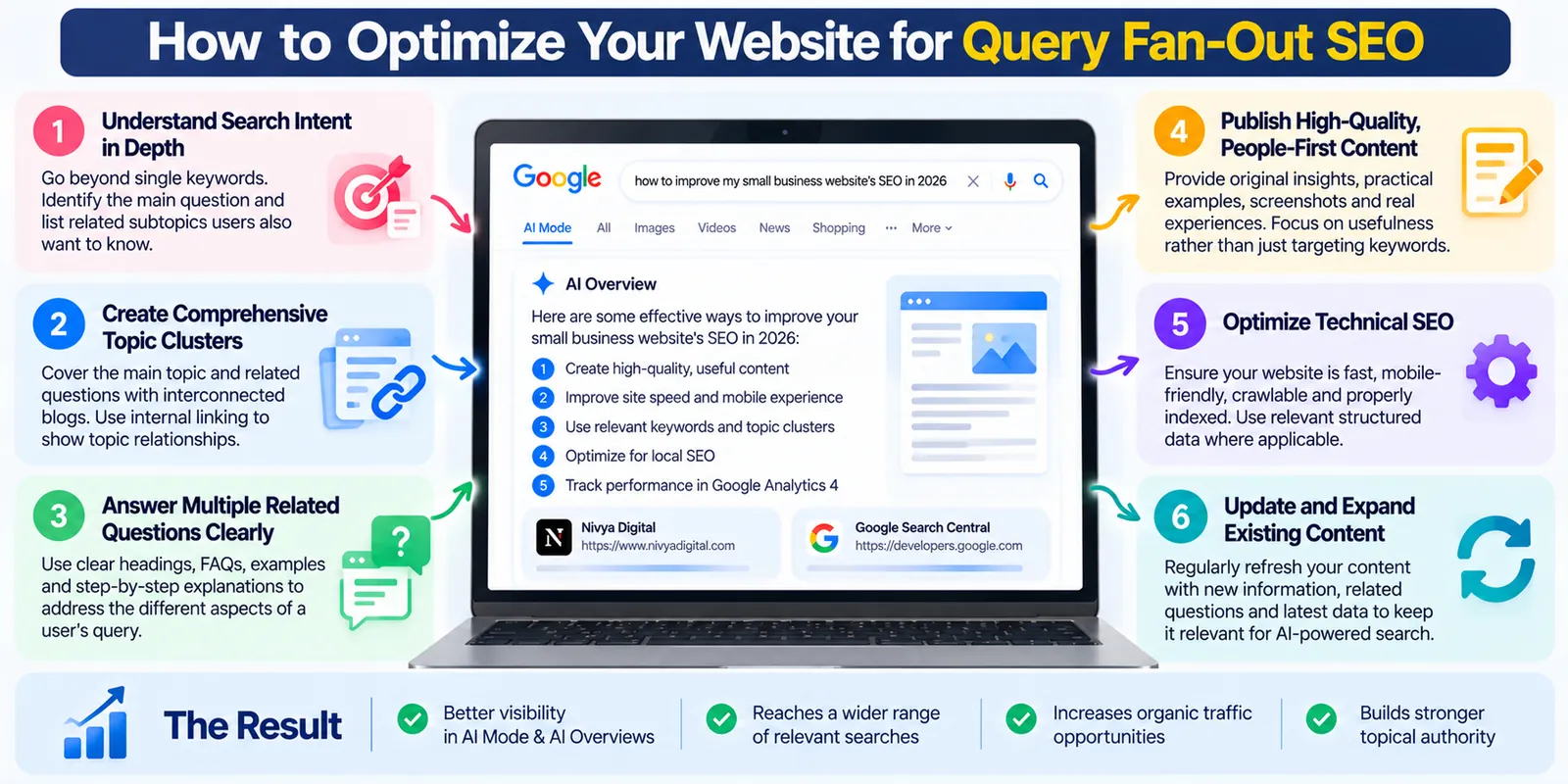
How to Optimize Your Website for Query Fan-Out SEO
There is no separate Google ranking factor officially called "query fan-out optimization."
However, businesses can adapt their content strategies using established SEO principles.
1. Research the Complete Search Intent
Start with a primary topic and identify the questions people naturally ask about it.
For example, consider the keyword:
"SEO for Small Businesses"
Related questions might include:
How much does small business SEO cost?
How long does SEO take to work?
What are the best SEO tools for beginners?
How can local businesses improve visibility?
How do businesses track SEO results?
Use these questions to create genuinely useful content.
Avoid producing separate, nearly identical pages for every possible question variation.
2. Create Relevant Topic Clusters
A topic cluster connects a comprehensive main article with related supporting content.
For example:
Pillar Page: Complete Guide to SEO for Small Businesses
Supporting Articles:
Local SEO Strategies for Small Businesses
Keyword Research for Beginners
Technical SEO Checklist
On-Page SEO Best Practices
How to Track Organic Traffic in GA4
These pages can link to one another when the connections are helpful to readers.
The objective is to improve topical coverage and navigation, not artificially increase page counts.
3. Answer Questions Clearly and Directly
Use descriptive H2 and H3 headings that reflect real user questions.
For example:
H3: How Long Does SEO Take to Show Results?
SEO results depend on factors such as competition, website history, technical issues, and content quality. Improvements often take time, and no specific ranking timeline is guaranteed.
After giving a direct answer, provide additional context or examples where useful.
This makes content easier for readers to understand.
4. Publish Original and Experience-Based Content
Original information helps distinguish your website from competing resources.
Consider adding:
Practical SEO examples
Original screenshots
Relevant comparison tables
Expert explanations
Step-by-step tutorials
Verified research and statistics
If you publish case studies, use genuine results and explain their context.
Avoid inventing performance statistics or customer experiences.
5. Strengthen Technical SEO
Technical SEO remains important for traditional and AI-powered Google Search.
Review essential elements such as:
Crawl accessibility
Indexing eligibility
Internal linking
Mobile usability
Page experience
Text accessibility
Appropriate structured data
Google states that websites do not need special AI-specific structured data or additional machine-readable files to appear in AI Mode.
6. Keep Existing Content Updated
Review important articles when industry information changes.
Update outdated examples, incorrect instructions, broken links, and discontinued tools.
Focus on meaningful improvements instead of changing publication dates without improving the content.
Practical Example: Query Fan-Out SEO Strategy for Nivya Digital
Suppose a business owner searches:
"How can I increase my website traffic without spending money on advertising?"
This question involves several related SEO topics.
| Related Question | Suggested Blog Topic |
|---|---|
| How can I get organic website traffic? | Organic Traffic Growth Strategies |
| How do I find low-competition keywords? | Keyword Research for Beginners |
| Why is my website not ranking? | Common SEO Ranking Problems |
| How can I improve local visibility? | Local SEO Optimization Guide |
| How do I measure organic traffic? | GA4 Organic Traffic Tracking |
Nivya Digital could publish useful articles covering these topics and connect them through relevant internal links.
This approach helps readers find answers to different parts of their research journey.
It does not require predicting Google's exact internal fan-out queries.
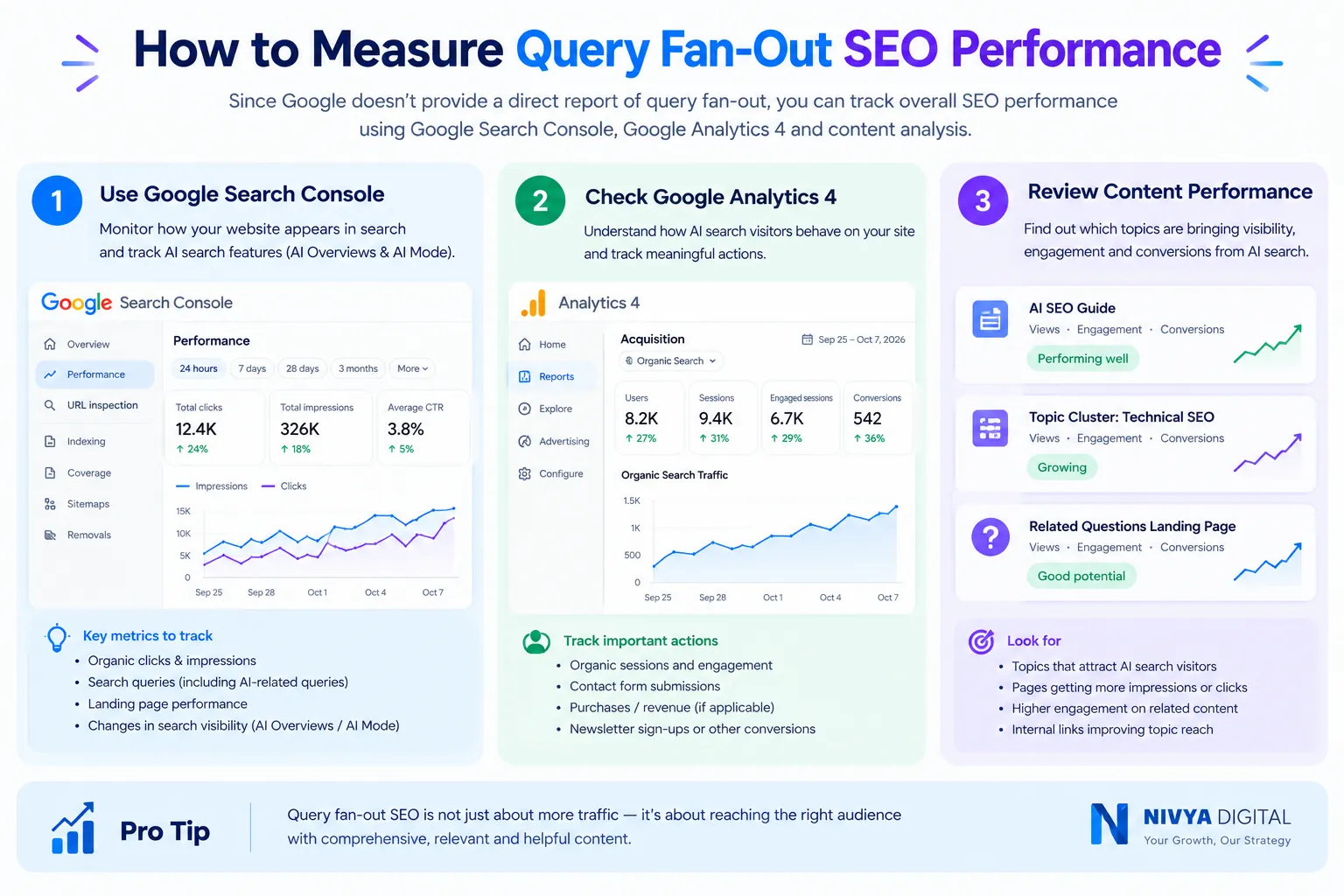
How to Measure Query Fan-Out SEO Performance
Measuring query fan-out directly is difficult because Google does not provide a complete public report of the internal related searches generated for every AI Mode question.
However, businesses can evaluate their overall SEO performance.
Google Search Console
Use Google Search Console to review:
Organic clicks
Search impressions
Search queries
Landing page performance
Changes in search visibility
Google includes AI Mode and AI Overviews traffic within the overall Web search performance reporting rather than providing a complete query fan-out report.
Google Analytics 4
Use GA4 to analyze visitor behavior and conversions.
Important measurements may include:
Organic sessions
Engagement
Contact form submissions
Purchases
Consultation requests
Combining Search Console and GA4 data can provide a broader understanding of search performance.
However, traffic changes should not automatically be attributed to query fan-out.
Common Query Fan-Out SEO Mistakes to Avoid
One common mistake is creating dozens of similar pages targeting every possible related question.
Google warns against producing content at scale primarily to manipulate rankings or AI-generated responses.
Other mistakes include keyword stuffing, publishing unverified information, ignoring search intent, and relying entirely on automated content generation without editorial review.
Another misconception is that special AI schema markup guarantees visibility in Google AI Mode.
Google has not introduced such a requirement.
Businesses should prioritize quality, accuracy, usability, and established SEO fundamentals.
The Future of Query Fan-Out and Keyword Research
As AI-powered search continues to develop, keyword research will increasingly involve understanding complete user journeys.
SEO professionals will need to consider not only what people search for, but also why they search and which related questions influence their decisions.
Traditional keyword research will remain valuable for understanding demand and prioritizing opportunities.
Combining that research with helpful topic coverage, technical SEO, and original insights offers a practical way to prepare for evolving search experiences.
Final Thoughts
Query fan-out is an important development in how Google AI Mode processes complex search questions.
It allows Google's AI systems to explore related topics and retrieve information from multiple sources before generating a response.
For businesses, the opportunity is to create accurate, helpful, and well-organized content that addresses genuine customer needs.
At Nivya Digital, we believe effective SEO begins with understanding search intent, publishing valuable information, and maintaining a technically accessible website.
By combining these principles with thoughtful keyword research, businesses can build a stronger SEO foundation for 2026 and beyond.
Comments (0)
No comments yet
Start the discussion by sharing your perspective