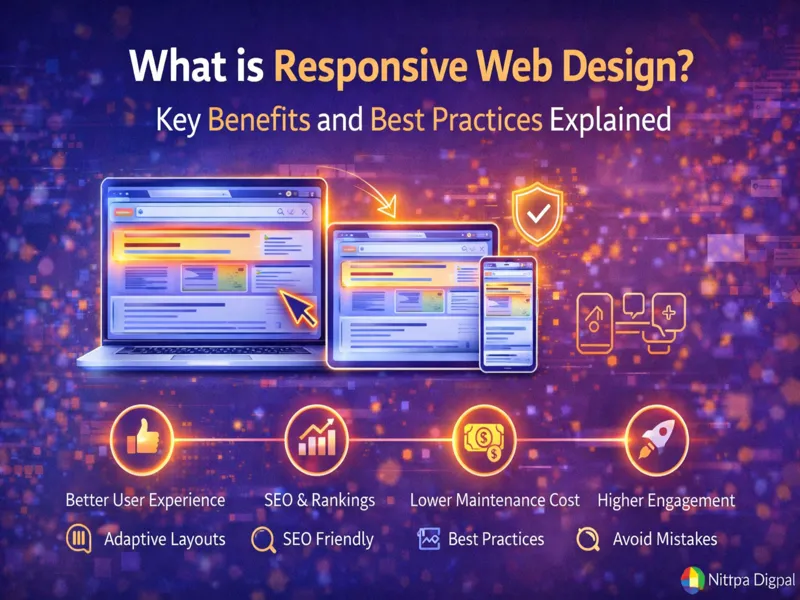
In today’s digital world, users access websites from a wide range of devices including smartphones, tablets, laptops, and desktops. To ensure a seamless experience across all these devices, businesses must adopt responsive web design (RWD).
Responsive web design is an approach that allows websites to automatically adjust their layout, images, and content based on the screen size and device being used. Instead of creating separate versions for mobile and desktop, responsive design ensures a consistent and optimized experience for all users.
With search engines like Google Search prioritizing mobile-friendly websites, responsive design has become essential for SEO, user experience, and overall digital success.
In this blog, we will explore what responsive web design is, its key benefits, and best practices to implement it effectively.
Overview Table: Responsive Web Design
| Aspect | Description | Benefit |
|---|---|---|
| Responsive Design | Adapts to different screen sizes | Better user experience |
| Mobile-Friendly | Optimized for smartphones | Higher engagement |
| Flexible Layout | Uses grids and media queries | Consistent design |
| SEO Impact | Improves rankings | More traffic |
| Performance | Faster loading across devices | Lower bounce rate |
1. What is Responsive Web Design?
Responsive web design (RWD) is a web development technique that ensures a website automatically adjusts its layout and content to fit different screen sizes and devices. This is achieved using flexible grids, fluid images, and CSS media queries.
Instead of building separate websites for mobile and desktop users, responsive design creates a single website that adapts dynamically. This approach simplifies website management and provides a consistent user experience.
Responsive design focuses on usability, readability, and accessibility. It ensures that users can easily navigate the website, read content, and interact with elements regardless of the device they are using.
As mobile usage continues to grow, responsive design has become a standard practice in web development.
Key Points
- Adapts layout to screen size
- Uses flexible grids and media queries
- Works across all devices
- Improves usability and accessibility
- Essential for modern websites
2. Key Benefits of Responsive Web Design
Responsive web design offers numerous benefits for businesses and users. One of the biggest advantages is improved user experience. When a website looks and functions well on all devices, users are more likely to stay longer and engage with the content.
Another major benefit is SEO improvement. Search engines like Google Search prioritize mobile-friendly websites, which can lead to higher rankings and increased traffic.
Responsive design also reduces development and maintenance costs. Instead of managing multiple versions of a website, businesses only need to maintain one responsive site.
Additionally, responsive websites tend to have faster loading times and lower bounce rates, which further enhance performance and user satisfaction.
Key Points
- Better user experience
- Improved SEO rankings
- Lower development costs
- Faster loading speed
- Reduced bounce rate
3. How Responsive Design Impacts SEO
Responsive web design plays a crucial role in SEO. Search engines favor websites that provide a seamless experience across devices.
Mobile-first indexing means that search engines primarily use the mobile version of a website for ranking and indexing. If a website is not mobile-friendly, it may struggle to rank well in search results.
Responsive design also improves page speed and usability, which are important ranking factors.
By providing a consistent URL structure and content across devices, responsive design eliminates duplicate content issues and improves SEO performance.
Key Points
- Supports mobile-first indexing
- Improves page speed
- Enhances user experience
- Eliminates duplicate content
- Boosts search rankings
4. Best Practices for Responsive Web Design
To create an effective responsive website, businesses should follow best practices.
Start with a mobile-first approach. Design the website for smaller screens first and then scale up for larger devices.
Use flexible grids and layouts that adjust automatically. Avoid fixed-width elements that may not display properly on smaller screens.
Optimize images to ensure fast loading times. Use responsive images that adapt to different screen sizes.
Test the website on multiple devices and screen sizes to ensure compatibility and performance.
Key Points
- Use mobile-first design
- Implement flexible layouts
- Optimize images
- Test across devices
- Focus on performance
5. Common Mistakes to Avoid
While implementing responsive design, businesses often make common mistakes.
One mistake is ignoring mobile optimization. Even with responsive design, poor mobile usability can affect performance.
Another mistake is using large images that slow down page speed. Optimization is essential for better performance.
Poor navigation design can also impact user experience. Menus should be easy to use on smaller screens.
Avoid cluttered layouts and ensure that content is easy to read and interact with.
Key Points
- Don’t ignore mobile usability
- Avoid heavy images
- Simplify navigation
- Maintain clean design
- Focus on user experience
Conclusion
Responsive web design is no longer optional—it is a necessity in today’s mobile-driven world. By ensuring that websites adapt to different devices, businesses can improve user experience, boost SEO performance, and increase engagement.
With search engines like Google Search prioritizing mobile-friendly websites, adopting responsive design is essential for long-term success.
By following best practices and avoiding common mistakes, businesses can create responsive websites that deliver excellent performance across all devices.
Comments (0)
No comments yet
Start the discussion by sharing your perspective