
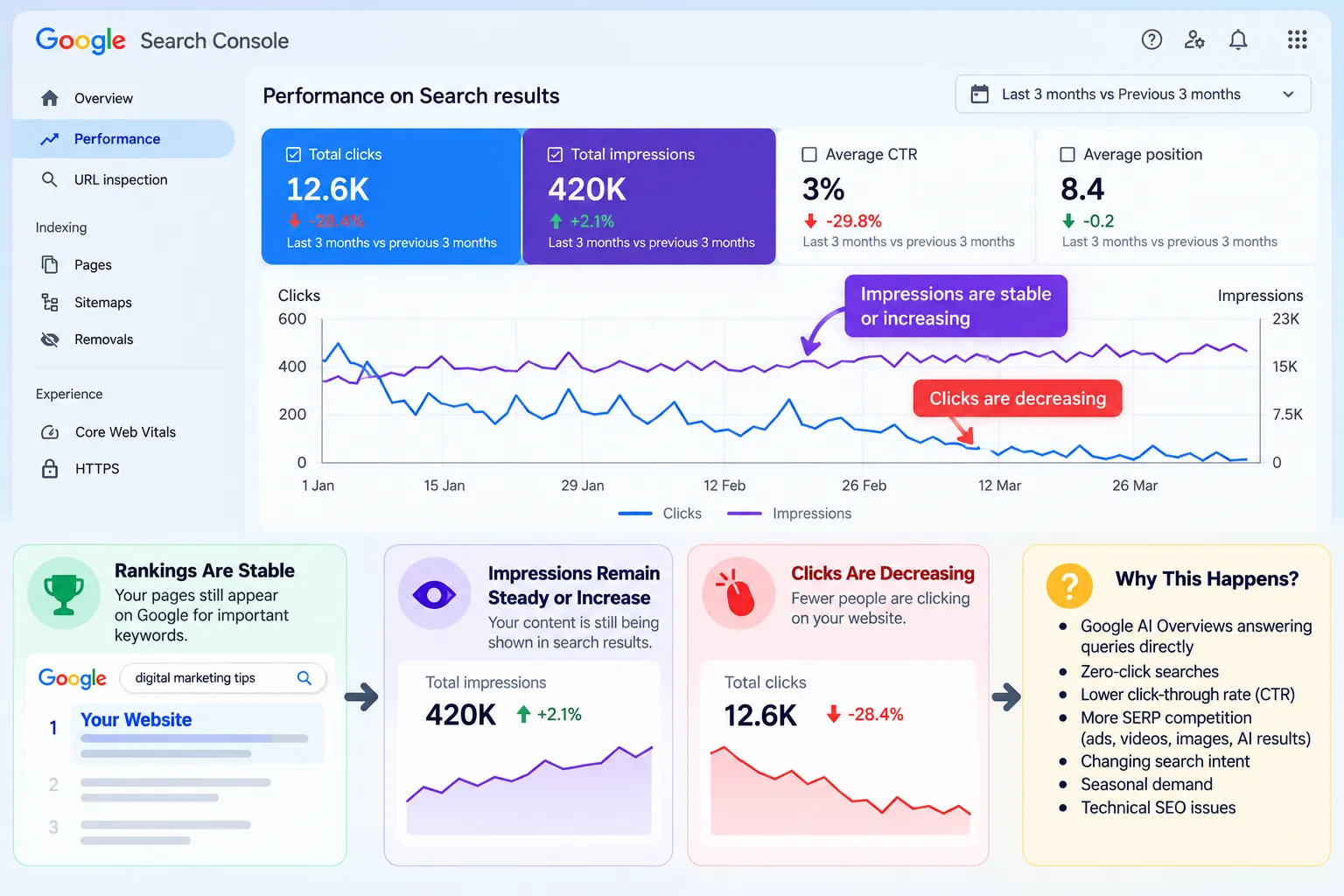
Imagine opening Google Search Console and noticing something confusing. Your website is still ranking for important keywords, impressions remain healthy, and your pages continue appearing in Google Search. Yet your organic traffic keeps declining.
For businesses investing in search engine optimization, this situation can be frustrating.
Why is website traffic dropping in 2026 even when Google rankings appear stable?
One possible explanation is the growing influence of AI-powered search experiences, including Google AI Overviews and AI Mode. These features can change how users interact with search results and whether they need to visit a website to get an answer.
However, AI Search is not the only possible reason. Changes in click-through rate, search demand, competition, technical SEO, and user behavior can also affect organic traffic.
In this guide, we explain how AI Search may influence website clicks, how to diagnose declining traffic using Google Search Console and Google Analytics 4, and what businesses can do to protect their organic visibility.
Why Is Website Traffic Dropping Even When Google Rankings Are Stable?
Traditionally, SEO success was often associated with higher keyword rankings and increased organic traffic.
Although rankings remain important, they do not tell the complete story.
A website can maintain a similar average position while receiving fewer clicks because search results have changed, user demand has shifted, or competing results have become more attractive.
Understanding Rankings, Impressions, Clicks, and CTR
Before identifying the cause of a traffic decline, it is important to understand four SEO metrics.
1. Average Position
Average position represents the average ranking position of your website's results across recorded impressions. It is not a fixed ranking for every user or search.
2. Impressions
Impressions indicate how often your website appeared in eligible Google Search results.
3. Clicks
Clicks represent visits initiated when users select your website's result in Google Search.
4. Click-Through Rate (CTR)
CTR measures the percentage of impressions that result in clicks.
CTR Formula:
CTR = (Clicks ÷ Impressions) × 100
For example, suppose your website receives 20,000 impressions and 1,000 clicks.
Your CTR would be:
(1,000 ÷ 20,000) × 100 = 5%
If impressions remain at 20,000 but clicks fall to 600, CTR declines to 3%.
This indicates that fewer search appearances are turning into website visits.
It does not automatically prove that AI Overviews caused the decline, but it provides an important starting point for investigation.
How AI Search Is Changing Google Traffic in 2026
Google Search has evolved beyond traditional blue-link results.
AI-powered experiences can summarize information, organize answers, and provide links to supporting sources.
These changes create new opportunities for website discovery, but they also influence how users interact with search results.
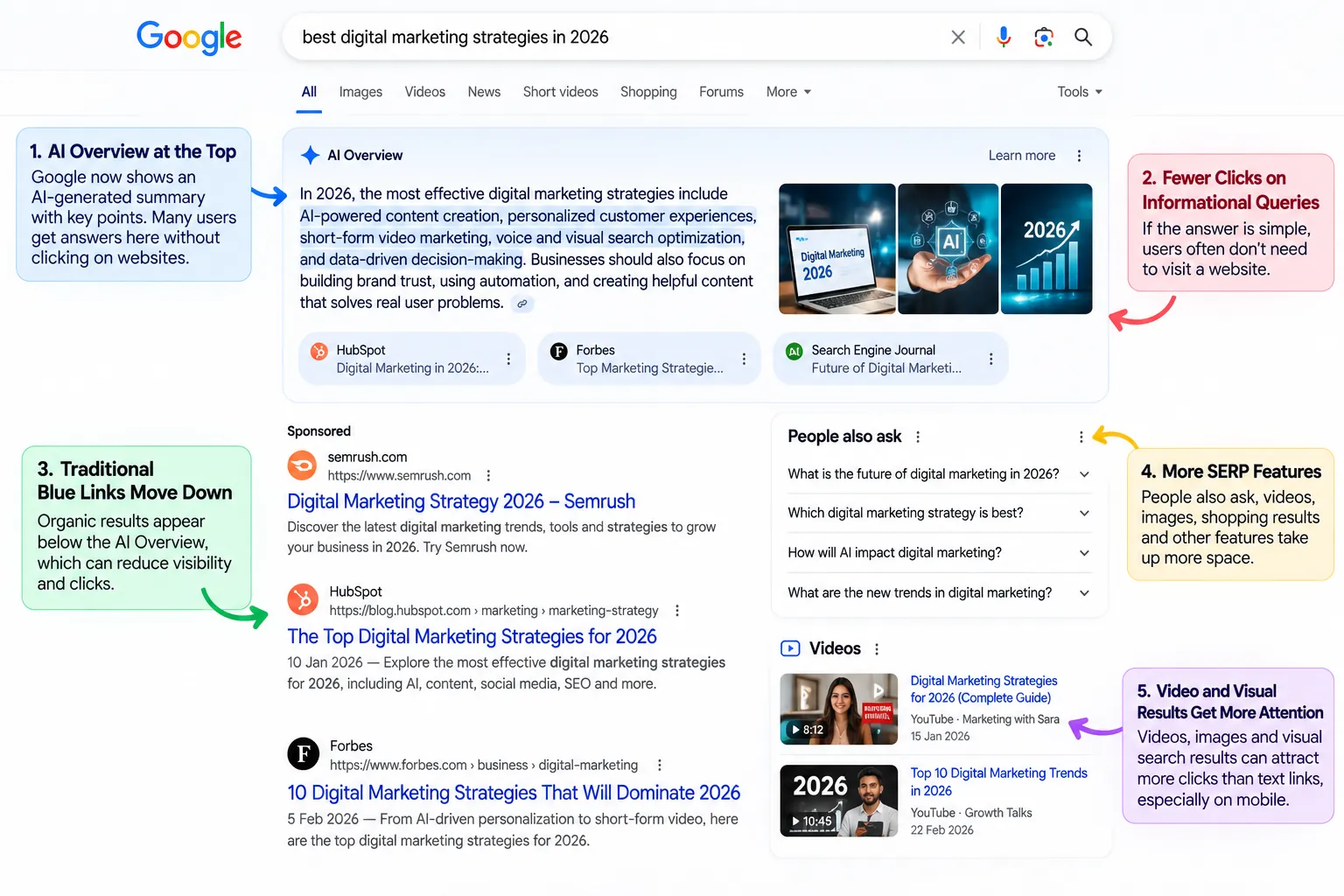
1. Google AI Overviews Can Answer Questions Directly
AI Overviews provide AI-generated summaries for certain searches.
For informational queries, users may find enough information in the overview to satisfy their immediate question without opening another website.
Consider someone searching:
“What is bounce rate in Google Analytics?”
If the search experience provides a useful definition and explanation, some users may not need to visit a separate article.
This can affect the number of clicks received by websites targeting straightforward informational searches.
However, the effect varies by query. Users researching complex topics may still visit websites for detailed explanations, comparisons, tools, or professional services.
2. Zero-Click Searches Can Reduce Website Visits
A zero-click search occurs when a user completes a search without clicking through to an external website.
This can happen because the search results page already provides the information needed.
Zero-click behavior existed before generative AI through featured snippets, knowledge panels, calculators, and other search features.
AI-generated answers introduce another way for users to obtain information directly from search.
For SEO professionals, the challenge is to create content that provides value beyond a short answer.
3. AI Mode Can Change the Search Journey
Google AI Mode allows users to explore questions through more conversational interactions.
Instead of searching for several separate keywords, users may ask follow-up questions within the same experience.
This can change how people discover businesses, compare options, and decide which websites to visit.
Businesses should therefore consider the complete customer journey rather than focusing exclusively on individual keyword positions.
4. Search Results Are Becoming More Competitive
Organic listings compete for attention with multiple search features, including advertisements, videos, images, shopping results, featured snippets, and AI-generated experiences.
Even when a page maintains a similar ranking position, the amount of attention available to that result can change.
That is why rankings alone are insufficient for evaluating SEO performance in 2026.
Is AI Search Really Stealing Your Website Clicks?
The answer depends on your website's actual performance data.
AI-powered search experiences can contribute to changes in click behavior, particularly for certain informational queries.
But it would be misleading to attribute every organic traffic decline to AI.
Google identifies several additional causes of Search traffic drops, including algorithm changes, technical problems, security issues, seasonality, and changing search demand.
Common Reasons for Declining Organic Traffic
| Possible Cause | What You May Notice | What to Investigate |
|---|---|---|
| AI-powered search features | Informational pages receive fewer clicks despite continued visibility | Query patterns and generative AI visibility |
| Lower organic CTR | Impressions remain stable but clicks decrease | Titles, snippets, competing search features |
| Ranking changes | Average position declines for important queries | Query-level ranking trends |
| Seasonal demand | Impressions and clicks decline together | Google Trends and previous-year data |
| Technical SEO issues | Sudden losses across affected pages | Indexing, redirects, server errors |
| Search algorithm changes | Significant visibility shifts across page groups | Google Search updates and content quality |
| Competitor improvements | Specific pages lose clicks or rankings | Competing content and search intent |
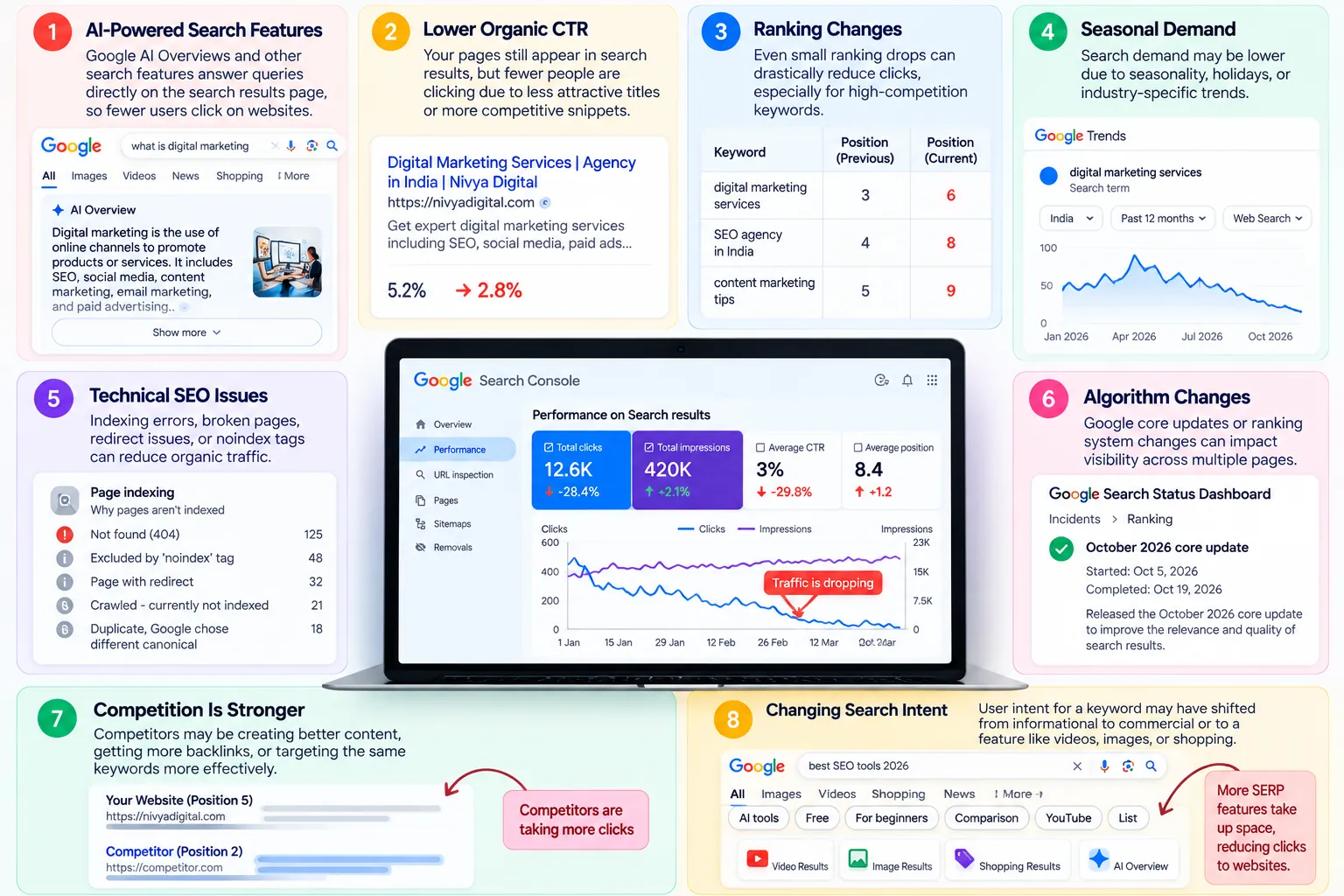
Important: Treat AI Search as a possible contributing factor, not a confirmed cause, until you have investigated the available evidence.
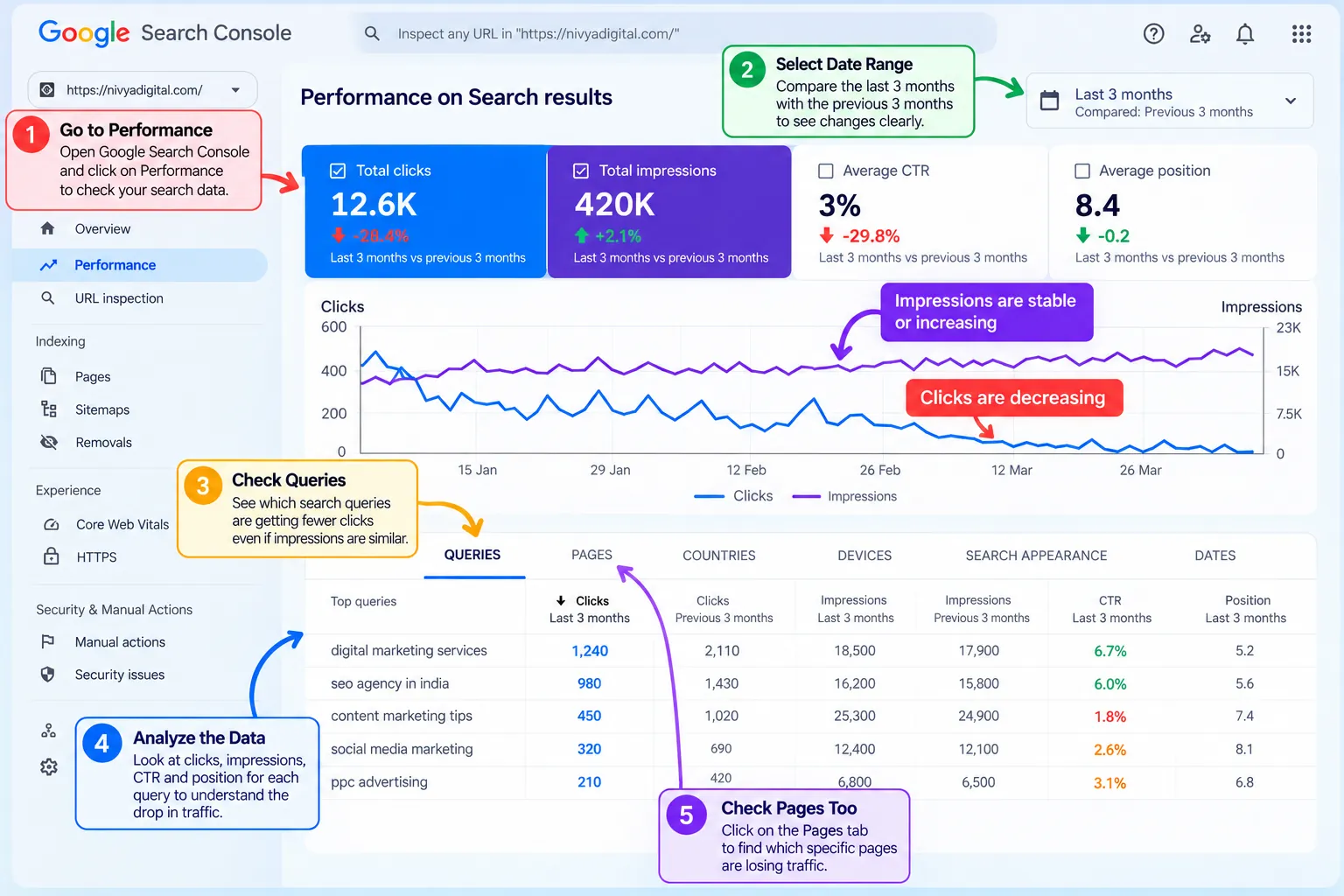
How to Diagnose Website Traffic Drops Using Google Search Console
Google Search Console is one of the most useful tools for understanding changes in organic search performance.
Follow these steps before making major changes to your website.
Step 1: Compare Two Relevant Time Periods
Open Google Search Console and navigate to:
Performance → Search Results
Choose a date range and compare it with an equivalent previous period.
For example, compare the last 28 days with the preceding 28 days.
For seasonal businesses, also compare performance with the same period in the previous year.
Review total clicks, impressions, average CTR, and average position.
Step 2: Identify Pages Losing the Most Clicks
Open the Pages tab and sort by the largest decline in clicks.
Determine whether the traffic loss affects:
A few informational blog posts
Important service landing pages
Product or category pages
A specific section of the website
Most pages across the domain
A decline concentrated in informational articles may require a different investigation from a site-wide technical traffic loss.
Step 3: Analyze Queries Instead of Only Average Position
Select an affected page and open the Queries tab.
Look for search terms where impressions remain stable but clicks or CTR have declined.
Check whether the query is informational, commercial, navigational, or transactional.
For example, a query such as “what is SEO” has a different user intent from “hire SEO agency in Noida.”
Different query types may be affected differently by search features and user behavior.
Step 4: Compare Device and Country Performance
Review performance by mobile versus desktop and by country.
Search results can vary across locations and devices.
A decline affecting one country or device category may point toward changes that are not visible in your usual manual searches.
Step 5: Review Generative AI Visibility Reports
In June 2026, Google introduced dedicated generative AI performance reporting in Search Console and stated that the reports were available worldwide by August 31, 2026.
These reports provide additional visibility into how website URLs appear within Google's generative AI features.
Available dimensions include impressions, pages, countries, dates, and devices for supported Search reporting.
Use this information alongside the overall Performance report to understand where your pages appear in AI-powered experiences.
Remember that an impression in an AI feature is not the same as a click or a conversion.
Step 6: Check for Technical and Indexing Problems
Before blaming AI Search, review:
Page indexing errors
Unexpected noindex directives
Incorrect canonical tags
Broken redirects
Server errors
Changes to robots.txt
Website migrations
Security and manual-action reports
A technical problem can cause a major traffic decline even when some pages continue ranking normally.
How to Analyze Organic Traffic Drops in Google Analytics 4
Google Search Console measures search visibility and clicks, while Google Analytics 4 helps you understand what visitors do after arriving on your website.
Both tools provide useful but different information.
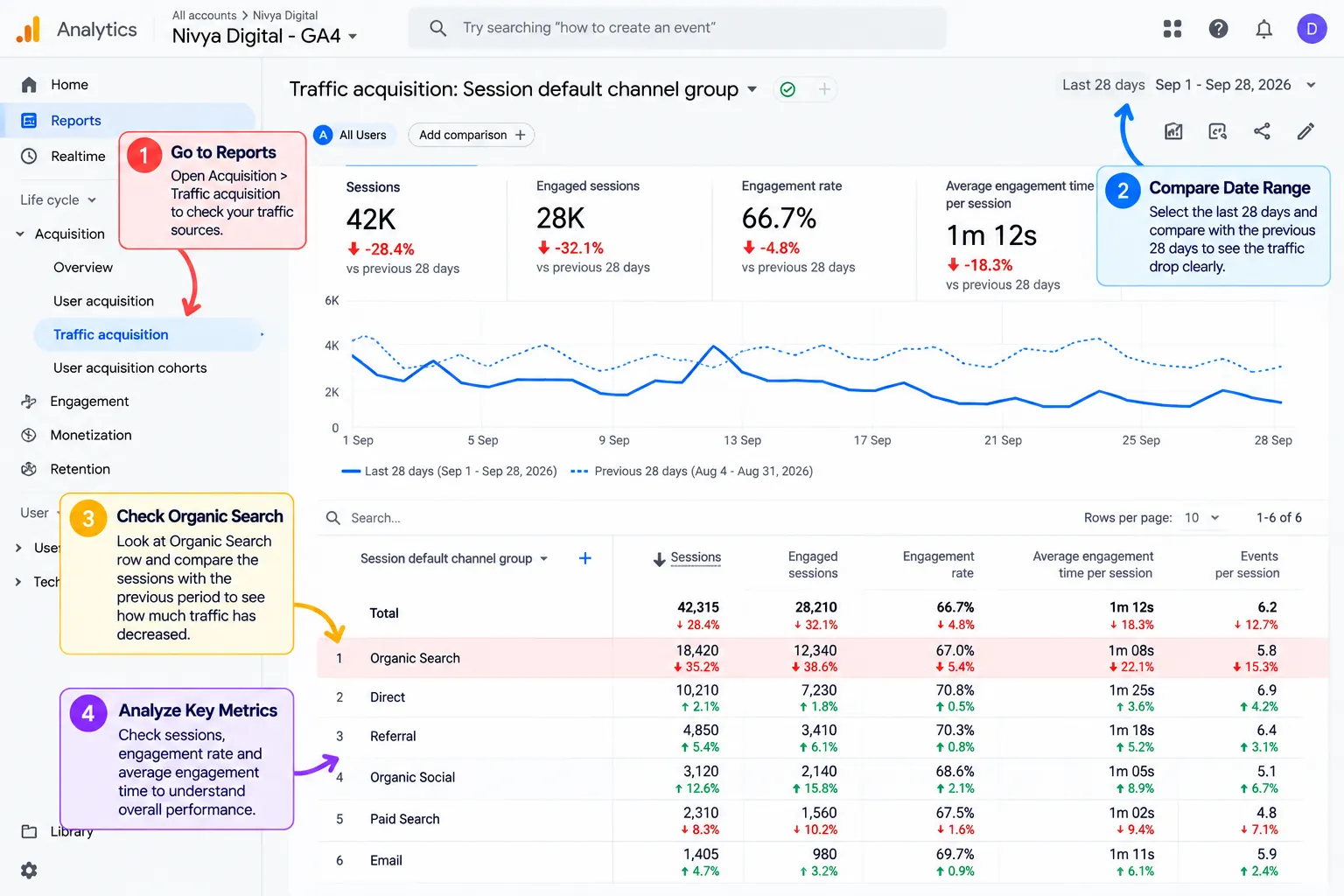
1. Check Organic Search Sessions
In GA4, review traffic acquisition reporting and focus on the Organic Search channel.
Compare sessions across equivalent periods.
Check whether the decline affects Google organic traffic specifically or multiple traffic sources.
2. Analyze Landing Pages
Identify which landing pages experienced the largest reductions in organic sessions.
Compare these findings with the pages losing clicks in Search Console.
If both reports show declines on the same pages, investigate their queries, search appearance, and technical health.
3. Monitor Engagement and Conversions
Traffic volume is important, but it is not the only measure of SEO success.
Review metrics such as:
Engaged sessions
Engagement rate
Key events
Lead form submissions
Purchases
Revenue, where applicable
A website may receive fewer visits but maintain strong business performance if the remaining traffic is more qualified.
Conversely, stable traffic with declining conversions may indicate a separate problem with user experience or lead quality.
4. Review AI Referral Traffic Where Identifiable
Some visits from AI assistants may appear as referral traffic, depending on the platform and how the visit is attributed.
Review recognizable AI referral sources in GA4 when available.
However, not every AI-influenced visit can be identified reliably through standard referral reporting.
Avoid treating AI referral numbers as a complete measure of AI Search visibility.
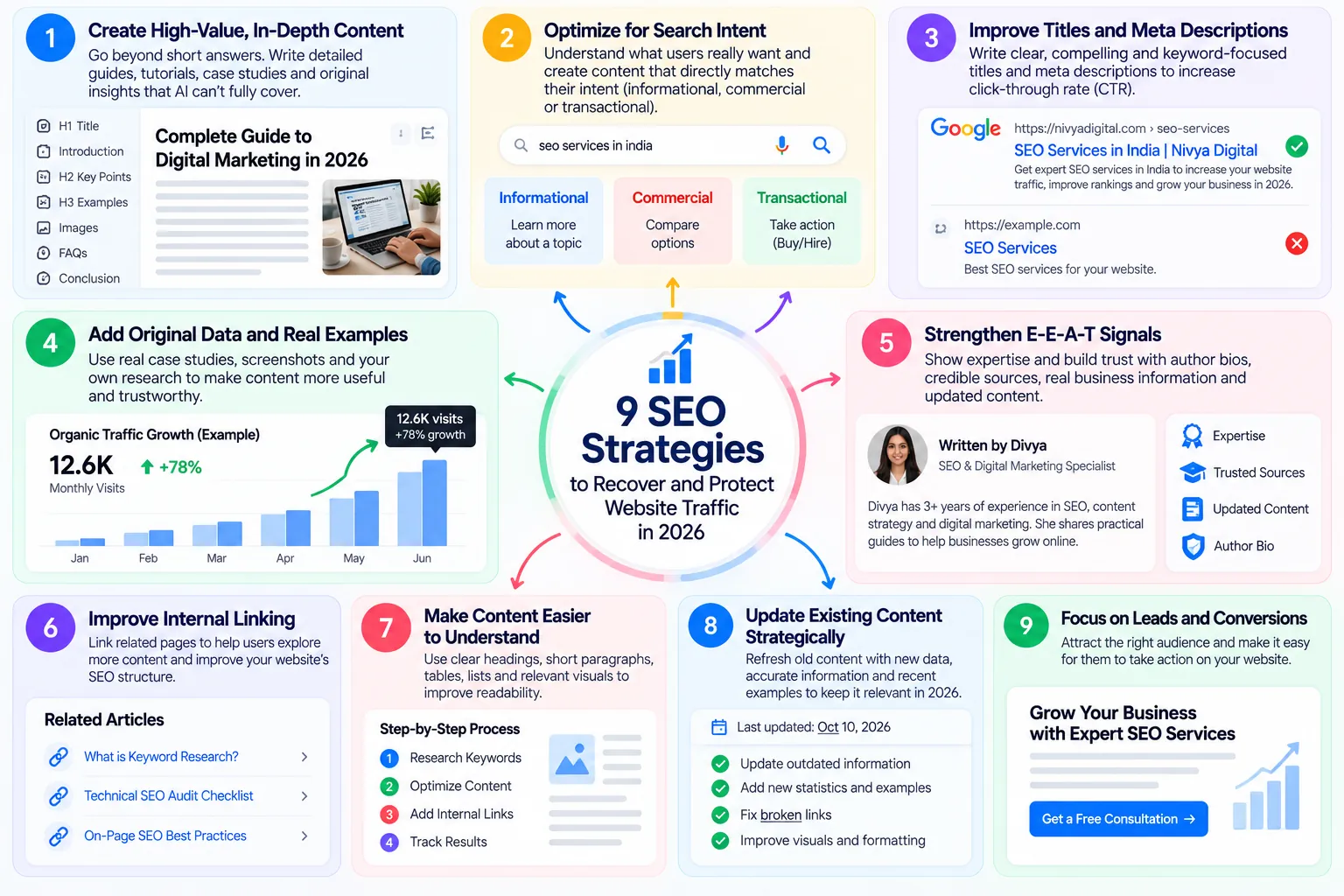
9 SEO Strategies to Recover and Protect Website Traffic in 2026
Once you understand the likely causes of declining traffic, you can prioritize improvements.
The following strategies support both traditional SEO and visibility in AI-powered search experiences.
1. Create Content That Goes Beyond Basic Answers
Short definitions and generic explanations are easy to reproduce.
To make your content more useful, include original analysis, practical examples, detailed tutorials, comparisons, and real-world applications.
For example, instead of publishing another generic article about CTR, create a guide showing how to investigate CTR changes in Google Search Console.
Content that solves a specific problem gives users a stronger reason to visit your website.
2. Optimize for Search Intent
Understand why users search for a particular keyword.
Informational users may want explanations, while commercial users may need comparisons, pricing information, or service details.
Make sure your page directly addresses the intended purpose of the search.
Do not assume that adding more keywords automatically improves relevance.
3. Improve Title Tags and Search Snippets
A clear and compelling title can help users understand why your page is relevant.
Avoid vague titles, exaggerated promises, and unnecessary keyword repetition.
For example:
Generic title: “Best SEO Tips”
More specific title: “Why Your Organic Traffic Dropped: 9 SEO Checks to Run”
Write useful meta descriptions that accurately summarize the page.
Google may generate its own search snippets, so improving page content is also important.
4. Add Original Data and Firsthand Experience
Original research can differentiate your website from competing content.
Consider adding:
Verified case studies
Screenshots from real workflows
Expert commentary
Original survey findings
Before-and-after examples
Practical troubleshooting results
Never invent performance statistics or client outcomes.
If you publish a case study, explain the context, methodology, and limitations of the results.
5. Strengthen E-E-A-T Signals
Experience, Expertise, Authoritativeness, and Trustworthiness are useful concepts for evaluating content quality.
Add appropriate author information, reliable references, accurate explanations, and transparent business details.
For professional topics, involve people with relevant expertise in the research and review process.
E-E-A-T is not a single ranking score, and adding an author biography alone does not guarantee improved rankings.
6. Improve Internal Linking
Internal links help users discover related content and allow search engines to understand connections between pages.
For example, an article about declining organic traffic could link to relevant guides about Google Search Console, technical SEO audits, CTR optimization, and content marketing.
Use descriptive anchor text and link only where the destination provides meaningful additional value.
7. Make Content Easier to Understand
Use descriptive headings, concise explanations, comparison tables, and relevant visual examples.
For complex topics, provide clear steps that readers can follow.
Structured data may help Google understand supported content types, but it does not guarantee rich results or AI citations.
Avoid adding unnecessary markup simply because a tool recommends it.
8. Update Existing Content Strategically
Older content may lose relevance when tools, interfaces, regulations, or industry practices change.
Review important pages for outdated screenshots, broken links, unsupported claims, and missing information.
Do not change publication dates merely to make old content appear new.
Prioritize meaningful updates that improve accuracy and usefulness.
9. Focus on Leads and Conversions, Not Only Clicks
A successful SEO strategy should support business outcomes.
Make it easy for qualified visitors to contact your company, request a consultation, explore services, or complete a purchase.
Use relevant calls to action without interrupting the reading experience.
The goal is not simply to recover every lost click. It is to attract the right audience and help those visitors take useful actions.
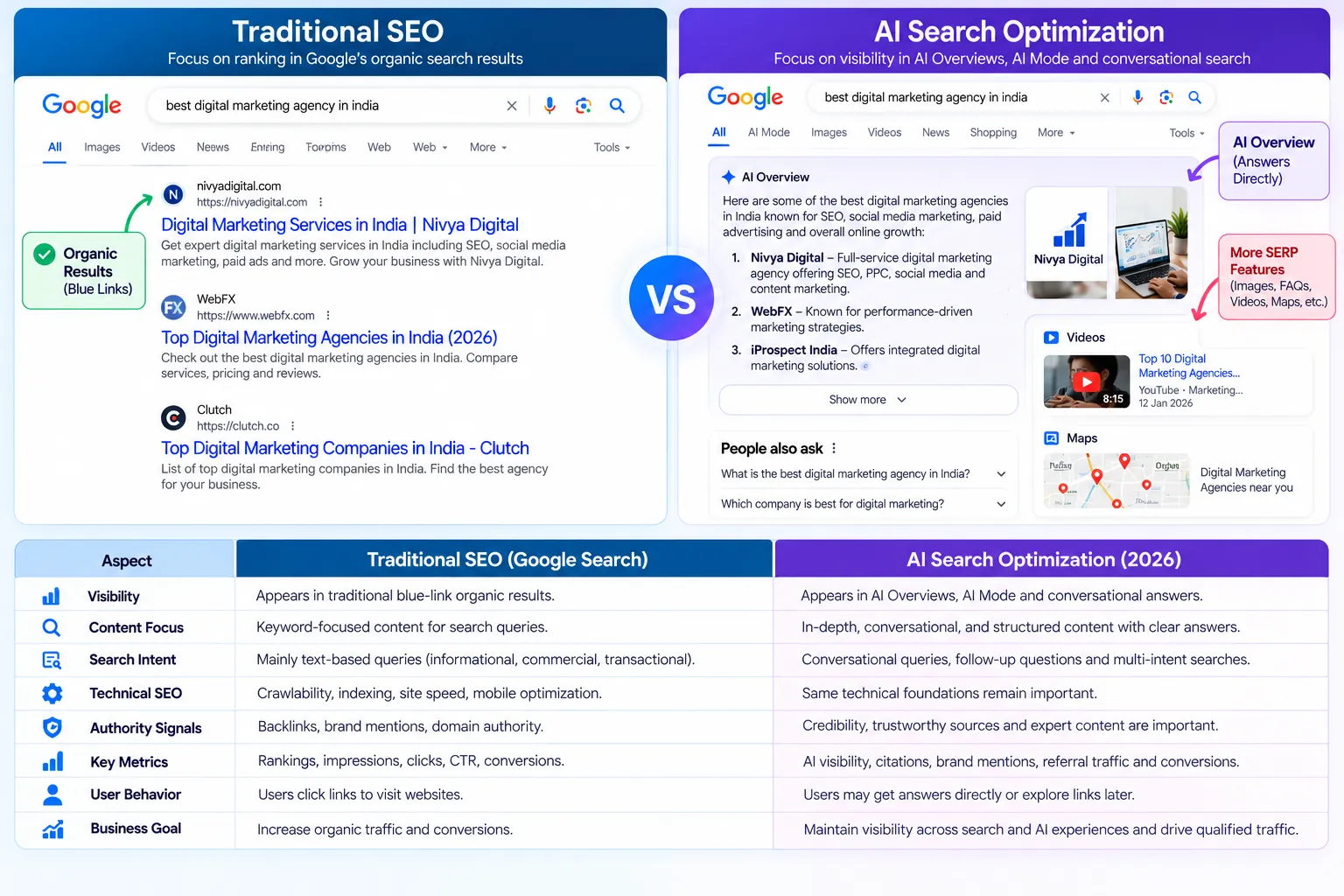
Traditional SEO vs AI Search Optimization in 2026
| SEO Area | Traditional SEO Focus | AI Search Consideration |
|---|---|---|
| Visibility | Organic rankings and search appearances | Visibility within AI-powered search experiences |
| Content | Relevant, useful pages | Unique information that answers complex questions |
| Keywords | Search queries and intent | Queries and conversational follow-up needs |
| Technical SEO | Crawlability, indexing, accessibility | The same technical foundations remain essential |
| Authority | Reliable content and reputation | Credible sources and original expertise remain valuable |
| Measurement | Clicks, impressions, CTR, conversions | Additional AI visibility and referral indicators |
| Business goal | Organic traffic and conversions | Qualified discovery, engagement, and conversions |
AI Search optimization should not be treated as a replacement for traditional SEO.
Google's own guidance emphasizes that established SEO best practices remain relevant to its generative AI experiences.
A Practical 30-Day SEO Traffic Recovery Plan
If your website is losing traffic, use a structured approach rather than making random changes.
| Timeline | Priority | Recommended Action |
|---|---|---|
| Days 1–5 | Diagnose | Compare GSC and GA4 performance and identify affected pages |
| Days 6–10 | Investigate | Check queries, CTR, ranking changes, technical issues, and demand |
| Days 11–15 | Improve content | Update priority pages with clearer answers and original insights |
| Days 16–20 | Optimize SEO | Review titles, internal links, indexing, and user experience |
| Days 21–25 | Strengthen conversions | Improve relevant calls to action and landing-page clarity |
| Days 26–30 | Measure | Review early results and plan further improvements |
Thirty days is a useful period for initial investigation and implementation, but it is not a guaranteed SEO recovery timeline.
Search performance changes can take longer to become measurable.
What Should Businesses Prioritize in 2026?
Businesses should stop evaluating SEO success through rankings alone.
A modern measurement strategy should consider search visibility, clicks, CTR, user engagement, lead quality, and conversions.
It should also distinguish between a decline caused by lower demand and a decline caused by reduced click-through behavior.
For companies with limited resources, improving existing high-value pages may be more useful than publishing large numbers of generic articles.
The strongest strategy combines technical SEO, original content, useful website experiences, and ongoing performance analysis.
Final Thoughts: Is AI Search Stealing Your Clicks?
AI-powered search is changing how people discover and consume information, and it may influence website traffic for some queries.
But if your Google rankings remain stable while clicks decline, do not immediately assume AI Overviews are responsible.
Investigate your Search Console data, compare GA4 performance, examine search intent, review technical issues, and understand which pages have lost visibility or engagement.
In 2026, successful SEO is not just about appearing in Google Search. It is about providing enough value for the right users to visit, engage, and convert.
At Nivya Digital, we help businesses approach digital growth through SEO strategy, content marketing, website optimization, and data-driven decision-making.
If your organic traffic is declining, a structured SEO audit can help identify the most important issues and opportunities for improvement.
Explore Nivya Digital's SEO services: https://nivyadigital.com
Comments (1)
A very insightful article explaining why website rankings alone are no longer enough to guarantee traffic in 2026. It highlights how AI powered search is changing user behavior and why businesses need to focus on search intent, high quality content, technical SEO, and visibility across AI search platforms. A valuable read for anyone looking to adapt their SEO strategy and maintain organic growth.