
Last Updated: October 22, 2026
Your website is appearing in Google Search. Your impressions are increasing, and some of your pages are maintaining their rankings.
But there's a problem.
People are seeing your content without clicking through to your website.
If you've noticed this pattern in Google Search Console, you're not alone. Search behavior is changing as Google increasingly provides answers directly through featured snippets, knowledge panels, AI Overviews, and other search features.
This shift is commonly known as zero-click search.
For business owners, marketers, and website publishers, it raises an important question: How can you generate organic traffic and qualified leads when search engines answer users' questions before they visit your website?
Research suggests the challenge is significant. A 2026 SparkToro study, reported by Search Engine Land, estimated that 68.01% of US Google searches ended without a click during the first four months of the year.
However, this doesn't mean SEO is dead.
It means businesses need to reconsider how they measure visibility, create content, and convert search interest into meaningful customer relationships.
In this guide, we'll explain what zero-click searches are, how AI Overviews influence website traffic, and which practical SEO strategies can help businesses adapt in 2026.
1. What Are Zero-Click Searches?
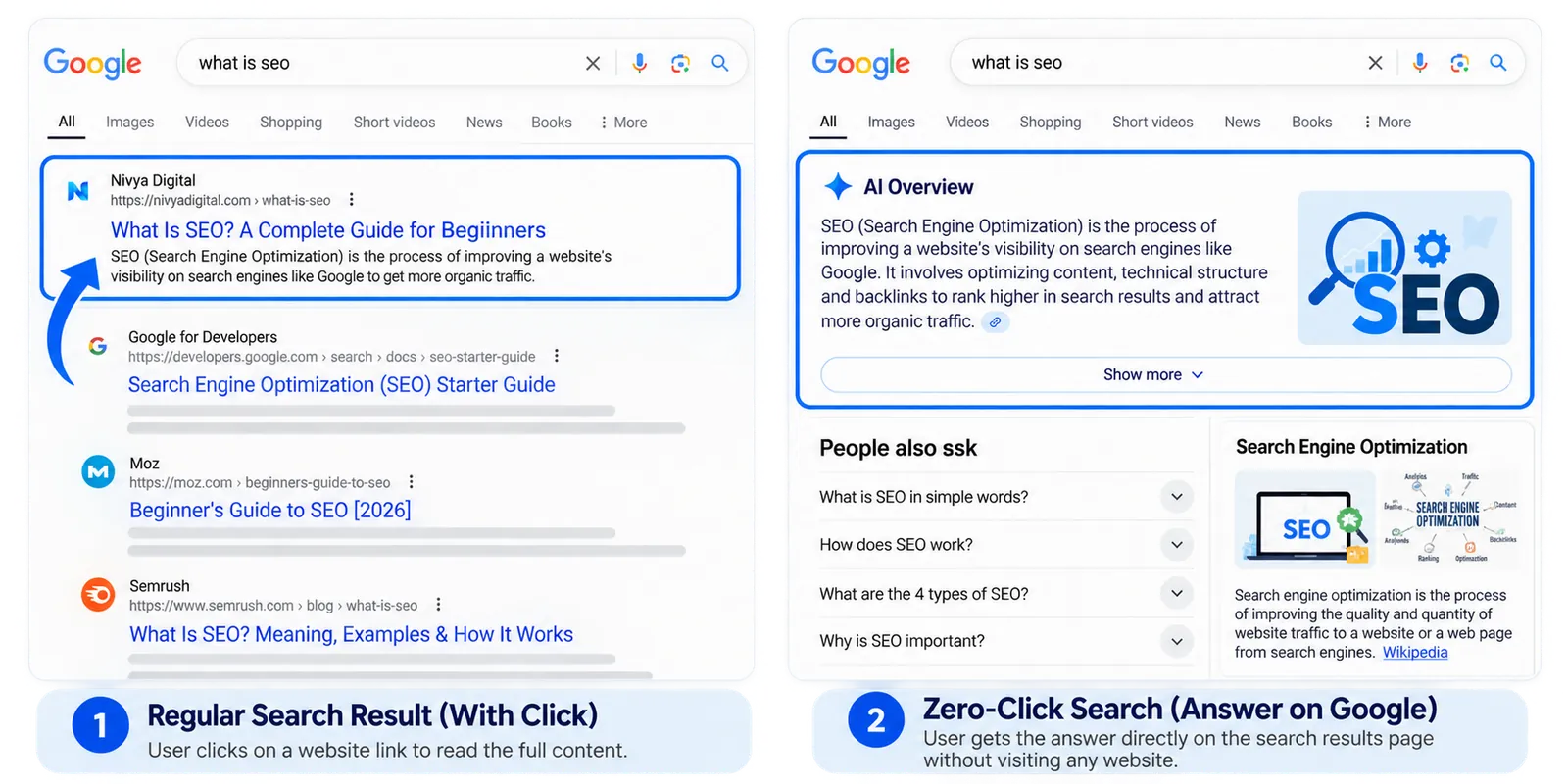
A zero-click search occurs when someone performs a search but doesn't click through to another website from the search results.
Instead, they may find the answer directly on the results page, continue searching, or leave without opening a result.
For example, imagine someone searches:
"What is the recommended image size for a LinkedIn post?"
Google may display the answer directly in a featured snippet or another search feature.
The user gets the information they need without visiting the website that originally provided it.
This is a simple example of zero-click behavior.
Common Types of Zero-Click Search Experiences
Featured snippets: Short answers extracted from webpages and displayed prominently in search results.
Knowledge panels: Information about entities such as companies, people, and places.
Direct answers: Results for simple questions involving calculations, definitions, or factual information.
Local search features: Business information, directions, and contact details shown directly in search.
AI Overviews: AI-generated summaries that help users understand topics and explore relevant sources.
Not every search displaying these features becomes a zero-click search.
Some users still open websites to verify information, compare options, or complete a purchase.
Why Should Businesses Care?
If fewer people click informational search results, websites may receive less traffic even when their content continues appearing in search.
However, search visibility can still influence brand awareness and future buying decisions.
The challenge is understanding which types of visibility contribute to business results.
2. Why Are Zero-Click Searches Increasing in 2026?
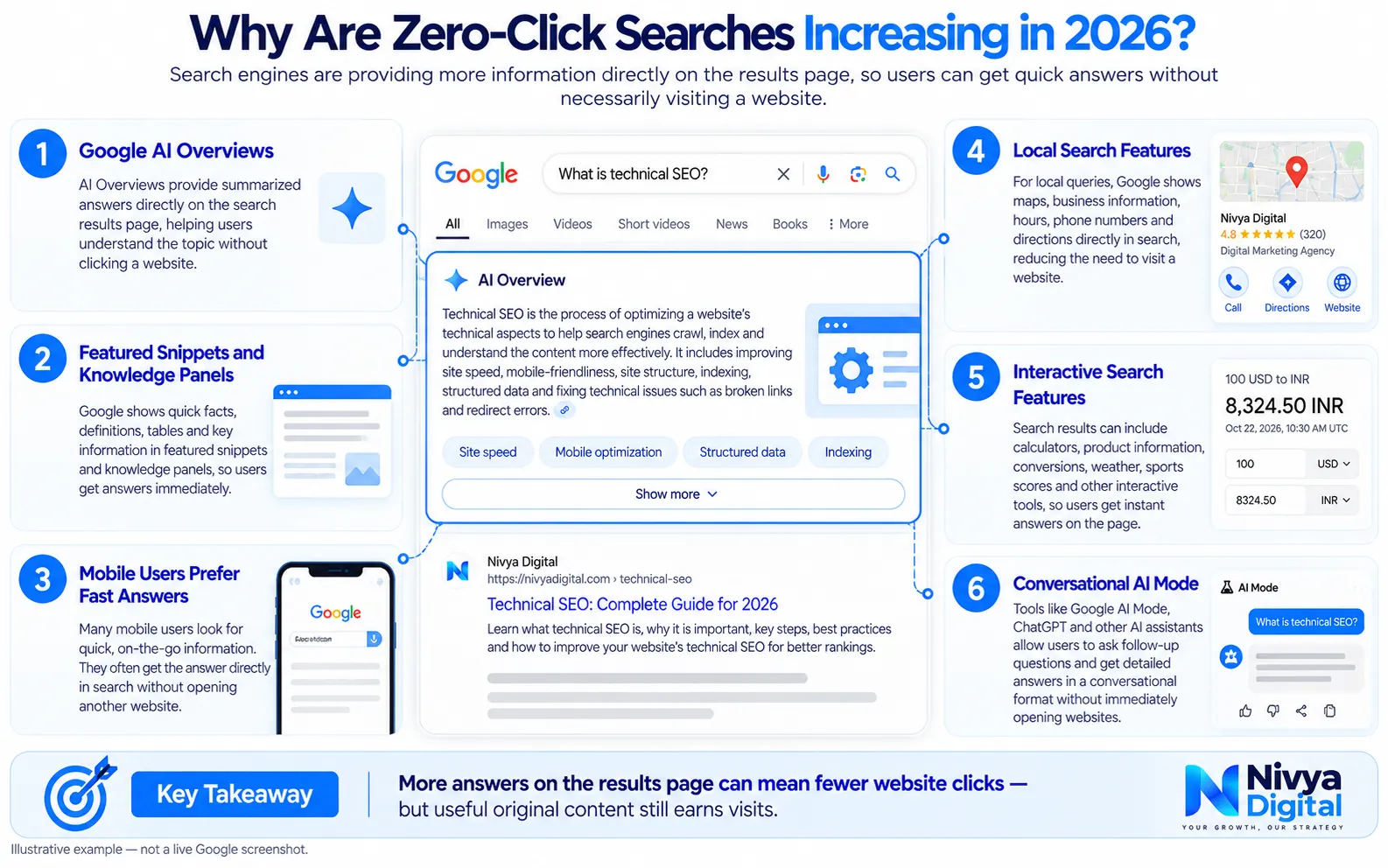
Several changes in search behavior are contributing to the growth of zero-click experiences.
Google Is Answering More Questions Directly
Search engines increasingly provide information within the search results themselves.
For straightforward questions, users may not need to visit another page.
AI Overviews Are Changing Information Discovery
Google AI Overviews summarize information and provide supporting links.
They can help users understand complex topics without immediately opening several websites.
This can change which pages receive clicks and when users decide to explore additional sources.
Mobile Search Encourages Quick Answers
Many mobile users search while traveling, shopping, or completing everyday tasks.
For simple queries, a direct answer may satisfy their immediate needs.
Search Results Include More Interactive Features
Maps, product information, calculators, images, videos, and other elements can help users complete tasks within the search experience.
What Does Research Show?
Ahrefs published an updated study in February 2026 analyzing 300,000 keywords.
The researchers found that AI Overview presence correlated with a 58% lower average click-through rate for the top-ranking page compared with their modeled expectation.
This finding doesn't mean every website loses 58% of its traffic.
Actual effects depend on query type, industry, ranking position, search features, and user behavior.
3. How Google AI Overviews Affect Organic Traffic
AI Overviews introduce a different way for people to interact with search results.
Instead of viewing only a list of links, users may receive an AI-generated explanation accompanied by relevant sources.
The Impact on Informational Keywords
Consider the query:
"What is technical SEO?"
A user may receive an explanation directly in Google's results.
If the answer satisfies their question, they might not visit an external website.
This can reduce opportunities for publishers targeting simple informational queries.
Why Some Queries Still Generate Clicks
Now consider a different query:
"How can I fix indexing errors on my WordPress ecommerce website?"
The user may need detailed instructions, screenshots, troubleshooting steps, or professional assistance.
A short summary may not fully resolve the problem.
This creates opportunities for websites publishing genuinely useful, detailed resources.
AI Search Can Also Create Discovery Opportunities
Google states that AI Overviews and AI Mode can introduce users to relevant websites and supporting sources.
The goal for businesses shouldn't be to avoid AI search entirely.
Instead, they should publish information that gives users a meaningful reason to explore their website.
Important SEO Consideration
There is no guaranteed method for appearing in AI Overviews.
Google's guidance emphasizes established SEO practices, technical accessibility, and helpful content rather than special AI-only optimization tricks.
4. Zero-Click SEO vs Traditional SEO
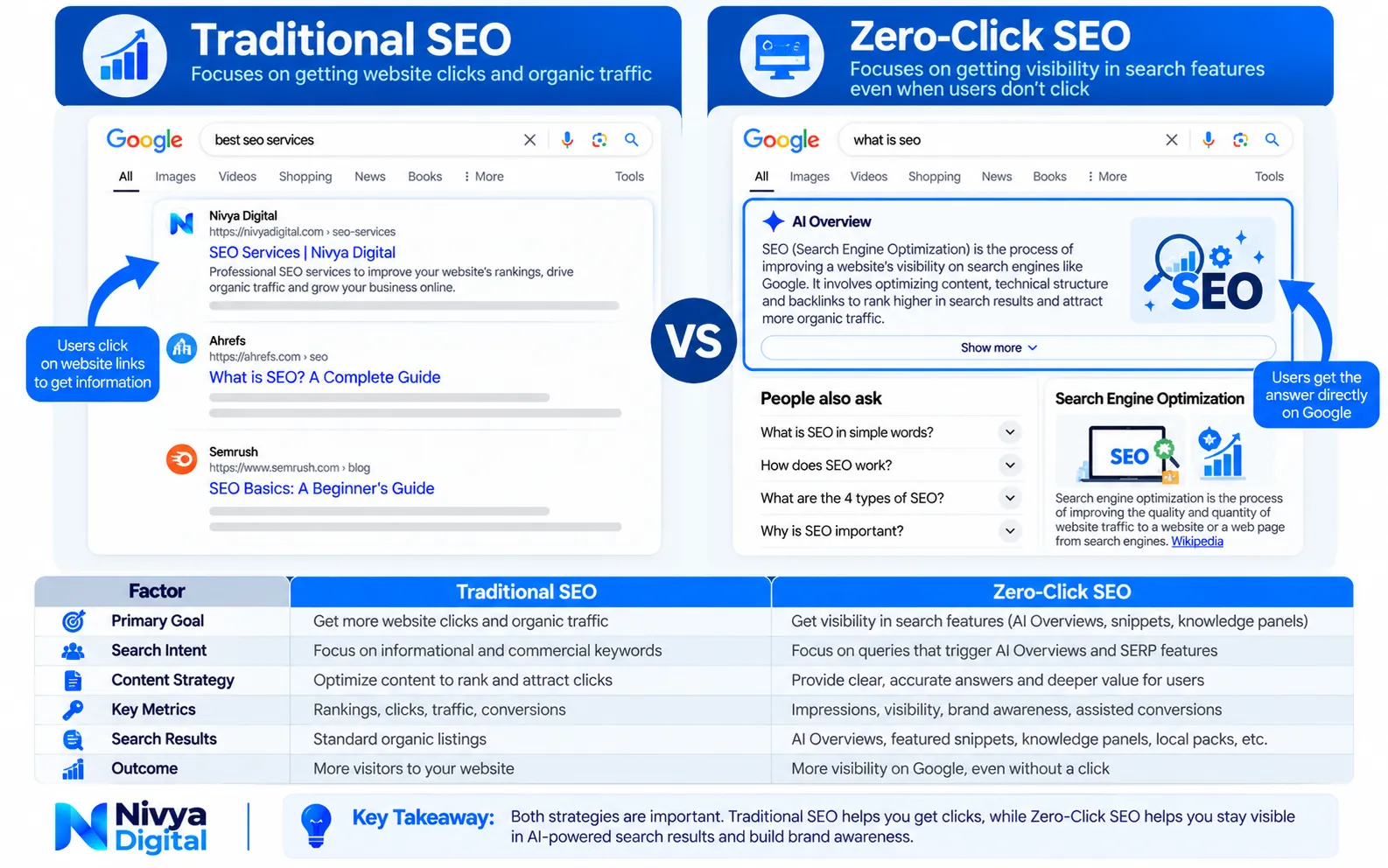
Traditional SEO and zero-click SEO aren't completely separate disciplines.
Both rely on making content useful, accessible, and relevant.
However, businesses may need to evaluate success differently.
| Factor | Traditional SEO focus | Zero-click-aware SEO focus |
|---|---|---|
| Primary objective | Organic search traffic | Visibility and business outcomes |
| Keyword strategy | Rankings and search volume | Intent and click opportunity |
| Content strategy | Relevant optimized pages | Useful content with distinctive value |
| Search features | Organic listings | Organic listings and SERP features |
| Measurement | Rankings, clicks, traffic | Clicks, conversions, visibility, leads |
| Commercial strategy | Attract visitors | Attract qualified visitors and customers |
Should You Stop Targeting Informational Keywords?
No.
Informational content helps potential customers understand problems, evaluate solutions, and discover businesses.
However, relying entirely on basic definitions may not generate the traffic or leads you expect.
A more balanced content strategy includes educational, comparison, problem-solving, and commercial topics.
5. How to Identify Zero-Click Traffic Loss in Google Search Console
Google Search Console is one of the most useful free tools for understanding organic search performance.
It shows how often your pages appear in Google Search and how users interact with those results.
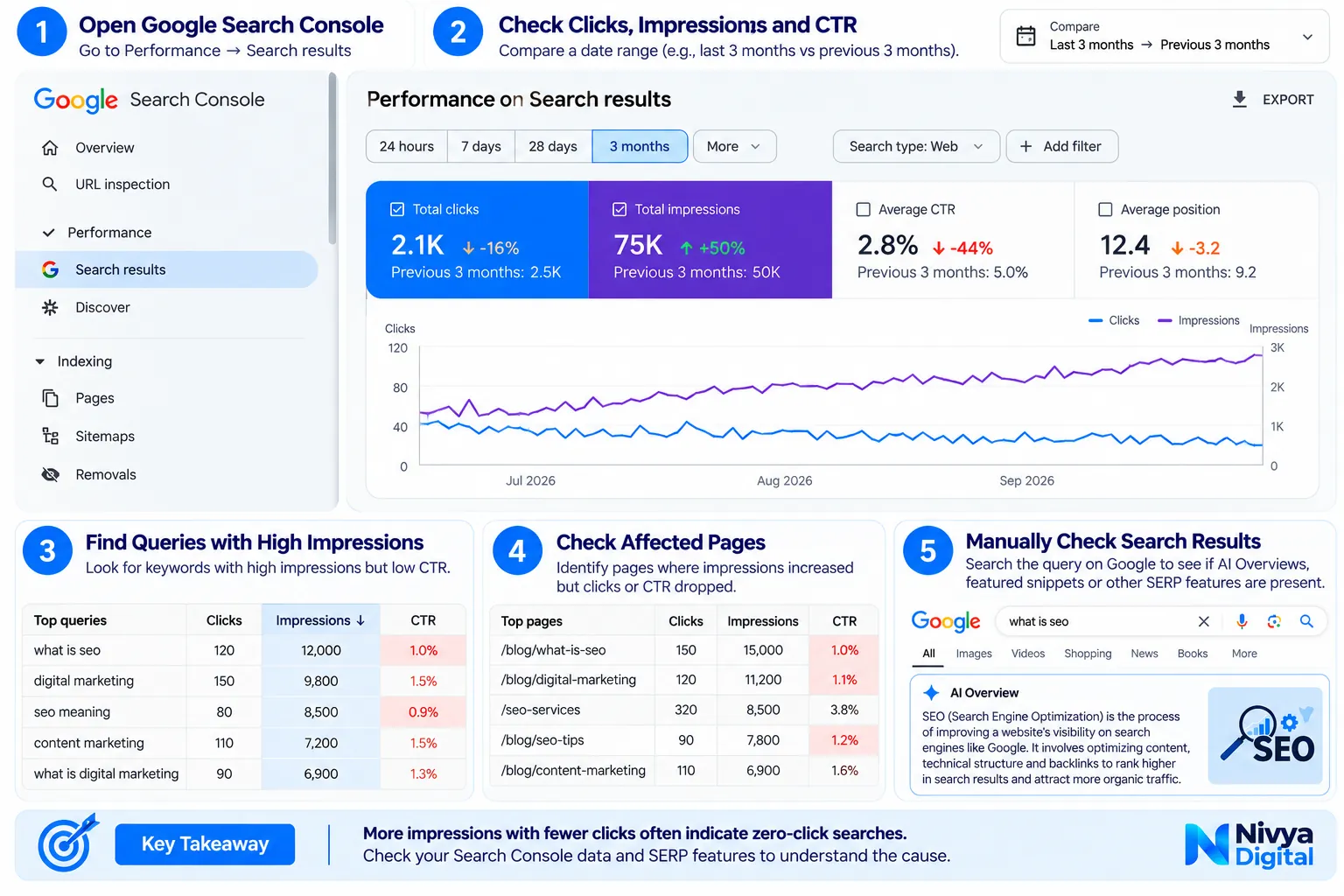
Step 1: Open the Performance Report
Sign in to Google Search Console and select your verified website.
Navigate to Performance → Search results.
Review:
Total clicks
Total impressions
Average click-through rate
Average position
Step 2: Compare Relevant Date Ranges
Compare the last three months with the previous three months, or use year-over-year comparisons where appropriate.
Look for meaningful changes rather than focusing on daily fluctuations.
Step 3: Identify Queries with High Impressions and Low CTR
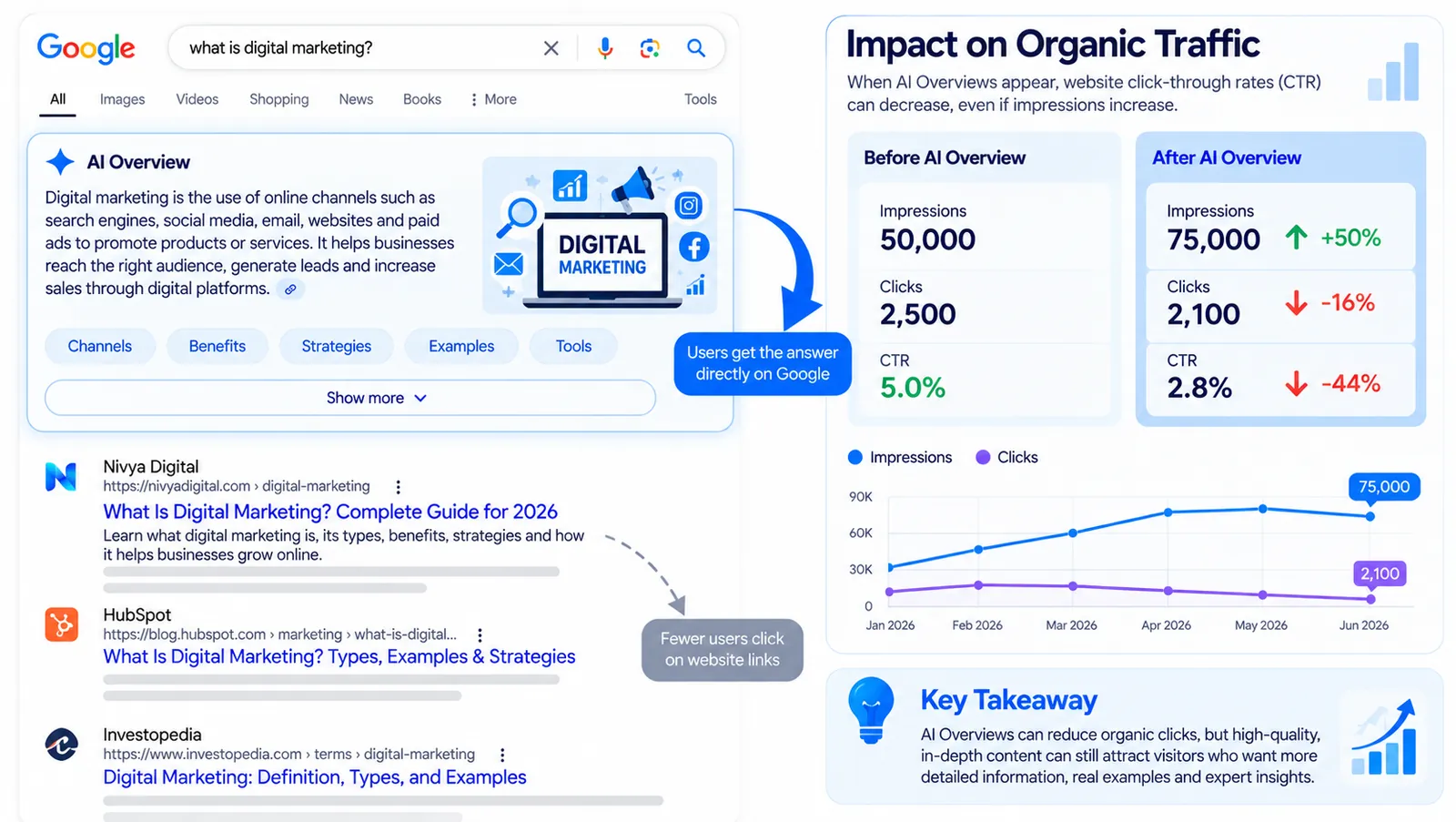
For example, imagine a website has the following results:
| Metric | Previous period | Current period |
|---|---|---|
| Impressions | 50,000 | 75,000 |
| Clicks | 2,500 | 2,100 |
| CTR | 5.0% | 2.8% |
Illustrative example only; not actual Nivya Digital analytics.
The website is appearing more frequently but receiving fewer clicks.
This pattern deserves investigation.
Step 4: Review Individual Pages
Identify pages where impressions are increasing while clicks or CTR are declining.
Compare search queries, countries, devices, and average positions.
Step 5: Investigate Search Features
Manually inspect representative search results to understand whether AI Overviews, featured snippets, or other features are present.
Google has introduced additional AI search visibility insights, although reporting capabilities and data availability should be checked within your property.
Step 6: Avoid Assuming AI Is the Only Cause
A decline in clicks can also result from:
Ranking changes
Seasonal demand
Search intent changes
Competitor improvements
Unappealing titles
Technical issues
Changes in query mix
Search Console alone cannot prove that every lost click was caused by a zero-click search.
Use multiple sources of evidence before deciding what to fix.
6. How to Optimize Your Website for Zero-Click Searches
The objective isn't simply to force users to click.
It's to provide information that is valuable enough for users to visit your website when they need more detail.
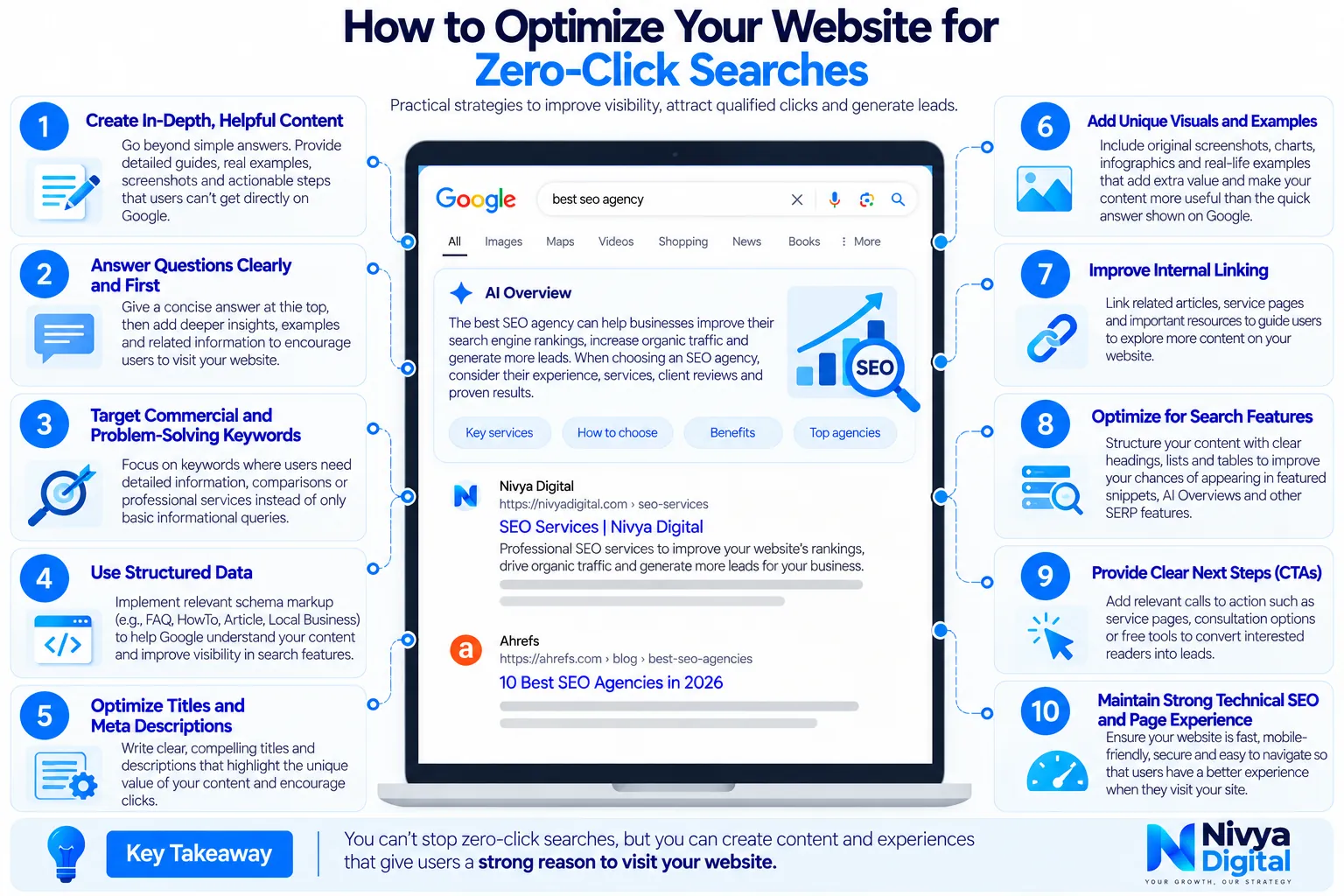
Create Content That Goes Beyond Basic Definitions
Instead of publishing only:
"What is SEO?"
Consider developing:
"How to Fix 10 Common SEO Problems on a New Business Website"
The second topic provides an opportunity to deliver detailed troubleshooting guidance.
Include Original Examples
Useful examples make content more distinctive.
You can include:
Original screenshots
Real troubleshooting processes
First-hand observations
Relevant data
Practical checklists
Step-by-step tutorials
Avoid creating fictional case studies and presenting them as real client results.
Answer Questions Clearly
Don't hide the answer to a simple question merely to increase time on page.
Provide the essential information first, then offer additional context that helps readers take action.
Improve Internal Linking
Connect related articles to useful service pages and supporting resources.
For example, an SEO audit article can naturally link to a detailed technical SEO guide.
Maintain Technical SEO Fundamentals
Ensure that important pages are crawlable, indexable, accessible on mobile, and easy to navigate.
Good content cannot perform effectively if technical problems prevent users or search engines from accessing it.
7. How to Turn Search Visibility into Leads
Traffic is valuable, but traffic alone doesn't pay the bills.
For service businesses, qualified enquiries and conversions often matter more than raw visitor counts.
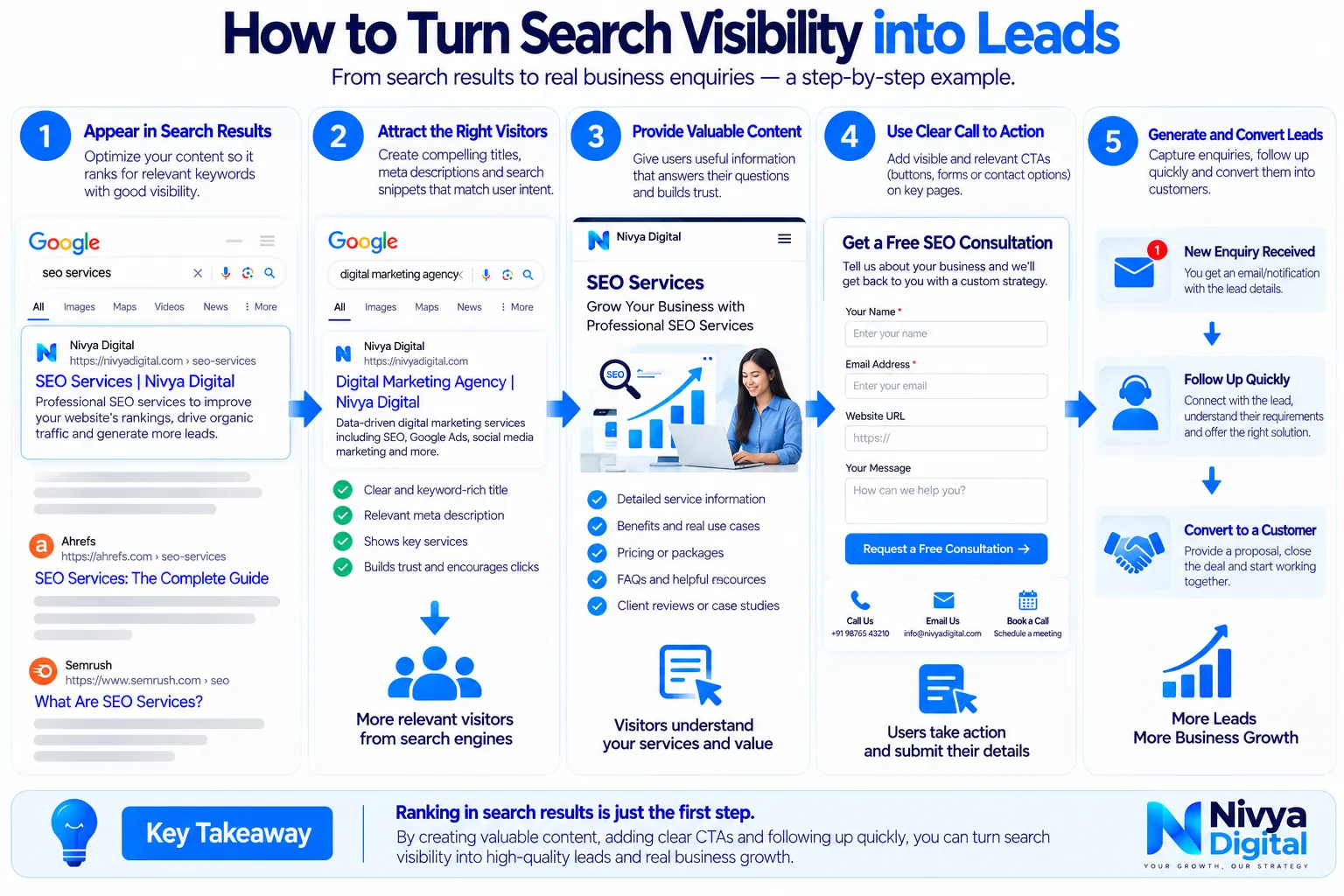
Match Your Content to the Customer Journey
Someone searching "what is SEO" may only want to learn.
Someone searching "technical SEO audit services for ecommerce websites" may be evaluating a provider.
These users have different needs.
Create content for both stages, but don't expect identical conversion rates.
Add Relevant Calls to Action
A useful article can offer the next logical step.
For example:
"Need help identifying technical SEO issues? Explore our SEO services."
The call to action should connect naturally to the article.
Create Helpful Service Pages
Your SEO service page should explain:
What the service includes
Who it is suitable for
Your working process
How customers can enquire
Relevant evidence of experience
Simplify Contact Forms
Avoid requesting unnecessary information.
A short enquiry form with clear expectations may reduce friction for potential customers.
Measure Meaningful Conversions
Use GA4 to monitor relevant actions, such as form submissions, consultation requests, or qualified enquiries.
A website with fewer but more relevant visitors can sometimes generate better business outcomes than one attracting large volumes of low-intent traffic.
8. Best Tools to Track Zero-Click SEO Performance
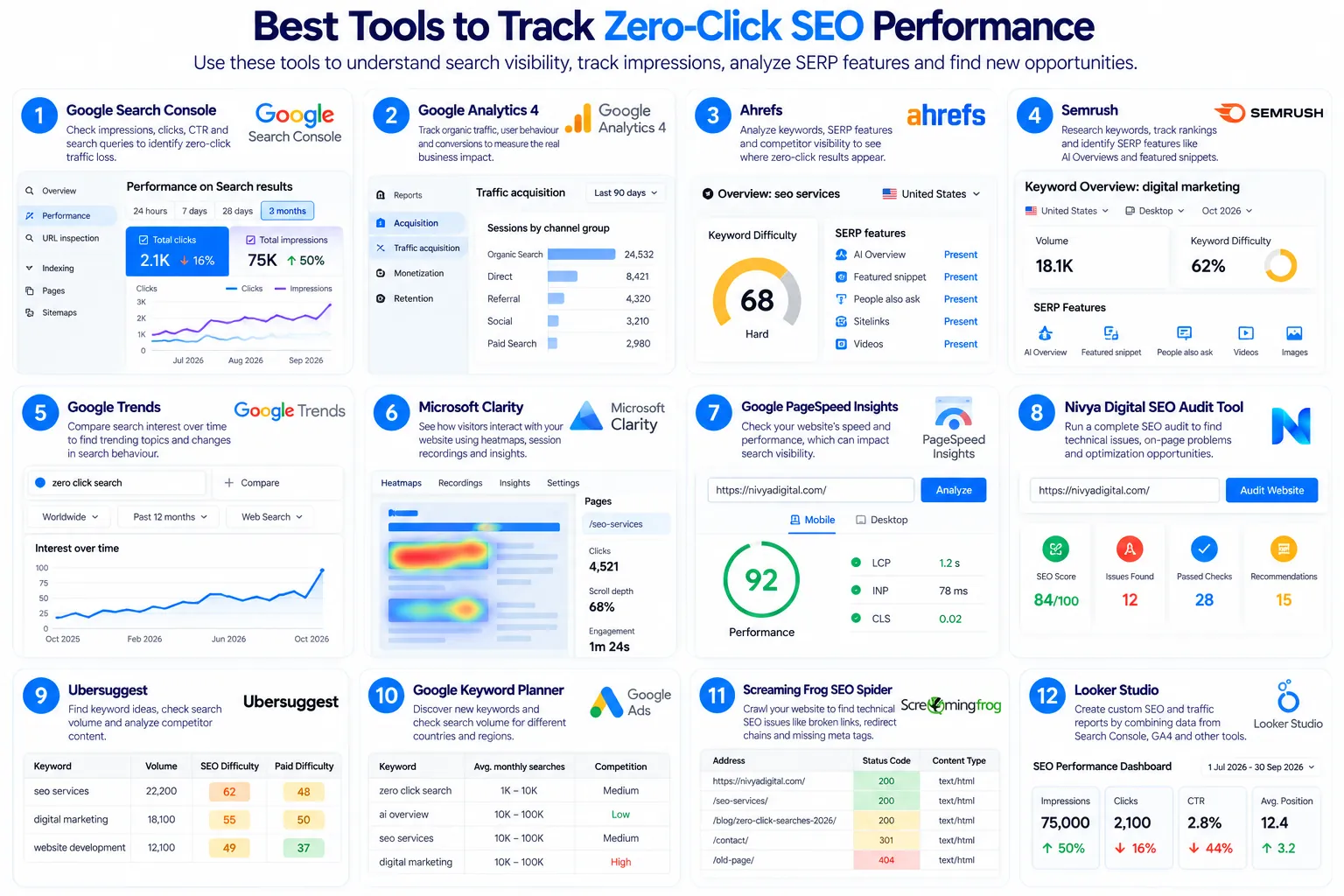
No single tool provides a complete view of every zero-click search.
However, combining different tools can help businesses understand changing search performance.
| Tool | Main purpose |
|---|---|
| Google Search Console | Search impressions, clicks, queries, and indexing |
| Google Analytics 4 | Engagement, traffic sources, and conversions |
| Google Trends | Relative search interest |
| Ahrefs | Keyword research, SERP analysis, and competitor research |
| Semrush | Keyword visibility and search feature analysis |
| Microsoft Clarity | Visitor behavior and usability |
| Google PageSpeed Insights | Website performance diagnostics |
| Nivya Digital SEO Audit Tool | Preliminary website SEO checks |
Which Tools Should Beginners Start With?
Begin with Google Search Console and GA4.
These tools help you understand how visitors discover your website and what happens after they arrive.
Use additional SEO platforms when you need more detailed competitor analysis or keyword research.
Third-party estimates should not be confused with verified first-party analytics.
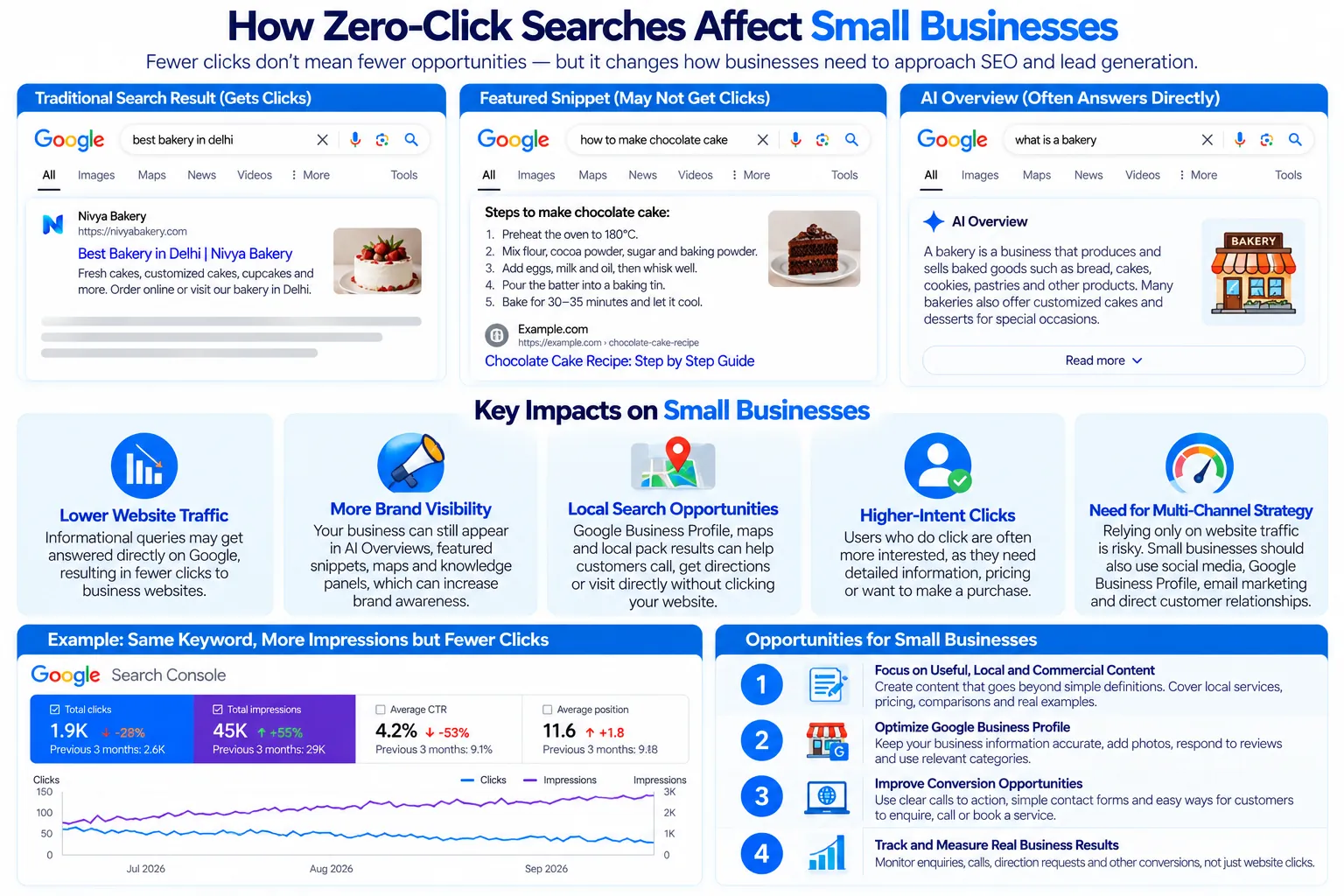
9. How Zero-Click Searches Affect Small Businesses
Small businesses often have limited marketing budgets.
That makes it especially important to prioritize search activities that support actual business objectives.
Informational Traffic May Become Less Predictable
A small business publishing basic informational articles may find that some searchers receive sufficient answers directly in Google.
Local Visibility Still Matters
Businesses serving specific locations can benefit from maintaining accurate Google Business Profile information, where eligible.
Customers may call, request directions, or interact with business information without visiting the website.
These actions can still be valuable.
Commercial Queries Can Create Opportunities
Searches involving services, comparisons, pricing, and provider selection may attract users with stronger purchasing intent.
For example:
"SEO agency for small ecommerce businesses"
may be more commercially relevant than:
"What does SEO stand for?"
Build More Than One Acquisition Channel
Email marketing, social media, referrals, and direct customer relationships can complement organic search.
Businesses should avoid relying entirely on one traffic source.
10. Zero-Click SEO Strategies for International Websites
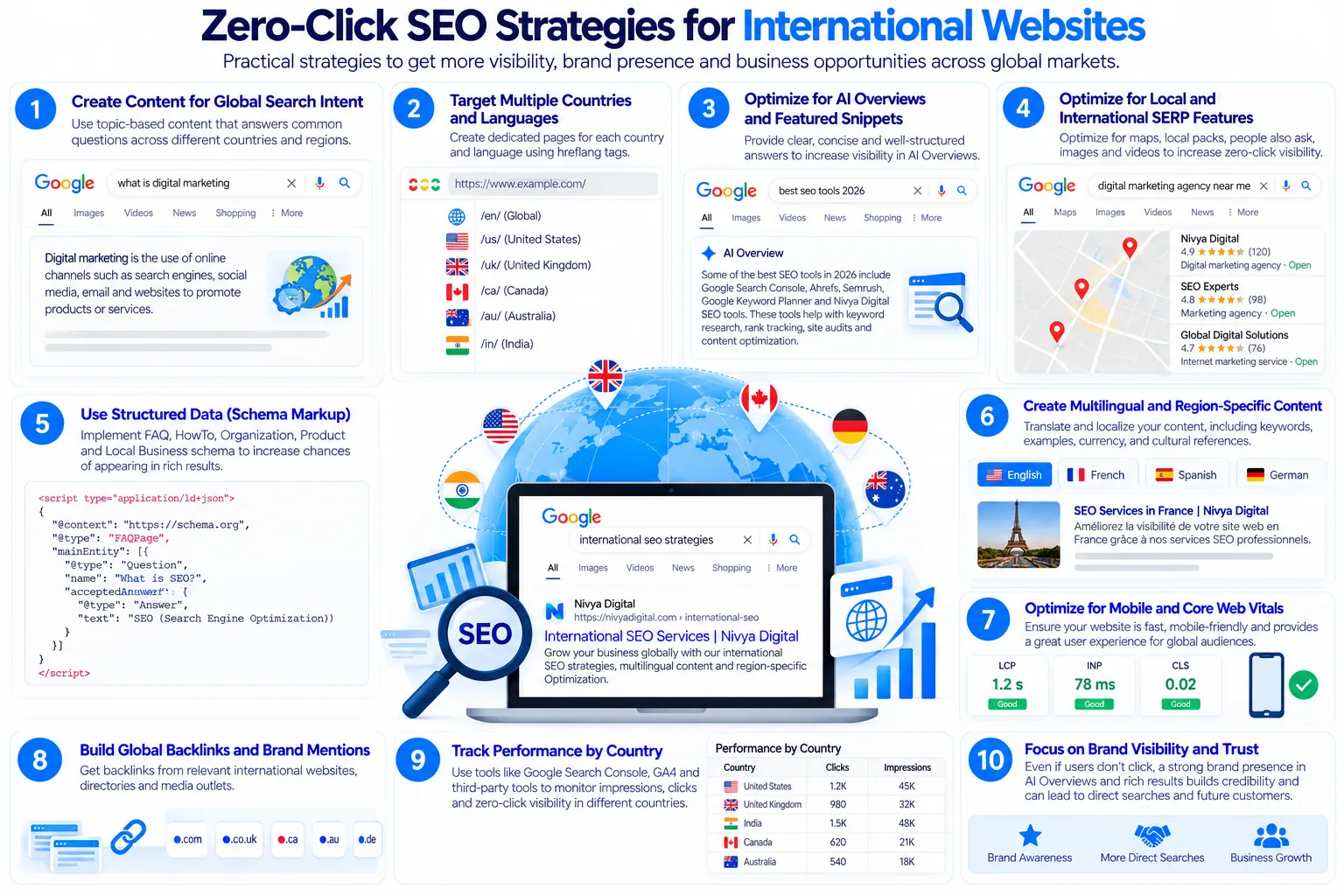
Businesses targeting international customers need to understand how search behavior varies by market.
A strategy that works in India may require adjustments for the United States, United Kingdom, Canada, or Australia.
Research Search Intent by Country
Keyword wording, competition, and commercial expectations can differ.
Use country-level data in Search Console and keyword research platforms.
Create Relevant International Content
Don't simply duplicate the same article and replace country names.
Where regional pages are justified, provide genuinely useful information specific to that audience.
Use Clear International Service Information
Explain which markets your business serves.
Provide suitable contact options, service availability, and relevant business details.
Implement Hreflang Where Appropriate
Hreflang can help search engines understand alternate language or regional versions of content.
It isn't automatically necessary for every globally accessible website.
Track Performance by Country
Review impressions, clicks, conversions, and qualified enquiries separately for your priority markets.
A rise in international impressions doesn't necessarily mean international lead generation is improving.
11. Common Zero-Click SEO Mistakes Businesses Should Avoid
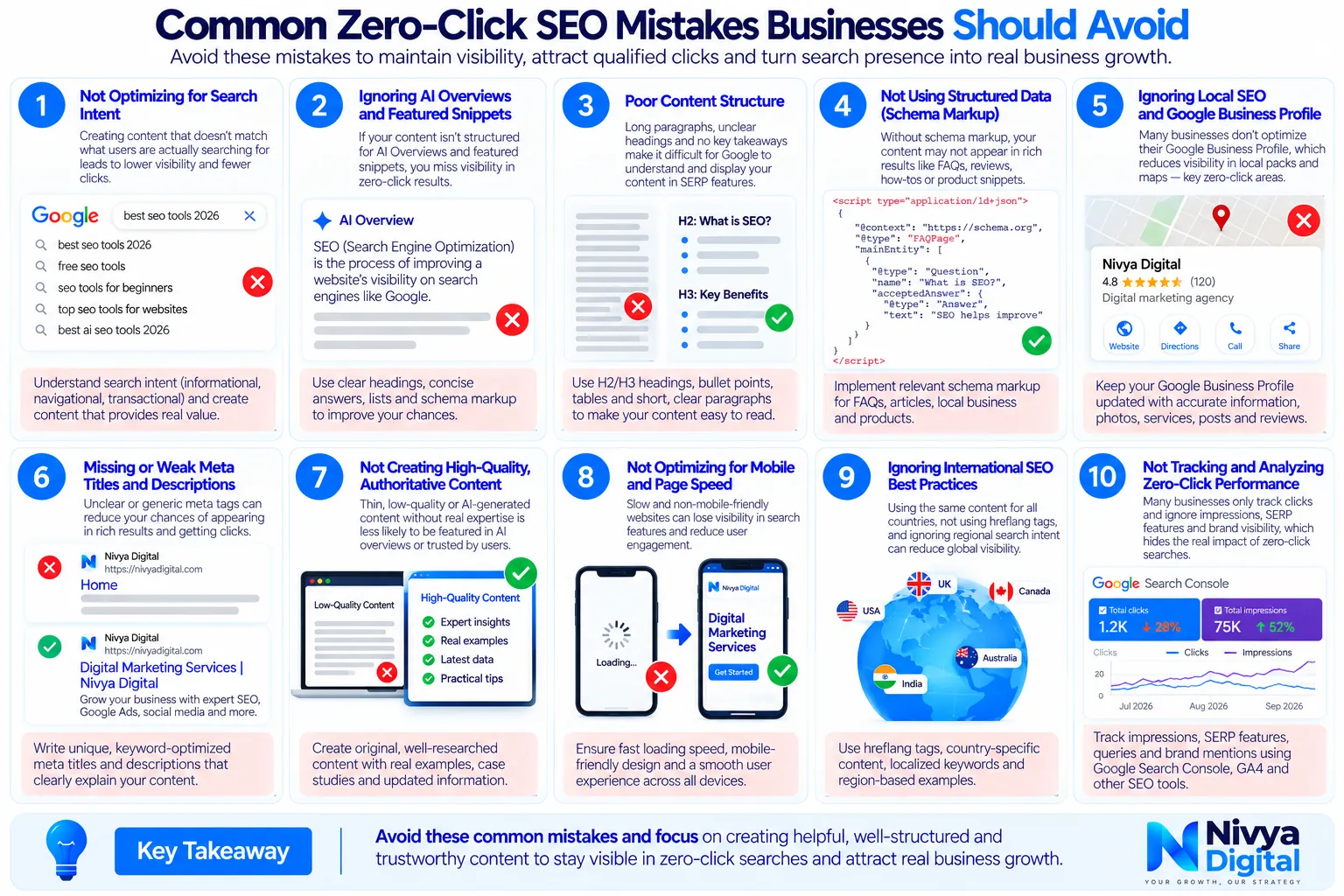
Mistake 1: Focusing Only on Search Volume
A high-volume keyword may attract users who don't need to visit a website.
Evaluate search intent and potential business value alongside volume.
Mistake 2: Publishing Generic AI Content
Content that repeats widely available information without adding useful insight may struggle to stand out.
Prioritize original examples and accurate information.
Mistake 3: Ignoring Conversion Optimization
Attracting visitors is only part of the process.
Your website should help interested users understand your services and take the next step.
Mistake 4: Assuming Every CTR Drop Is Caused by AI
Search performance changes for many reasons.
Investigate ranking movements, devices, query mix, seasonality, and technical issues.
Mistake 5: Trying to Manipulate AI Answers
Avoid unsupported claims that special markup or keyword repetition guarantees inclusion in AI-generated responses.
Mistake 6: Neglecting Existing Content
Improving a useful article may sometimes be more valuable than publishing another article on an almost identical topic.
Mistake 7: Measuring Rankings Without Leads
Strong rankings are helpful, but businesses should also monitor enquiries, sales, and other meaningful outcomes.
12. A Practical 30-Day Zero-Click SEO Action Plan
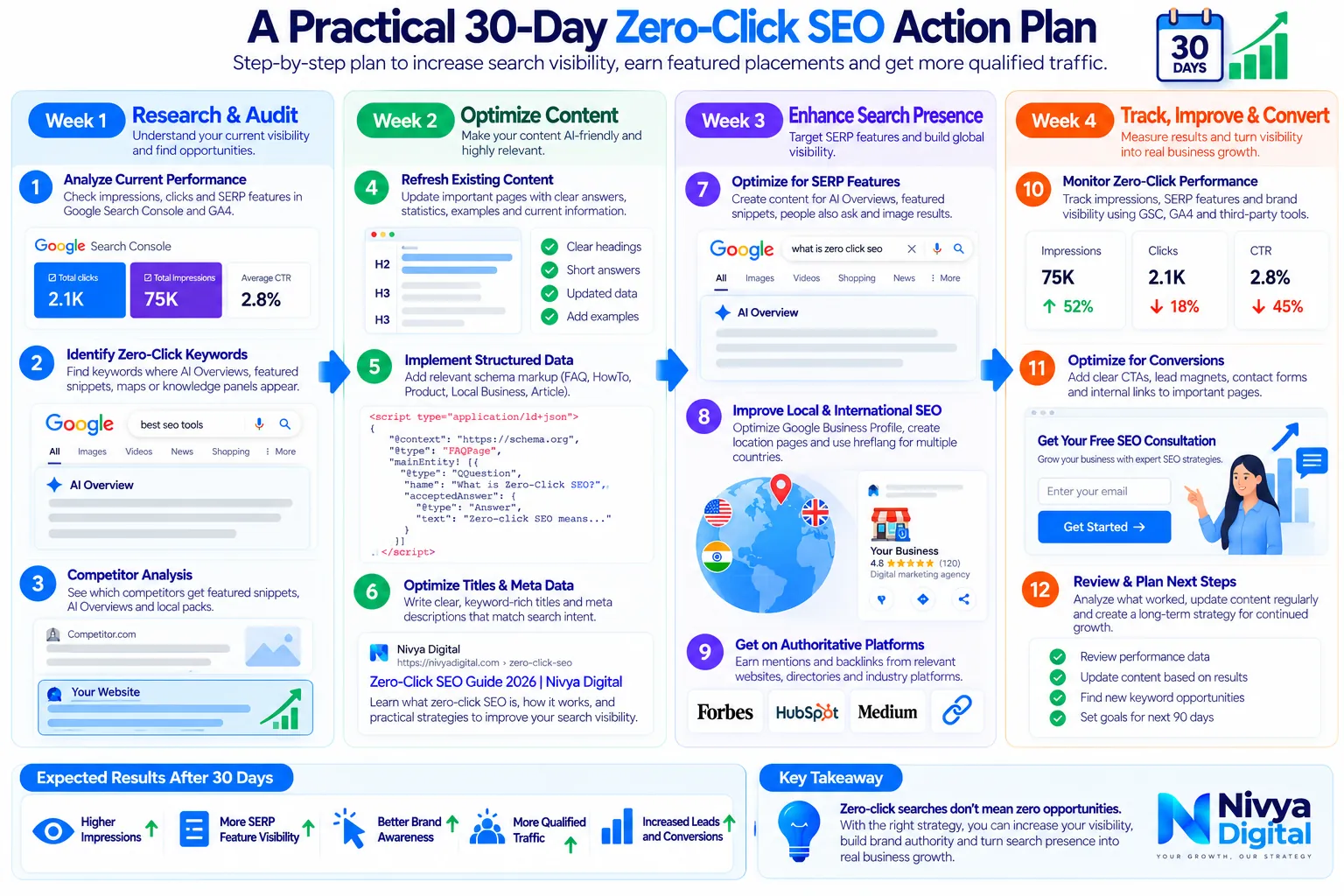
You don't need to redesign your entire marketing strategy overnight.
Start with a structured four-week review.
| Timeline | Main activities |
|---|---|
| Week 1 | Review Search Console data, identify declining CTR, analyze key queries |
| Week 2 | Improve existing content, search intent alignment, titles, and internal links |
| Week 3 | Strengthen commercial pages, calls to action, forms, and conversion tracking |
| Week 4 | Review results, compare country performance, and prioritize further improvements |
Week 1: Understand the Problem
Identify pages experiencing meaningful changes in impressions, clicks, and CTR.
Review whether ranking changes or search features could explain the pattern.
Week 2: Improve Content Quality
Update high-priority articles with accurate examples, clearer explanations, and genuinely useful supporting resources.
Week 3: Improve Lead Generation
Review important service pages and ensure users can easily contact your business.
Configure relevant conversion tracking.
Week 4: Evaluate and Refine
Compare performance against a suitable baseline.
Document completed changes and monitor their effects over time.
Remember: Four weeks is a useful implementation period, not a guaranteed timeline for recovering organic traffic.
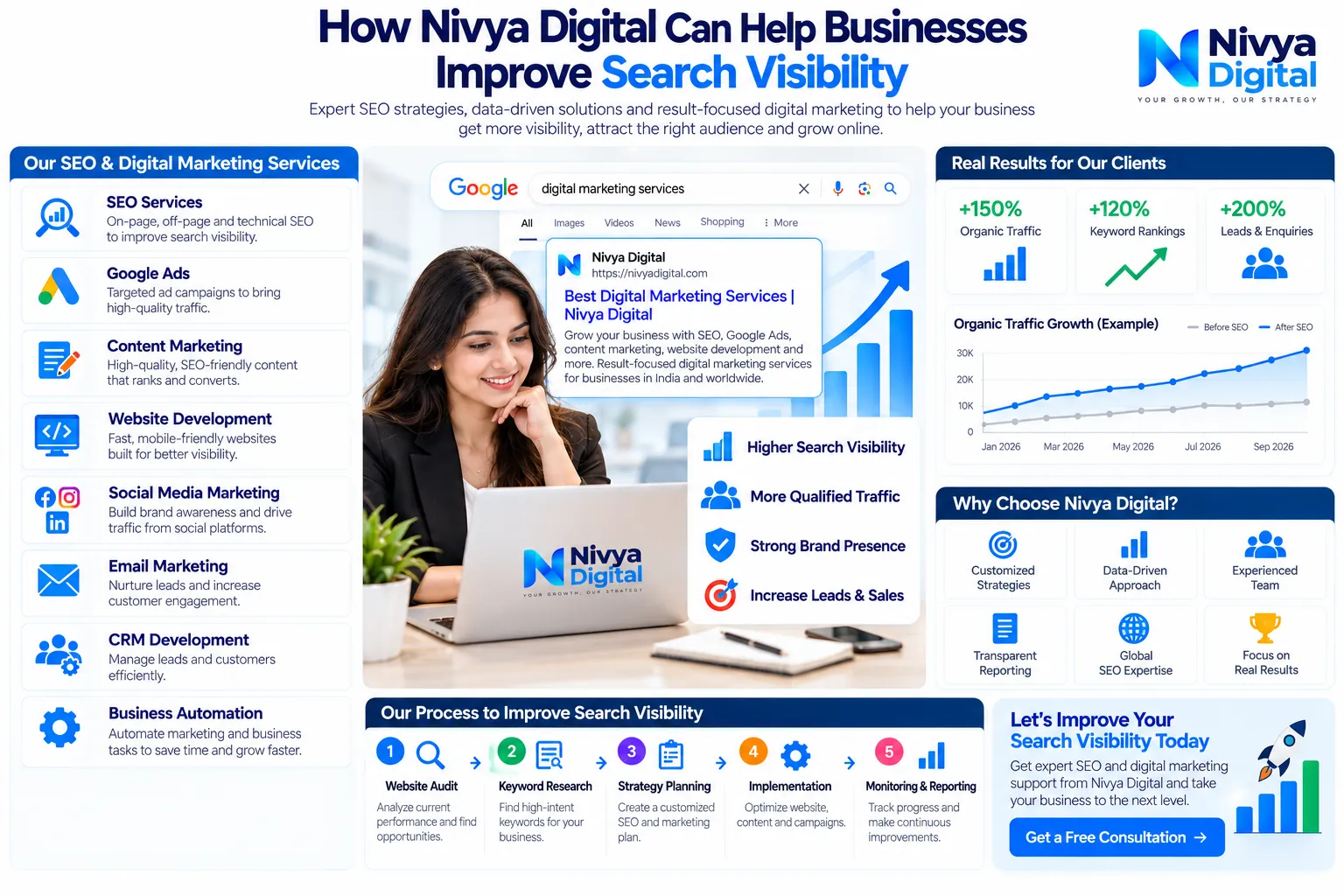
13. How Nivya Digital Can Help Businesses Improve Search Visibility
As search experiences evolve, businesses need a digital strategy that goes beyond rankings alone.
Nivya Digital offers digital marketing and technology services, including SEO, content marketing, website development, and related solutions.
These services can support businesses working to improve online visibility and turn relevant website visits into enquiries.
SEO Services
Technical and on-page SEO improvements can help businesses make important content accessible, relevant, and easier to discover.
Content Marketing
Useful content can answer customer questions, explain solutions, and support potential buyers throughout their decision-making process.
Website Development
A clear, responsive website can make it easier for visitors to understand services and contact a business.
Analytics and Performance Review
Monitoring search performance and user behavior can help businesses identify opportunities and evaluate improvements.
Start by Reviewing Your Website
Businesses can explore the available SEO tools and services through Nivya Digital.
An initial SEO review can help identify potential issues, while a more detailed strategy should consider business goals, competitors, and conversion opportunities.
Want to improve your website's search visibility and lead generation?
Visit Nivya Digital to explore SEO, website development, and digital marketing solutions.
14. Final Thoughts: SEO Success Is About More Than Clicks
Zero-click searches are changing how people interact with search engines.
Google AI Overviews and other search features can provide answers before users visit a website, creating new challenges for publishers and businesses.
But declining clicks don't automatically mean your SEO strategy has failed.
The more useful question is whether your website is attracting the right audience and supporting meaningful business results.
Focus on accurate, original content, strong technical SEO, clear service information, and conversion opportunities.
Monitor impressions and rankings, but also pay attention to qualified leads and customer engagement.
The future of SEO isn't simply about earning more clicks. It's about creating enough value that the right people choose to engage with your business.
For businesses seeking support with SEO, content marketing, and website development, explore the services available at Nivya Digital
Comments (1)
This article clearly explains why zero-click searches are affecting website traffic and how businesses can adapt their SEO strategies. I found the tips for improving search visibility, optimizing content for AI-powered results, and generating more leads especially useful. A practical read for website owners and digital marketers!