
When you create content for a business website, using the right keywords is only part of the job. You also need to know whether those keywords are being used naturally and consistently throughout your content.
This is where the Zuhio Keyword Count Checker can be useful.
A keyword count checker helps you understand how often a particular keyword or phrase appears in your content. Instead of manually searching through a long article and counting every occurrence, you can use a keyword counting tool to check keyword usage more quickly.
For businesses, marketers, bloggers, and SEO professionals, this simple check can be useful before publishing an article, landing page, product description, or other important website content.
In this guide, we'll explain what the Zuhio Keyword Count Checker is, how to use it, what keyword counting tells you, and how you can use the information to make better content decisions.
Quick Answer: What Is Zuhio Keyword Count Checker?
Zuhio Keyword Count Checker is an online keyword-counting tool that helps you check how frequently a keyword or phrase appears in a piece of content.
You can use a keyword count checker to review your content before publishing and identify whether a target keyword is appearing naturally, too frequently, or less often than expected.
The tool is most useful as a content-checking step. It should not replace keyword research, search intent analysis, content quality checks, or a complete SEO strategy.
What Is a Keyword Count Checker?
A keyword count checker is a tool that counts how many times a specific word or phrase appears in a block of text.
For example, suppose you write a 1,500-word article about digital marketing and your target keyword is digital marketing strategy.
Instead of searching the article manually, you can use a keyword count checker to find out how many times the phrase appears.
This gives you a simple way to review keyword usage before publishing.
A keyword count checker can be useful for:
Blog posts
Website pages
Product descriptions
Service pages
Landing pages
SEO content
Marketing copy
Long-form articles
The important point is that the number itself is not the goal. You should use the result to understand your content and then make changes only when they improve clarity and readability.
Why Does Keyword Count Matter for Business Content?
Businesses often create content with specific topics and search queries in mind.
If a target phrase is barely mentioned, you may want to review whether the page clearly explains the topic.
On the other hand, repeating the same keyword too many times can make the content sound unnatural.
For example, consider these two sentences:
Natural:
A keyword research strategy helps businesses understand what their customers are searching for.
Repetitive:
A keyword research strategy is important because a keyword research strategy helps businesses create a keyword research strategy for better keyword research.
The second example uses the keyword repeatedly without adding useful information.
A keyword count checker can help you spot this kind of repetition.
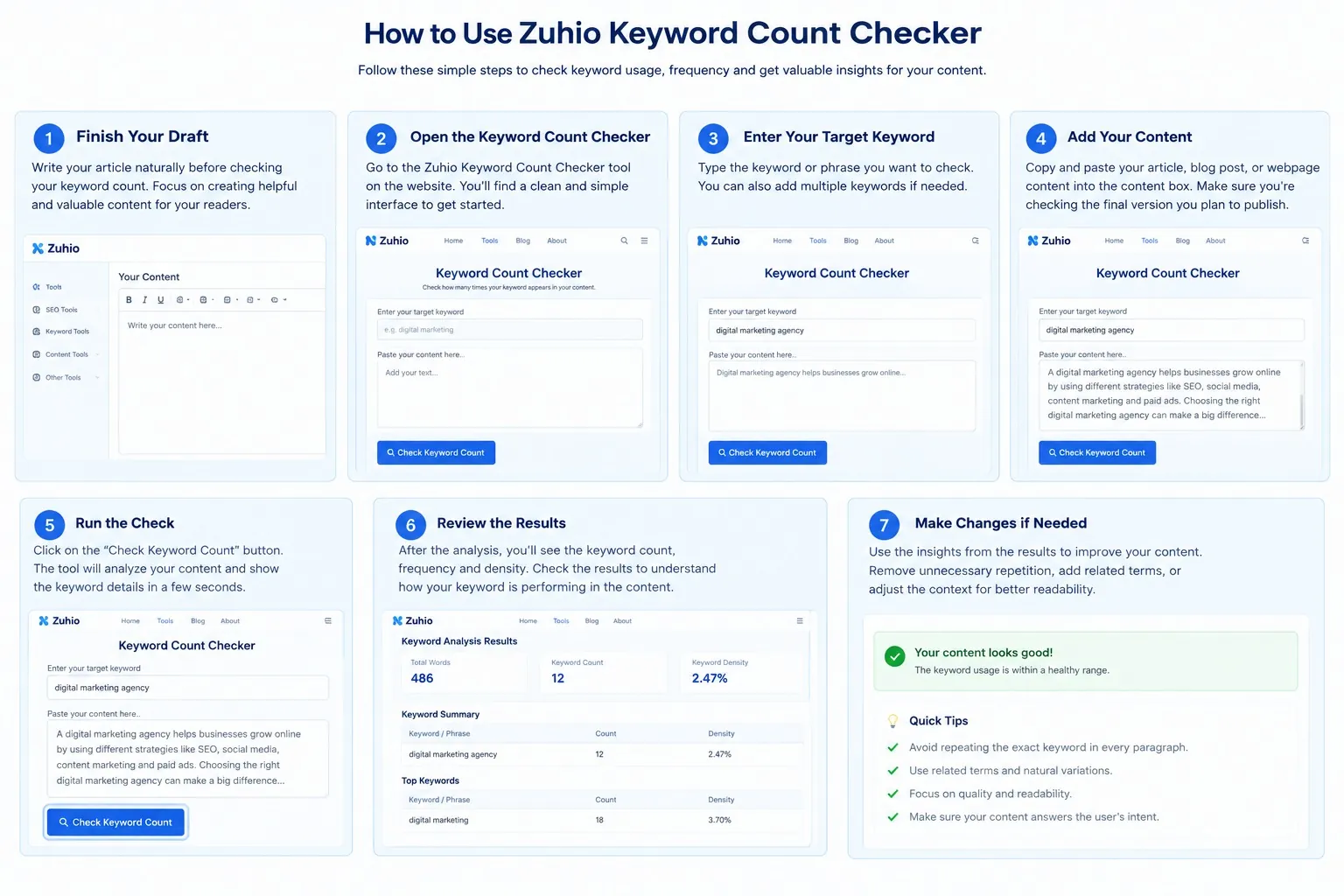
How to Use Zuhio Keyword Count Checker
Using a keyword counting tool is generally straightforward. The exact interface can vary, but the basic workflow is simple.
Step 1: Finish Your Draft
Write your article naturally before worrying too much about the final keyword count.
Your first priority should be answering the reader's question and covering the topic properly.
Do not interrupt every few sentences to count your keyword. Doing this can lead to forced writing.
Step 2: Open the Keyword Count Checker
Open the Zuhio Keyword Count Checker and prepare the content you want to analyze.
If you're checking a blog post, use the complete draft rather than only a small section.
Step 3: Enter Your Target Keyword
Enter the keyword or phrase you want to check.
For example:
Target keyword: digital marketing agency
You can also check important secondary phrases when your workflow requires it.
Step 4: Add Your Content
Copy your article or page content and place it into the tool's content area.
Make sure you are checking the actual version you plan to publish.
Step 5: Run the Check
Run the keyword check and review the results.
Depending on the tool version and available options, you may see information related to keyword count, frequency, density, or keyword usage.
Step 6: Review the Context
This is the most important step.
Don't change your article simply because a number looks high or low.
Read the sentences where the keyword appears.
Ask:
Does the keyword fit naturally?
Is it helping the reader?
Am I repeating the same phrase unnecessarily?
Could a related term make the sentence easier to read?
Numbers can identify a possible issue, but context helps you decide what to do about it.
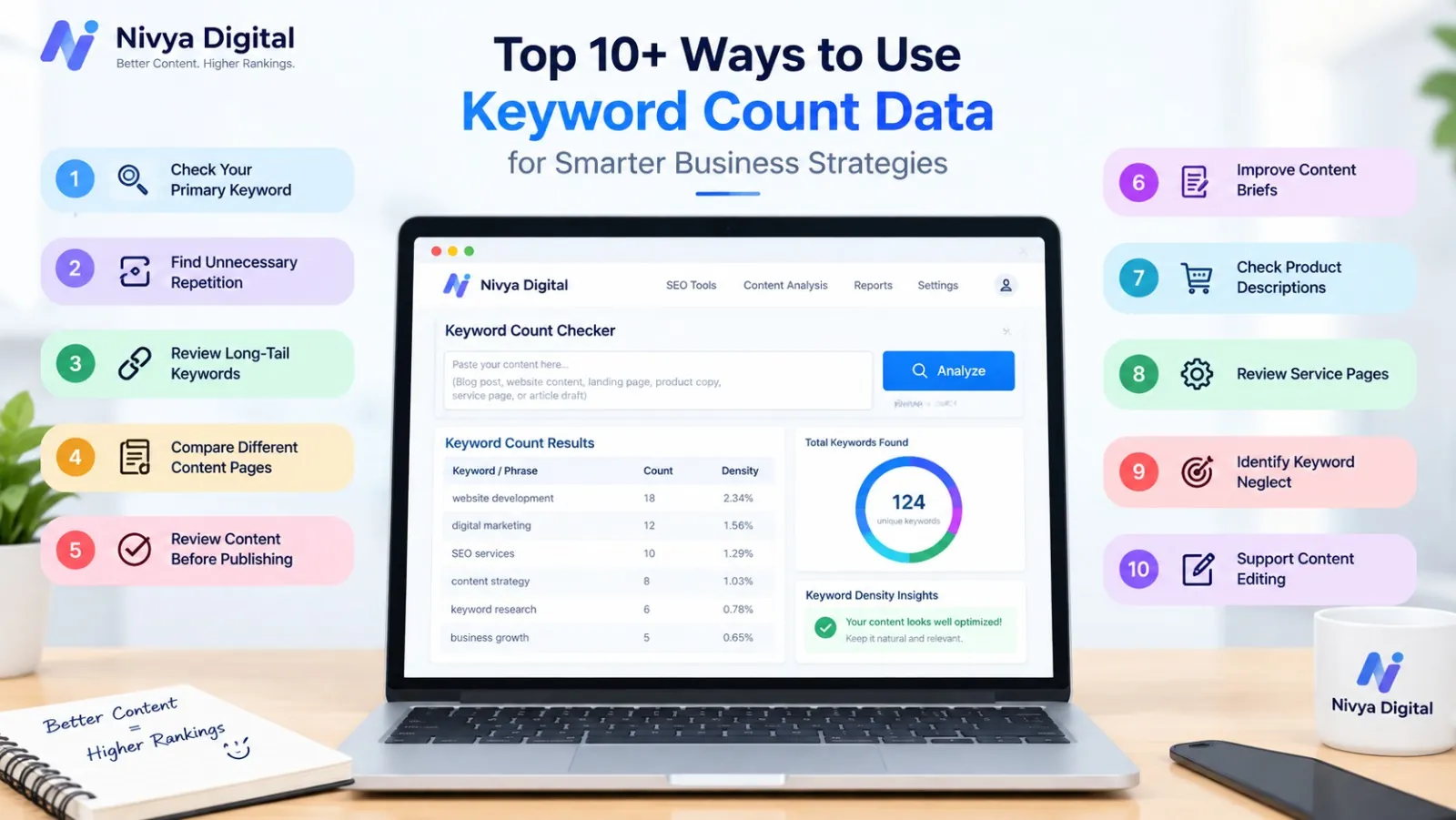
Top 10+ Ways to Use Keyword Count Data for Smarter Business Strategies
A keyword count checker can be used for more than simply counting words.
1. Check Your Primary Keyword
Start by checking the main keyword your page is targeting.
This gives you a quick overview of how frequently the phrase appears throughout your content.
For example, if your page targets website development services, checking the phrase can help you identify whether it appears naturally across the article.
2. Find Unnecessary Repetition
Sometimes writers repeat a phrase without noticing it.
A keyword counter can make that repetition easier to identify.
If several sentences use exactly the same phrase, consider whether some instances can be rewritten with natural variations.
3. Review Long-Tail Keywords
Long-tail keywords can be important when your content targets a specific search intent.
Examples include:
best digital marketing services for small businesses
how to improve website visibility
keyword density checker for SEO content
Checking these phrases can help you understand whether your intended topic is actually reflected in your draft.
4. Compare Different Content Pages
Businesses can use keyword-count data when reviewing multiple pages covering related topics.
For example, you might compare:
A service page
A supporting blog
A landing page
An FAQ page
The purpose isn't to make every page use the same number of keywords.
Instead, it helps you understand how consistently important topics are represented across your content.
5. Review Content Before Publishing
A quick keyword check can become part of your publishing checklist.
Before publishing, you can review:
Main keyword usage
Important supporting terms
Unnecessary repetition
Content readability
Search intent
Headings and structure
This makes keyword counting a quality-control step rather than the entire SEO process.
6. Improve Content Briefs
Content teams can also use keyword-count information when preparing or reviewing content briefs.
For example, a brief might identify a primary topic and several supporting concepts.
After the article is written, the writer or editor can check whether the important terms have been addressed.
However, the goal should be topic coverage—not forcing exact phrases into the article.
7. Check Product Descriptions
E-commerce businesses can use keyword counting when reviewing product descriptions.
For example, a product page may target:
wireless headphones
The checker can help identify excessive repetition of the exact phrase while you review whether related product information is clearly explained.
8. Review Service Pages
Service pages are another useful application.
Suppose a company offers:
SEO services for small businesses
The page should explain the service, benefits, process, audience, and relevant questions.
A keyword counter can then be used as a final check to see how frequently the target phrase appears.
9. Identify Keyword Neglect
Keyword counting can sometimes reveal that an important phrase barely appears in a long article.
This doesn't automatically mean you need to add it repeatedly.
Instead, check whether the content genuinely covers the topic associated with that phrase.
If it does, you may simply need to improve the wording in one or two relevant sections.
10. Support Content Editing
Editors can use keyword-count information as an additional signal when reviewing content.
For example, if an article repeatedly uses one exact phrase, an editor can look for opportunities to improve sentence variety.
This can make the content more natural without changing its core message.
11. Build a Repeatable SEO Workflow
For businesses producing content regularly, a keyword count checker can become part of a repeatable workflow:
Research → Write → Edit → Check Keywords → Review Intent → Publish
This approach is more useful than treating keyword count as a standalone SEO strategy.
Keyword Count vs. Keyword Density
Keyword count and keyword density are related, but they are not exactly the same.
| Metric | What It Tells You |
|---|---|
| Keyword Count | How many times a keyword appears |
| Keyword Density | What percentage of the content contains the keyword |
| Keyword Frequency | How often the keyword occurs in the text |
For example, if a keyword appears 10 times in a 1,000-word article, the count is 10 and the basic density calculation is 1%.
The number gives you useful context, but it doesn't tell you whether the content is good.
Is There an Ideal Keyword Density?
There is no universal keyword density percentage that guarantees better Google rankings.
This is an important distinction.
You may find SEO articles recommending a specific range such as 1% or 2%, but you should not treat that number as a Google ranking requirement.
A better approach is to use keyword density as a diagnostic metric.
Ask:
Does the keyword appear naturally where it makes sense?
If yes, you generally don't need to keep adding it simply to reach a specific percentage.
Does Keyword Count Help SEO?
Keyword counting can support SEO content optimization, but it is only one small part of the process.
A useful SEO page also needs:
Clear search intent
Helpful information
Good content structure
Relevant headings
Natural keyword usage
Strong internal linking
Original information or useful analysis
Good readability
A useful page experience
A keyword counter cannot evaluate all of these factors.
Think of it as a content checking tool, not a ranking score.
Keyword Stuffing: What to Avoid
Keyword stuffing happens when keywords are added excessively or unnaturally in an attempt to influence search rankings.
For example:
Our SEO agency provides SEO services. Our SEO agency offers SEO packages and SEO consulting. If you need an SEO agency, our SEO agency can help with SEO.
The keyword appears repeatedly, but the paragraph doesn't provide much useful information.
A better version would use natural language:
Our team helps businesses improve their search visibility through technical SEO, content optimization, keyword research, and practical on-page improvements.
The second version communicates more information without repeatedly forcing the same phrase.
What a Keyword Count Checker Cannot Tell You
Keyword counting is useful, but it has clear limitations.
A keyword count checker generally cannot tell you:
Whether your content satisfies search intent
Whether your information is accurate
Whether your article is better than competing pages
Whether your content is original
Whether your page has strong backlinks
Whether your technical SEO is correct
Whether users find the page useful
Whether a keyword has strong business value
That is why keyword counting should be combined with broader SEO and content analysis.
Common Mistakes When Using a Keyword Counter
Mistake 1: Chasing a Number
Don't rewrite an article just to reach an arbitrary keyword percentage.
Mistake 2: Adding Keywords to Every Heading
Not every heading needs the exact target keyword.
Use headings that clearly describe what the section is about.
Mistake 3: Ignoring Search Intent
A page can have perfect keyword distribution and still fail to answer the visitor's actual question.
Mistake 4: Replacing Natural Language
Don't make sentences awkward just to include an exact-match phrase.
Mistake 5: Treating the Result as a Ranking Score
A keyword count or density percentage is an analysis metric. It isn't a Google ranking score.
Who Can Benefit From a Keyword Count Checker?
A keyword counting tool can be useful for:
SEO professionals:
To perform quick content checks during optimization.
Content writers:
To review keyword usage before submitting an article.
Bloggers:
To understand how frequently important terms appear in their posts.
Marketing teams:
To maintain consistency across content projects.
Small businesses:
To review website copy without needing a complex SEO platform.
Editors:
To identify obvious repetition during the editing process.
Zuhio Keyword Count Checker vs. Other SEO Tools
A keyword counter has a narrower purpose than a full SEO platform.
For example:
| Tool Type | Main Purpose |
|---|---|
| Keyword Count Checker | Counts keyword usage |
| Keyword Research Tool | Finds search terms and related opportunities |
| Rank Tracker | Monitors search rankings |
| SEO Audit Tool | Checks technical and on-page issues |
| Backlink Tool | Analyzes links pointing to a website |
This means you don't necessarily need to choose one tool for everything.
A keyword counter can handle the content-counting part while other tools handle research, rankings, technical SEO, and backlinks.
How Businesses Can Turn Keyword Data Into Better Decisions
The real value of keyword counting comes from what you do with the information.
For example:
Data: A target keyword appears 25 times.
Decision: Don't automatically delete 15 occurrences.
Instead, review the content.
If the keyword appears naturally because the topic genuinely requires it, leave it alone.
If several occurrences make the writing repetitive, replace some with natural variations or rewrite the sentences.
This turns keyword data into a practical editing decision rather than a rigid SEO rule.
A Simple Keyword Checking Workflow
For most content teams, a simple workflow is enough:
Choose the topic
Understand what the page needs to answer.Research the search intent
Determine what users actually want to know or accomplish.Write naturally
Focus on useful information first.Check keyword usage
Use a keyword count checker to identify frequency and repetition.Edit for readability
Remove unnecessary repetition and improve awkward sentences.Check the complete page
Review headings, links, structure, accuracy, and overall usefulness.Publish and monitor
Use your SEO tools and Search Console data to understand how the page performs over time.
Final Thoughts
The Zuhio Keyword Count Checker can be a practical addition to a content workflow when you want to understand how frequently keywords appear in an article or webpage.
The biggest benefit isn't reaching a particular keyword percentage. It's getting a clearer view of your content so you can make better editing decisions.
Use keyword count data to find unnecessary repetition, review important phrases, and improve content consistency—but always look at the actual sentences and the needs of your audience.
For smarter business content, the best approach is simple:
Write for people first, check keyword usage second, and use the data to improve the content rather than forcing the content to fit a number.
Comments (0)
No comments yet
Start the discussion by sharing your perspective