
Choosing the right SEO tool in 2026 is no longer just about finding high-volume keywords or checking how many backlinks a competitor has.
Search behavior is changing. Businesses still compete for visibility on Google, but they are also trying to understand how their brands appear in AI-powered search experiences such as ChatGPT, Google AI Overviews, Gemini, and Perplexity.
For digital marketers, SEO professionals, content creators, and business owners, this creates an important question: Ahrefs vs Semrush — which platform is better for modern SEO?
Both tools offer powerful keyword research, backlink analysis, technical SEO auditing, competitor research, and rank tracking. They also provide AI visibility capabilities, although their features, datasets, and reporting approaches differ.
The challenge is choosing the right platform for your needs and budget.
For example, an SEO specialist working on link-building campaigns may prioritize detailed backlink reports. A digital marketing agency managing SEO, advertising, and content campaigns may prefer a broader marketing platform. Meanwhile, a business trying to understand its visibility in AI-generated answers may focus on brand mentions, citations, and competitor comparisons.
In this guide, we compare Ahrefs and Semrush in 2026, explain their strengths and limitations, and help you decide which SEO tool makes sense for your business.
What Is Ahrefs?
Ahrefs is an SEO and marketing intelligence platform designed to help businesses research keywords, analyze competitors, investigate backlinks, audit websites, and monitor search visibility.
It is particularly well known for its backlink analysis and organic search research capabilities.
Ahrefs allows marketers to explore competing websites, identify content opportunities, investigate referring domains, and monitor keyword rankings. Its tools also help businesses understand how their brands appear in AI-powered search environments.
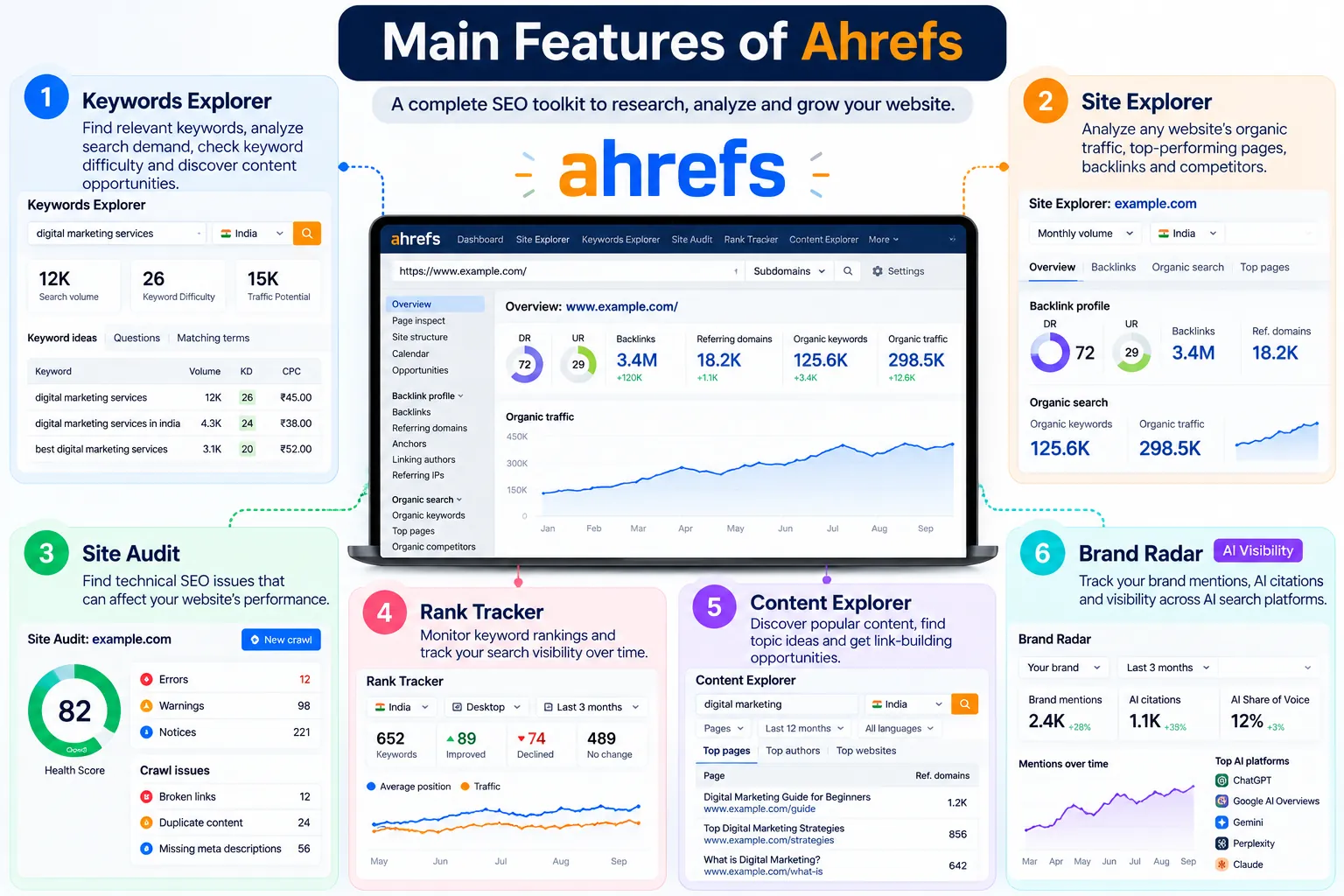
Main Features of Ahrefs
1. Keywords Explorer
Ahrefs Keywords Explorer helps users discover relevant search terms, analyze search demand, assess keyword difficulty, and investigate ranking opportunities.
It also provides metrics such as Traffic Potential and Parent Topic, which help marketers understand broader content opportunities rather than focusing on one keyword.
2. Site Explorer
Site Explorer allows users to analyze a competitor's estimated organic traffic, top-performing pages, backlinks, and referring domains.
It is useful for understanding why competing websites attract search visibility.
3. Site Audit
Site Audit identifies technical SEO issues such as broken links, redirect problems, duplicate metadata, and crawlability concerns.
4. Rank Tracker
Rank Tracker helps monitor keyword ranking changes and search visibility over time.
5. Content Explorer
Content Explorer supports content research and helps marketers discover relevant pages, topics, and potential link-building opportunities.
6. Brand Radar
Ahrefs Brand Radar provides AI visibility research, including brand mentions, citations, AI Share of Voice, and competitor comparisons across supported datasets.
Who Should Use Ahrefs?
Ahrefs can be a strong choice for SEO specialists, content strategists, link-building professionals, and agencies that regularly work on organic search campaigns.
Its research tools are particularly useful when you need to understand competitor rankings, content gaps, and backlink opportunities.
What Is Semrush?
Semrush is a digital marketing platform offering tools for SEO, keyword research, competitor analysis, content optimization, advertising research, website auditing, and AI search visibility.
While Ahrefs has traditionally been strongly associated with organic SEO and backlinks, Semrush positions itself as a broader marketing intelligence platform.
This can be helpful for businesses that manage several marketing channels alongside organic search.
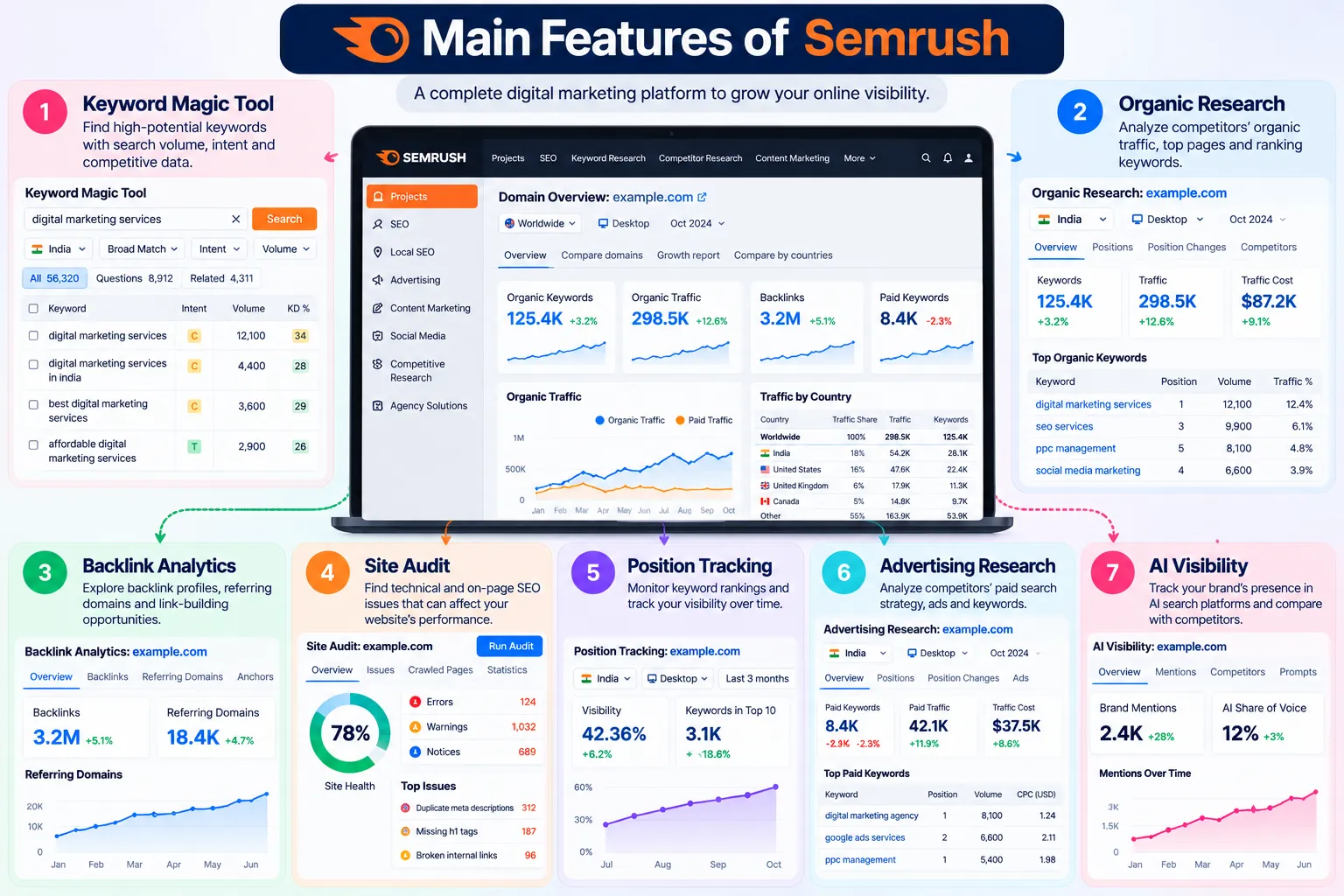
Main Features of Semrush
1. Keyword Magic Tool
Semrush Keyword Magic Tool helps marketers discover keyword ideas, analyze search intent, explore related terms, and identify long-tail keyword opportunities.
2. Organic Research
Organic Research provides estimates of competitors' ranking keywords, search traffic, and top-performing pages.
3. Backlink Analytics
Backlink Analytics helps users investigate referring domains, backlinks, anchor text, and competing websites' link profiles.
4. Site Audit
Site Audit identifies technical SEO issues affecting website accessibility, crawlability, and on-page optimization.
5. Position Tracking
Position Tracking helps monitor selected keyword rankings across devices and locations.
6. Advertising Research
Semrush also provides advertising research capabilities, making it useful for businesses that manage paid and organic marketing campaigns.
7. AI Visibility
Semrush's AI visibility features help marketers analyze brand presence, competitor visibility, sentiment, and tracked prompts across supported AI search experiences.
Who Should Use Semrush?
Semrush can be suitable for digital marketing agencies, SEO professionals, PPC specialists, content marketers, and businesses that need several marketing capabilities within one platform.
It may be especially useful when SEO research needs to connect with broader marketing planning.
Ahrefs vs Semrush: Key Differences in 2026
Before exploring individual features, here is a comparison of the two platforms.
| Feature | Ahrefs | Semrush |
|---|---|---|
| Primary focus | SEO, backlinks, search intelligence | SEO and broader digital marketing |
| Keyword research | Keywords Explorer | Keyword Magic Tool |
| Backlink analysis | Site Explorer and backlink reports | Backlink Analytics |
| Technical SEO | Site Audit | Site Audit |
| Rank tracking | Rank Tracker | Position Tracking |
| Competitor analysis | Organic keywords, pages, backlinks | Organic research, keyword gaps, advertising research |
| Content research | Content Explorer and related tools | Content research and optimization tools |
| AI visibility | Brand Radar | AI visibility and AI search monitoring |
| PPC competitor research | More limited as a broader workflow | Dedicated advertising research tools |
| Ideal users | SEO-focused professionals | SEO and multi-channel marketing teams |
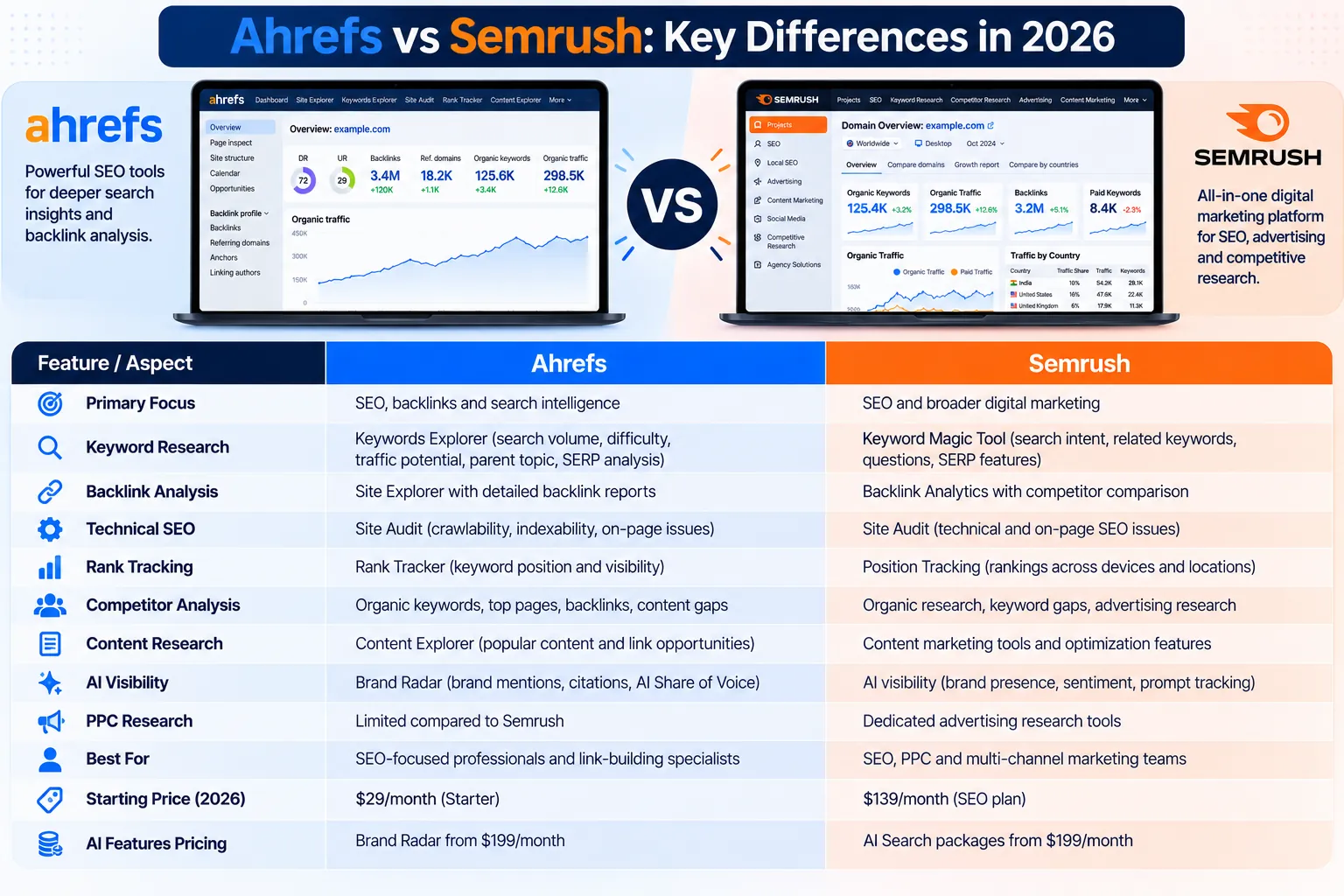
Both platforms offer valuable SEO capabilities. The better choice depends on how you plan to use the data.
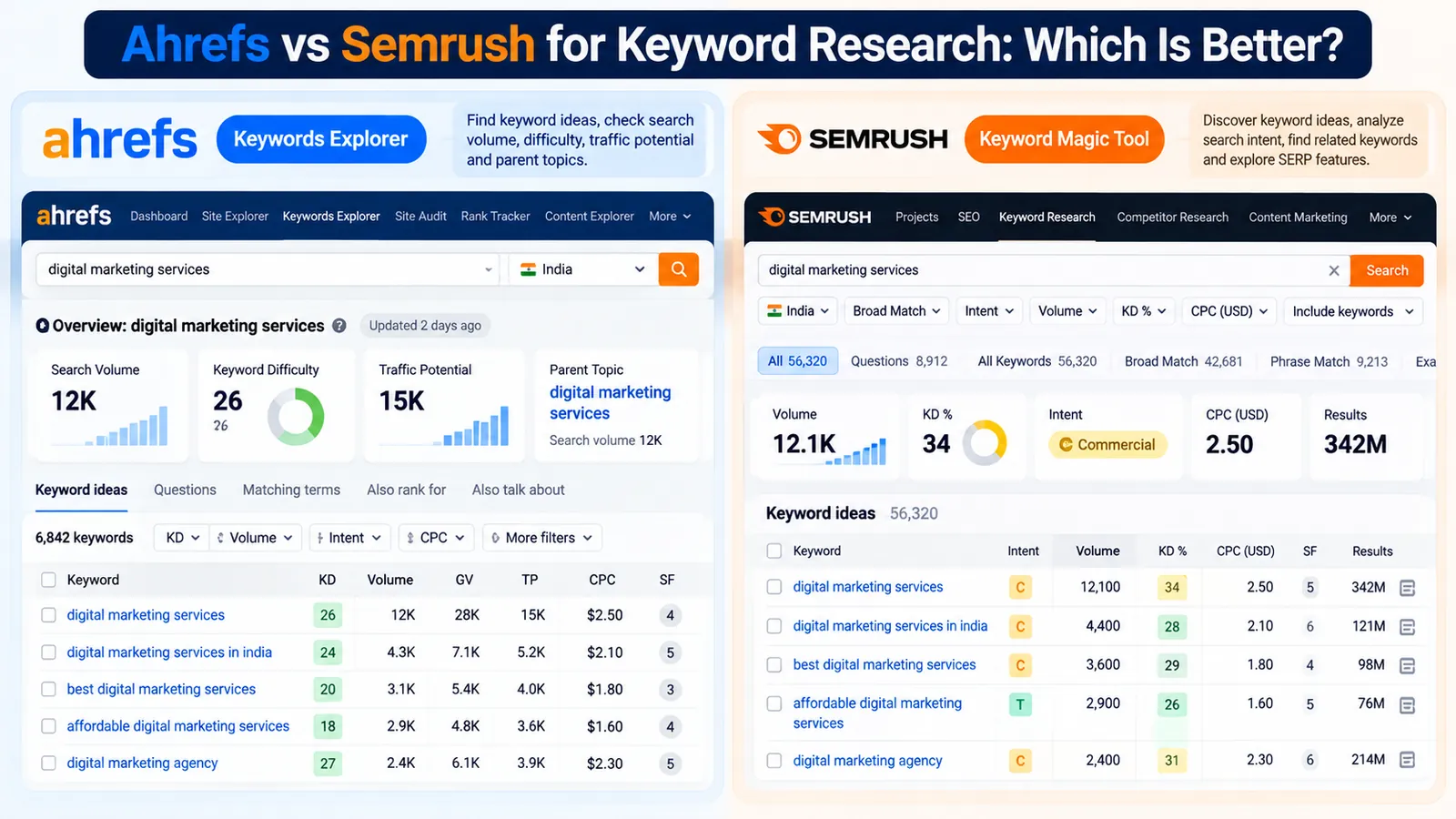
Ahrefs vs Semrush for Keyword Research: Which Is Better?
Keyword research is one of the most important parts of SEO.
Without understanding what your audience searches for, even a technically optimized website may struggle to attract relevant visitors.
However, successful keyword research involves more than finding terms with high monthly search volume.
You need to consider search intent, competition, relevance, content opportunities, and the likelihood that visitors will become customers.
Ahrefs Keywords Explorer
Ahrefs provides several useful keyword research metrics.
Search Volume: Estimates the number of searches a keyword receives.
Keyword Difficulty: Estimates how difficult it may be to rank for a keyword based on Ahrefs' methodology.
Traffic Potential: Estimates the organic traffic opportunity associated with a topic by looking beyond the volume of an individual keyword.
Parent Topic: Helps identify a broader topic that may cover multiple related searches.
SERP Overview: Shows competing pages and SEO metrics that can help users understand the ranking landscape.
Practical Example
Suppose you manage a digital marketing website and want to target the keyword “SEO audit services.”
Using Ahrefs, you can investigate the keyword's estimated search demand, competing websites, backlinks, and related search opportunities.
You might discover that users also search for technical SEO audits, website SEO audits, and professional SEO audit services.
Rather than publishing separate articles for every variation, you can evaluate whether these terms belong on one comprehensive service page.
This helps create content that addresses user intent more effectively.
Semrush Keyword Magic Tool
Semrush provides keyword research capabilities that support SEO and content planning.
Users can explore:
Keyword search volume
Keyword difficulty
Search intent
Related keywords
Questions and long-tail terms
SERP features
Competitor keyword opportunities
Semrush can also be useful when you want to connect keyword research with advertising strategy.
Practical Example
Imagine a small business wants to target “digital marketing services in India.”
Semrush can help identify related commercial keywords, competitor rankings, and search intent.
You can then group keywords into service-page opportunities, informational articles, and comparison content.
This approach helps create a more organized SEO strategy.
Ahrefs vs Semrush for Keyword Research: Verdict
Ahrefs is a strong choice if you value Traffic Potential, Parent Topic, and detailed organic search analysis.
Semrush is attractive if you prefer structured keyword research integrated with broader marketing workflows.
Winner: Tie — depending on your workflow.
Neither platform provides perfectly accurate search volumes or a guaranteed measure of ranking difficulty. Treat these metrics as estimates and validate your decisions using Google Search Console and actual website performance.
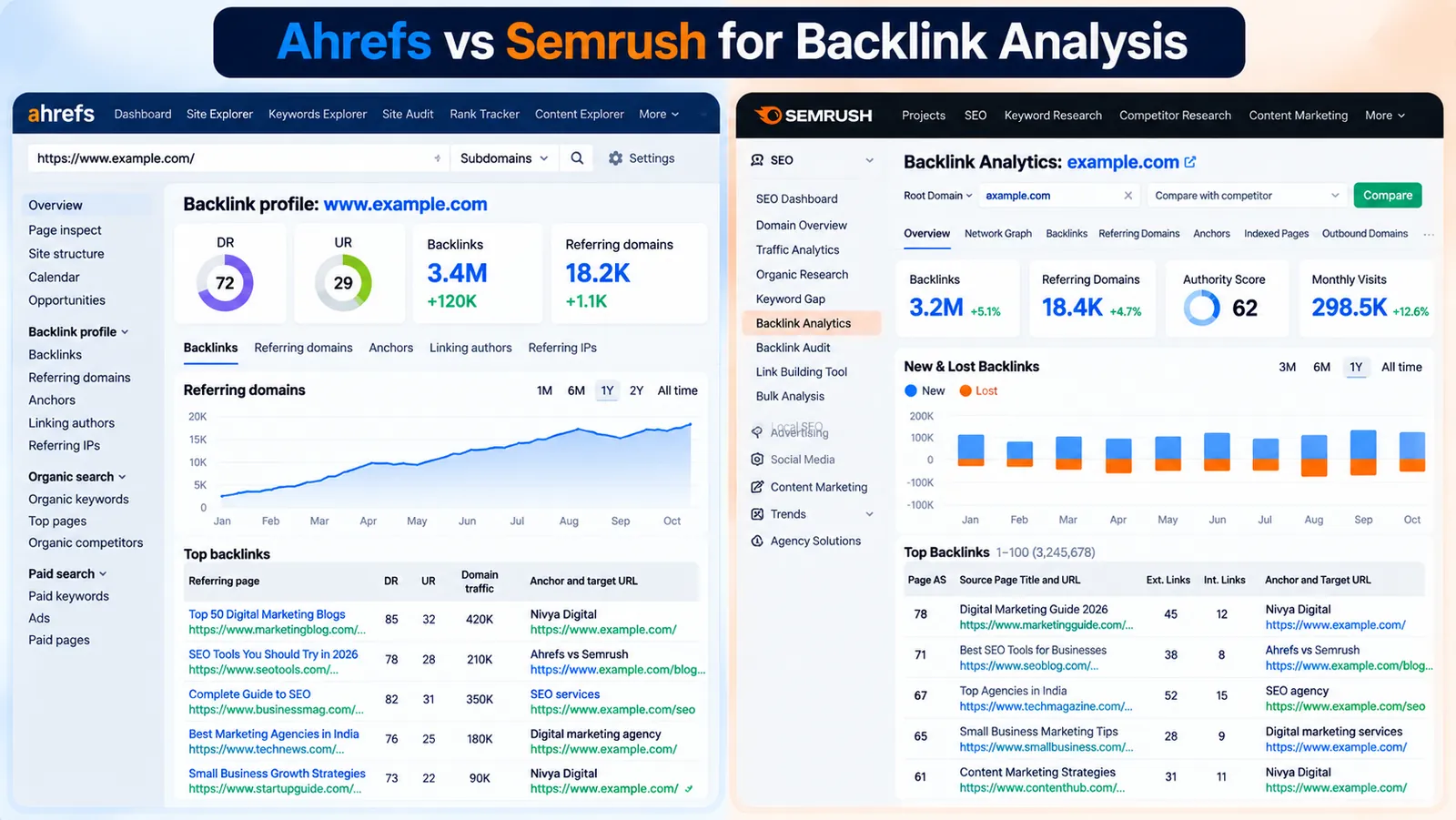
Ahrefs vs Semrush for Backlink Analysis
Backlinks remain an important part of SEO research because links help search engines discover pages and understand relationships between websites.
However, building backlinks should not be about collecting as many links as possible.
Relevant, editorially earned links from trustworthy websites are generally more valuable than large numbers of low-quality links.
Ahrefs Backlink Analysis
Ahrefs provides detailed backlink research through Site Explorer.
Users can investigate:
Referring domains
New and lost backlinks
Anchor text
Competitor backlink profiles
Linking pages
Broken backlinks
Link-building opportunities
Practical Example
Suppose a competing SEO agency has published a detailed guide about technical SEO.
That article attracts backlinks from marketing blogs, educational resources, and industry websites.
Using Ahrefs, you can investigate which websites reference the competitor's content.
You can then identify opportunities to create more helpful resources or pursue relevant editorial outreach.
The goal is not to copy backlinks automatically. It is to understand what makes certain content worth citing.
Semrush Backlink Analytics
Semrush provides backlink reports that help users investigate:
Total backlinks
Referring domains
Anchor text
Link attributes
Competitor backlink profiles
Backlink opportunities
Changes in backlink profiles
These features can support competitor research and link-building strategy.
For agencies, backlink reporting can also help explain changes in a website's link profile over time.
Ahrefs vs Semrush for Backlinks: Verdict
Ahrefs is a compelling option for SEO professionals who regularly perform detailed backlink research.
Semrush also offers capable backlink analysis, especially when combined with its other marketing tools.
Winner: Ahrefs for a backlink-focused workflow, although the best dataset should be evaluated using real websites.
Both tools have their own link indexes, so backlink counts and discovered links may differ.
Ahrefs vs Semrush for AI Visibility in 2026
AI search visibility is one of the biggest developments in modern SEO measurement.
Traditional SEO tools focus heavily on rankings, clicks, impressions, and organic traffic.
But AI-powered discovery introduces additional questions.
Does your brand appear when someone asks an AI assistant for a recommendation?
Which competitors are mentioned?
Which websites are cited as sources?
What topics are associated with your business?
These questions are important because AI-generated answers may influence how people discover and evaluate brands, even when they do not immediately visit a website.
Ahrefs Brand Radar
Ahrefs Brand Radar helps users investigate how brands appear across supported AI search datasets.
Its reporting includes metrics such as:
Brand Mentions: How often a brand appears within the tracked AI responses.
Citations: References to sources appearing in AI-generated answers.
AI Share of Voice: A measure of a brand's relative presence within the selected AI visibility dataset.
Competitor Comparison: Helps compare brand visibility against competing businesses.
Prompt Research: Supports investigation of questions and prompts associated with brand discovery.
Example
Suppose someone asks an AI assistant:
“Which digital marketing agencies offer SEO services for small businesses in India?”
A business may want to understand which agencies are mentioned, which sources are cited, and what information appears to influence the responses.
Brand Radar can help investigate such patterns within its supported data.
However, it cannot capture every AI conversation or guarantee that the same answer will appear for every user.
Semrush AI Visibility
Semrush provides AI visibility features for monitoring brand presence across supported AI platforms.
Its capabilities include:
Brand visibility analysis
AI prompt monitoring
Competitor comparisons
Brand sentiment reporting
AI search performance insights
Identification of relevant visibility opportunities
Example
Imagine a SaaS company discovers that competitors frequently appear in AI answers about customer relationship management software.
The company can use these insights to investigate missing topics, weak brand associations, and opportunities to improve its content and digital reputation.
This can inform content strategy, digital PR, and brand positioning.
AI-powered tools are also changing how marketers research topics and create content. Explore our ChatGPT vs Gemini in 2026 comparison to understand how these AI assistants can support SEO, content writing, and digital marketing.
Ahrefs Brand Radar vs Semrush AI Visibility
| Comparison | Ahrefs Brand Radar | Semrush AI Visibility |
|---|---|---|
| Brand mentions | Yes | Yes |
| AI citation analysis | Yes | Available through relevant reporting |
| Competitor comparison | Yes | Yes |
| Prompt monitoring | Yes | Yes |
| AI Share of Voice | Yes | Visibility and competitive metrics |
| Brand sentiment | Not its primary emphasis | An important reporting capability |
| Main advantage | AI mentions, citations, and prompt research | AI visibility within broader marketing analysis |
Feature access depends on the subscription and supported platform coverage.
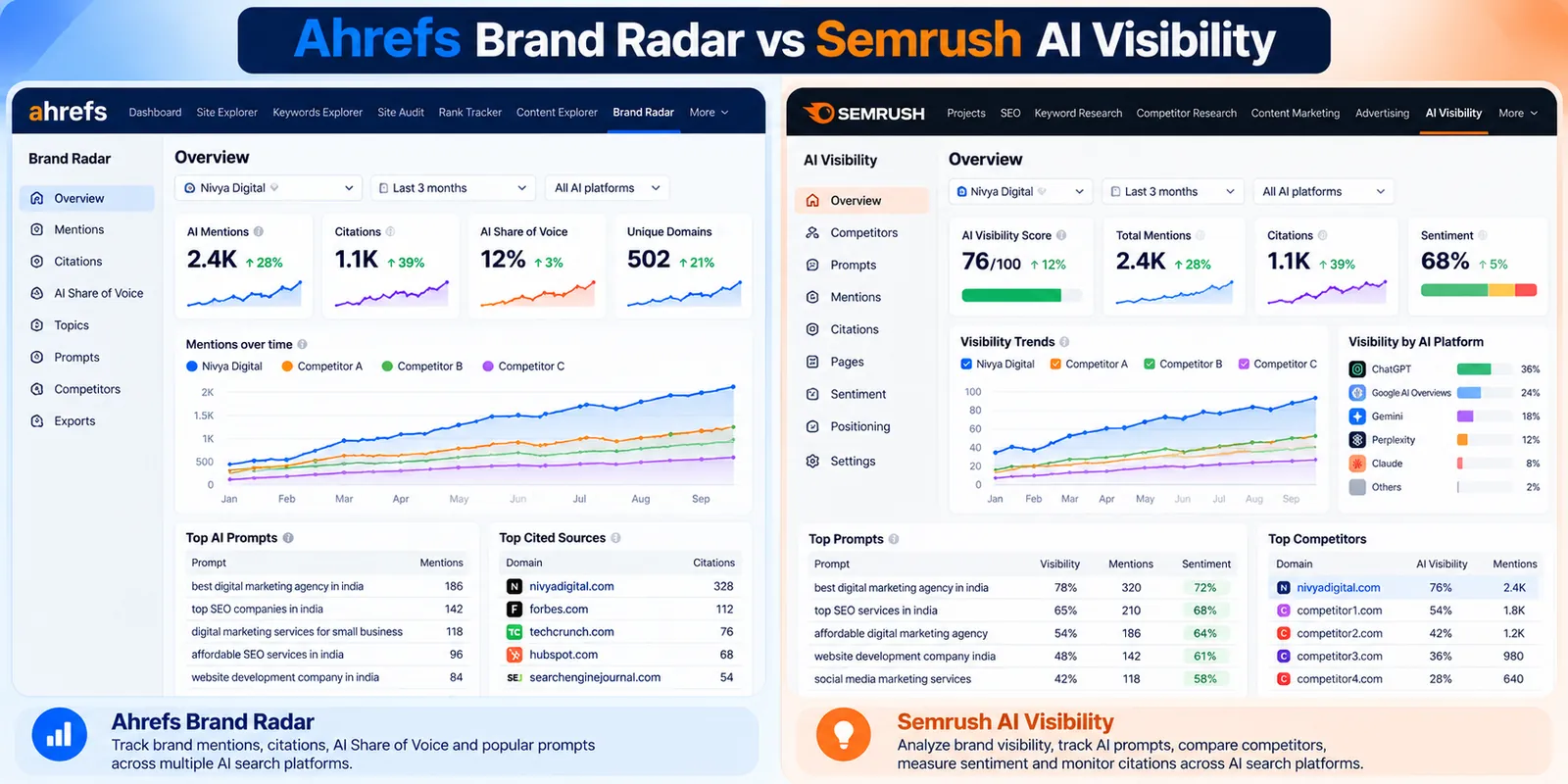
Which Tool Is Better for AI Visibility?
Ahrefs may appeal to marketers who want to investigate AI citations, brand mentions, and prompt datasets in detail.
Semrush may be preferable for teams that want AI visibility reporting alongside other SEO and marketing activities.
Winner: Depends on your AI measurement goals.
Neither platform can guarantee placement in ChatGPT, Google AI Overviews, Gemini, or Perplexity.
AI visibility reports should be interpreted as directional measurements based on specific datasets, prompts, and tracking methods.
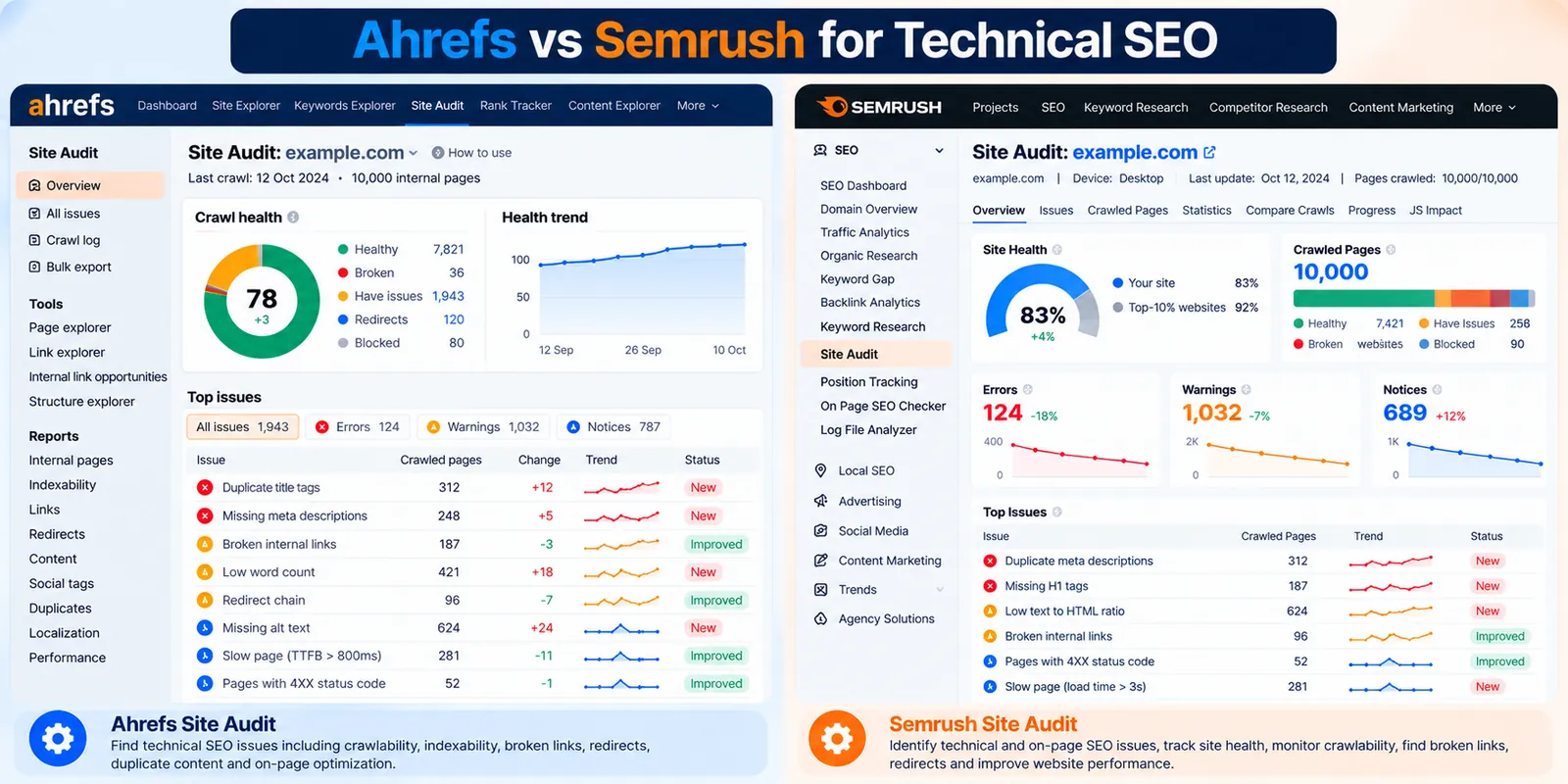
Ahrefs vs Semrush for Technical SEO
Technical SEO helps ensure that search engines can access, crawl, and understand important website pages.
A website may have excellent content but still struggle because of technical issues.
Common problems include broken internal links, incorrect redirects, duplicate content, indexing restrictions, and poorly structured pages.
Ahrefs Site Audit
Ahrefs Site Audit helps identify technical issues involving:
Crawlability
Indexability
Broken links
Redirects
Internal linking
Duplicate content
Metadata
Other website health concerns
It can help teams identify patterns across large websites.
Semrush Site Audit
Semrush Site Audit also identifies technical and on-page issues.
Its reports can help investigate:
Broken pages
Crawl errors
Redirect problems
Duplicate metadata
Internal linking issues
HTTPS problems
Other technical SEO concerns
Which Tool Wins for Technical SEO?
Both platforms provide useful technical auditing capabilities.
Winner: Tie.
The right choice depends on your crawl requirements, reporting preferences, website size, and available subscription limits.
Remember that third-party crawlers do not replace Google Search Console, which provides direct information about how Google interacts with your verified website.
Ahrefs vs Semrush for Competitor Analysis
Competitor analysis helps marketers understand which strategies may be contributing to another website's search visibility.
It can reveal content opportunities, keyword gaps, and potential link-building opportunities.
Ahrefs Competitor Analysis
Ahrefs can help identify:
Competitor ranking keywords
Estimated organic traffic
Top-performing pages
Backlink sources
Content gaps
Historical search performance
It is especially useful when researching organic search competitors.
Semrush Competitor Analysis
Semrush supports competitor analysis through organic research, keyword gap analysis, and advertising research.
Users can investigate:
Competing domains
Ranking keywords
Organic visibility
Keyword gaps
Advertising-related insights
Content opportunities
Which Is Better?
For organic search and backlink research, Ahrefs offers a strong workflow.
For businesses combining SEO with PPC and broader competitive marketing research, Semrush may be more convenient.
Winner: Ahrefs for focused organic research; Semrush for broader marketing research.
Ahrefs vs Semrush Pricing in 2026
Pricing is an important consideration, particularly for freelancers, small businesses, and agencies managing several clients.
Both platforms offer multiple plans, and advanced features may require additional subscriptions or usage allowances.
The following figures are published US-dollar prices reviewed in October 2026.
Ahrefs Pricing
| Plan | Published Price |
|---|---|
| Starter | $29/month |
| Lite | $129/month |
| Standard | $249/month |
| Advanced | $449/month |
| Enterprise | From $1,499/month, annual commitment |
Ahrefs also lists Brand Radar AI research starting from $199/month, with separate custom prompt-tracking options.
Some AI prompt tracking is included in core subscriptions, but broader AI research has different pricing and usage limits.
Semrush Pricing
Semrush offers both traditional SEO plans and packages combining SEO with AI search capabilities.
| Plan | Published Monthly Price |
|---|---|
| SEO | $139/month |
| SEO + AI Search Starter | $199/month |
| SEO + AI Search Pro+ | $299/month |
| SEO + AI Search Advanced | $549/month |
Semrush also advertises discounted effective monthly prices for eligible annual billing.
Which Tool Offers Better Value?
There is no universal answer.
Ahrefs may provide better value for a team that primarily needs organic SEO and backlink research.
Semrush may offer better value for a business that wants SEO, advertising research, and AI visibility workflows within a broader platform.
Before subscribing, compare the total cost of the exact features you need.
Consider project limits, tracked keywords, report allowances, AI prompt tracking, historical data, and additional user fees.
Important: Prices are subject to change. Check the official pricing pages before purchasing.
Ahrefs vs Semrush for Small Businesses
Small businesses often have limited marketing budgets.
They need tools that help them identify useful opportunities without requiring unnecessary subscriptions.
For example, a local service business may need to:
Find relevant commercial keywords
Analyze competing websites
Identify technical SEO issues
Monitor keyword rankings
Understand organic traffic changes
Both platforms can support these tasks.
However, the business may not need every advanced feature.
A practical approach is to start with Google Search Console and Google Analytics 4, identify the biggest SEO problems, and then select a paid platform that addresses those needs.
If your main objective is organic keyword research and backlinks, Ahrefs may be a suitable choice.
If you manage SEO alongside advertising and broader marketing activities, Semrush may be more appropriate.
Ahrefs vs Semrush for Digital Marketing Agencies
Digital marketing agencies often manage several client websites, each with different goals.
One client may need local SEO.
Another may need e-commerce keyword research.
A third may require competitor analysis, technical SEO, and AI visibility monitoring.
When Agencies Should Consider Ahrefs
Ahrefs may suit agencies focusing on:
Organic SEO
Backlink analysis
Content gap research
Link-building opportunities
Competitor rankings
Technical audits
When Agencies Should Consider Semrush
Semrush may suit agencies handling:
SEO
PPC research
Content marketing
Competitive intelligence
Technical auditing
AI search visibility
Broader marketing reporting
Should an Agency Use Both?
Some agencies use both because the platforms provide different datasets and workflows.
However, using both is not essential.
For a smaller agency, one carefully selected platform combined with Google Search Console, GA4, and effective reporting processes may be sufficient.
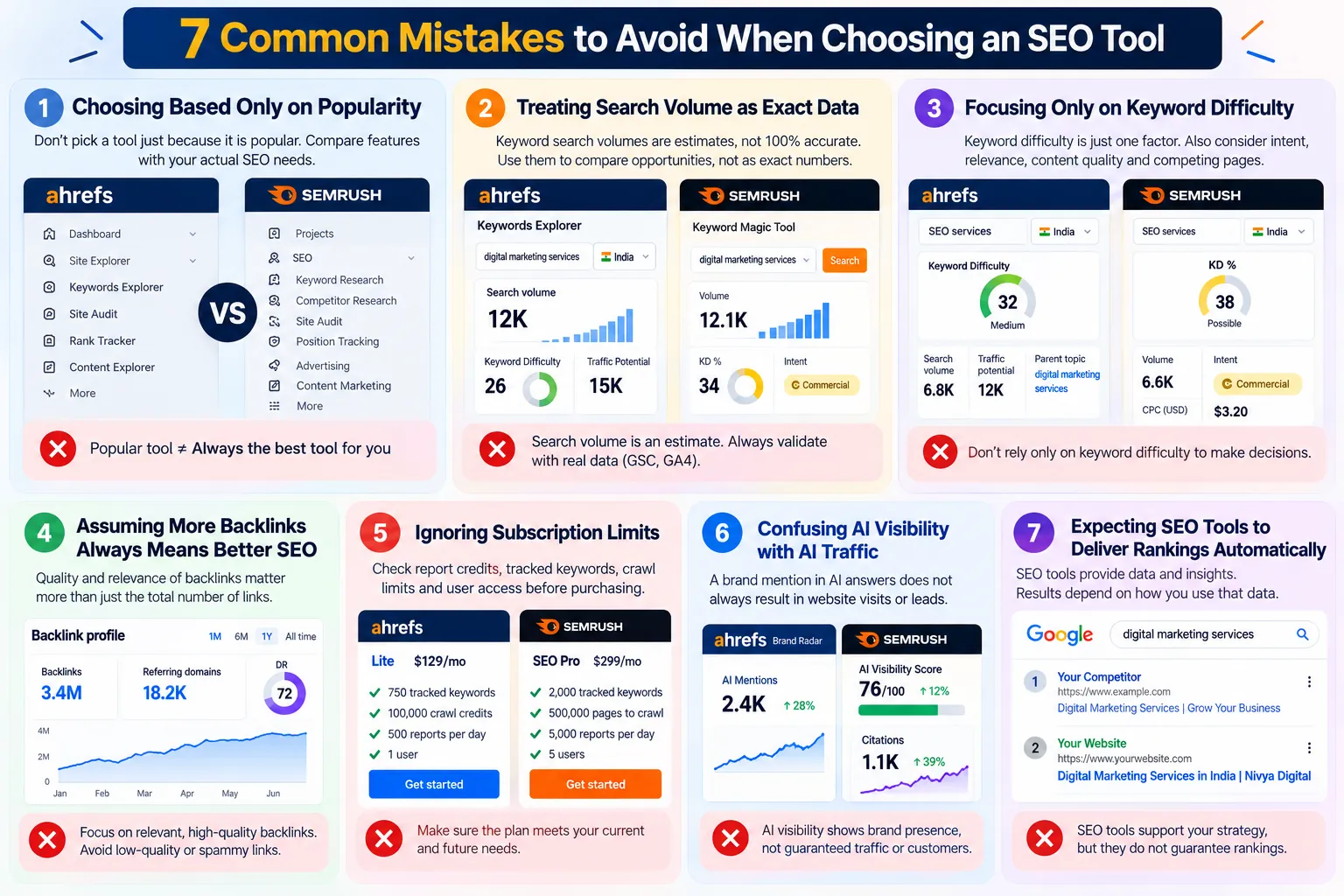
7 Common Mistakes to Avoid When Choosing an SEO Tool
1. Choosing Based Only on Popularity
A widely used platform is not automatically the best choice for every business. Compare features against your actual needs.
2. Treating Search Volume as Exact Data
Keyword volumes are estimates. Use them to compare opportunities rather than treating them as precise predictions.
3. Focusing Only on Keyword Difficulty
Keyword difficulty is only one consideration. Search intent, content quality, relevance, and competing pages also matter.
4. Assuming More Backlinks Always Means Better SEO
The number of backlinks alone does not determine rankings. Link relevance and quality matter.
5. Ignoring Subscription Limits
Review report credits, crawl limits, user access, and AI visibility allowances before purchasing.
6. Confusing AI Visibility with AI Traffic
A brand mention in an AI-generated answer does not necessarily result in a website visit or customer inquiry.
7. Expecting SEO Software to Deliver Rankings Automatically
SEO tools provide information. Results depend on how effectively you use that information to improve your website and content.
How to Choose Between Ahrefs and Semrush: A Practical Checklist
Before purchasing, answer these questions:
Is keyword research your main priority?
Do you regularly investigate competitor backlinks?
Do you need technical SEO auditing?
Are you managing one website or multiple client projects?
Do you also handle PPC campaigns?
Do you need AI visibility reporting?
What is your monthly software budget?
How many users require access?
Which reports will you use every week?
Can you test the platform before committing to a larger subscription?
The best tool is the one that helps you make better decisions consistently.
Final Verdict: Ahrefs vs Semrush in 2026
So, which SEO tool should you choose?
The answer depends on your business goals.
| Your Priority | Recommended Starting Point |
|---|---|
| Detailed backlink analysis | Ahrefs |
| Keyword research | Either platform |
| Organic competitor research | Either platform |
| Technical SEO audits | Either platform |
| SEO combined with advertising research | Semrush |
| AI mentions and citation research | Ahrefs Brand Radar |
| AI visibility with broader marketing reporting | Semrush |
| Small business SEO | Compare plan limits and total cost |
| Multi-channel digital marketing agency | Semrush may be more convenient |
Choose Ahrefs if you primarily focus on organic SEO, backlinks, competitor research, and AI citation analysis.
Choose Semrush if you want to connect SEO research with advertising, content marketing, competitive analysis, and AI visibility.
For businesses with complex requirements, testing both tools on the same website can provide useful insights.
Ultimately, SEO success depends less on which platform you purchase and more on the quality of your research, strategy, implementation, and measurement.
Improve Your SEO Strategy with Nivya Digital
Choosing between Ahrefs and Semrush is only one part of building a successful SEO strategy.
Businesses also need to identify the right keywords, improve website performance, create useful content, and turn relevant visitors into potential customers.
At Nivya Digital, we help businesses approach digital growth through SEO, website optimization, content marketing, and other digital marketing services.
Whether your website is struggling to attract organic traffic or you want to strengthen your visibility in a competitive market, a structured SEO strategy can help identify the next steps.
Looking to improve your website's search visibility and generate more qualified inquiries?
Visit Nivya Digital to explore our services and request a consultation.
References and Further Reading
Editorial Note: This article compares publicly documented product capabilities and published prices reviewed in October 2026. Pricing, feature availability, AI platform coverage, and usage limits may change. Recommendations reflect differences in product positioning and workflows, not a controlled hands-on benchmark or guaranteed SEO results.
Comments (1)
A helpful comparison of Ahrefs and Semrush for SEO professionals and businesses in 2026. It explores how the two platforms differ in keyword research, backlink analysis, competitor research, site audits, and AI search visibility tracking. A valuable resource for marketers, bloggers, and business owners looking to choose SEO tools that fit their goals, improve search performance, and make more informed data-driven decisions.