
Artificial intelligence has transformed how businesses create content, research keywords, manage marketing campaigns, and communicate with customers. In 2026, two of the most recognizable AI assistants are ChatGPT by OpenAI and Gemini by Google.
Both platforms can help marketers generate ideas, summarize information, analyze documents, and improve productivity. However, their features, integrations, workflows, and limitations are not identical.
This raises an important question: ChatGPT vs Gemini—which AI tool should businesses and digital marketers choose in 2026?
The answer depends on what you want to accomplish. A content writer may prioritize editing and creative flexibility, while a marketing agency may need research capabilities, file analysis, collaboration, and integration with existing business software.
In this detailed comparison, we explore the differences between ChatGPT and Gemini, including their capabilities for SEO, content creation, keyword research, social media marketing, competitor analysis, pricing, and business productivity.
What Is ChatGPT?
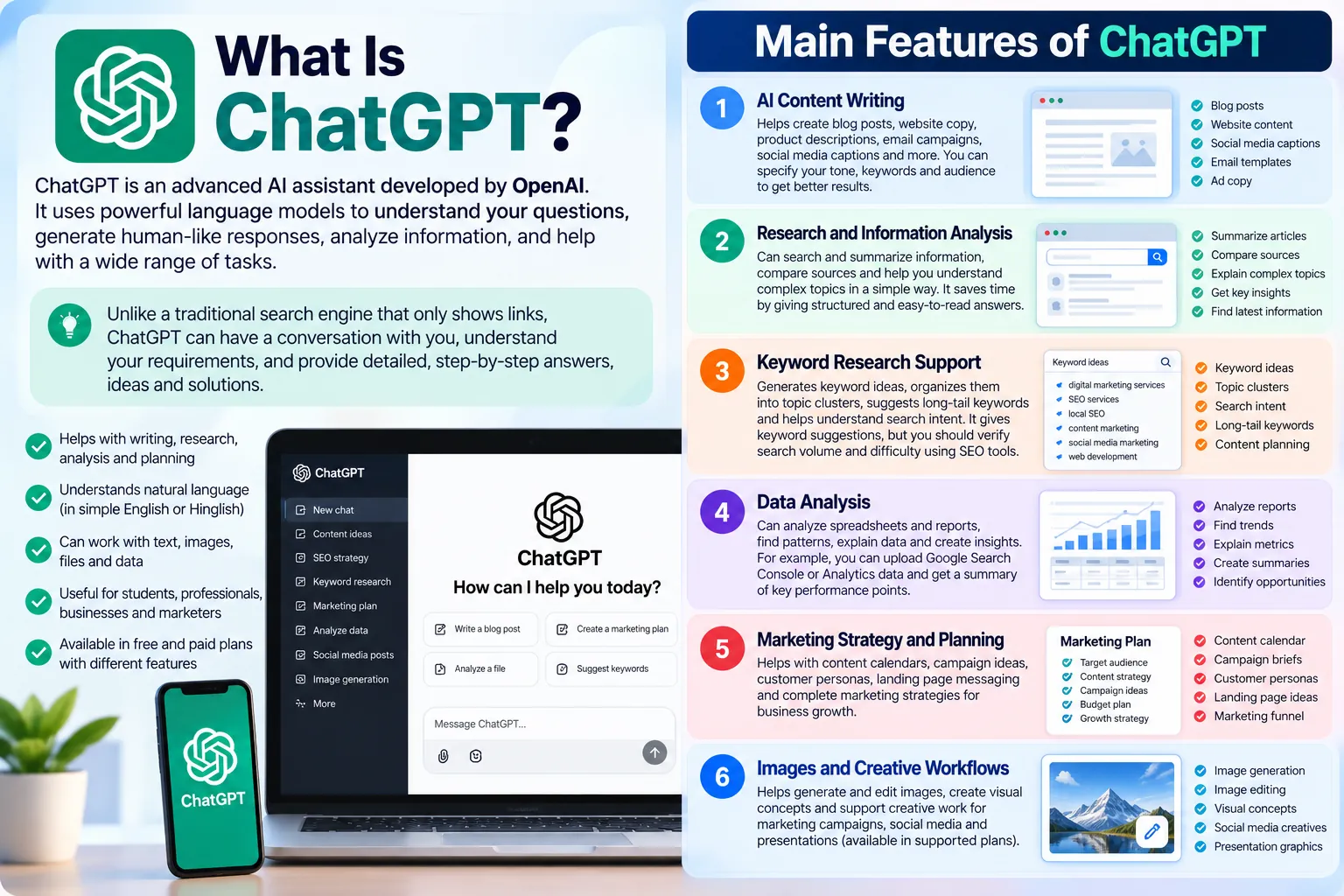
ChatGPT is an AI assistant developed by OpenAI. It uses advanced language models to understand questions, generate responses, analyze information, and assist with complex tasks.
Businesses use ChatGPT for everything from writing website content to preparing marketing strategies, reviewing spreadsheets, brainstorming campaigns, and organizing workflows.
Unlike a traditional search engine that primarily presents links, ChatGPT can help users work through a task conversationally, revise outputs, and develop ideas through multiple interactions.
Main Features of ChatGPT
- AI Content Writing
ChatGPT can assist with blog outlines, website copy, product descriptions, email campaigns, advertising headlines, and social media captions.
Marketers can specify their target audience, preferred tone, keywords, and content objectives. They can also request revisions to improve clarity, readability, or structure.
- Research and Information Analysis
ChatGPT supports research-oriented workflows, including web-assisted information gathering and more extensive research capabilities, depending on the available plan and tools.
It can help marketers compare sources, identify research questions, summarize reports, and organize findings. Important facts still require independent verification.
- Keyword Research Support
ChatGPT can generate seed keyword ideas, organize keywords into topic clusters, identify possible search intent, and suggest long-tail keyword variations.
However, it should not be treated as a substitute for a dedicated keyword database. Actual search volume, keyword difficulty, and SERP competition should be checked using tools such as Google Keyword Planner, Ahrefs, or Semrush.
- Data Analysis
With supported file-analysis capabilities, ChatGPT can help interpret spreadsheets, identify patterns, explain marketing metrics, and organize campaign reports.
For example, a marketer can upload an exported Google Search Console report and ask for an analysis of pages with declining clicks or keywords with high impressions but low click-through rates.
- Marketing Strategy and Campaign Planning
ChatGPT can assist with content calendars, customer personas, campaign briefs, landing-page messaging, and marketing funnel ideas.
These outputs are starting points that should be refined using actual audience research and business data.
- Images and Creative Workflows
Supported ChatGPT experiences offer image-generation and editing capabilities that can help with concept development, creative briefs, and visual content preparation.
Features and limits vary by subscription.
Who Should Use ChatGPT?
ChatGPT may be particularly useful for:
SEO specialists developing content briefs and topic clusters.
Content writers drafting and editing articles.
Marketing agencies managing different client projects.
Small businesses preparing website and promotional content.
Professionals analyzing documents and marketing reports.
What Is Google Gemini?
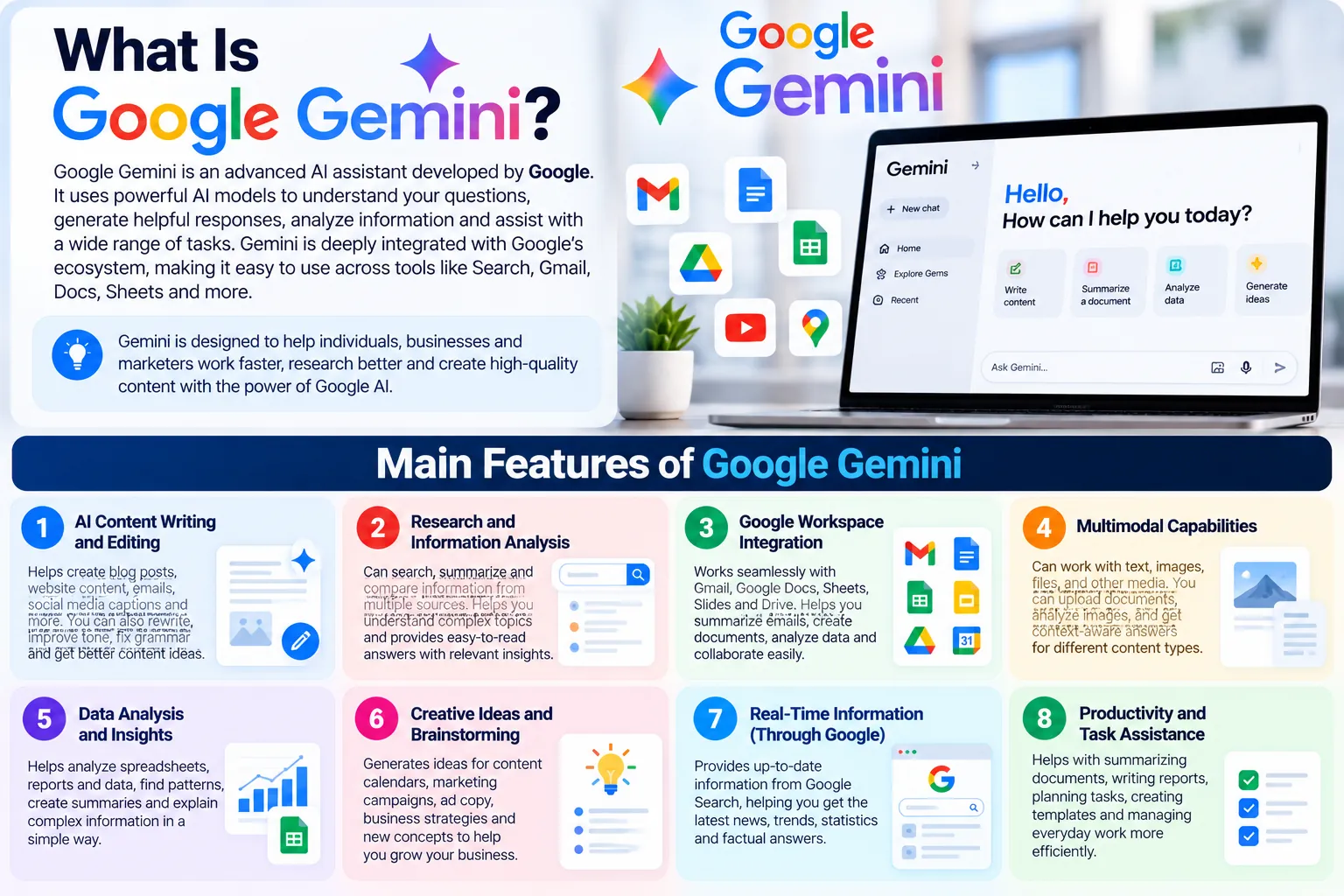
Google Gemini is an AI assistant developed by Google. It helps users write, research, analyze information, generate creative content, and complete everyday productivity tasks.
A major attraction of Gemini is its relationship with Google's broader ecosystem, including services such as Gmail, Google Docs, and other Workspace applications, where supported.
Gemini also offers research and multimodal capabilities, with access varying by product, region, and subscription.
Main Features of Google Gemini
- AI Writing and Editing
Gemini can help draft blog posts, marketing emails, website descriptions, social media captions, and business documents.
Users can request alternative versions, summaries, rewritten passages, or adjustments to tone.
- Research Assistance
Gemini provides research capabilities that can help users explore complex subjects, organize findings, and develop structured reports.
As with any AI assistant, users should review cited sources and verify claims before publishing.
- Google Workspace Integration
One of Gemini's most useful advantages for certain businesses is its integration with Google Workspace.
Depending on the subscription, Gemini capabilities can be available within Gmail, Docs, Sheets, and other Google productivity applications.
This can reduce the need to move information between separate tools.
- Document and Information Analysis
Gemini can help summarize documents, explain information, and extract important points from supported inputs.
This can be useful for reviewing marketing briefs, business proposals, meeting notes, and research material.
- Multimodal Capabilities
Gemini supports various combinations of text, image, and other media-related interactions, depending on the model and product.
This allows marketers to explore visual concepts and work with different content formats.
- AI Research and Creative Tools
Google offers additional AI experiences, including research and creative tools, through its AI plans.
These can be useful for businesses producing multimedia content or researching complex subjects.
Who Should Use Gemini?
Gemini may be especially useful for:
Businesses already using Google Workspace.
Teams that collaborate through Gmail and Google Docs.
Professionals who need AI assistance within Google applications.
Marketers researching topics and preparing documents.
Users who want access to Google's wider AI ecosystem.
ChatGPT vs Gemini: Key Differences in 2026
Although both platforms offer advanced AI capabilities, their practical strengths differ.
| Comparison Factor | ChatGPT | Google Gemini |
|---|---|---|
| Developer | OpenAI | |
| Main purpose | General AI assistance and task workflows | General AI assistance and Google ecosystem productivity |
| Content writing | Drafting, editing, restructuring and ideation | Drafting, editing, summarization and ideation |
| SEO assistance | Topic clustering, briefs, analysis and content planning | Topic research, briefs, analysis and content planning |
| Keyword volume data | Not a dedicated verified keyword database | Not a dedicated verified keyword database |
| Research | Web-assisted and advanced research capabilities | Research and Deep Research capabilities |
| Document analysis | Supported uploads and data-analysis workflows | Supported document and multimodal workflows |
| Business integrations | Connected apps and supported workflows | Strong Google ecosystem integrations |
| Image creation | Available in supported plans | Available in supported plans |
| Best fit | Flexible cross-functional workflows | Google-centered productivity workflows |
| Free access | Available with limits | Available with limits |
| Paid access | Multiple subscription tiers | Multiple Google AI subscription tiers |
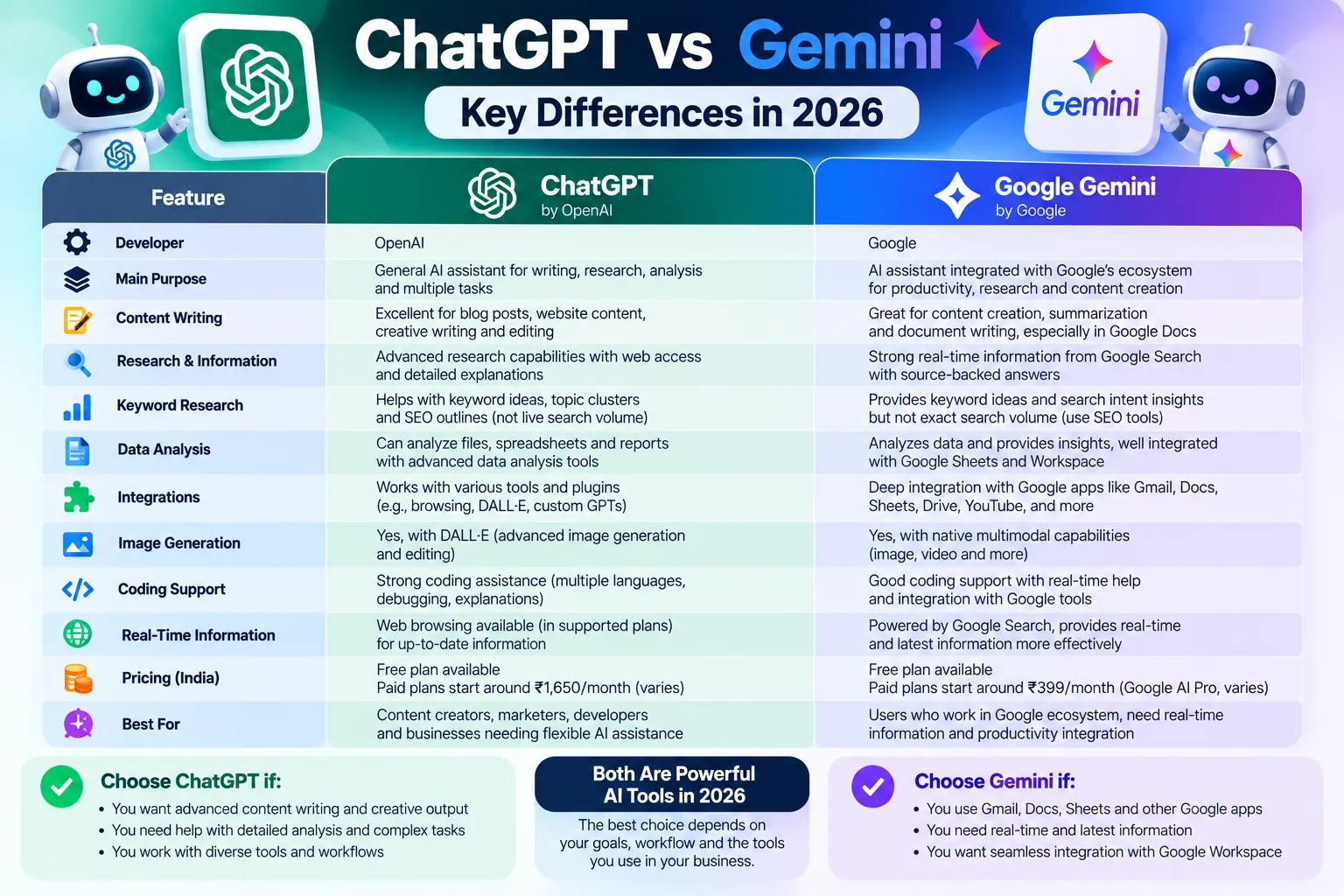
Key takeaway: Neither platform is universally better. ChatGPT may suit businesses seeking flexible task-oriented workflows, while Gemini may be a convenient choice for teams that spend much of their day in Google applications.
ChatGPT vs Gemini for SEO: Which Is Better?
Search engine optimization requires much more than generating content. Successful SEO involves keyword research, search intent analysis, technical optimization, content quality, internal linking, competitor research, and performance measurement.
Both ChatGPT and Gemini can assist with these activities, but neither replaces specialized SEO software or professional judgment.
How ChatGPT Helps With SEO
ChatGPT can support SEO workflows by helping marketers:
Generate keyword and topic ideas.
Group related keywords into content clusters.
Analyze likely informational and commercial search intent.
Create SEO-friendly article outlines.
Improve title tags and meta descriptions.
Review exported performance reports.
Develop internal linking recommendations.
Prepare content refresh checklists.
Example:
An SEO specialist working with a website development company could ask ChatGPT to organize topics around the keyword “website development cost in India.”
The assistant might suggest related articles covering WordPress development costs, ecommerce website pricing, custom website budgets, and maintenance expenses.
These ideas can then be validated using keyword tools and live search results.
How Gemini Helps With SEO
Gemini can support similar activities, including:
Brainstorming relevant topics.
Summarizing industry research.
Preparing content briefs.
Identifying possible content gaps.
Reviewing documents and marketing reports.
Organizing SEO recommendations.
Supporting collaboration through Google productivity tools.
Example:
A marketing team using Google Docs could use available Gemini features to help organize an SEO content brief, refine copy, or summarize research material within its existing document workflow.
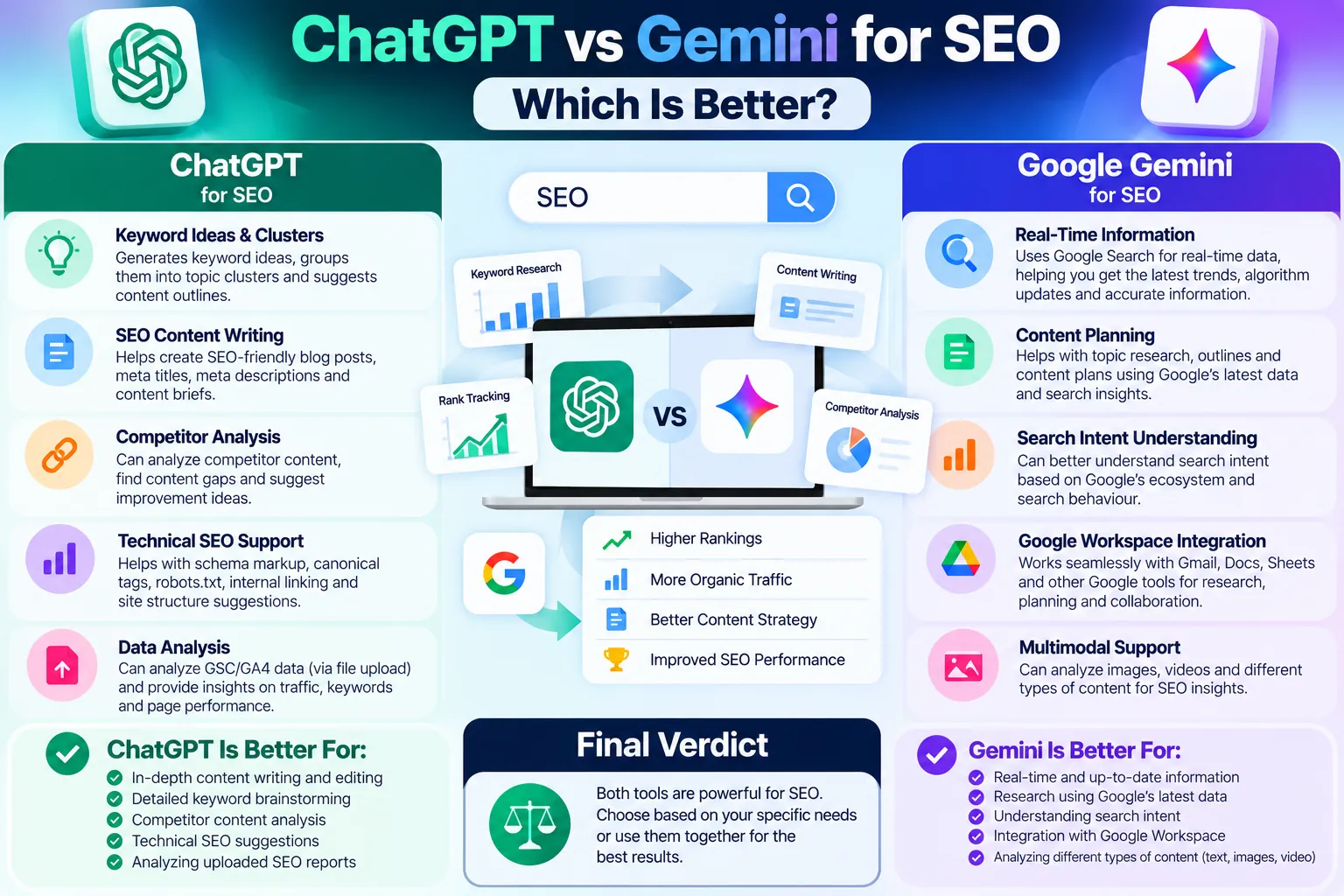
ChatGPT vs Gemini for SEO: Verdict
There is no reliable universal winner for SEO performance.
ChatGPT may be preferable for teams that want a flexible conversational workflow across writing, data analysis, and planning.
Gemini may be preferable when Google Workspace integration is a major productivity requirement.
For actual SEO performance, the quality of your research, implementation, website, and measurement matters more than which assistant produces the first draft.
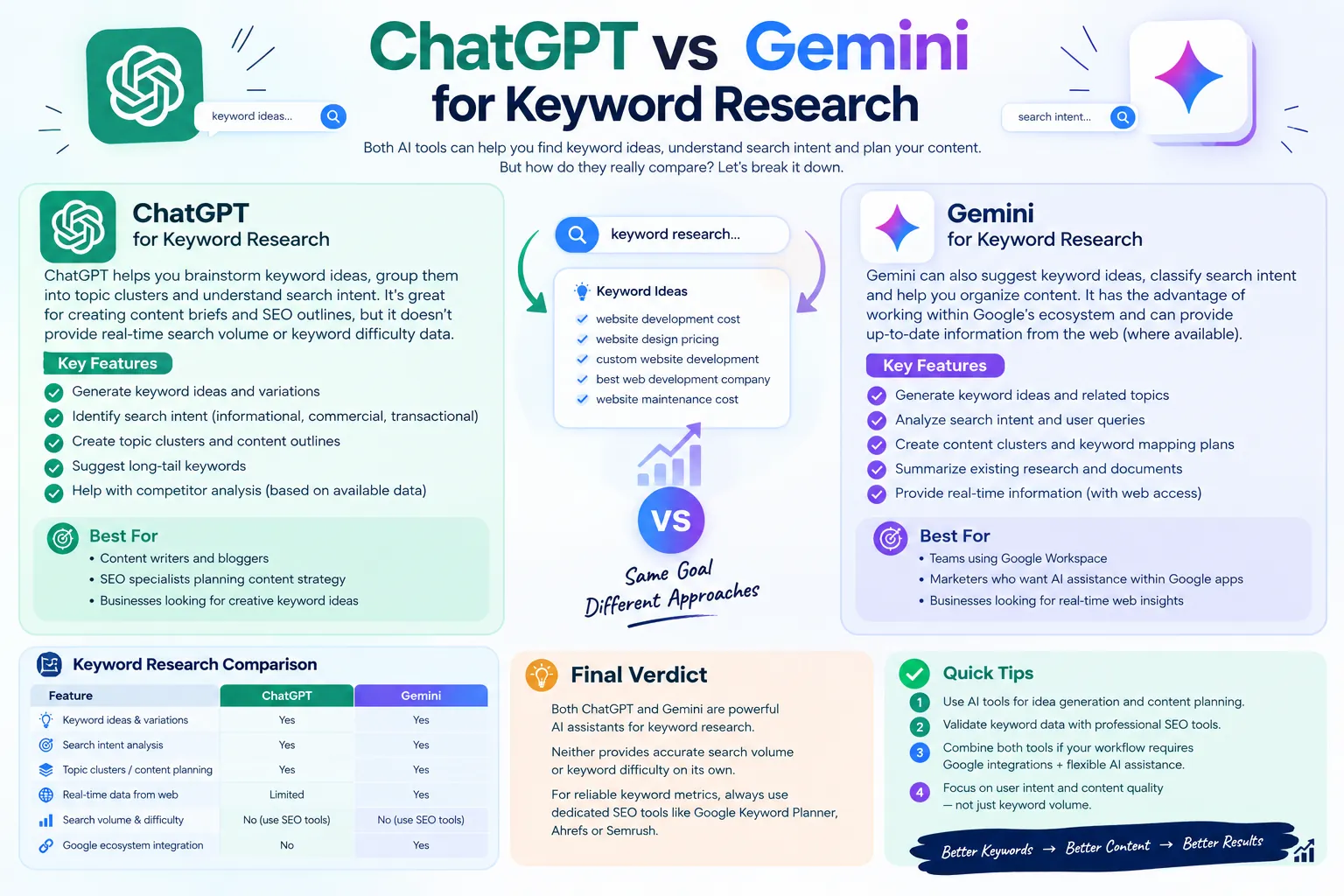
ChatGPT vs Gemini for Keyword Research
Keyword research is one of the most important elements of a successful SEO campaign.
Businesses need to understand what people search for, why they search for it, and whether a particular keyword can attract relevant customers.
ChatGPT for Keyword Research
ChatGPT can help identify keyword themes and organize them into practical categories.
For example, a digital marketing agency targeting Indian businesses might start with the topic “SEO services.”
ChatGPT could suggest keyword directions such as:
SEO services for small businesses
Local SEO services in India
Ecommerce SEO agency
Technical SEO audit services
SEO consultant vs agency
SEO services pricing in India
These are keyword ideas, not verified high-volume search terms.
A marketer should validate them before assigning priorities.
Gemini for Keyword Research
Gemini can also help generate keyword ideas, classify search intent, and structure content clusters.
For example, it can organize website development queries into informational, commercial, and transactional categories.
It may also help summarize existing research documents and prepare a keyword mapping plan.
For accurate keyword research, backlink analysis, and competitor insights, dedicated SEO tools are essential. Read our Ahrefs vs Semrush in 2026 comparison to discover which SEO platform best fits your business needs.
Which Tool Provides More Accurate Search Volume?
Neither ChatGPT nor Gemini should be relied upon to provide exact, independently verified monthly search volume from a conversational answer alone.
For reliable keyword metrics, marketers should use appropriate tools such as:
Google Keyword Planner
Google Search Console
Ahrefs Keywords Explorer
Semrush Keyword Magic Tool
Verdict: Both tools are useful for keyword brainstorming. Choose a dedicated SEO platform for verified keyword metrics.
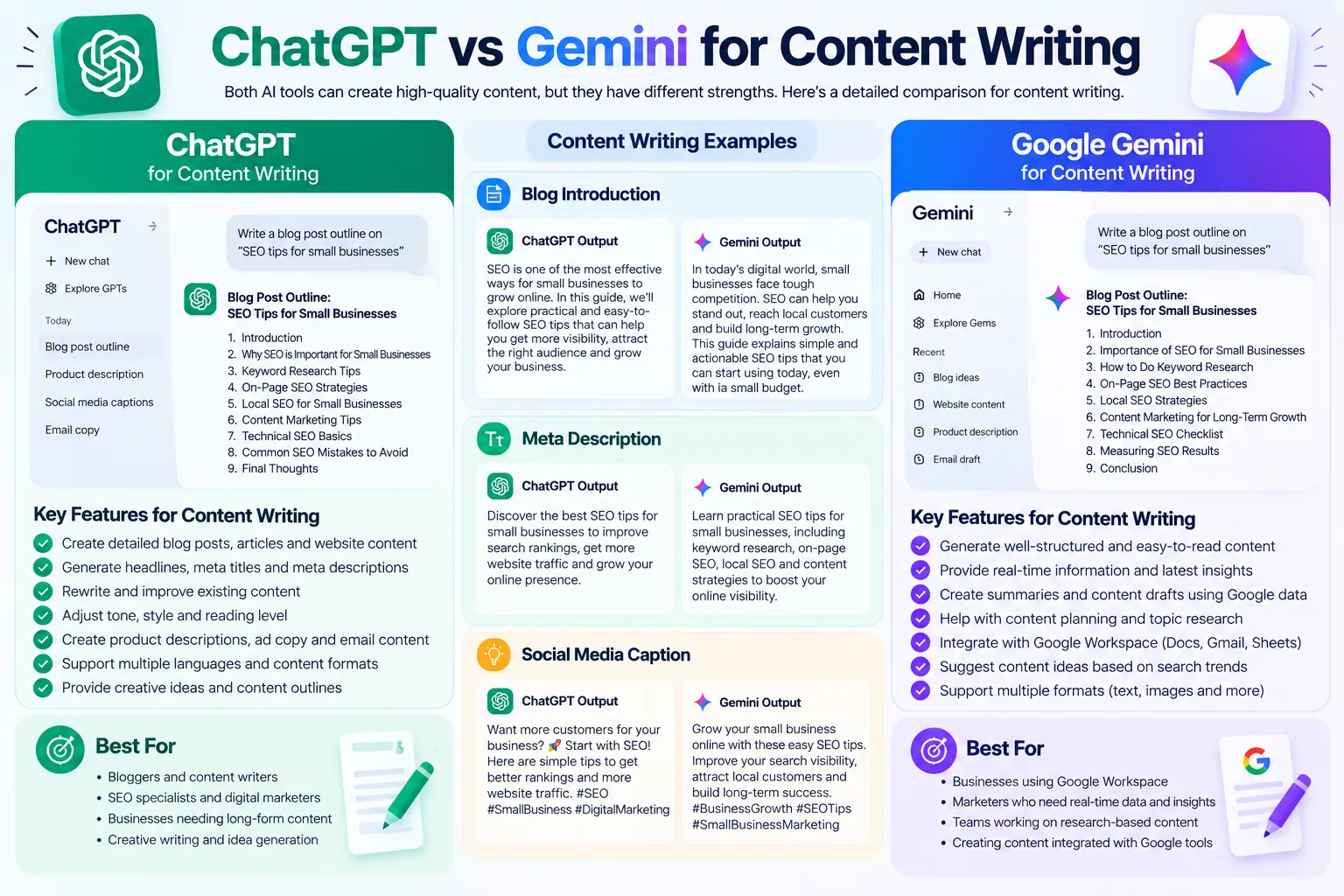
ChatGPT vs Gemini for Content Writing
Content writing is one of the most common uses of generative AI.
Both tools can help businesses produce first drafts, improve existing text, and plan content more efficiently.
However, creating content quickly does not automatically mean creating content that deserves to rank.
ChatGPT for Content Writing
ChatGPT can be used to develop structured blog posts, rewrite confusing paragraphs, create multiple headline variations, and adapt content for different audiences.
For example, an agency could use it to turn a detailed technical SEO report into a simple explanation for a small business owner.
Its conversational editing workflow can be useful when a writer needs multiple rounds of revisions.
Gemini for Content Writing
Gemini can help draft, summarize, and revise content, particularly within workflows connected to Google's productivity applications.
For teams preparing content in Google Docs, supported integrations may make editing and collaboration convenient.
Which Produces Better SEO Content?
The answer depends on the prompt, model, research quality, editorial process, and the writer's expertise.
Neither tool can guarantee original insight or strong search rankings.
A high-quality SEO article should include accurate information, meaningful examples, clear explanations, appropriate sources, and value that readers cannot easily get from generic summaries.
Verdict: Test both tools with the same content brief. Compare factual accuracy, editing effort, clarity, and how well the result serves your audience.
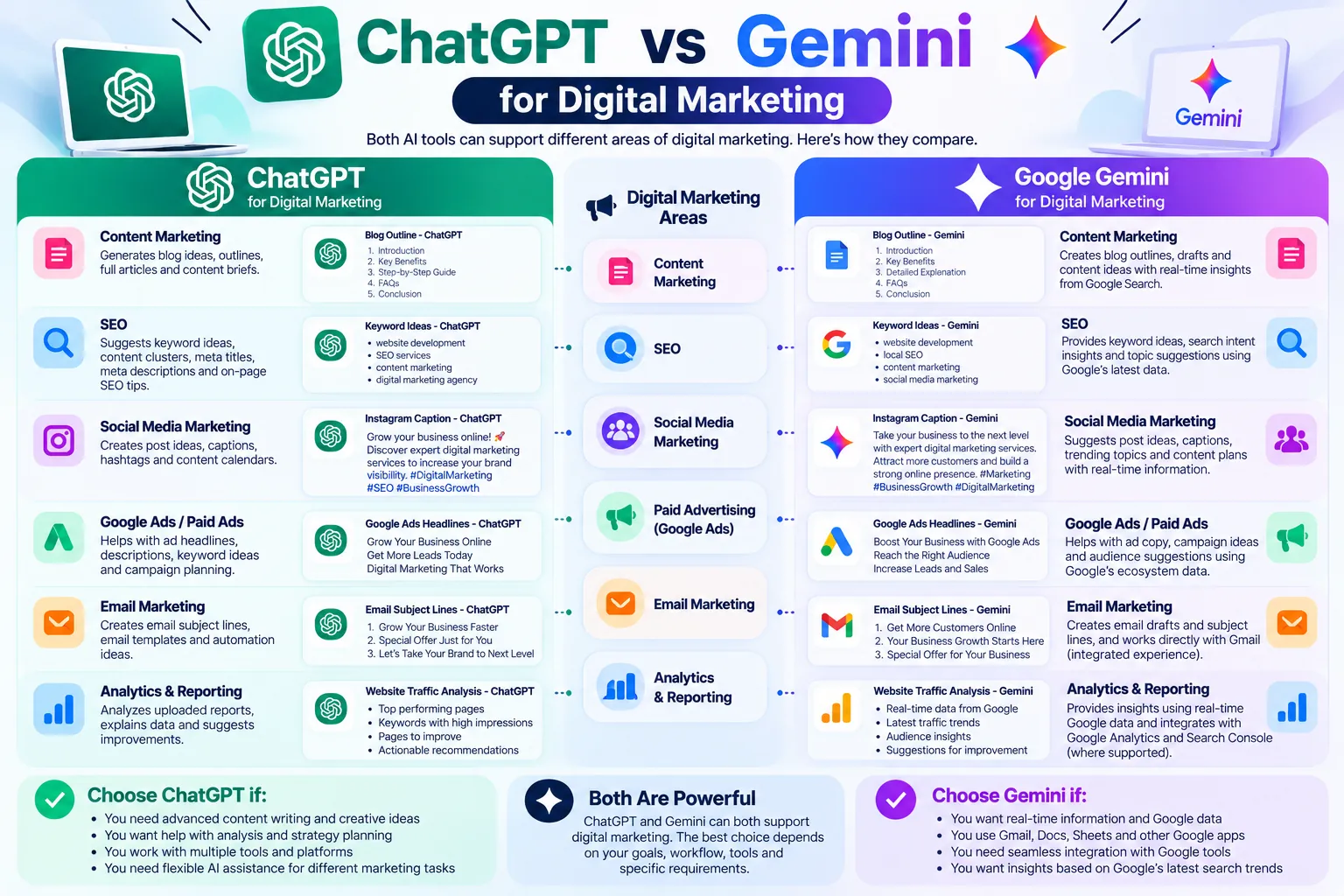
ChatGPT vs Gemini for Digital Marketing
Digital marketing includes SEO, paid advertising, social media, email marketing, analytics, and customer acquisition.
Both AI assistants can support these areas.
1. Social Media Marketing
ChatGPT can help generate social media calendars, captions, campaign concepts, and variations of promotional messaging.
Gemini can perform similar tasks and may fit naturally into workflows that use Google documents for content planning.
Neither tool should replace audience research or performance testing.
2. Google Ads Campaign Planning
Both assistants can help brainstorm ad headlines, descriptions, landing-page messages, and negative keyword ideas.
However, they cannot reliably determine campaign profitability without actual advertising data.
For example, an AI-generated recommendation to increase ad spending should be evaluated against conversion tracking, cost per lead, lead quality, and available budget.
3. Email Marketing
ChatGPT and Gemini can assist with subject lines, welcome emails, promotional sequences, and customer communication.
Marketers should test subject lines, maintain consistent brand messaging, and follow relevant email marketing regulations.
4. Competitor Analysis
Both tools can help build competitor research templates and summarize information provided by users.
A useful competitor analysis may include:
Website positioning
Service offerings
Content topics
Search visibility
Backlink opportunities
Advertising messages
Calls to action
Reliable conclusions require current competitor data, not AI-generated assumptions.
5. Marketing Analytics
ChatGPT can help interpret uploaded reports and explain performance trends.
Gemini can also assist with analytical tasks, particularly where supported Google application integrations are useful.
In both cases, businesses should verify calculations and maintain proper access controls for confidential data.
ChatGPT vs Gemini for Research and Accuracy
Accuracy is one of the most important considerations when selecting an AI assistant.
Both platforms can produce useful explanations, but both can also make mistakes.
Potential problems include incorrect statistics, outdated information, invented citations, and overconfident recommendations.
How to Improve Research Accuracy
A reliable research workflow should include several steps.
Step 1: Ask for source-backed information.
Request primary sources, official documentation, and clear publication dates.
Step 2: Verify important claims.
Check statistics, pricing, product features, and technical recommendations directly.
Step 3: Separate facts from suggestions.
A marketing idea generated by AI is not the same as a proven marketing result.
Step 4: Review industry-specific information.
Healthcare, finance, legal, and other sensitive subjects require additional expert review.
Step 5: Update content regularly.
AI products evolve rapidly, so comparisons written several months earlier may no longer reflect current capabilities.
Verdict: Neither platform should be considered automatically more accurate for every topic. Accuracy should be evaluated using specific tasks and verified references.
ChatGPT vs Gemini Pricing in 2026
Both ChatGPT and Gemini offer free and paid options.
Pricing and access can vary by country, subscription, promotional offer, and product changes.
ChatGPT Pricing
OpenAI offers a free tier alongside paid subscriptions for individuals and organizations.
Paid plans generally provide expanded access to models, tools, and usage limits.
The exact features available depend on the plan.
Official pricing: https://openai.com/chatgpt/pricing/
Gemini Pricing in India
Google lists several consumer AI subscription options in India, including:
| Google AI Plan | Listed Monthly Price |
|---|---|
| Free | ₹0 |
| Google AI Plus | ₹399 |
| Google AI Pro | ₹1,950 |
| Google AI Ultra | From ₹6,500 |
The listed prices and included features can change. Higher Ultra access tiers may cost more.
Official pricing: https://gemini.google/in/about/
Which AI Tool Offers Better Value?
The most affordable option is not necessarily the most valuable.
A business should evaluate:
Monthly subscription costs.
Usage limits.
Features needed by its team.
Integration with existing software.
Time saved on repetitive work.
Security and data-handling requirements.
Quality of results for actual business tasks.
For example, a team that works heavily in Gmail and Docs may value Gemini's integration, while an agency handling varied research and content workflows may prefer ChatGPT.
Pricing note: Verify all subscription prices on the official websites immediately before publishing or purchasing.
ChatGPT vs Gemini for Small Businesses
Small businesses often have limited time, marketing budgets, and internal resources.
AI assistants can help business owners prepare first drafts, organize ideas, and reduce repetitive work.
When ChatGPT May Be a Better Choice
ChatGPT may suit a small business that wants to:
Create website content and service descriptions.
Plan social media campaigns.
Analyze exported marketing reports.
Brainstorm advertising strategies.
Develop customer communication templates.
When Gemini May Be a Better Choice
Gemini may suit a business that wants to:
Work within Google Workspace.
Prepare documents and emails.
Summarize research.
Collaborate using familiar Google applications.
Combine AI assistance with existing productivity workflows.
Practical Recommendation
Start with a real business task rather than choosing based on popularity.
For example, ask both platforms to prepare a landing-page content outline for the same service.
Compare their outputs for relevance, accuracy, originality, and the amount of editing required.
ChatGPT vs Gemini for Digital Marketing Agencies
Digital marketing agencies manage multiple clients, campaigns, and reporting requirements.
Their choice of AI platform should depend on how effectively it supports these workflows.
ChatGPT for Agencies
ChatGPT can assist with content briefs, SEO planning, client reporting explanations, campaign messaging, and spreadsheet analysis.
It can also support standardized workflows when appropriate tools and account features are available.
Gemini for Agencies
Gemini can support research, content planning, documentation, and collaboration.
Agencies using Google Workspace extensively may find its supported integrations especially convenient.
Should Agencies Use Both?
Using both tools can make sense when they solve different problems.
For example, an agency might use one assistant to organize a content strategy and another to assist with document collaboration.
However, subscribing to both is unnecessary unless the additional capabilities provide measurable value.
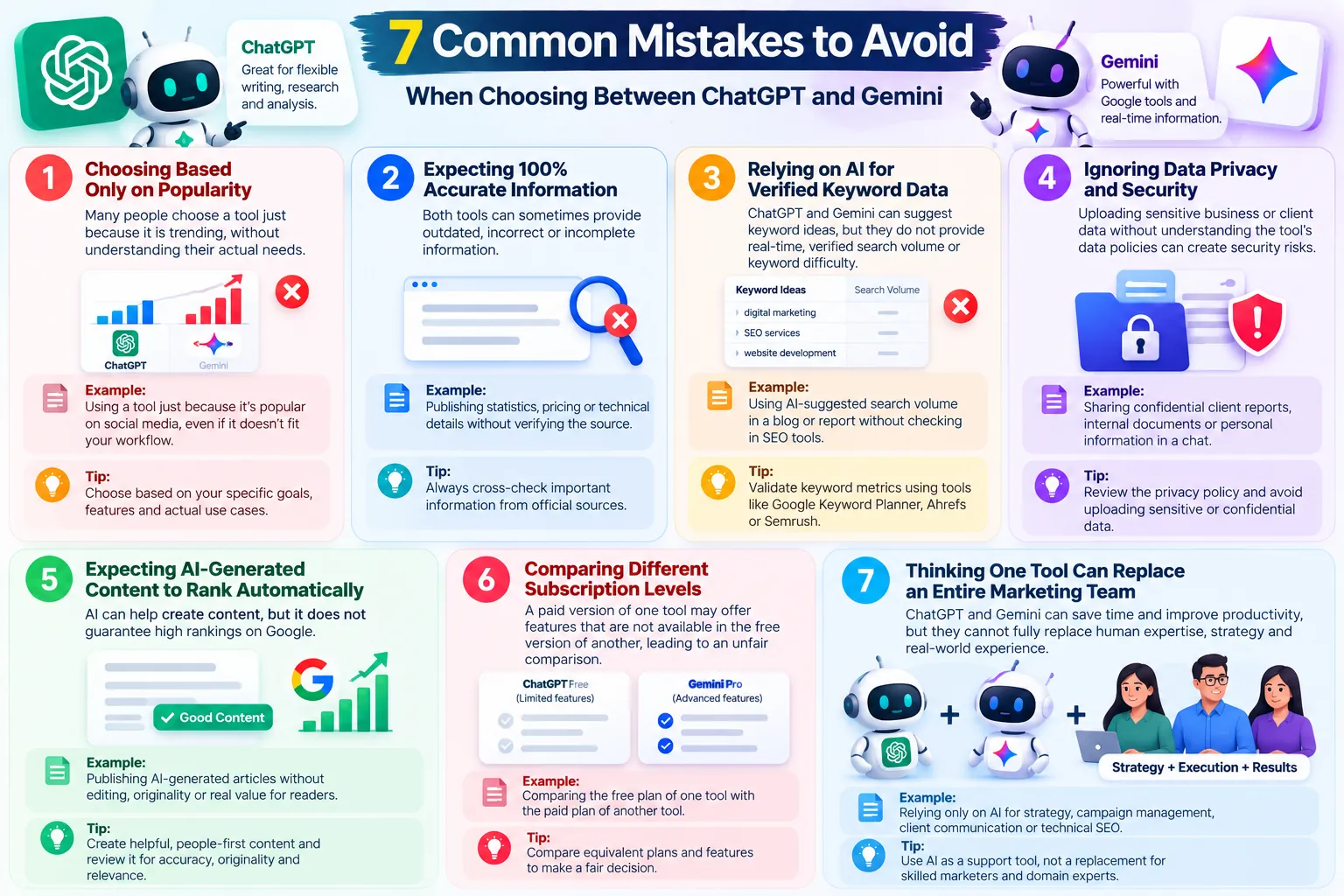
7 Common Mistakes to Avoid When Choosing Between ChatGPT and Gemini
1. Choosing Based Only on Popularity
A widely discussed AI tool is not automatically the best choice for every business.
Evaluate features against your actual requirements.
2. Assuming AI-Generated Content Will Rank Automatically
Search engines evaluate content usefulness and relevance. AI-generated text does not receive guaranteed ranking benefits.
Publishing large quantities of low-value content can also create SEO risks.
3. Trusting Unverified Keyword Metrics
Do not publish search volume, keyword difficulty, or competitor traffic estimates without reliable sources.
Use appropriate SEO research tools.
4. Ignoring Data Privacy
Avoid uploading confidential client information without checking organizational policies, permissions, and the platform's data controls.
5. Comparing Different Subscription Levels
A paid version of one tool may offer capabilities unavailable in the free version of another.
Compare equivalent plans wherever possible.
6. Publishing Content Without Human Editing
AI-assisted writing should be reviewed for accuracy, originality, tone, and usefulness.
Human expertise remains essential.
7. Expecting One AI Tool to Replace an Entire Marketing Team
AI assistants can improve productivity, but strategy, customer understanding, technical implementation, creative judgment, and performance measurement still require skilled people.
How to Choose Between ChatGPT and Gemini: A Practical Checklist
Before choosing an AI assistant, answer these questions.
| Question | What to Consider |
|---|---|
| What is your main goal? | Writing, research, analytics, collaboration, or automation |
| Which software do you use? | Google Workspace or a wider mix of tools |
| How important is content editing? | Revision flexibility and editorial workflow |
| Do you analyze marketing data? | Supported file formats and analytical capabilities |
| Do you need advanced research? | Sources, citations, depth, and verification |
| What is your budget? | Subscription price and usage limits |
| Will you upload client information? | Security, privacy, permissions, and governance |
| How will you measure value? | Time saved, accuracy, productivity, and quality |
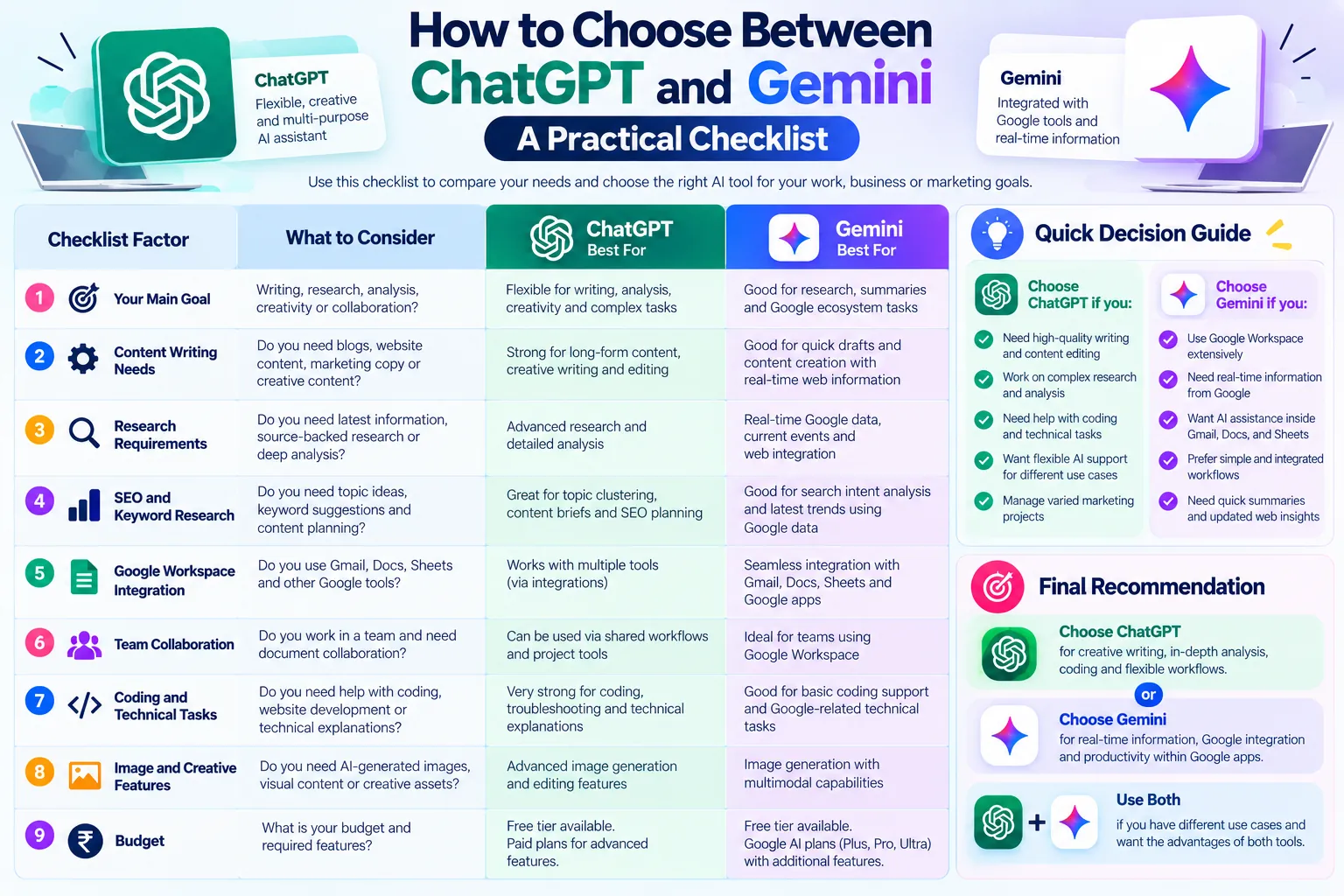
A simple evaluation method is to select three recurring tasks, test both platforms, and score each result.
For example, a marketing agency could compare:
Task A: Prepare an SEO content brief.
Task B: Analyze a sample monthly performance report.
Task C: Create a campaign plan for a local service business.
Record the time required, factual corrections, output quality, and ease of use.
This provides a more meaningful comparison than relying on promotional claims.
Can ChatGPT and Gemini Improve Google Rankings?
Both tools can contribute to an SEO workflow, but neither directly guarantees improved rankings.
Google's published guidance emphasizes creating helpful, reliable, people-first content.
AI can assist with research and structure, but producing large quantities of content without meaningful value can violate Google's spam policies.
To improve search performance, businesses should focus on:
Understanding search intent.
Publishing accurate, original content.
Demonstrating relevant expertise.
Maintaining technically accessible websites.
Improving user experience.
Using relevant internal links.
Monitoring search performance.
Updating content when information changes.
In 2026, businesses should also consider how their content serves users across traditional search and AI-powered discovery experiences.
However, AI visibility is not a substitute for business outcomes such as qualified inquiries, purchases, or conversions.
ChatGPT vs Gemini in 2026: Final Verdict
So, which is better: ChatGPT or Gemini?
The answer depends on your workflow.
Choose ChatGPT if you prioritize flexible writing, research, document analysis, marketing planning, and conversational task workflows.
Choose Gemini if your team relies heavily on Google Workspace and wants AI assistance integrated with familiar productivity applications.
Consider both if your organization has distinct use cases that justify the additional cost.
For SEO and digital marketing, neither assistant replaces Google Search Console, Google Analytics, keyword research platforms, or experienced marketers.
The strongest approach combines AI-assisted productivity with verified data, human expertise, and a clear business strategy.
Ultimately, the best AI tool is the one that helps your team produce more accurate, useful work and achieve measurable business outcomes.
Need Help Growing Your Business With SEO and AI-Powered Digital Marketing?
AI tools can support content creation and research, but turning website visitors into paying customers requires a complete digital marketing strategy.
At Nivya Digital, we help businesses develop practical digital growth strategies through SEO, content marketing, Google Ads, social media marketing, and website development.
Whether you want to improve organic visibility, generate qualified leads, or strengthen your online presence, the right combination of technology and marketing expertise can make a difference.
Explore our digital marketing services or contact Nivya Digital to discuss your business growth goals.
Website: https://nivyadigital.com/
References and Further Reading
OpenAI — ChatGPT Official Website: https://chatgpt.com/
OpenAI — ChatGPT Pricing: https://openai.com/chatgpt/pricing/
Google — Gemini Official Website: https://gemini.google.com/
Google — Gemini Plans in India: https://gemini.google/in/about/
Google Search Central — Guidance on Generative AI Content: https://developers.google.com/search/docs/fundamentals/using-gen-ai-content
Google Search Central — AI Optimization Guide: https://developers.google.com/search/docs/fundamentals/ai-optimization-guide
Google Search Central — Creating Helpful, Reliable, People-First Content: https://developers.google.com/search/docs/fundamentals/creating-helpful-content
Editorial Note: This comparison is based on publicly documented product capabilities and practical marketing use cases. It is not a controlled head-to-head benchmark. Features, model access, and subscription prices may change. Any claims about relative writing quality, accuracy, or SEO effectiveness should be validated through independent testing before being presented as measured
Comments (1)
An insightful comparison of ChatGPT and Gemini for SEO, content writing, and digital marketing in 2026. It explores how both AI tools can support keyword research, content creation, competitor analysis, marketing workflows, and campaign planning. A useful resource for marketers, bloggers, and business owners looking to choose the right AI tools, improve productivity, and build more effective digital marketing strategies.