
Writing SEO-friendly content in 2026 isn't about repeating the same keyword until search engines notice it. It's about understanding what your audience is searching for and creating content that answers their questions naturally.
Still, many bloggers, website owners, and content marketers face a familiar question: How many times should I use my target keyword in an article?
Use it too little, and you might worry that your topic isn't clear. Repeat it too often, and your writing can become awkward, repetitive, and frustrating to read.
That's where keyword density analysis can help.
A keyword density checker allows you to measure how frequently a particular word or phrase appears in your content. But the percentage alone doesn't tell you whether your article is optimized for Google.
In this practical guide, you'll learn how to check keyword density, calculate it manually, identify keyword stuffing, use tools such as the Zuhio Keyword Count Checker, and improve your content without sacrificing readability.
What Is Keyword Density in SEO?
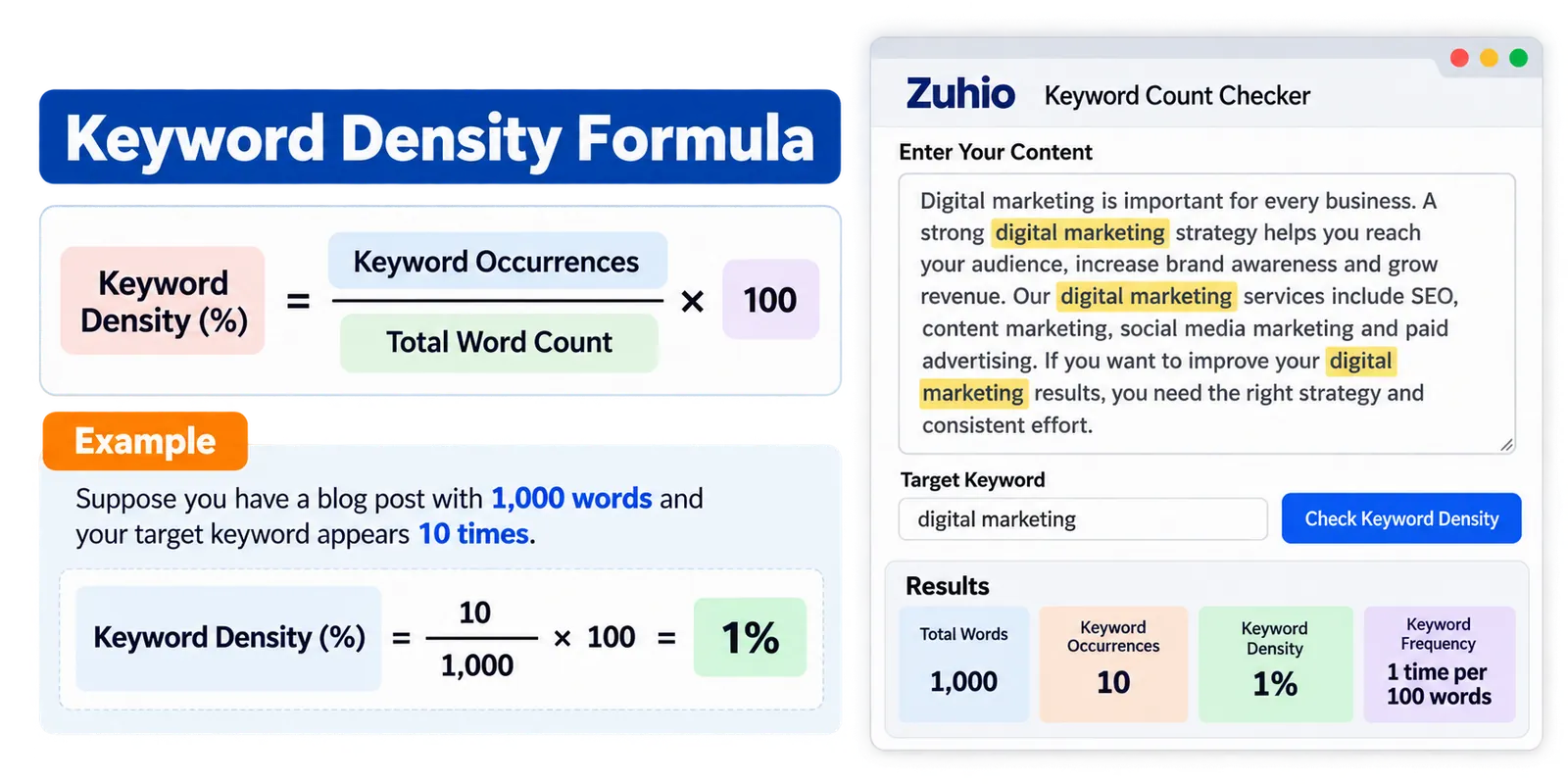
Keyword density is the percentage of times a target keyword appears in a piece of content relative to its total word count.
For example, imagine you've written a 1,000-word blog about email marketing.
If the phrase "email marketing" appears 10 times, a simple occurrence-based calculation would report a keyword density of 1%.
However, different tools may calculate multi-word keyword density differently. Some count phrase occurrences, while others account for the number of words within each phrase.
This means two keyword density tools can sometimes display different percentages for the same article.
Why Do SEO Writers Check Keyword Density?
Keyword density analysis can help writers identify potential content issues before publishing.
It can reveal whether a target phrase has been repeated unnecessarily, whether important terminology is missing, or whether a paragraph sounds overly optimized.
For example, a blog targeting "small business SEO services" might naturally use that phrase in its introduction and a relevant section heading.
But if every paragraph repeats "small business SEO services," the content may start sounding promotional rather than helpful.
The purpose of checking keyword density is to support better editing—not to achieve a particular number.
How to Calculate Keyword Density: Formula and Example
You don't need expensive SEO software to calculate basic keyword density.
The commonly used occurrence-based formula is:
Keyword Density (%) = (Keyword Occurrences ÷ Total Word Count) × 100
Let's look at a practical example.
Suppose you publish an article containing 1,200 words, and your target phrase appears 12 times.
Keyword density = (12 ÷ 1,200) × 100
Result: 1%
Here's another example showing how the calculation changes with frequency:
| Total Words | Keyword Occurrences | Density |
|---|---|---|
| 500 | 5 | 1% |
| 800 | 12 | 1.5% |
| 1,000 | 20 | 2% |
| 1,500 | 15 | 1% |
| 2,000 | 30 | 1.5% |
These figures demonstrate the calculation. They are not recommended SEO targets.
Does Google Recommend a Specific Keyword Density?
No.
Google has explicitly stated that it does not have an optimal keyword density requirement.
That means there is no official Google rule requiring a 1%, 2%, or 3% keyword density.
Search engines are increasingly capable of understanding page topics through context, language, and related information.
Your goal should be to communicate the subject clearly and satisfy the user's search intent.
If your article explains a topic thoroughly using natural language, you don't need to add keywords simply to increase a percentage.
How to Check Keyword Density Step by Step
Checking keyword density is straightforward when you follow a structured process.
Step 1: Identify Your Primary Keyword
Start by selecting one primary search topic that accurately represents your article.
For example:
Primary keyword: how to check keyword density
Your article may also naturally discuss related terms such as keyword frequency, SEO writing, content optimization, and keyword stuffing.
These terms help explain the topic from different perspectives.
Avoid treating every related phrase as a keyword that must appear a fixed number of times.
Step 2: Complete Your First Draft
Write your article for the reader before focusing on keyword frequency.
Answer the main question early, explain important concepts, and provide examples where they improve understanding.
Use headings to organize information logically.
Your first draft should prioritize clarity, usefulness, and accuracy.
Step 3: Use a Keyword Density Checker
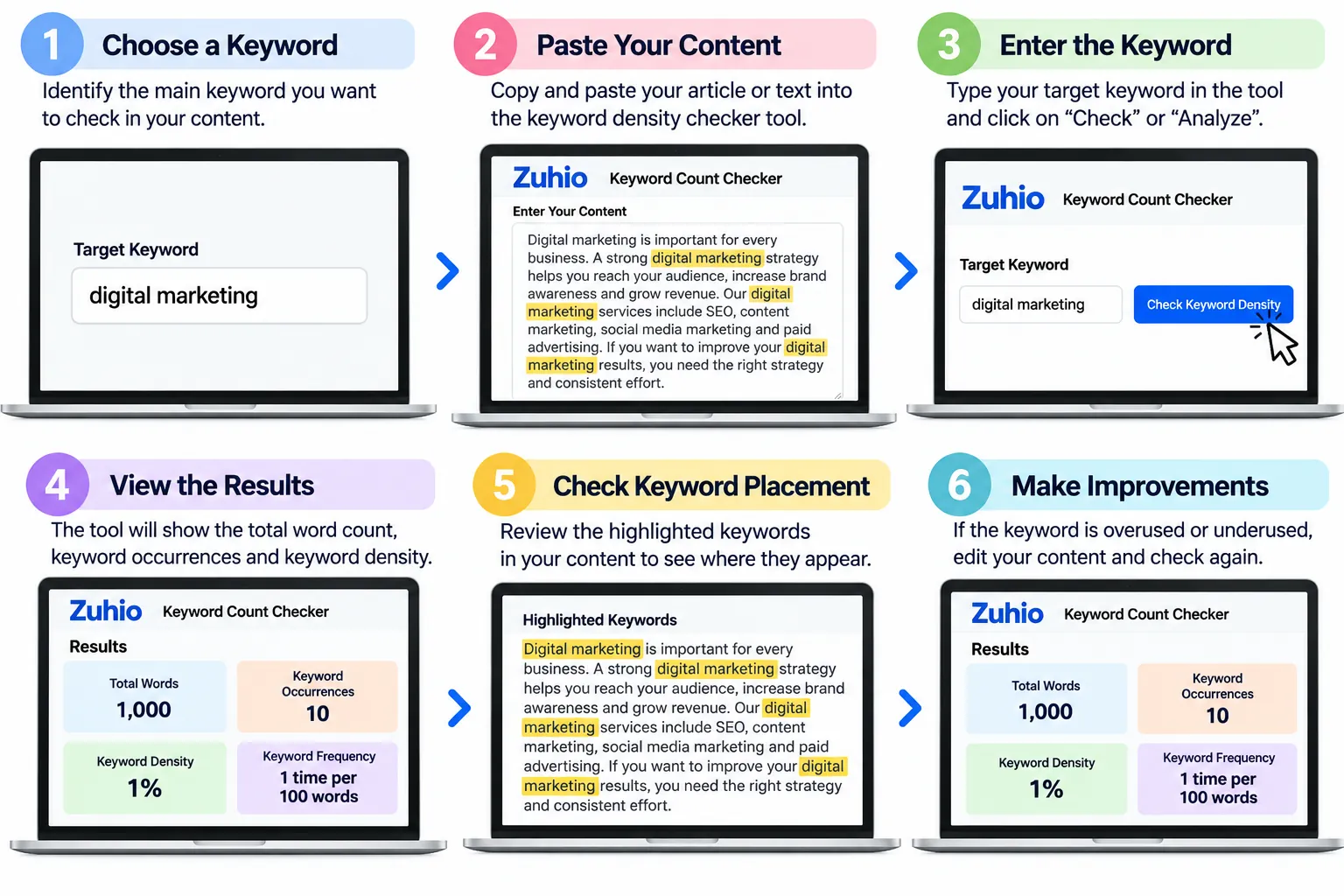
After completing your draft, use a keyword checker to review how frequently your primary phrase appears.
Depending on the tool, you may be able to paste your article, enter a target keyword, and review the number of occurrences and a calculated percentage.
A checker can save time compared with manually searching through a long document.
Step 4: Review Repeated Phrases in Context
Don't judge the article based on its density percentage alone.
Read the paragraphs where your target phrase appears.
Ask yourself:
Does the keyword fit naturally into the sentence?
Is the phrase repeated unnecessarily?
Would a simpler expression improve readability?
Does the content answer the reader's question?
Are important concepts explained without forced wording?
If a phrase feels repetitive, rewrite the sentence rather than replacing it mechanically with another keyword variation.
Step 5: Edit and Check Again
Once you've improved the content, run another check if necessary.
Compare the results with the actual writing.
A lower density percentage isn't automatically better, just as a higher percentage isn't automatically harmful.
The final decision should be based on clarity, relevance, and the quality of the reader's experience.
How to Use Zuhio Keyword Count Checker for Content Optimization
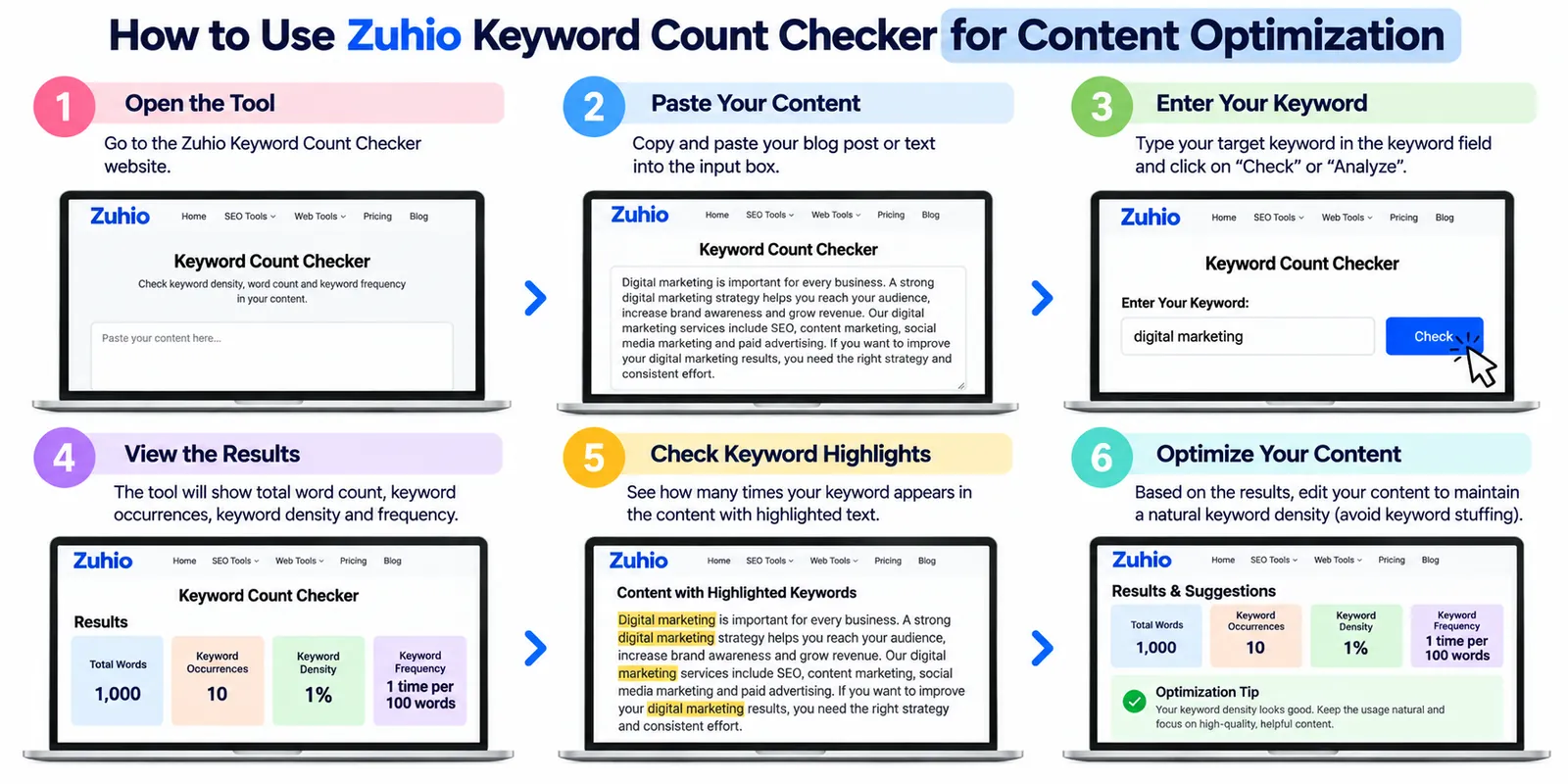
The Zuhio Keyword Count Checker is one example of a lightweight keyword-counting tool discussed in SEO writing guides.
Published descriptions indicate that it can help users check the frequency of target keywords within pasted content.
Because tool interfaces and calculation methods can change, verify the current functionality before relying on a particular feature.
A Practical Zuhio Keyword Checking Workflow
- Prepare your content.
Complete your article in WordPress, Google Docs, or your preferred writing platform.
- Identify important keywords.
Choose the primary phrase and a small number of relevant secondary terms.
- Open the keyword checker.
Review the available input fields and instructions.
- Paste the content and enter your keywords.
Follow the tool's current input requirements.
- Review the results.
Check which phrases appear, how often they're used, and whether the results reveal unnecessary repetition.
- Make editorial improvements.
Return to your article and revise sentences that sound unnatural.
What a Keyword Counter Cannot Tell You
A keyword count checker cannot reliably determine whether your article deserves to rank on Google.
It does not replace:
Search intent analysis
Competitor content research
Technical SEO auditing
Original research and expertise
Internal linking
Content quality assessment
Conversion optimization
Treat keyword counting as one small part of a broader content optimization workflow.
What Is Keyword Stuffing?
Keyword stuffing is the excessive or unnatural repetition of keywords in an attempt to influence search engine rankings.
It can appear in body paragraphs, headings, titles, image alt text, or other page elements.
Example of Keyword Stuffing
Consider this sentence:
"If you need SEO services, our SEO services provide the best SEO services for businesses looking for affordable SEO services."
The phrase "SEO services" appears repeatedly without adding useful information.
The sentence is difficult to read and provides little value.
A More Natural Version
"Our SEO team helps businesses improve search visibility through technical improvements, content optimization, and practical keyword research."
The revised sentence communicates the service more clearly.
It also gives readers useful information about what the business offers.
The lesson is simple: write to communicate, not to fill a keyword quota.
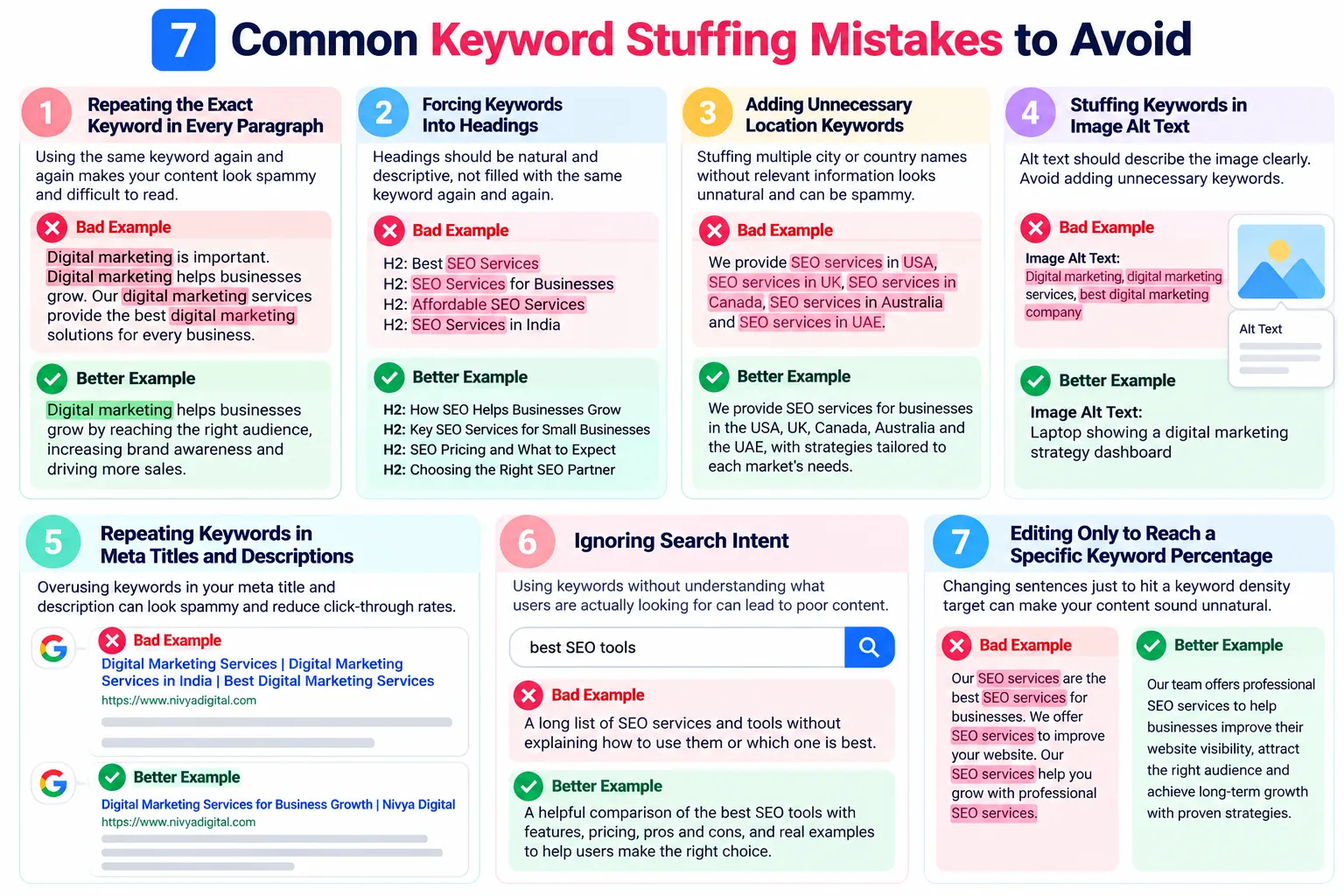
7 Common Keyword Stuffing Mistakes to Avoid
1. Repeating the Exact Keyword in Every Paragraph
A keyword doesn't need to appear in every paragraph for readers or search engines to understand the subject.
Use it where it adds clarity.
2. Forcing Keywords Into Headings
Headings should describe what each section explains.
Instead of repeatedly using "best SEO tools" in every H2, write headings that address distinct questions.
3. Adding Unnecessary Location Keywords
Businesses targeting multiple countries sometimes repeat city and country names in unnatural lists.
For example, adding "SEO services USA, SEO services UK, SEO services Canada" repeatedly without meaningful location-specific information does not create a useful international SEO strategy.
4. Stuffing Keywords Into Image Alt Text
Image alt text should describe the image accurately.
If an image shows a keyword analysis dashboard, a useful description might be:
"Keyword analysis dashboard displaying phrase frequency and word count."
Avoid inserting unrelated service keywords into the description.
5. Repeating Keywords in Meta Titles
Your SEO title should accurately summarize the page.
A title overloaded with variations of the same phrase can appear spammy and discourage clicks.
6. Ignoring Search Intent
A page can have a carefully calculated keyword density and still fail to answer what visitors want to know.
For example, someone searching "how to check keyword density" expects instructions, examples, and useful tools—not just a lengthy sales pitch.
7. Editing Only to Reach a Percentage
Removing useful explanations or adding repetitive sentences simply to reach a target density can make your content worse.
Use keyword frequency as a diagnostic measurement rather than a writing rule.
What Is a Good Keyword Density for SEO in 2026?
There is no universal ideal percentage.
You may encounter recommendations suggesting a density of 1–2%, but those are not official Google requirements and should not be treated as ranking targets.
A helpful article might use its primary keyword several times because the topic naturally requires it.
Another article might use the exact phrase less frequently while explaining the subject through clear terminology and related concepts.
Both approaches can be appropriate.
What Matters More Than Keyword Density?
Focus on the following:
Search intent: Does your page answer the question the user searched for?
Content quality: Is the information accurate, complete, and useful?
Originality: Does the article contribute examples, explanations, or insights beyond competing pages?
Readability: Can visitors understand the content without struggling through repetitive language?
Structure: Do your headings help readers navigate the page?
Website experience: Is the page accessible, mobile-friendly, and easy to use?
Trustworthiness: Are important claims supported by reliable sources?
These considerations are more meaningful than trying to achieve a fixed keyword density score.
Keyword Density vs Keyword Frequency: What's the Difference?
Although the terms are related, they measure different things.
| Factor | Keyword Frequency | Keyword Density |
|---|---|---|
| Meaning | Number of times a keyword appears | Percentage relative to total words |
| Measurement | Count | Percentage |
| Example | 10 occurrences | 1% under an occurrence-based formula in 1,000 words |
| Main use | Identifying repetition | Comparing repetition relative to content length |
| Ranking guarantee | No | No |
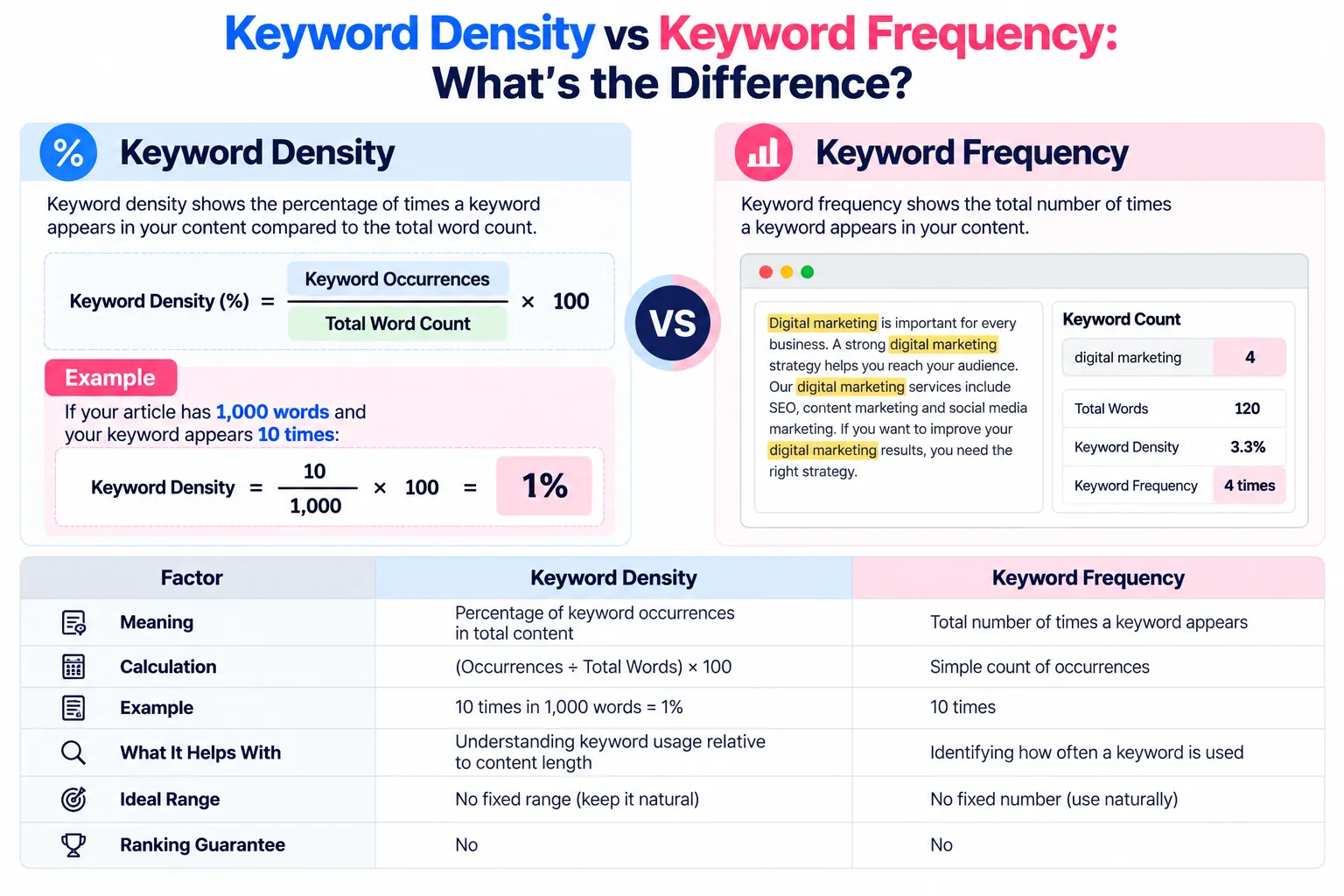
Keyword frequency tells you how many times a phrase appears.
Keyword density adds the context of article length.
Neither metric independently measures content quality or guarantees search visibility.
How to Optimize Keywords Naturally for International SEO
If your website targets readers in the United States, United Kingdom, Canada, Australia, India, or other English-speaking markets, natural language becomes particularly important.
Different audiences may use different expressions for similar concepts.
For example, businesses might search for "SEO services," "search engine optimization services," or "SEO agency."
Rather than forcing every variation into one paragraph, use terminology where it helps explain the subject.
Understand Your International Audience
Research what people in each target market are trying to accomplish.
A small business owner may want a simple explanation of keyword density.
An experienced content marketer may want information about phrase matching, tool accuracy, or editorial workflows.
Create content that serves the intended audience rather than attempting to target every possible search query.
Avoid Duplicate Country-Specific Content
Don't publish nearly identical articles for different countries simply by changing the location name.
Create regional content only when you have genuinely relevant information for that market.
For a general educational article like this one, a single comprehensive English-language page can serve readers in multiple countries.
Use Clear, Globally Understandable English
Prefer direct explanations, practical examples, and familiar terminology.
Avoid unnecessary jargon or references that only make sense to a small local audience.
This makes the article more accessible to international readers.
A Practical Keyword Optimization Example
Imagine you're editing a blog titled:
"How to Improve Website SEO for Small Businesses"
The first draft contains 1,000 words and repeats the exact phrase "website SEO for small businesses" 18 times.
A simple occurrence-based calculation reports 1.8% density.
However, several paragraphs repeat the phrase unnecessarily.
Before Optimization
"Website SEO for small businesses is important because website SEO for small businesses helps companies improve website SEO for small businesses and attract customers."
After Optimization
"Search engine optimization helps small businesses improve their online visibility and connect with customers searching for relevant products or services."
The revised version explains the benefit more clearly.
You can still use the primary phrase in the title, introduction, and relevant sections where it fits naturally.
The objective isn't to reduce the density to a particular number.
It's to make every sentence useful.
SEO Content Checklist Before Publishing
Before publishing your next blog, review these important questions:
Does the article answer the main search query?
Is the primary topic clear from the title and introduction?
Are the headings descriptive and logically organized?
Have unnecessary keyword repetitions been removed?
Are related concepts explained naturally?
Does the article include useful examples or original insights?
Are important factual claims accurate?
Have relevant internal links been included?
Are images optimized and described appropriately?
Does the content provide a satisfying experience for readers?
A keyword density checker can support this review, but human editorial judgment remains essential.
How Nivya Digital Helps Businesses Create Better SEO Content
Creating search-friendly content requires more than identifying keywords and calculating percentages.
Businesses also need to understand their audience, organize website content, address technical SEO issues, and measure performance over time.
Nivya Digital offers digital marketing services including SEO, content marketing, website development, and related solutions for businesses seeking to strengthen their online presence.
Whether your business serves a local market or wants to reach international customers, a thoughtful content strategy can help connect relevant search queries with useful information.
The goal is not simply to publish more articles.
It's to create content that supports your audience, reflects your expertise, and contributes to your wider business objectives.
Want to improve your website's SEO and content strategy?
Explore the services available at Nivya Digital and discuss your website's optimization needs.
Final Thoughts
Keyword density is a useful measurement, but it should never become the main goal of SEO writing.
In 2026, creating effective content means understanding your audience, answering their questions clearly, and using keywords only where they make sense.
Tools such as the Zuhio Keyword Count Checker can help identify repetition, but they cannot replace strong writing, original insights, or a well-planned SEO strategy.
Instead of asking, "How many times should I repeat this keyword?" ask a more useful question:
"Does this article give readers the information they came here to find?"
When you focus on clarity, relevance, and genuine value, keyword optimization becomes a natural part of creating better content.
Build a stronger content strategy with Nivya Digital.
Comments (1)
A practical guide to checking keyword density without keyword stuffing. It explains how to maintain natural keyword usage, improve content readability, and follow SEO best practices to create helpful, search-friendly content in 2026.