
SEO content optimization has changed significantly over the years. Earlier, marketers often focused heavily on how many times a keyword appeared on a page. Today, search engines are much better at understanding context, relevance, search intent, and the overall meaning of content.
Still, checking keyword usage remains useful. Content writers and SEO professionals need to know whether important terms have been included naturally or repeated too many times. Two approaches commonly discussed are using a Keyword Density Checker and a Zuhio Keyword Count Checker.
But what is the difference between them? Does keyword density still matter? And which approach is more useful for SEO in 2026?
In this guide, we compare Keyword Density Checker vs Zuhio Keyword Count Checker, explain how each works, and help you understand how keyword analysis should fit into a modern SEO strategy.
What Is a Keyword Density Checker?
A Keyword Density Checker is a tool designed to calculate how frequently a particular keyword or phrase appears within a piece of content relative to its total word count.
Keyword density is generally calculated using the following formula:
Keyword Density = (Number of Keyword Uses ÷ Total Number of Words) × 100
For example, if an article contains 1,000 words and a keyword appears 10 times, its keyword density is:
(10 ÷ 1,000) × 100 = 1%
A Keyword Density Checker automates this calculation and may provide information about frequently used words, phrases, and their percentage within the content.
This makes it easier for writers to identify potential overuse of keywords and review whether their content sounds natural.
What Is Zuhio Keyword Count Checker?
Zuhio Keyword Count Checker is associated with checking how often specified keywords are used within content.
Instead of focusing only on the percentage of a keyword compared with the entire article, keyword-count analysis can help writers determine whether required terms have been included the expected number of times.
This can be particularly useful when working from an SEO content brief containing multiple keywords.
For example, imagine a brief recommends using:
Primary keyword – 8 times
Secondary keyword – 5 times
Supporting keyword – 3 times
Manually checking each keyword across a long article can be time-consuming. A keyword count checker can make this review process easier by showing keyword occurrences more clearly.
The important point is that keyword counts should be treated as guidance rather than strict ranking requirements.
Keyword Density Checker vs Zuhio Keyword Count Checker
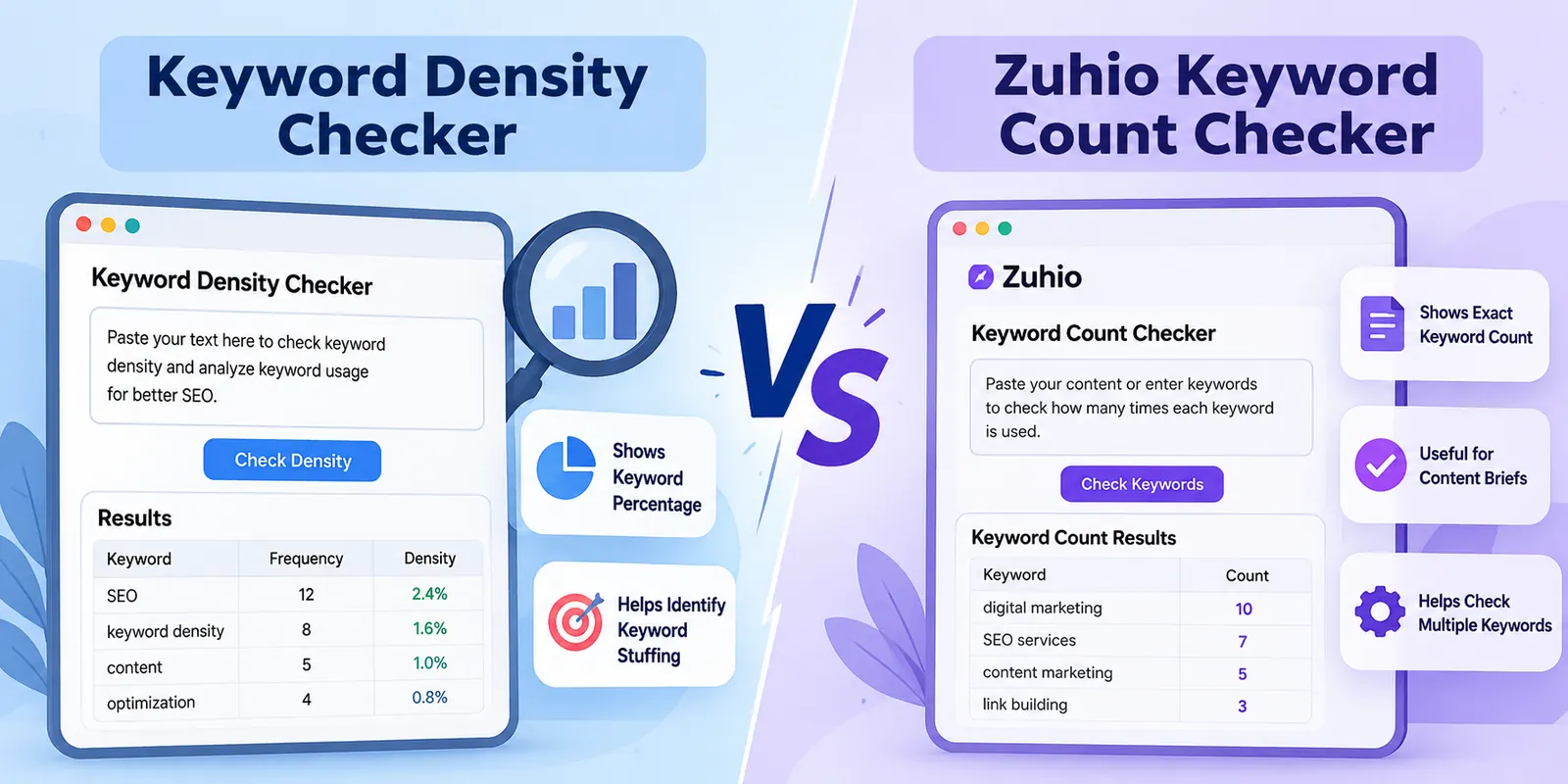
Although both approaches analyze keywords, they answer slightly different questions.
| Feature | Keyword Density Checker | Zuhio Keyword Count Checker |
|---|---|---|
| Main Purpose | Measures keyword usage as a percentage | Checks keyword occurrence/count |
| Output | Density percentage | Number of keyword uses |
| Useful For | Spotting overuse | Reviewing keyword requirements |
| Content Analysis | Percentage-focused | Count-focused |
| Best Use | General SEO content review | Content brief verification |
| Helps Identify Repetition | Yes | Yes |
| Should Determine Rankings? | No | No |
Neither measurement should become the main goal of content optimization.
Why Keyword Analysis Still Matters in 2026
Modern SEO is no longer about repeating an exact-match keyword as many times as possible.
However, keyword analysis still has practical value.
1. Helps Identify Keyword Stuffing
Repeating the same phrase unnaturally can make content difficult to read.
For example:
“Use our Keyword Density Checker because this Keyword Density Checker is the best Keyword Density Checker for checking keyword density.”
The phrase is technically relevant, but the sentence sounds forced.
A keyword analysis tool can highlight excessive repetition so the content can be rewritten naturally.
2. Helps Check Important Keyword Coverage
Sometimes writers have the opposite problem.
They create a detailed article but barely mention the primary topic using terminology users actually search for.
Checking keyword usage can help ensure that important phrases and related concepts have not been accidentally missed.
3. Makes Content Briefs Easier to Follow
SEO teams frequently provide writers with a list of primary, secondary, and supporting keywords.
Checking each one manually in a 2,000-word article can take time.
A keyword count tool can speed up the final content review process.
4. Improves Content Quality Control
Keyword analysis can become one part of a pre-publishing SEO checklist.
Before publishing, teams can review keyword usage alongside headings, internal links, metadata, search intent, readability, and factual accuracy.

Is There an Ideal Keyword Density for SEO?
A common question among beginners is:
“What should my keyword density be?”
There is no universal percentage that guarantees better rankings.
You may encounter recommendations suggesting 1%, 2%, or another specific number. However, SEO should not be approached as though reaching a particular keyword-density percentage automatically improves rankings.
Instead, ask:
Does the keyword appear naturally?
Is the topic clear?
Does the article answer the searcher's question?
Are relevant subtopics covered?
Does the content avoid unnecessary repetition?
These questions are much more useful than trying to achieve an arbitrary percentage.
Keyword Count vs Keyword Density: Which Matters More?
Neither should be treated as a direct ranking target.
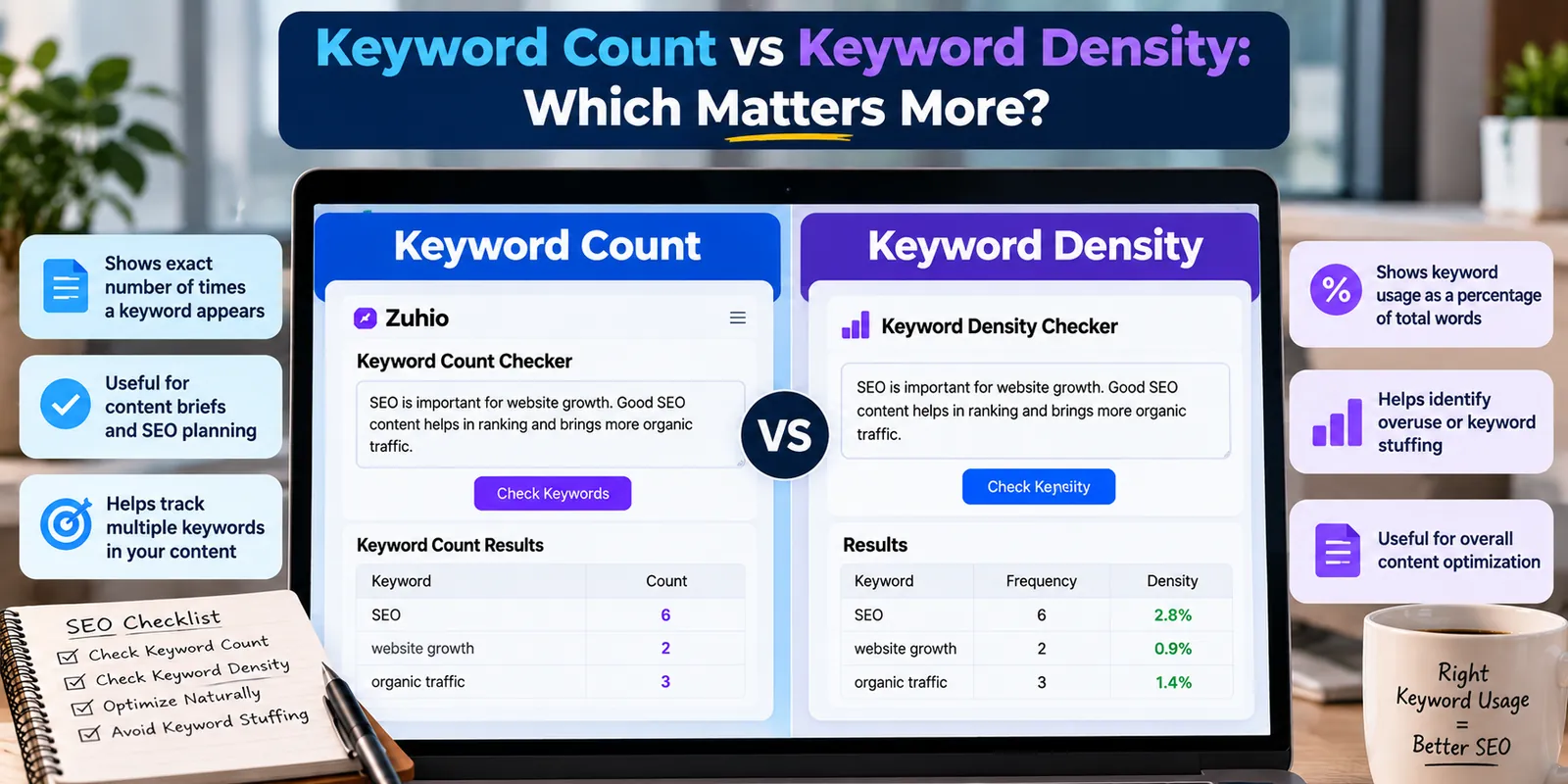
Keyword count tells you how many times a word or phrase appears.
Keyword density tells you how much of the overall content that keyword represents.
Suppose Keyword A appears 10 times.
In a 500-word article, that represents 2% density.
In a 2,000-word article, the same 10 uses represent only 0.5%.
Therefore, count and density provide different perspectives on keyword usage.
For modern SEO, both are best used as diagnostic metrics rather than optimization targets.
When Should You Use a Keyword Density Checker?
A Keyword Density Checker can be useful when you want to analyze the overall distribution of terms in your content.
Consider using one when:
Your content sounds repetitive.
You want to review keyword frequency.
You are optimizing an older blog.
You suspect keyword stuffing.
You want a quick overview of commonly used terms.
It can be particularly useful during the final editing stage.
When Should You Use Zuhio Keyword Count Checker?
A Zuhio Keyword Count Checker may be more practical when you are working with a keyword list or SEO content brief and want to verify whether specific terms have been included.
For example, a writer may receive a list containing a primary keyword plus several secondary terms.
Rather than searching for every phrase manually, a count-based checker can make it easier to review how often each target term appears.
However, don't add keywords simply to reach a target count if doing so damages readability or adds no value.
How to Optimize Keywords Naturally in 2026
The strongest SEO content combines keyword optimization with genuine usefulness.
Use the Primary Keyword in Important Places
Where natural and relevant, consider including your main keyword in the:
SEO title
H1
Introduction
Relevant H2/H3 headings
Main body
Meta description
URL slug
Conclusion
You do not need the exact phrase in every heading.
Use Related Terms and Concepts
If your primary keyword is Keyword Density Checker, relevant supporting terms might include:
keyword frequency, keyword count, keyword analysis, keyword stuffing, SEO content optimization, search intent, keyword usage, and content optimization.
Using related terminology allows you to explain the topic comprehensively without forcing the same exact keyword repeatedly.
Prioritize Search Intent
Ask what the searcher actually wants.
Someone searching “Keyword Density Checker vs Zuhio Keyword Count Checker” probably wants to understand the difference between the tools or approaches and decide which one is more useful.
Your article should answer that question clearly instead of being written simply to include both phrases many times.
Review Content Before Publishing
Once your article is complete, review:
Search intent
Keyword usage
Repetition
Grammar
Readability
Internal links
External references where appropriate
Title and meta description
Heading structure
Keyword analysis should be one part of this process—not the entire process.
Common Mistakes to Avoid
One of the biggest mistakes is assuming that more keywords equal better SEO.
Repeating keywords unnaturally can make your content less useful and less engaging.
Another mistake is optimizing exclusively around a density score. A page can have a seemingly “perfect” keyword percentage and still fail to satisfy the user's query.
Similarly, writers should avoid blindly following keyword-count recommendations. If a tool suggests using a term several more times but the article already explains the concept clearly, forcing those extra mentions may reduce content quality.

The best optimization decisions should always make sense in context.
Keyword Density Checker vs Zuhio: Which Is Better for SEO in 2026?
There isn't a single winner because the two measurements serve different purposes.
Choose a Keyword Density Checker when you want to understand keyword frequency relative to the total length of your content and identify potential overuse.
A Zuhio Keyword Count Checker can be useful when you want to check the number of times specified keywords appear, especially when reviewing an SEO brief.
For a stronger workflow, the two concepts can complement each other.
Use keyword counts to confirm that important terms have been covered, and use density analysis to spot excessive repetition. Then perform a manual editorial review to ensure the final content sounds natural and genuinely answers the searcher's question.
Final Verdict
The Keyword Density Checker vs Zuhio Keyword Count Checker comparison should not be viewed simply as choosing one tool and ignoring the other.
Both can provide useful information during content optimization.
A Keyword Density Checker gives you a percentage-based view of keyword usage, while a keyword count checker helps you track the actual number of occurrences.
But in 2026, neither keyword density nor keyword count should control your SEO strategy.
The strongest content is built around search intent, topical relevance, helpful information, natural language, readability, and user experience.
At Nivya Digital, we recommend using keyword analysis tools as quality-control assistants rather than trying to optimize content around fixed numbers. Measure your keywords, understand the data, and then make decisions based on what creates the best experience for the reader.
Ultimately, the best SEO content isn't the page that repeats a keyword the most—it is the page that answers the user's query most effectively.
Comments (1)
Nice Articles